Transmission Fluid Pump 2026: Match It to Your Fill Port
Picking a transmission fluid pump in 2026? Compare hand pumps, pneumatic ATF systems and adapter kits so your tool actually reaches sealed fill ports.
Reader-supported: we may earn a commission from links on this page, at no extra cost to you. It never affects our picks. Learn more.
Modern automatic transmissions mostly stopped giving you a dipstick around the mid-2000s. Instead you get a side-mounted fill plug — sometimes behind a heat shield, sometimes two inches from a subframe rail, almost always above the fluid level you're trying to reach. That geometry is the whole problem. A funnel won't work. Gravity won't work. You need a pump that can push fluid up and sideways through a hose small enough to thread into a 20–24 mm port.
The tool that does that job is usually sold as a "transmission fluid pump," but the category is messy: it covers $20 bottle-top hand pumps, $60 pneumatic ATF systems with adapter kits, and vacuum evacuators that do the opposite job. Here's how to tell which one your car actually needs.
The short version
- Best overall: VEVOR Transmission Fluid Pump 10L ATF Refill System
- Best for sealed-for-life boxes: Mityvac MV7201 Fluid Dispenser
- Budget pick: OEMTOOLS 24397 Fluid Transfer Pump
- Best extractor: Mityvac MV7300 Fluid Evacuator Plus
- Best manual lever pump: Lumax LX-1316 Fluid Transfer Pump
 Best manual lever pump · Lumax LX-1316 Fluid Transfer Pump — Check price on Amazon →
 Budget pick · OEMTOOLS 24397 Fluid Transfer Pump — Check price on Amazon →
We compared these based on manufacturer specifications, adapter coverage, and verified owner feedback from DIYers doing drain-and-fills on sealed ZF, Aisin, 722.9 and Ford 6R/10R units. GarageProof does not physically test tools; our rankings reflect research, spec comparison and real-world reports.
Start with your fill port, not the pump
Before you buy anything, crawl under the car (or look up a service procedure) and answer three questions:
- Is there a dipstick tube? If yes, you can refill through it with a long flexible hose and a simple pump. Older Hondas, many GM 4L60E-era boxes, and plenty of trucks still have one.
- Is it a side fill plug? Most sealed units — ZF 8HP, Aisin AWF8, Mercedes 722.9, Ford 6R80 — use a plug on the pan or case side. You need a pump with a hose that holds its shape enough to feed into the hole, plus pressure to lift fluid against the head difference.
- Is the plug recessed or threaded into a tube? This is where adapter kits earn their keep. Some ports accept a plain hose; others want a threaded fitting so the fluid doesn't just dribble back out at you.
Also note the volume. A diff takes a couple of quarts. A drain-and-fill on a 10-speed can take 5–7 quarts, and a full fluid exchange considerably more. Stroke-per-stroke hand pumping gets old fast past about 4 quarts.
Comparison table
| Tool | Type | Capacity / source | Adapter coverage | Best for | Main compromise |
|---|---|---|---|---|---|
| VEVOR 10L ATF Refill System | Pneumatic + manual, two-way | 10L reservoir | 14 adapters, broad brand coverage | Sealed side-fill transmissions, repeat use | Bulky; needs a compressor for the fast mode |
| Mityvac MV7201 | Hand-pressurized dispenser | Own reservoir | Hose + basic fittings | No-compressor garages, uphill fills | Refill/re-pressurize cycles on big fills |
| OEMTOOLS 24397 | Bottle-top hand pump | Screws onto quart bottles | Minimal | Diffs, transfer cases, dipstick refills | Slow, low pressure, limited reach |
| Mityvac MV7300 | Manual vacuum evacuator | 8.8L tank | Multiple tube diameters | Extracting old fluid out of ports/dipsticks | Pulls fluid only — it doesn't fill |
| Lumax LX-1316 | Lever-action transfer pump | Pails, jugs, bulk | Hose only | High-volume transfers from bulk containers | No threaded fill-port adapters |
The picks
VEVOR Transmission Fluid Pump 10L ATF Refill System — best overall
Prices last checked October 22, 2026. Amazon prices change frequently, so treat these as a guide and check the live price before you buy.
VEVOR Transmission Fluid Pump 10L ATF Refill System
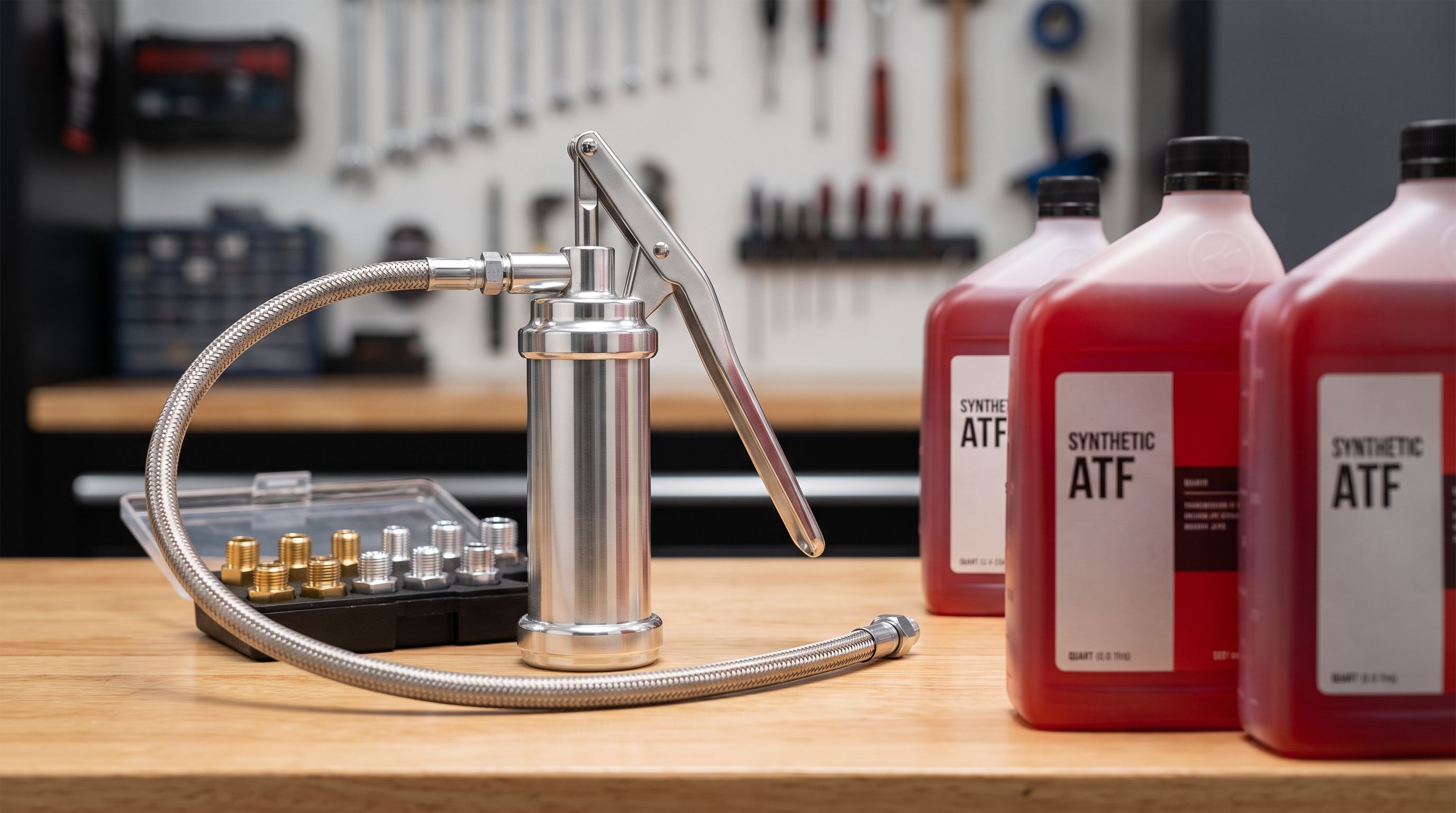
Pneumatic/manual 10L ATF system with a 14-adapter set that covers most sealed fill ports.
This is the tool most DIYers actually want when they say "transmission fluid pump." It's a sealed 10-litre canister with a dual control setup: you can pressurize it with shop air for a fast, steady fill, or work it manually when a compressor isn't available. The reason it tops the list is the adapter set — a 14-piece kit covering the common thread sizes used across German, Japanese and domestic sealed boxes, which is what separates a usable tool from one that leaves you holding a hose against a dripping port.
What it gives up: size. It's a floor-standing unit, not something that lives in a drawer. Owner feedback also notes that the included adapters are generic, not OEM-branded, so you should confirm your specific port thread before the car is on stands. Quality is value-tier rather than professional-tool-tier — fine for annual service, less so for a shop running daily fills.
Mityvac MV7201 — best for sealed-for-life boxes
Mityvac MV7201 Fluid Dispenser
Pressurized dispenser that pushes fluid uphill into stubborn side-fill ports without a compressor.
If you don't have a compressor but still need to push fluid uphill into a side fill plug, the MV7201 is the sensible answer. It's a hand-pressurized dispenser: you pump the handle to build pressure in the reservoir, open the valve, and fluid flows steadily through the hose without you working a lever for every ounce. That makes it far less fatiguing than a stroke-action pump on a 6-quart fill, and the controlled flow means you can stop the instant fluid starts weeping back out of the port — the standard "full" indicator on sealed transmissions.
The compromise is cycle time. On larger capacities you'll re-pressurize and, depending on reservoir size, refill the unit partway through. It's also more expensive than a basic bottle pump, and the fitting selection is less expansive than a dedicated adapter kit, so check your port fitment first.
OEMTOOLS 24397 — budget pick
OEMTOOLS 24397 Fluid Transfer Pump
Simple bottle-top hand pump that empties quart bottles cleanly into diffs and transfer cases.
Not every job needs a pressurized canister. If you're changing differential fluid, a transfer case, a manual gearbox, or topping up a transmission that still has a dipstick tube, a bottle-top hand pump is the cheapest clean way to do it. The OEMTOOLS 24397 threads onto standard quart bottles and pumps fluid through a flexible tube, so you're not decanting gear oil into a funnel and wearing half of it.
Its limits are honest ones: modest volume per stroke, low pressure, and a hose that's flexible rather than semi-rigid, so feeding it into a hard-to-see side port can be fiddly. For a 1–2 quart diff service it's ideal. For a 7-quart sealed automatic with a tight port, you'll wish you'd spent more. Keep one in the drawer regardless — it's the tool you'll reach for most often.
Mityvac MV7300 — best extractor
Mityvac MV7300 Fluid Evacuator Plus
Manual-vacuum 8.8L evacuator for pulling old ATF out through dipstick tubes and fill holes.
Half of a fluid service is getting the old stuff out, and on some vehicles the drain plug is awkward, absent, or you simply want to measure exactly what came out so you can put exactly that much back in. The MV7300 Fluid Evacuator Plus is a manual-vacuum tank — pump the handle to build vacuum, then let it siphon through a tube into the 8.8-litre reservoir. It's the standard approach for dipstick-tube extraction and for pulling fluid through fill ports on vehicles where dropping the pan is a bigger job than the service warrants.
It gives up the ability to fill. This is strictly an extraction tool, so most people pair it with a dispensing pump. The tubes also need to be sized to your dipstick tube — too fat won't go, too thin draws slowly. And fluid must be at a workable temperature; cold, thick gear oil is painfully slow.
Lumax LX-1316 — best manual lever pump
Lumax LX-1316 Fluid Transfer Pump
Metal-bodied lever pump with flexible hose for high-volume fills from bulk jugs or pails.
If you buy ATF or gear oil in pails or 5-gallon jugs, a lever-action transfer pump is the right tool. The Lumax LX-1316 is a metal-bodied pump with a flexible delivery hose, designed to move meaningful volume per stroke from a bulk container into whatever you're filling. For fleet-minded DIYers, farm equipment, or anyone servicing several vehicles a year, buying fluid in bulk and pumping it out is far cheaper than quart bottles.
What it isn't: a sealed-fill-port tool. There's no adapter kit, no pressurized reservoir, and no fine flow control for the "fill until it weeps" moment. Think of it as the thing that gets fluid from the pail into your dispenser or into a dipstick tube — a complement to the VEVOR or Mityvac, not a replacement.
How to choose
Adapter coverage beats raw capacity
A 10-litre reservoir is useless if the hose won't seal in your fill port. Before buying, find your transmission's fill plug thread size in a service manual or a model-specific forum thread, then check the adapter list of the kit you're considering. Kits advertising "14 most used adapters" cover a wide swath of common applications but are not universal — Mercedes 722.9, ZF 8HP and some CVTs all have their own quirks. Fitment is vehicle-specific: verify by year, make, model and transmission code, not just by brand.
Pneumatic vs. manual
Pneumatic units are faster and far less tiring on multi-quart fills, but they assume you own a compressor and are comfortable regulating pressure — too much and you'll make a mess, or force fluid past seals. Manual hand-pressurized dispensers need no air supply and give excellent control. Pure stroke-action pumps are cheapest and fine under about 2–3 quarts. Match the mechanism to how much fluid you move per year.
Hose stiffness and length
This is the spec nobody lists and everybody complains about. A hose that's too floppy won't feed into an overhead port; one that's too stiff won't route around a subframe. Semi-rigid nylon or braided hoses with a short rigid tip are the sweet spot. Length matters too — you want to reach from a pump sitting on the floor to a port that may be 2–3 feet up and well inboard.
Fill vs. extract vs. exchange
Decide which job you're doing. A drain and fill needs a dispenser only. A dipstick-tube service needs an evacuator plus a dispenser. A true fluid exchange — cycling the transmission's own pump to displace old fluid through the cooler lines — needs a two-way system or a cooler-line setup and a careful procedure; it's not something to improvise on a high-mileage box.
Materials and fluid compatibility
ATF, gear oil and some CVT fluids attack cheap seals and plastics over time. Look for Viton or nitrile seals, metal or chemical-resistant polymer bodies, and avoid using the same pump for coolant or brake fluid. Dedicate one pump per fluid type and label it — cross-contamination is a genuinely expensive mistake.
A note on procedure
Tools don't replace the service procedure. Sealed transmissions typically require filling at a specified fluid temperature, with the engine running and the vehicle level, checking level via overflow at the fill plug. Get the temperature window wrong and you'll be several hundred millilitres off — enough to cause shudder or overheating. Look up the exact procedure for your transmission code before you start, and have a way to read transmission fluid temperature (a capable scan tool, or in some cases an OBD2 dongle with the right app).
FAQ
Can I use a transmission fluid pump for differential and transfer case fluid? Yes, as long as the pump's seals are rated for gear oil. Thick 75W-140 pumps slowly in cold weather; warming the bottle in a bucket of hot water helps considerably.
Do I need a compressor? Only for the pneumatic mode on units like the VEVOR system. The Mityvac MV7201 and the manual lever pumps work entirely without shop air.
Will the included adapters fit my car? Treat adapter lists as a starting point, not a guarantee. Check your transmission's fill plug thread size against the kit's spec sheet, and confirm with your vehicle's service information before you drain anything.
What's the difference between a fluid pump and a fluid extractor? A pump pushes fluid in; an extractor uses vacuum to pull old fluid out. Many sealed-transmission services need both, which is why the MV7300 and a dispenser are a common pairing.
Is a transmission "flush" the same as a drain and fill? No. A drain and fill replaces roughly 40–50% of the fluid in one go. A full exchange or flush replaces nearly all of it, usually via the cooler lines with a dedicated machine or two-way system, and carries more risk on neglected high-mileage transmissions.
How much fluid should I buy? Buy more than the drain capacity. Sealed-fill procedures waste fluid at the overflow point, and you may do a second drain-and-fill a few hundred miles later to improve the replacement percentage.
Get the best car care deals in your inbox
Join the GarageProof newsletter for hand-picked car care deals and new buying guides. No spam, unsubscribe anytime.
Related reads
Oil Extractor vs Drain Pan in 2026: Which One Fits Your Car
Engine oil extractor pump or classic drain pan in 2026? Compare removal completeness, filter location and clearance — plus 5 researched picks for your garage.
Car Ramps vs Jack Stands in 2026: What Fits Your Garage
Car ramps vs jack stands in 2026: how ground clearance, ramp angle, curb weight and ceiling height decide which lift setup actually works in your garage.
Long Reach Floor Jack for Trucks 2026: Reach Before Tonnage
A 2026 guide to long reach floor jacks for trucks and lifted SUVs — how chassis reach, max lift height, and saddle design decide whether a jack actually works.