Oil Extractor vs Drain Pan in 2026: Which One Fits Your Car
Engine oil extractor pump or classic drain pan in 2026? Compare removal completeness, filter location and clearance — plus 5 researched picks for your garage.
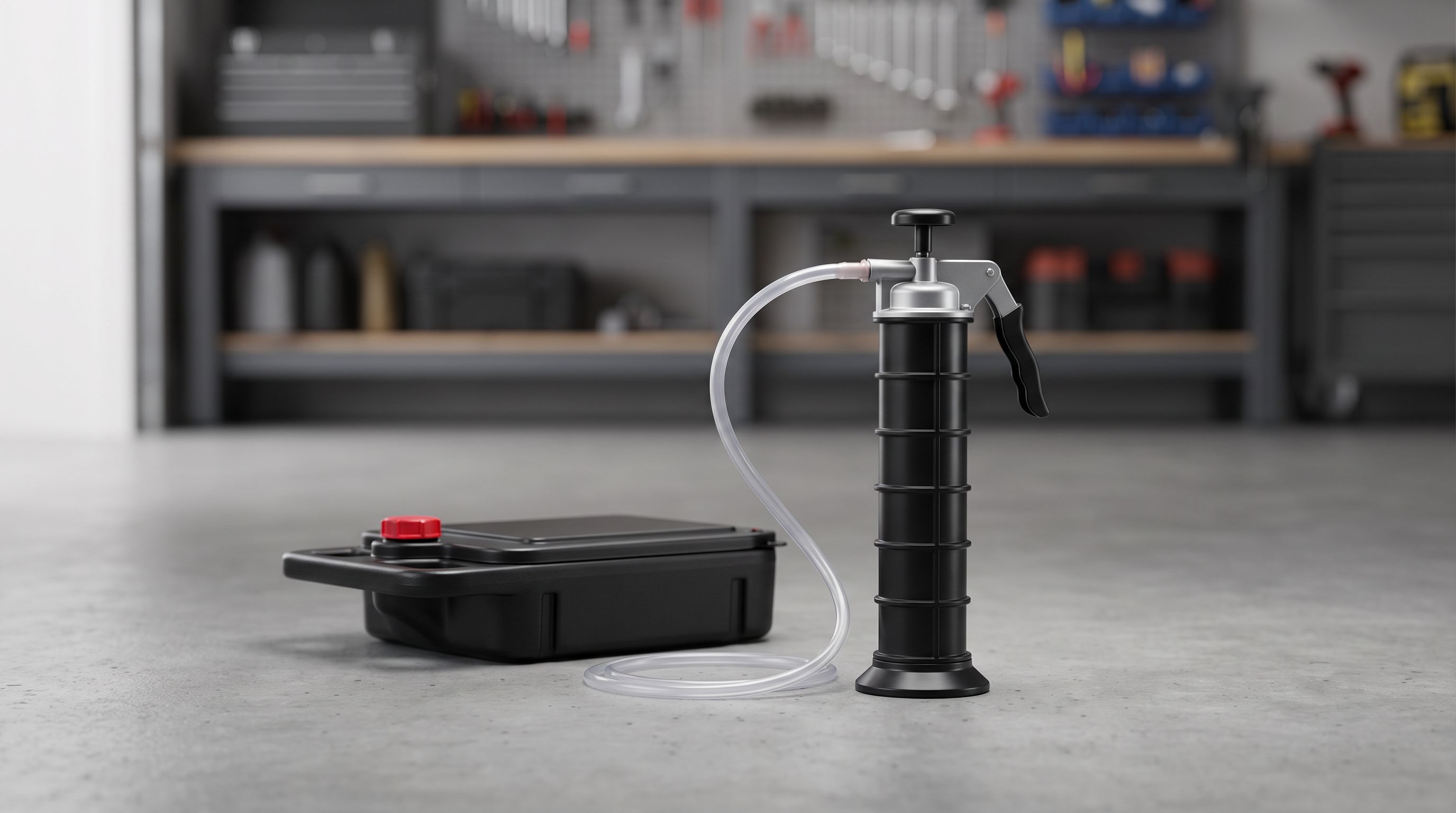
Reader-supported: we may earn a commission from links on this page, at no extra cost to you. It never affects our picks. Learn more.
The short version
- Best overall extractor: OEMTools 24389 7.5-Liter Fluid Extractor
- Best pneumatic/shop pick: Airpower America Topsider 5060
- Budget pick: EWK 6.5L Manual Oil Extractor Pump
- Best drain pan: Lumax LX-1632 15-Quart Drainmaster Drain Pan
- Best low-clearance pan: Hopkins FloTool 42002MI Drain Container
 Budget pick · EWK 6.5L Manual Oil Extractor Pump — Check price on Amazon →
 Best overall · OEMTools 24389 7.5-Liter Fluid Extractor — Check price on Amazon →
Oil changes used to involve exactly one piece of gear: a pan, a wrench, and a willingness to lie on cold concrete. Then topside extractors went mainstream, and now half the internet insists you never need to crawl under a car again. The truth is messier. An engine oil extractor pump is genuinely better for some vehicles and genuinely worse for others, and the deciding factors have almost nothing to do with the extractor itself — they're about your engine's dipstick tube, your filter location, and whether you can safely reach the drain plug.
We compared current extractors and drain pans using manufacturer specs, independent reviews, and verified owner feedback to sort out which approach fits which garage. Here's the decision framework, then the hardware.
Extractor vs drain pan: the honest comparison
| Topside oil extractor | Drain pan (drain plug) | |
|---|---|---|
| Vehicle access needed | None — work from the engine bay | Must get under the car (ramps/jack stands for most) |
| Oil removal completeness | ~90–98% on engines with a straight dipstick tube; worse on angled/baffled tubes | Essentially complete, aided by gravity |
| Mess risk | Low; oil stays in a sealed container | Moderate — gasket drip, splashback, stripped plug risk |
| Crush washer / plug wear | Plug never touched, so no stripping or over-torquing | Plug and washer cycled every change |
| Works with cartridge filters up top? | Yes — complete topside change on many Euro/modern engines | Yes, but you're under the car anyway |
| Works with spin-on filters underneath? | Partially — you still go under for the filter | Fully |
| Typical capacity | 6–8 L common; heavy-duty up to 15 L+ | 8–18 quarts |
| Time per change | 10–20 min of (mostly unattended) suction | 15–30 min including lifting the car |
| Disposal | Pour straight from the sealed canister | Pour from pan — easier with a sealed, spouted pan |
| Cold-weather performance | Slower; thick oil extracts poorly | Also slower, but gravity still wins |
| Upfront cost | Higher | Lower |
The short rule
If your engine uses a top-mounted cartridge filter and a straight, unobstructed dipstick tube, an extractor turns an oil change into a genuinely clean, no-lift, 15-minute job. That covers a lot of BMW, Mercedes, VW/Audi, Volvo, recent Ford EcoBoost, and most outboard marine engines.
If your filter is a spin-on canister underneath the car, an extractor only saves you half the work — you're still going under there with a pan to catch filter drip. In that case, many DIYers find the drain plug route simpler, and the extractor becomes a nice-to-have rather than the main tool.
How to choose
1. Find out where your oil filter actually lives
This is the single biggest factor and it's vehicle-specific. Pop the hood and look for a black plastic cap, roughly fist-sized, with a hex head or flats on top — that's a cartridge filter housing, and it means a full topside change is on the table. If you don't see one, get under the car (or search your exact year, make, model, and engine) to confirm where the filter is.
Don't assume across generations. The same nameplate can switch filter styles between model years and engine options. Check your owner's manual or the filter manufacturer's lookup tool using your VIN before buying gear around an assumption.
2. Check whether your dipstick tube is extractor-friendly
An extractor works by feeding a small-diameter tube down the dipstick passage to the bottom of the sump. Three things ruin that:
- Sharp bends or a kinked flex section that the tube can't negotiate
- Baffled or windage-tray sumps where the tube bottoms out above the lowest oil
- Unusually narrow tubes that only accept the smallest supplied hose
Most quality kits ship with two or three hose diameters (commonly around 5 mm, 6 mm, and 8 mm) for exactly this reason. Before you commit, pull your dipstick, measure its length, and feed the extractor hose in dry — if it stops well short of the dipstick depth, you'll leave oil behind.
3. Decide: manual pump, pneumatic, or 12 V
Manual vacuum extractors (hand-pumped, holding vacuum in a sealed canister) are the sweet spot for most home garages. No compressor, no power, and once you've built vacuum the thing works unattended. Downside: you may need to re-pump once or twice as the vacuum bleeds down.
Pneumatic/venturi extractors need an air compressor — typically a modest CFM at around 90 psi — but they pull continuously and finish faster, which matters on 8+ quart diesels and fleet work.
12 V electric pumps are convenient for boats and small engines, but gear pumps don't love hot oil and debris, and longevity feedback is mixed compared with vacuum designs.
4. Size the canister to your engine, not your optimism
Buy capacity above your crankcase volume with real margin. A 6.5 L unit on a 6.0-quart (5.7 L) engine leaves almost no headroom and risks drawing oil into the pump mechanism. For most four- and six-cylinder cars, 7.5–8 L is the comfortable choice; for 8+ quart V8s and diesels, go to 10–15 L. Overflow protection or a clearly marked max line is worth prioritizing — sucking oil into a vacuum chamber is the most common way these tools die.
5. If you're going the pan route, buy a sealed one
A basic open pan is fine until you try to carry 6 quarts of hot oil across a garage. Sealed drain containers with a screw cap and integrated spout let you drain, cap, carry, and pour without a funnel. Measure your clearance first: if your car sits low and you don't own ramps, you need a low-profile container, not a tall bucket-style one.
The picks
OEMTools 24389 — best overall
Prices last checked October 12, 2026. Amazon prices change frequently, so treat these as a guide and check the live price before you buy.
OEMTools 24389 7.5-Liter Fluid Extractor
7.5L manual vacuum extractor that holds suction well and fits most dipstick tubes with its multi-hose kit.
The 24389 is the extractor we'd point most DIYers toward. It's a 7.5-liter manual vacuum unit with a built-in pump handle, multiple hose diameters for different dipstick tubes, and a canister large enough to swallow a typical 6- to 7-quart change with headroom to spare. Owner feedback consistently praises how well it holds vacuum — pump it up, walk away, come back to a near-empty sump. It's also useful beyond engine oil for gear oil, coolant, and transmission fluid via the dipstick on applicable vehicles. What it gives up: it's manual, so very cold or very thick oil extracts slowly, and like all extractors it won't touch an underbody spin-on filter.
Airpower America Topsider 5060 — best pneumatic/shop pick
Airpower America Topsider 5060
Steel-canister air-powered extractor built for diesels, big V8s and boats — fast, durable, needs a compressor.
The Topsider is the old-school steel-canister extractor that marine shops and serious home mechanics have used for decades. It runs on shop air, pulling a strong continuous vacuum, and the metal construction tolerates hot oil far better than thin plastic. If you're servicing a diesel, a big V8, a boat with a hard-to-reach sump, or several vehicles a year, the speed and durability justify it. Trade-offs are real: you need an air compressor, it's heavier and bulkier to store, and it costs meaningfully more than a plastic manual unit. It's overkill for a single commuter car.
EWK 6.5L manual oil extractor — budget pick
EWK 6.5L Manual Oil Extractor Pump
Low-cost entry into topside changes; ideal for four-cylinders, motorcycles and outboards.
EWK's 6.5-liter manual extractor is the entry point for anyone who wants to try topside changes without a big outlay. It uses the same sealed-canister vacuum principle as pricier units, ships with multiple hose sizes, and gets good marks in owner reviews for build quality relative to its price. The compromises: 6.5 liters is tight for engines holding 6 quarts or more, so check your capacity first; and the pump mechanism generally needs more re-priming than premium units over a long extraction. For a four-cylinder car, a motorcycle, or an outboard, it's plenty.
Lumax LX-1632 Drainmaster — best drain pan
Lumax LX-1632 Drainmaster 15-Quart Drain Pan
Sealed 15-quart pan with screw cap and spout — drain, carry and pour without a funnel.
If you're staying with the drain plug, the Drainmaster is the pan that makes the job civilized. It's a sealed 15-quart container with a wide catch basin, a screw-on cap, and a built-in spout, so you drain, seal, carry, and pour without a funnel or a second container. The large capacity means you can do back-to-back changes or handle a big truck sump without panic. What it gives up is clearance — it's taller than a true low-profile pan, so a lowered car or a tight ramp setup may need something flatter. Also note the obvious: you still have to get under the vehicle.
Hopkins FloTool 42002MI — best low-clearance pan
Hopkins FloTool 42002MI Drain Container
Flat, sealable catch container that slides under low cars without ramps.
FloTool's low-profile drain container is built for the problem the Drainmaster can't solve: cars that barely clear a curb. The flat, wide profile slides under vehicles with limited ground clearance, and the sealed design with a screw cap means you can tip it, carry it, and pour it into a recycling jug without a mess. It also doubles as a general fluid catch for coolant and transmission work. The trade-off is capacity and splash headroom — a wide shallow basin catches a fast-flowing stream less forgivingly than a deep pan, so position it carefully and expect a little splash on the first gush.
When the answer is "both"
Plenty of well-equipped garages own an extractor and a sealed pan, and that's not redundancy. A realistic split:
- Extractor for the car with a top-mounted cartridge filter, for between-change top-offs and sampling, for brake fluid reservoir flushes, and for pulling fluid out of anything you can reach with a tube.
- Drain pan for the truck with a spin-on filter underneath, for the annual "get it all out" change, and for every other fluid job where gravity is doing the work.
One thing worth saying plainly: the concern that extractors leave sludge behind is largely overstated for modern engines on a sane service interval. Independent comparisons have repeatedly found extraction removes a comparable amount of oil to draining on engines with a suitable dipstick tube. The caveat is "suitable" — on an engine where the tube can't reach the sump floor, you really will leave a meaningful amount behind, and that's an argument for checking your specific application rather than trusting a blanket claim either way.
Whatever you choose, warm the engine for a few minutes first (warm, not scalding), confirm your oil capacity from the manual rather than the internet, and recycle the used oil at an auto parts store or municipal collection site.
FAQ
Does an oil extractor remove all the oil? On engines with a straight dipstick tube reaching the sump floor, extraction typically removes a comparable amount to draining — the difference is usually a few ounces. On engines with heavily bent or baffled tubes, it can leave noticeably more. Test by feeding the hose in dry and comparing its depth against the dipstick length.
Do I still need to get under the car if I use an extractor? Only if your oil filter is underneath. With a top-mounted cartridge filter, you can complete the entire change from the engine bay. With an underbody spin-on filter, you'll still go under to swap it — though you avoid touching the drain plug.
What size extractor should I buy? Pick a capacity comfortably above your engine's oil capacity. For most four- and six-cylinder cars, 7.5–8 liters is right. For 8+ quart V8s, diesels, or multi-vehicle households, go to 10–15 liters.
Will an extractor work on cold oil? Poorly. Thick cold oil moves slowly through a narrow hose. Run the engine a few minutes to warm the oil, then shut it off and let it settle briefly before extracting — same principle as draining.
Is skipping the drain plug actually a benefit? It can be. Repeatedly removing and torquing a drain plug is how oil pan threads get stripped and crush washers get reused when they shouldn't be. If you've already had a plug issue — or your pan is aluminum — leaving it undisturbed is a legitimate advantage.
Can I use the same extractor for other fluids? Most vacuum extractors handle gear oil, coolant, transmission fluid (via dipstick where equipped), and brake reservoir fluid. Clean the hoses thoroughly between fluid types, and never mix brake fluid residue into an engine oil extraction.
Get the best car care deals in your inbox
Join the GarageProof newsletter for hand-picked car care deals and new buying guides. No spam, unsubscribe anytime.
Related reads
Transmission Fluid Pump 2026: Match It to Your Fill Port
Picking a transmission fluid pump in 2026? Compare hand pumps, pneumatic ATF systems and adapter kits so your tool actually reaches sealed fill ports.
Car Ramps vs Jack Stands in 2026: What Fits Your Garage
Car ramps vs jack stands in 2026: how ground clearance, ramp angle, curb weight and ceiling height decide which lift setup actually works in your garage.
Long Reach Floor Jack for Trucks 2026: Reach Before Tonnage
A 2026 guide to long reach floor jacks for trucks and lifted SUVs — how chassis reach, max lift height, and saddle design decide whether a jack actually works.