Long Reach Floor Jack for Trucks 2026: Reach Before Tonnage
A 2026 guide to long reach floor jacks for trucks and lifted SUVs — how chassis reach, max lift height, and saddle design decide whether a jack actually works.
Reader-supported: we may earn a commission from links on this page, at no extra cost to you. It never affects our picks. Learn more.
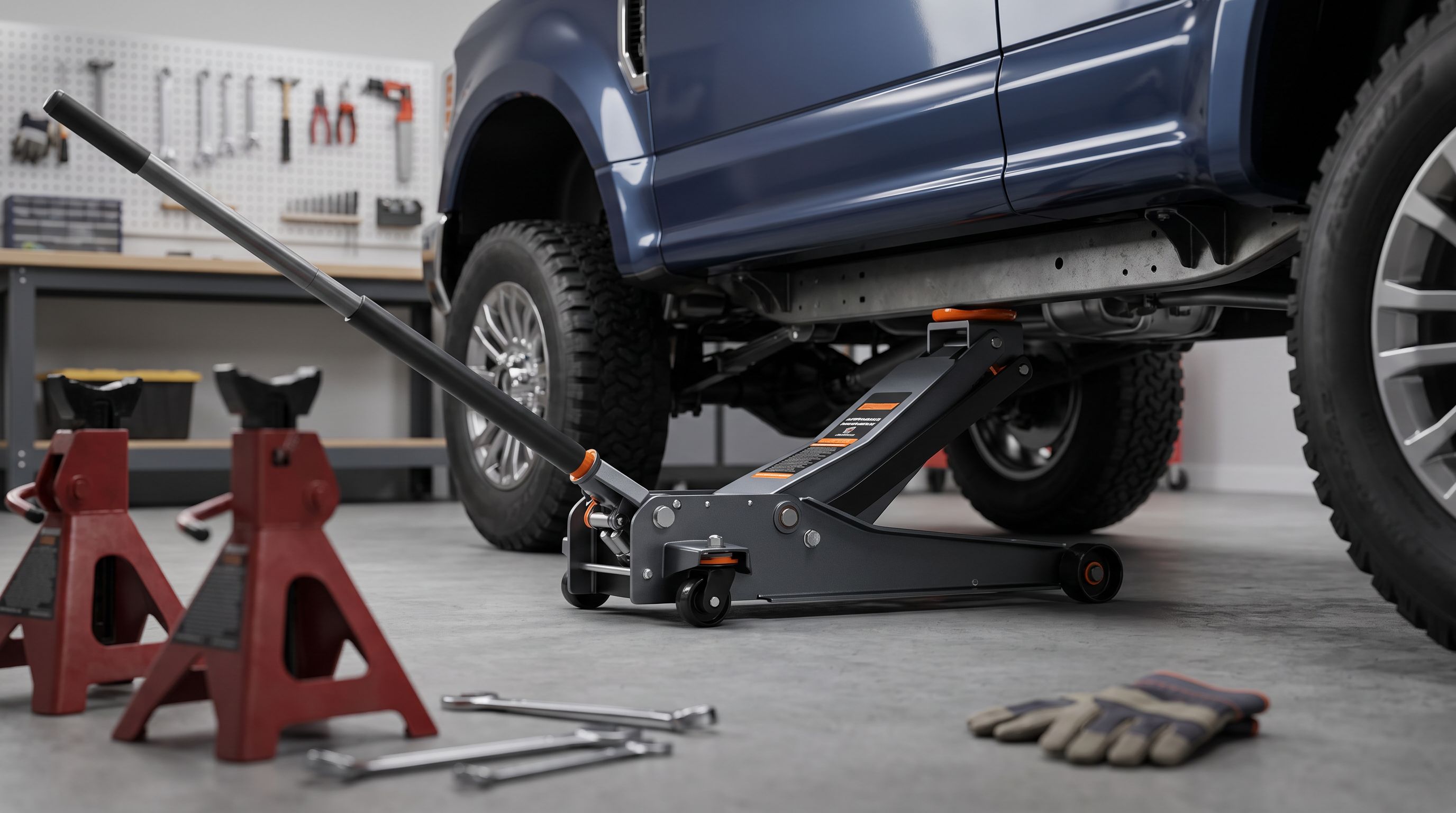
If you've ever rolled a slick aluminum racing jack under a leveled F-250, you already know the problem: the jack slides in beautifully, the saddle comes up, and then it stops about four inches short of doing anything useful. Low-profile jacks are built for the opposite problem — getting under a car that sits two fingers off the ground. Trucks and lifted SUVs need the other half of the equation: reach (how far the saddle travels inboard toward the frame rail) and max height (how far up it can push before it runs out of stroke).
This guide is about matching those two numbers to your vehicle. GarageProof compares products using manufacturer specifications, independent test reports, and verified owner feedback; we don't physically test units in a lab. What follows is a research-based ranking, with the tradeoffs spelled out.
The short version
- Best overall: Sunex 6604 4-Ton Low Profile Floor Jack
- Best value long-reach: Daytona 3-Ton Long Reach Low Profile Floor Jack
- Best for lifted trucks and off-road: Torin Big Red AT84007R All-Terrain Jack
- Best traditional service jack: Blackhawk B6350 3.5-Ton Service Jack
- Best onboard backup: Pro-LifT B-004D 2-Ton Bottle Jack
 Best onboard backup · Pro-LifT B-004D 2-Ton Bottle Jack — Check price on Amazon →
 Best traditional service jack · Blackhawk B6350 3.5-Ton Service Jack — Check price on Amazon →
 Best value long-reach · Daytona 3-Ton Long Reach Low Profile Floor Jack — Check price on Amazon →
Why "long reach" matters more than tonnage
Here's the thing most buyers get backwards. A half-ton pickup might weigh 5,500 lb, and a 3-ton jack is rated at 6,000 lb — sounds marginal, right? It isn't. A floor jack only ever lifts one corner or one axle end at a time, so you're realistically asking it to move 30–40% of the vehicle's curb weight. Tonnage is rarely the constraint on a light-duty or half-ton truck.
What is the constraint:
1. Chassis reach. Truck frame rails and factory pinch-weld lift points sit well inboard of the rocker panel. On a crew cab with running boards or rock sliders, the saddle may need to travel 20+ inches from where the jack's wheels can sit. A compact 20-inch-long jack physically cannot get there without the handle end jamming into the tire or the running board.
2. Max lift height. This is the number that kills most purchases. A typical low-profile aluminum jack tops out around 18–19 inches. A stock half-ton with 33s can need 19–21 inches to get a wheel clear. A leveled or 4-inch-lifted truck on 35s can need more than that — and you need extra height beyond "tire clear" to slide a jack stand under and lower onto it.
3. Starting height. Here's the tension nobody mentions: tall-lifting jacks are usually taller at rest. A 23-inch-max service jack might have a 5.5-inch minimum saddle height. That's fine on a lifted truck, useless on a lowered car. If one jack has to serve both the truck and a sedan, you're looking for the widest possible range, not the lowest possible profile.
4. Caster size. Small, hard steel casters are fine on epoxy. On a gravel driveway or a cracked slab, a jack that won't roll will fight the arc of its own lift arm and try to drag the vehicle sideways. Larger wheels solve this.
How to choose
Measure your actual lift point first
Don't guess. Park on level ground, put a tape measure on the frame rail at your intended lift point, and record the height to the ground. Then measure the horizontal distance from where a jack's wheels would sit (outboard of the rocker, clear of the running board) to that rail. Those two numbers — target height and required reach — are your shopping criteria. Add 3–4 inches to the height figure so you have room to place stands.
Also check your owner's manual for the approved lift points. Frame rails are the obvious answer on body-on-frame trucks, but unibody SUVs (Explorer, Highlander, Grand Cherokee) use reinforced pinch welds or specific subframe pads, and lifting on sheet metal will crease it. Lift points are vehicle-specific — verify yours for your exact year, make, and model.
Decide between "low profile long reach" and "service jack"
These are two different design philosophies and both are valid:
- Low-profile long reach jacks use a long, flat chassis arm so they can slide far under a vehicle while still starting low (often 3–3.5 in.). Good compromise if you own both a truck and a car.
- Traditional service jacks sit higher at rest but use taller geometry for more top-end height, heavier steel, and more serviceable hydraulics. Better if trucks are all you lift.
Match the saddle to the lift point
A bare steel saddle on a bare steel frame rail will slip — frame rails are often powder-coated and slick. Look for a rubber or urethane saddle pad, or buy a slotted pinch-weld adapter separately. For differential lifts, a cupped or scalloped saddle keeps the housing from walking. Cheap flat saddles are the single most common upgrade owners make after purchase.
Weight is a real-world factor
A 4-ton steel service jack can weigh 80–100+ lb. That's a jack that lives in one bay and never moves. Aluminum and hybrid alloy jacks are far easier to haul to a friend's driveway, but aluminum at high lift heights usually means paying more or accepting less capacity. Be honest about whether the jack stays put or travels.
Comparison table
| Jack | Best for | Construction | Design type | Reach/height character | Portability |
|---|---|---|---|---|---|
| Sunex 6604 | 3/4- and 1-ton trucks, mixed garage | Steel | Low-profile, long chassis | Roughly 23 in. max height per spec — enough for most frame rails | Heavy, bay-resident |
| Daytona 3-Ton Long Reach | Half-ton trucks, SUVs, budget builds | Steel | Low-profile long reach | Long arm, 6,000 lb capacity | Heavy |
| Torin Big Red AT84007R | Lifted trucks, gravel, off-road | Steel | All-terrain, large casters | Tall lift range, rolls on rough surfaces | Heavy but rolls well |
| Blackhawk B6350 | Durability-first truck owners | Steel | Traditional service jack | Tall service-jack geometry | Heavy |
| Pro-LifT B-004D | Trail/roadside backup | Steel | Bottle jack | Very tall lift from small footprint | Rides in the truck |
The picks
Sunex 6604 — best overall
Prices last checked October 30, 2026. Amazon prices change frequently, so treat these as a guide and check the live price before you buy.
Sunex 6604 4-Ton Low Profile Floor Jack
Long chassis reach plus roughly 23 in. of max lift — the combination most 3/4- and 1-ton trucks need.
The 6604 is the jack that comes up over and over in home-garage roundups for one reason: it pairs a genuinely long, low chassis with a max height in the neighborhood of 23 inches, which is where three-quarter-ton and one-ton frame rails actually live. The 4-ton rating gives real margin on a loaded diesel, and the steel construction is built for abuse rather than showroom shine.
What it gives up is portability and price positioning. This is a heavy jack — it lives on one slab and stays there. It's also overkill if your fleet is a Civic and a RAV4; you'd be paying for capacity and height you'll never touch. If you own a heavy truck and want one jack to handle it properly, this is the default answer.
Daytona 3-Ton Long Reach — best value long-reach
Daytona 3-Ton Long Reach Low Profile Floor Jack
Harbor Freight's long-reach Daytona pairs a genuinely long chassis arm with 3-ton capacity at a fair price.
Harbor Freight's Daytona line has earned a surprisingly solid reputation, and the 3-ton long-reach low-profile model is the specific one truck owners want. It combines a 6,000 lb capacity with an extended chassis arm, so it can reach inboard frame rails on half-ton pickups and mid-size SUVs without the handle fouling on running boards. Owner feedback consistently praises the pump feel and lift speed relative to what it costs.
The compromises: it's a low-profile design first, so top-end height is good but not service-jack tall — check it against your measured number if you're running a 4-inch lift on 35s. It's also steel and heavy, and the stock saddle benefits from a rubber pad.
Torin Big Red AT84007R — best for lifted trucks and off-road
Torin Big Red AT84007R All-Terrain Jack
Big wheels and tall lift range make it the one that actually works on gravel, grass, and lifted rigs.
This is the one that shows up when people specifically ask what works on a lifted rig. The all-terrain design uses large-diameter wheels so it rolls across gravel, packed dirt, and grass instead of digging in — which matters enormously, because a jack that can't roll as the arm swings will scrub your tires sideways or tip. Its lift range is built around trucks with real ground clearance rather than sports cars.
The tradeoff is right there in the design: the all-terrain geometry means a higher minimum height, so it's a poor choice for lowered cars. It's also bulky to store. If your truck spends time somewhere other than a flat garage floor, that's a fair trade.
Blackhawk B6350 — best traditional service jack
Blackhawk B6350 3.5-Ton Service Jack
Old-school steel service jack geometry: tall lift, durable pump, decades-long reputation for reliability.
The B6350 is a long-running favorite in professional-style roundups, and it earns that through old-fashioned virtues: heavy steel construction, a service-jack lift arc that gets high, and hydraulics with a reputation for lasting. It's the jack you buy when you don't want to think about buying another one, and when rebuild seals and parts availability matter more than looks.
What it gives up is low-end access. Traditional service jack geometry means a higher starting saddle height than any low-profile model here, so a lowered car needs ramps or pucks before this jack will slide under. It's also genuinely heavy. For a truck-only garage, that's not a real drawback.
Pro-LifT B-004D — best onboard backup
Pro-LifT B-004D 2-Ton Bottle Jack
A tall-reach bottle jack that rides in the truck for trail or roadside lifts where a floor jack can't go.
No floor jack rides in a truck bed usefully, and no floor jack works on a trail. A 2-ton bottle jack like the B-004D solves the specific problem of lifting a tall vehicle from a tiny footprint — bottle jacks deliver far more height per pound of tool than any floor jack design. It stows behind a seat or under the rear bench and costs a fraction of the garage jacks here.
The limits are serious and worth stating: bottle jacks need a flat, hard surface, they have a small unstable base, and they offer zero horizontal reach, so you must have a lift point directly above. Use a base plate on soft ground, and never work under a vehicle supported by one. It's a backup, not a replacement.
Safety: the part that isn't optional
A jack lifts. It does not hold. Every pick above is a lifting device only, and hydraulic seals fail without warning.
- Buy jack stands rated at or above your jack's capacity, and use them in pairs on a hard, level surface.
- Match the stands' height range to your truck. Standard 3-ton stands often top out around 16–18 inches — useless on a lifted truck. Look for tall or extra-tall stands that reach your measured frame height.
- Chock the wheels that stay on the ground, front and back.
- Lower onto the stands and give the vehicle a firm shove before anything goes underneath.
- Keep the floor jack in place, lightly loaded, as a secondary catch.
FAQ
Is 2 tons enough for a half-ton pickup? It's cutting it close. A floor jack carries roughly a third to 40% of curb weight at one corner, so the math often works — but margin matters when the load shifts mid-lift. For any full-size truck, 3 tons is the sensible floor and 4 tons is better on heavy-duty models.
Will a low-profile aluminum racing jack work on my lifted truck? Usually not well. Most cap out around 18–19 inches of lift and have short chassis arms. On a lifted truck you'll either run out of height before the tire clears, or be unable to reach the frame rail at all. Measure before you buy.
Long reach floor jack or two-stage/dual-piston jack? Dual-piston ("quick lift") jacks raise the saddle faster through the empty part of the stroke, which is convenience, not capability. Reach and max height are capability. If you can only optimize one, optimize reach and height.
Can I lift a unibody SUV on the frame? Unibody SUVs don't have a traditional frame. They use reinforced pinch welds or specific subframe points, and those vary by model. Check your owner's manual for your exact year, make, and model — a slotted pinch-weld adapter on the saddle is a cheap, worthwhile add-on.
Do I need a different jack for the front and rear? No, but you may use different lift points. Many trucks allow a center lift on the front crossmember and the rear differential, which lets you raise a whole axle at once. Confirm your vehicle permits differential lifting — some independent rear suspensions do not.
Get the best car care deals in your inbox
Join the GarageProof newsletter for hand-picked car care deals and new buying guides. No spam, unsubscribe anytime.
Related reads
Floor Jack and Jack Stand Buying Guide 2026: Match Lift to Ride Height
The best floor jack and jack stands for 2026, matched to ride height and tonnage — low-profile sedans, half-ton trucks and lifted SUVs, with stand ratings explained.
Car Ramps vs Jack Stands in 2026: What Fits Your Garage
Car ramps vs jack stands in 2026: how ground clearance, ramp angle, curb weight and ceiling height decide which lift setup actually works in your garage.
Oil Filter Wrench Fitment 2026: Cap, Cup or Claw?
Cap, cup, claw or strap? Match the right oil filter wrench to your engine's filter size and flute count in 2026 — plus five picks that actually fit.