Jack Pad Pinch Weld Adapter 2026: Match It to Your Car First
A fitment-first guide to jack pad pinch weld adapters, EV jack pads and wheel chocks in 2026 — how to find your lift points before you buy anything.
Reader-supported: we may earn a commission from links on this page, at no extra cost to you. It never affects our picks. Learn more.
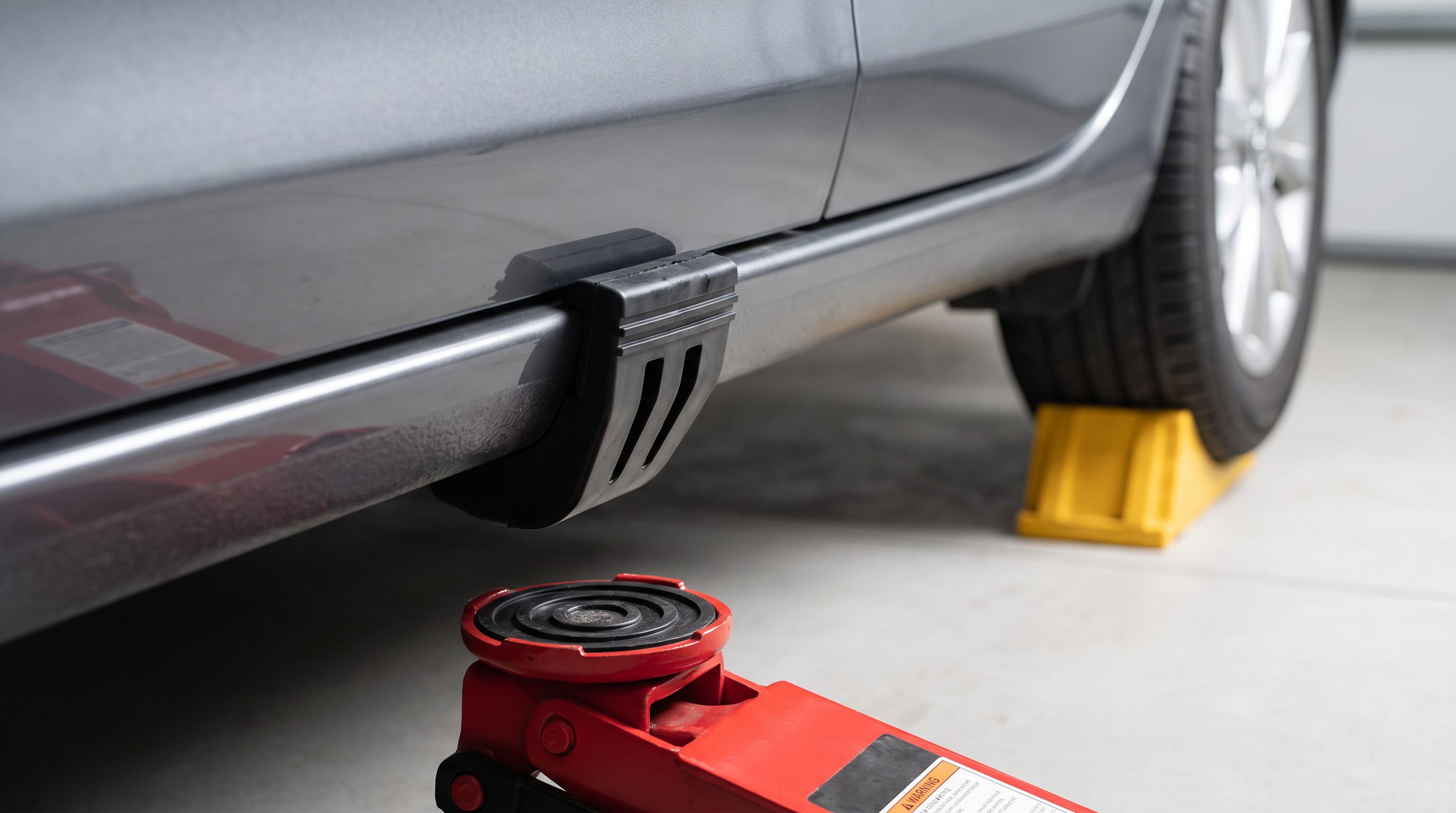
Lifting a modern car is less forgiving than it used to be. Unibody sedans and crossovers hang their weight on a thin folded steel seam — the pinch weld — and a bare steel jack saddle will fold that seam like a beer can. EVs add a second problem: a structural battery pack under the floor with a handful of specific, reinforced lift points and a lot of surface area you must never touch. Meanwhile body-on-frame trucks don't have pinch welds at all in the usual sense, and want a flat pad on a frame rail.
So the right first question isn't "which jack pad pinch weld adapter is best?" It's "what does my vehicle actually want under it?" Get that right and the hardware is cheap and simple. Get it wrong and you're paying a body shop to straighten a rocker panel.
GarageProof compares products using manufacturer specs, owner feedback and independent reviews — we don't physically test units. Below is what we'd buy, and more importantly, how to work out what fits.
The short version
- Best overall: Powerbuilt 620422E Jack Pad Adapter
- Best for jack stands: ESCO 10499 Jack Pad Adapter
- Best magnetic pick: Kaizen Auto Magnetic Jack Pad Adapter (2-Pack)
- Best for EVs: Tesla Model 3/Y Jack Lift Pad Pucks (4-Pack)
- Best wheel chocks: MAXXHAUL 70473 Solid Rubber Wheel Chocks
 Best for EVs · Tesla Model 3/Y Jack Lift Pad Pucks (4-Pack) — Check price on Amazon →
Find your lift points before you spend a cent
This is the step people skip. Every one of these adapters is useless — or dangerous — in the wrong spot.
1. Open the owner's manual, not a forum thread
Every manufacturer publishes jacking points, usually in the "changing a tire" or "emergency" section. It will show either reinforced notches in the pinch weld, dedicated pucks/sockets, or frame rail pads. Many 2026 vehicles ship a digital-only manual; the PDF is on the brand's owner site, free.
2. Get under the car and look
Run your hand along the seam behind the front wheel and ahead of the rear wheel. On most unibody cars you'll feel a short section where the seam is thicker, has a notch cut into it, a small triangular tab, or a plastic marker arrow in the rocker trim. That's your spot. Everywhere else, the seam is sheet metal that will fold.
3. Measure the seam
This matters more than anything else and almost nobody does it. Measure two things: how far the seam hangs down, and how thick it is including any plastic rocker cladding. Lots of owners discover their rubber pad slot is too wide or too shallow because the molding sits right next to the seam — a common complaint on cars with aggressive rocker trim. If the seam is short and the cladding is close, you want a narrow, deep slot or a metal-bodied adapter rather than a chunky rubber puck.
4. Identify your vehicle's construction type
- Unibody car/crossover (most 2026 vehicles): pinch weld seams, slotted adapter required.
- EV with a structural pack: dedicated lift points only, often a puck or socket. A generic slotted pad can contact the pack tray.
- Body-on-frame truck/SUV: lift on the frame rail or axle; use a flat rubber pad to stop metal-on-metal slip, not a slotted one.
- Older cars with proper frame rails or subframes: flat pad, or lift at the subframe/control arm per the manual.
5. Know the difference between a jack pad and a jack stand pad
A common forum point worth repeating: most slotted rubber blocks are designed for a floor jack saddle. Stands are a different geometry and a different load path. Either buy a slotted pad specifically sized for your stand's saddle, or move the car onto a flat, strong support point once it's lifted. Never balance a loose puck on a stand and walk under the car.
How to choose
Slot shape and depth
A slotted pad's job is to let the seam sit inside the groove while the shoulders of the pad take the load on the floor pan edges either side. If the slot is too shallow, the seam bottoms out and still bends. If it's too wide, the pad can rock. Deep, snug slots are better; look for pads where owners of your body style confirm the seam disappears fully into the groove.
Material: rubber, polyurethane or metal
Soft rubber is kind to paint and deforms to grip, but it also compresses, which means a tall pad can squat and lose slot depth under full load. Polyurethane holds its shape better under heavy vehicles. Aluminum or steel adapters are the answer for tight clearances and narrow seams where the rubber is simply too bulky — just accept they'll scuff undercoating.
Magnet or no magnet
Magnets are genuinely useful if you work alone: stick the pad to the seam, then wheel the jack in and line up the saddle without the pad falling off. The caveat that comes up constantly in owner discussions: it's easy to drive away with the pad still magnetically clamped to the rocker. Build a habit of counting pads back into the toolbox.
Height added, and whether your jack still fits
Every adapter raises the saddle by an inch or more. On a low car, that can mean the jack no longer slides under at rest height. If your car is lowered or just low-slung from the factory, check your jack's minimum saddle height plus adapter thickness against the seam height — or use a low-profile jack and a thinner metal adapter.
Chocks are part of the system
Lifting one corner changes how the car wants to roll. Chock the diagonally opposite wheel — or both wheels of the axle staying on the ground — before the jack goes under. Rubber chocks with a real tread face grip concrete far better than light plastic wedges, and hold up to oil and UV better than foam.
Comparison
| Pick | Type | Best suited to | Mount style | Main trade-off |
|---|---|---|---|---|
| Powerbuilt 620422E | Slotted rubber pad | Most unibody cars and crossovers | Sits in floor jack saddle | Bulky slot can be too wide for seams with close rocker cladding |
| ESCO 10499 | Slotted polyurethane pad | Heavier vehicles, jack stand use | Stand or jack saddle | Harder material is less paint-friendly |
| Kaizen Auto Magnetic (2-pack) | Slotted magnetic pad | Working alone, frequent lifts | Magnetically clamps to seam | Easy to forget on the car; magnets collect debris |
| Tesla Model 3/Y Pucks (4-pack) | Indexed EV lift puck | Tesla Model 3 / Model Y | Inserts into factory lift point | Vehicle-specific, not a universal pad |
| MAXXHAUL 70473 | Solid rubber wheel chock | Any vehicle, any lift | Under tire | Heavy to carry; not a jack accessory |
Powerbuilt 620422E — best overall
Prices last checked November 10, 2026. Amazon prices change frequently, so treat these as a guide and check the live price before you buy.
Powerbuilt 620422E Jack Pad Adapter
Heavy rubber slotted puck that cradles the pinch weld seam instead of crushing it; fits most floor jack saddles.
This is the default recommendation for a typical 2026 unibody car or crossover: a thick slotted rubber puck that drops into a standard floor jack saddle and swallows the pinch weld seam so the load spreads onto the floor pan either side. It's simple, cheap, and it does the one job that matters. Who it suits: anyone doing tire rotations, brake jobs and oil changes on a normal passenger car. What it gives up: it's a chunky piece of rubber, so if your rocker cladding sits tight against the seam or your car is very low, it may not seat cleanly — measure your seam clearance first. It also isn't intended for jack stand use.
ESCO 10499 — best for jack stands
ESCO 10499 Jack Pad Adapter
Hard polyurethane slotted pad sized to sit on a jack stand saddle, not just a floor jack cup.
The ESCO pad is harder polyurethane rather than soft rubber, and that changes how it behaves: it keeps its slot depth under heavier vehicles instead of squashing flat, and its shape works on a jack stand saddle as well as a jack cup. That makes it the sensible choice for larger SUVs and loaded vehicles, or for anyone who wants the car to sit on stands with the seam properly supported rather than resting on bare steel. Who it suits: heavier vehicles, longer jobs on stands. What it gives up: the stiffer material is less forgiving on paint and undercoating, and it costs more than a basic rubber puck.
Kaizen Auto Magnetic Jack Pad Adapter (2-Pack) — best magnetic pick
Kaizen Auto Magnetic Jack Pad Adapter (2-Pack)
Magnet keeps the slotted pad stuck to the seam while you line up the jack solo — just remember to remove it.
If you work alone, a magnet is a quality-of-life upgrade that's hard to give up. You stick the slotted pad onto the seam at the correct point, then take your time rolling the jack in and raising the saddle — no juggling a loose puck one-handed under the car. Owner reports across a range of vehicles, from crossovers to late-model luxury SUVs, consistently praise exactly this. Who it suits: solo DIYers who lift often. What it gives up: the known failure mode is forgetting a pad stuck to the rocker and driving off with it. Magnets also pick up metal shavings off a shop floor, so wipe them before they touch paint.
Tesla Model 3/Y Jack Lift Pad Pucks (4-Pack) — best for EVs
Tesla Model 3/Y Jack Lift Pad Pucks (4-Pack)
Battery-safe pucks that index into the Model 3/Y lift points so the jack never touches the pack or rocker.
Teslas don't want a slotted pinch weld pad at all; they have purpose-built lift points, and these pucks index into them so the jack load lands exactly where the engineers intended — away from the battery pack and away from the rocker. For the Model 3 and Model Y this is the correct, boring answer, and a four-pack means you can leave pucks in place at all four points when the car sits on stands. Who it suits: Model 3 and Model Y owners. What it gives up: it's vehicle-specific, so it's no help on anything else. Other EVs — ID.4, Ioniq 5, Mach-E, Lightning — have their own geometry; check the manual and buy a pad confirmed by owners of your exact model, because a too-wide slot can crush rocker panels on some EVs.
MAXXHAUL 70473 Solid Rubber Wheel Chocks — best wheel chocks
MAXXHAUL 70473 Solid Rubber Wheel Chocks
Dense solid rubber chocks with real grip on concrete — the cheapest safety upgrade in the garage.
No adapter makes a car safe if it can roll. Solid rubber chocks grip concrete and asphalt properly, don't crack like cheap plastic, and shrug off oil and sunlight. Use them every single time you lift, on the wheels staying on the ground, before the jack goes under the car — and leave them in place the whole time it's on stands. Who it suits: everyone, no exceptions. What it gives up: solid rubber is heavy and takes up real space in a trunk, so they live best in the garage rather than travelling as roadside kit.
A safe lifting sequence
- Park on flat, hard, level ground. Not a sloped driveway, not grass, not a gravel pad.
- Transmission in Park (or in gear for a manual), parking brake set — unless you're lifting a rear wheel on a car where the brake acts on it; then rely on chocks and a drivetrain lock.
- Chock the wheels staying on the ground, front and back of the tire where possible.
- Seat the adapter on the marked lift point. Confirm the seam is fully inside the slot, with no plastic trim trapped.
- Raise slowly. Stop at the first inch and check the pad hasn't shifted. Then continue.
- Place jack stands at the manufacturer's supported points, lower onto them, and leave the jack lightly loaded as a backup.
- Push the car firmly at the fender before any body part goes underneath.
FAQ
Can I use the same pad on a truck and a car? Usually not well. Body-on-frame trucks lift on a flat frame rail or axle, where a slotted pad can rock or bite. A flat rubber jack pad is the right tool there; keep the slotted adapter for the unibody car.
Will a jack pad adapter work on a jack stand? Only if it's shaped for one. Many slotted rubber blocks are jack-only. The ESCO 10499 style pad works on stand saddles; a generic puck balanced on a stand is a bad idea.
My seam is too narrow or the rocker trim is in the way. Now what? Look at a metal adapter with a thin, deep slot, or a vehicle-specific pad. Plenty of cars with aggressive rocker cladding won't take a wide rubber puck, and owners of your exact model will have solved it already.
Does my EV need special pads? Often yes. If the manual shows dedicated lift points or pucks, use those. A structural battery pack is not a jacking surface, and some EVs will deform their rocker panels with a generic wide-slot pad.
How many chocks do I need? Two is the practical minimum for a single-corner lift. Four if you're lifting one entire end of the vehicle and want chocks ahead of and behind each grounded tire.
Can I just use a hockey puck? A plain puck spreads load but doesn't capture the seam, so it can still fold it and can slip off the saddle. A slotted adapter costs little more and does the job properly.
Get the best car care deals in your inbox
Join the GarageProof newsletter for hand-picked car care deals and new buying guides. No spam, unsubscribe anytime.
Related reads
Oil Filter Wrench Fitment 2026: Cap, Cup or Claw?
Cap, cup, claw or strap? Match the right oil filter wrench to your engine's filter size and flute count in 2026 — plus five picks that actually fit.
Car Ramps vs Jack Stands in 2026: What Fits Your Garage
Car ramps vs jack stands in 2026: how ground clearance, ramp angle, curb weight and ceiling height decide which lift setup actually works in your garage.
Floor Jack and Jack Stand Buying Guide 2026: Match Lift to Ride Height
The best floor jack and jack stands for 2026, matched to ride height and tonnage — low-profile sedans, half-ton trucks and lifted SUVs, with stand ratings explained.