Hydraulic Shop Press Buying Guide 2026: 12 vs 20 Ton
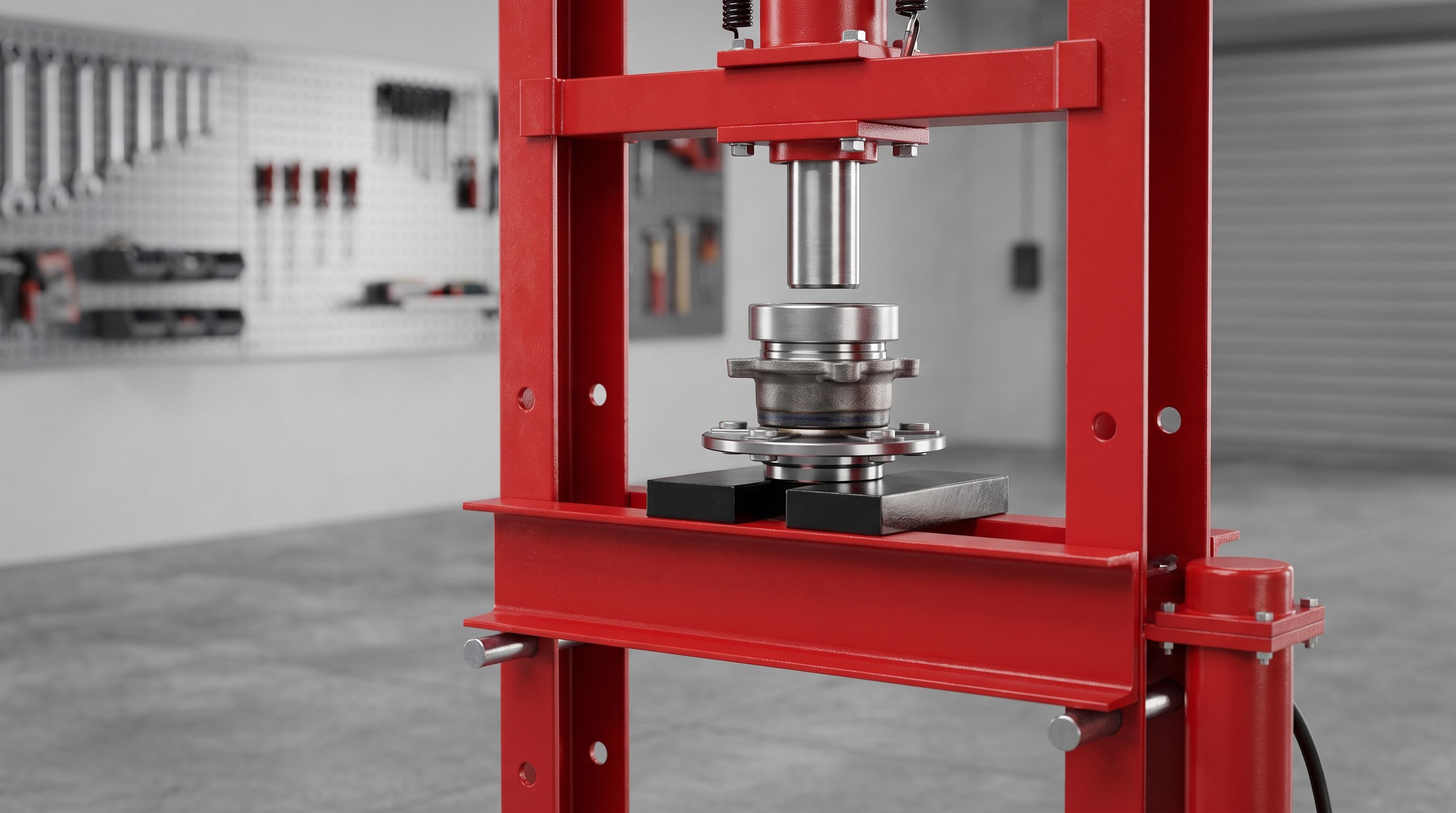
Picking between a 12 and 20 ton hydraulic shop press? Our 2026 buying guide compares frame width, daylight, ram travel and bench height for home garage work.
Reader-supported: we may earn a commission from links on this page, at no extra cost to you. It never affects our picks. Learn more.
A hydraulic shop press is one of those tools that sits unused for months and then saves you a full weekend. Wheel bearings, ball joints, control arm bushings, U-joints, pulleys, bent brackets — all of it goes faster and safer with a press than with a BFH and a prayer.
The hard part isn't deciding whether to buy one. It's deciding how much tonnage you actually need, and — the part most buyers get wrong — whether the frame is wide enough and tall enough to swallow the parts you'll be pressing. A 20-ton press with a narrow throat is less useful than a 12-ton with room to work.
GarageProof doesn't physically test presses. What follows is built from manufacturer spec sheets, published dimensions, independent reviews, and a lot of verified owner feedback about what actually breaks, binds, or doesn't fit.
The short version
- Best overall: Dake Model 972210 10-Ton Utility Press
- Best 12-ton value: BIG RED T51201 12-Ton Hydraulic Shop Press
- Best 20-ton for home garages: BIG RED T52001 20-Ton Hydraulic Shop Press
- Best with pressure gauge: Dragway Tools 20-Ton Hydraulic Shop Press with Gauge
- Best press companion: OTC 1815 Bearing Separator and Puller Set
 Best 20-ton for home garages · BIG RED T52001 20-Ton Hydraulic Shop Press — Check price on Amazon →
 Best overall · Dake Model 972210 10-Ton Utility Press — Check price on Amazon →
12 vs 20 ton: what the tonnage actually buys you
Here's the uncomfortable truth about shop press ratings: the number on the sticker is the cylinder's theoretical maximum, not a number you should plan to live at. Hand-pump H-frames reach rated tonnage slowly, with a lot of lever strokes, and the frame flexes visibly as you approach it. Buy the press whose comfortable working range covers your jobs, not one whose peak barely does.
What 12 tons handles comfortably: most passenger-car wheel bearings and hubs, ball joints, control arm and subframe bushings, small U-joints, pulleys, gears, steering knuckle work, and straightening light brackets. For a typical home mechanic working on sedans, crossovers and light trucks, 12 tons clears the overwhelming majority of jobs.
Where 12 tons starts to struggle: seized bearings in heavy-duty truck hubs, large U-joints on full-size trucks, press-fits that have been corroded in place for 15 winters, and anything where heat and penetrant have already failed. You'll be pumping hard, the frame will talk to you, and you'll wonder if you should have bought bigger.
What 20 tons buys: headroom. The job that takes 40 strokes on a 12-ton takes maybe 20 on a 20-ton, and you're operating at a fraction of rated capacity instead of leaning on the handle. Twenty-ton frames are also usually taller and heavier-gauge, which matters as much as the cylinder.
What 20 tons costs you: floor space, weight (often well over 200 lb assembled), and — on cheap models — a frame that's taller than it is stiff. A tall, lightly-braced 20-ton press can rack sideways under off-center loads. Bolt it down or brace it.
The rule of thumb
If you work mostly on cars and light trucks and have limited floor space, 12 tons is genuinely enough. If you own a full-size truck, do rust-belt work, or expect the press to outlast three vehicles, buy 20. The price gap between the two is usually smaller than the regret gap.
How to choose
Throat width and daylight matter more than tonnage
"Throat width" is the clear distance between the uprights. "Daylight" (or working height) is the maximum vertical gap between the ram tip and the bolster plates at their lowest setting. These two numbers decide what physically fits.
A hub assembly with a dust shield, a long control arm you need to support on both sides, or an axle shaft sticking out — these need width. A tall strut assembly or a bearing stack with a driver and support plates needs daylight. Before you buy, measure the biggest thing you realistically expect to press, add your press plates and a driver, and compare against the spec sheet. Many frustrated owners discover their press technically has the tonnage but can't get the part between the uprights.
Bolster plates that adjust across multiple pin holes are essential. More pin positions means finer control of working height, which means less wasted ram travel.
Ram travel, and whether the ram slides
Ram stroke is typically in the 4–7 inch range on H-frames. That sounds like plenty until you're pressing a bearing through a knuckle and run out of travel halfway, forcing you to reset the bolster pins mid-job with a loaded part sitting in the frame. Longer stroke is genuinely useful.
Separately: can the cylinder slide left and right along the top beam? On many presses it's fixed in the center, which is fine for symmetric work but awkward when you need to push on something off-center. Sliding-ram designs cost a bit more and are worth it if you do a lot of odd-shaped parts.
Frame construction and the pump
Look for welded or bolted channel steel rather than thin formed sheet. Check whether the top beam is a single heavy section or two thinner plates sandwiched together. Owner feedback on budget presses consistently points at the same weak points: thin bolster plates that bow, pins that deform, and welds at the leg joints.
On the hydraulics, a two-stage or two-speed pump is a quality-of-life upgrade — it closes the gap fast under no load, then switches to high-force mode. A pressure gauge is more than decoration: it tells you when you're approaching the limit, and it's the only way to apply consistent, repeatable force to something fragile like a soft aluminum housing.
Bench height and where it lives
Floor-standing H-frames typically put the work surface somewhere around waist height, which is comfortable for repeated use but eats real floor area. Benchtop presses save space but require a bench that can take the reaction load — and they usually give up daylight.
Measure your garage ceiling too. A 20-ton floor press plus a cylinder plus a long pump handle needs swing room. And plan for how you'll move 200+ lb of steel: most ship partly disassembled, and assembling one alone is a two-person job that people attempt solo exactly once.
The picks
Dake 972210 — best overall
Prices last checked October 28, 2026. Amazon prices change frequently, so treat these as a guide and check the live price before you buy.
Dake Model 972210 10-Ton Utility Press
American-built H-frame with a serious welded frame and smooth hand pump — the quality benchmark under 20 tons.
Dake builds its utility presses in the US, and the difference shows in the frame: heavy welded construction, a smooth hand pump, and a reputation among professional shops for lasting decades rather than seasons. The 972210 is rated at 10 tons, which sounds light next to a 20-ton import — but a well-built 10-ton frame operating in its comfortable range will outwork a flexy 20-ton you're afraid to load.
Who it suits: anyone who'd rather buy once, and anyone doing precision work where frame rigidity and a predictable ram matter. What it gives up: raw tonnage for the worst seized truck hubs, and it carries a clear price premium over import H-frames. Confirm daylight and throat dimensions against your biggest part before ordering.
BIG RED T51201 — best 12-ton value
BIG RED T51201 12-Ton Hydraulic Shop Press
Classic budget H-frame with adjustable bolster plates — enough for most bearings, ball joints and bushings.
This is the press most home garages actually end up with, and for good reason. The T51201 is a conventional H-frame with adjustable bolster plates, a hand pump, and enough capacity for bearings, ball joints, bushings and U-joints on passenger cars and light trucks. Assembly is straightforward, and the parts ecosystem is huge — press plate sets, arbor plates and adapters are all easy to source.
Who it suits: the DIYer doing their own suspension and bearing work on cars and crossovers, with limited floor space and a real budget. What it gives up: frame stiffness and finish compared to a Dake, and headroom on genuinely stubborn press-fits. Expect to add your own press plates and possibly bolt it to the slab.
BIG RED T52001 — best 20-ton for home garages
BIG RED T52001 20-Ton Hydraulic Shop Press
Extra tonnage and taller frame for truck hubs and stubborn press-fits without jumping to industrial pricing.
The 20-ton version of the same idea: taller frame, bigger cylinder, more capacity in reserve. If you own a full-size truck, work on rusty vehicles, or just hate the feeling of pumping a press to its limit, this is the sensible step up. Jobs that feel marginal on a 12-ton feel routine here, and you're operating well below rated capacity, which is where any press is happiest.
Who it suits: mixed-fleet home shops, truck owners, rust-belt mechanics. What it gives up: floor space and portability — it's heavy and tall, and it needs a stable, level surface. Budget for anchoring or bracing, and recruit help for assembly.
Dragway Tools 20-Ton Press with Gauge — best with pressure gauge
Dragway Tools 20-Ton Hydraulic Shop Press with Gauge
Gauge plus press plates included, so you can watch load build instead of guessing on fragile parts.
The headline feature is the integrated pressure gauge, and it's more useful than it sounds. Pressing a bearing into an aluminum housing or a bushing into a thin-wall control arm is exactly the situation where you want to know you're at 3 tons rather than 9. The gauge turns guesswork into a number you can repeat on the second side of the car. Press plates are commonly included in the package, which removes a purchase most buyers forget about.
Who it suits: anyone pressing fragile or expensive parts, or doing the same job repeatedly. What it gives up: it's still an import-grade frame — check the welds and pin fit on arrival, and treat the rated tonnage as a ceiling rather than a cruising speed.
OTC 1815 Bearing Separator and Puller Set — best press companion
OTC 1815 Bearing Separator and Puller Set
Splits stuck bearings and supports parts squarely under the ram — the accessory that makes a press usable.
A press without supports is half a tool. The OTC 1815 set gives you bearing splitters that wedge behind a stuck race plus puller hardware, letting you support a part squarely under the ram instead of balancing it on a pair of scrap steel bars. Squarely-supported parts press straight; badly-supported parts cock in the bore, gall, and sometimes launch.
Who it suits: everyone buying a press, honestly. This is the accessory that converts "I own a press" into "I can do this job tonight." What it gives up: it's not a universal fit — sizes have practical limits, so check the jaw capacity against your bearing diameters, and you'll still want a set of round press plates or a bearing driver kit alongside it.
Comparison table
| Model | Rated tonnage | Type | Gauge | Best for | Main trade-off |
|---|---|---|---|---|---|
| Dake 972210 | 10 ton | Floor H-frame, hand pump | No (varies) | Buy-it-once build quality | Price; less peak tonnage |
| BIG RED T51201 | 12 ton | Floor H-frame, hand pump | No | Car/light-truck DIY work | Frame flex near capacity |
| BIG RED T52001 | 20 ton | Floor H-frame, hand pump | No | Trucks, rusty press-fits | Size, weight, floor space |
| Dragway Tools 20-Ton | 20 ton | Floor H-frame, hand pump | Yes | Controlled, repeatable force | Import-grade fit and finish |
| OTC 1815 | n/a (accessory) | Separator/puller set | n/a | Supporting parts under the ram | Limited size range |
Always confirm throat width, daylight and stroke on the current listing — manufacturers revise frames, and dimensions differ between production runs.
Safety: the part people skip
Shop presses store enormous energy, and press-fit parts fail suddenly. Treat this as non-negotiable:
- Eye protection, every time. Fragments from a shattered race travel fast.
- Use a shield or blanket. A simple polycarbonate guard or a heavy moving blanket draped over the work contains most of what lets go.
- Support the part squarely. Angled supports are how parts get launched sideways.
- Never exceed the pin rating. If the pins are bending, stop — you're past the frame's real limit regardless of the sticker.
- Keep hands and head out of the load path. Stand to the side of the ram, not in line with it.
- Anchor tall frames. Bolting a 20-ton press to the slab, or bracing it to a wall, removes the tipping risk entirely.
FAQ
Is 12 tons enough for wheel bearings? For most passenger cars and crossovers, yes. Pressed-in wheel bearings typically come out and go in well within 12 tons when the knuckle is supported properly and the part isn't badly corroded. Heavy-duty truck hubs and heavily rusted assemblies are where you'll wish you had 20.
Do I need a pressure gauge? You don't need one, but it's genuinely useful. It tells you when a job is going wrong (force climbing with no movement usually means something is cocked or seized) and lets you repeat a known force on fragile aluminum parts. If two presses are close in price and one has a gauge, take the gauge.
Benchtop or floor press? Floor presses win on daylight and stability; benchtop presses win on floor space. If you have the square footage, buy the floor press — benchtop models frequently run out of vertical clearance once you add press plates and a driver.
Can I use a shop press as a bearing puller? A press pushes; a puller pulls. You can press a shaft out of a bearing, but to get a bearing off a shaft you need a separator like the OTC 1815 to grip behind the race, then press the shaft through. The two tools complement each other.
How do I know a part will fit before I buy? Measure the widest dimension of your largest expected part, then compare to throat width. Measure the tallest stack (part + support plates + driver) and compare to daylight at the bolster setting you'd use. Add an inch or two of margin — spec sheets measure to theoretical surfaces, not real-world clearance with pins and plates in place.
Do shop presses need maintenance? Minimal. Keep the ram clean and lightly oiled, check hydraulic fluid level annually, inspect pins and bolster plates for bending, and look over the welds if you regularly work near rated capacity. Bleed the cylinder if the ram becomes spongy or won't reach full stroke.
Get the best car care deals in your inbox
Join the GarageProof newsletter for hand-picked car care deals and new buying guides. No spam, unsubscribe anytime.
Related reads
Long Reach Floor Jack for Trucks 2026: Reach Before Tonnage
A 2026 guide to long reach floor jacks for trucks and lifted SUVs — how chassis reach, max lift height, and saddle design decide whether a jack actually works.
Oil Filter Wrench Fitment 2026: Cap, Cup or Claw?
Cap, cup, claw or strap? Match the right oil filter wrench to your engine's filter size and flute count in 2026 — plus five picks that actually fit.
Transmission Fluid Pump 2026: Match It to Your Fill Port
Picking a transmission fluid pump in 2026? Compare hand pumps, pneumatic ATF systems and adapter kits so your tool actually reaches sealed fill ports.