Garage Creeper vs Mechanic Stool in 2026: Clearance Guide
Measure your jacked-up clearance before you buy. Our 2026 garage creeper guide compares low-profile, Z-folding and stool options by deck height and caster size.
Reader-supported: we may earn a commission from links on this page, at no extra cost to you. It never affects our picks. Learn more.
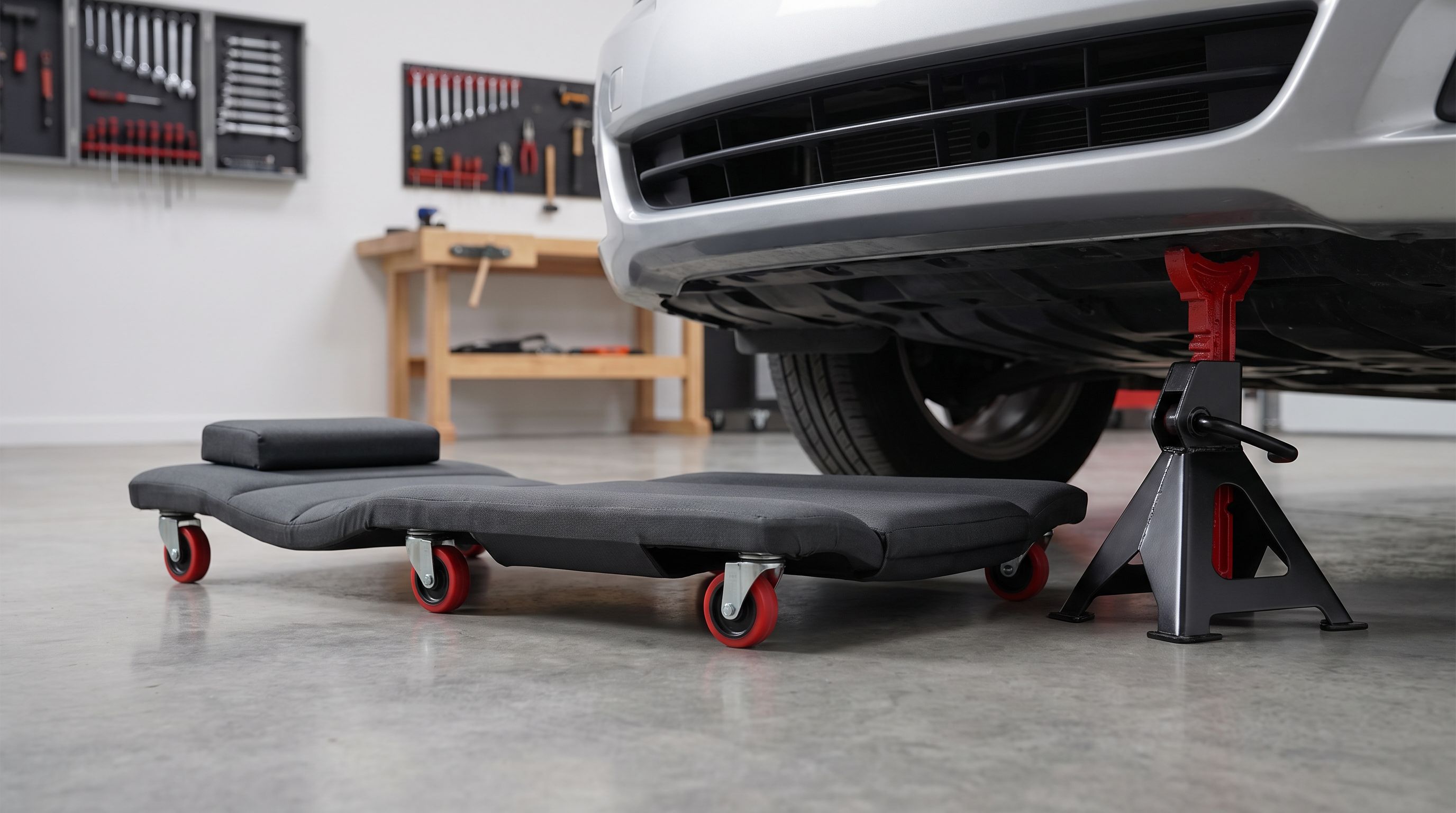
Most people buy the wrong rolling platform because they shop by price instead of by the one number that decides everything: how much space actually exists between your car's rocker panel and the garage floor once it's up on jack stands. A creeper that's 4.5 inches tall is useless under a lowered Civic sitting on 12-inch stands if your chest is thicker than the gap. And a flat creeper is the wrong tool entirely if 80% of your work is brakes, wheels and bumper-height fasteners.
This guide helps you measure first, then match. We compared current creepers and shop stools using manufacturer specifications, independent test roundups and verified owner feedback — GarageProof does not physically test units.
The short version
- Best overall: Omega Lift Equipment 91452 Z-Creeper
- Best low-clearance pick: Lisle 97102 Low Profile Plastic Creeper
- Best budget convertible: Pro-Lift C-2036D Z-Creeper
- Best for engine bay work: Traxion 2-700 ProGear Topside Creeper
- Best rolling stool: Torin Big Red TR6350 Rolling Garage Stool
 Best for engine bay work · Traxion 2-700 ProGear Topside Creeper — Check price on Amazon →
 Best budget convertible · Pro-Lift C-2036D Z-Creeper — Check price on Amazon →
 Best low-clearance pick · Lisle 97102 Low Profile Plastic Creeper — Check price on Amazon →
 Best overall · Omega Lift Equipment 91452 Z-Creeper — Check price on Amazon →
Creeper or stool? Answer this first
They are not competing products — they solve different geometry problems.
A creeper puts you flat on your back and rolls you under the vehicle. You need it for exhaust, transmission crossmembers, oil drain plugs, subframe bolts, skid plates and anything on the underside. Its limiting dimension is deck height: the distance from the floor to the top of the padding.
A mechanic stool (roller seat) keeps you seated at roughly 14–21 inches, rolling alongside the car. It's for brake calipers, wheel bearings, rotors, rocker trim, lower body panels, bumper covers, and long jobs where you'd otherwise squat. Its limiting dimensions are seat height range and floor clearance of the base.
A topside creeper is a third category: a padded chest support on a tall rolling frame that leans you over the fender into the engine bay. If you've ever spent 40 minutes draped over a radiator support chasing a rear-bank spark plug, you already know why these exist.
Most home garages end up with a creeper plus a stool, in that order. If you only buy one and your car is a modern crossover or truck with real ride height, buy the creeper. If you drive something low and mostly do brakes and wheels, buy the stool.
How to measure your actual clearance
Do this before you spend a dollar.
- Raise the vehicle exactly the way you normally would — same jack, same stand height, same lift points.
- Measure from the floor to the lowest point you need to roll under. For most cars that's the rocker pinch weld or the side skirt, not the differential.
- Subtract the creeper's listed deck height.
- What's left is your body clearance. Lying flat, a typical adult chest needs about 9–11 inches to move comfortably and work with hands raised.
So: 20 inches of rocker clearance minus a 4-inch creeper leaves 16 inches of working space — comfortable. The same creeper under a 14-inch clearance leaves 10 inches — tight but workable if you're slim. Under a lowered car on ramps with 11 inches, you're not using a padded creeper at all; you're using a thin plastic one or a moving blanket.
Also measure the garage door opening side clearance and, critically, whether your floor has a drainage slope. A sloped slab will roll a creeper away from you, which matters more than any spec sheet.
How to choose
Deck height and padding thickness
Low-profile plastic creepers typically sit in the 2.5–4 inch range; padded steel-frame creepers usually land around 4–6.5 inches once you count the cushion. Padding compresses a bit under load, but don't bet more than half an inch on it. If you regularly work on lowered cars, buy the thinnest deck you can tolerate and accept the comfort hit. If you work on trucks and SUVs, buy comfort — you have the headroom to spend.
Headrest design matters more than people expect. An adjustable or integrated headrest keeps your neck from craning for an hour straight; a flat creeper with no head support will end the session before the job does.
Caster size and wheel material
This is the single biggest quality differentiator and the one most listings bury. Small 1.5–2 inch casters catch on expansion joints, extension cords, dropped bolts and epoxy chips. Larger 2.5–3 inch casters roll over debris and tolerate rough or sealed concrete far better. Traxion's larger-wheel designs built their reputation on exactly this.
Material matters too: hard nylon or polyurethane wheels roll easily but can mark coated floors and skid on dust; softer urethane grips better and runs quieter. If your garage has an epoxy or polyaspartic coating, prefer non-marking urethane. If it's bare, rough-broom-finished concrete, prefer the biggest wheels you can get.
Count the casters as well. Six swivel casters distribute load and reduce the chance of one wheel dropping into a floor crack and stopping you dead.
Frame type: plastic, steel or convertible
One-piece molded plastic is the lowest-maintenance option. No fabric to soak up oil, no padding to rot, easy to hose off, and usually the lowest deck. It's also the least comfortable for long sessions.
Padded steel or wood frames are the comfort option, with vinyl-covered pads that are easy to wipe but will eventually tear at seams.
Z-style convertibles fold from a flat creeper into an upright seat. They're genuinely useful in a one-car garage because they replace two tools and store in half the footprint. The compromise: the folding mechanism adds a little deck height and a hinge that can rattle.
Weight capacity and footprint
Published capacities commonly run from roughly 300 lb on lightweight plastic and folding units up to 400–450 lb on heavy steel shop creepers. Buy with margin — you're also loading the deck with tools, a drain pan rim, and the shock of pushing off a tire. Check the folded or stored dimensions too; a 40-inch creeper that won't hang on a wall hook is a 40-inch obstacle.
Floor type reality check
Sealed epoxy: anything rolls well, so prioritize non-marking wheels. Bare concrete with a broom finish: go big on casters. Sloped slab: a stool with a brake or a heavier creeper that resists drifting. Gravel or a driveway: honestly, skip the creeper and use a thick moving blanket or a plastic creeper you don't mind destroying.
Comparison table
| Model | Type | Best for | Deck/seat style | Key trade-off |
|---|---|---|---|---|
| Omega 91452 Z-Creeper | Convertible creeper/seat | Mixed under-car and side work | Padded, folding Z-frame | Folding frame sits taller than flat plastic |
| Lisle 97102 | Low-profile plastic creeper | Lowered cars, oily jobs | Molded one-piece plastic | Minimal padding, less comfortable for long sessions |
| Pro-Lift C-2036D | Convertible creeper/seat | Budget-conscious one-tool buyers | Padded folding frame with headrest | Lighter-duty hardware than shop-grade units |
| Traxion 2-700 ProGear | Topside creeper | Engine bay and deep fender reaches | Padded chest/torso platform | Doesn't go under the car at all; bulky to store |
| Torin Big Red TR6350 | Rolling stool | Brakes, wheels, bumpers | Adjustable padded seat with tray | No under-car capability |
The picks
Omega Lift Equipment 91452 — best overall
Prices last checked October 10, 2026. Amazon prices change frequently, so treat these as a guide and check the live price before you buy.
Omega Lift Equipment 91452 Z-Creeper
Converts between a low flat creeper and an upright Z-seat, so one tool covers under-car and wheel-well work.
The Z-Creeper is the one that keeps showing up at the top of independent creeper roundups, and the reason is versatility rather than any single standout spec. Flat, it's a padded creeper with a headrest and six swivel casters; folded, it becomes an upright seat with a backrest for brake and wheel work. For a home garage where storage space is finite and the job list is varied, that two-in-one function is worth more than a half-inch of deck height. What you give up: it's taller than a bare plastic creeper, so it's a poor match for genuinely lowered cars, and the folding hardware adds weight you'll notice when hanging it on the wall.
Lisle 97102 — best low-clearance pick
Lisle 97102 Low Profile Plastic Creeper
Molded one-piece plastic deck sits very low and shrugs off oil, coolant and brake fluid.
If your measurement came back tight, this is the answer. A one-piece molded plastic creeper has no frame, no fabric and no cushion stack between you and the floor, which is exactly what you want under a car sitting at 13 or 14 inches of rocker clearance. It also handles the mess side of the job better than anything padded — gear oil, coolant and brake fluid wipe straight off, and you can hose it down without worrying about a soggy pad. The trade-off is blunt: plastic against your shoulder blades for an hour is not comfortable. Many owners add a thin foam mat on top, which costs them a little of the clearance advantage.
Pro-Lift C-2036D — best budget convertible
Pro-Lift C-2036D Z-Creeper
Folding Z-frame creeper-to-seat with padded headrest at a friendlier price than shop-grade models.
Pro-Lift's Z-creeper covers the same conceptual ground as the Omega — flat creeper that folds into a seat with a padded headrest — at a lower entry point. For someone doing a few oil changes, a brake job and the occasional exhaust hanger each year, that's a sensible place to spend. It suits weekend use and light-to-moderate loads. What it gives up is hardware quality under sustained abuse: budget convertibles are where owner reviews most often mention caster wear, hinge play and pad seams over time. If you're in the garage several times a week, step up.
Traxion 2-700 ProGear — best for engine bay work
Traxion 2-700 ProGear Topside Creeper
Leans you over the fender safely for deep engine-bay reaches instead of folding you over sheet metal.
This one solves a problem no creeper or stool can touch. Modern engine bays are deep and fenders are tall, so reaching a rear bank, a water pump or a timing cover means folding your ribs over sheet metal. The ProGear topside creeper rolls you up against the fender on a padded torso platform with large casters and a tool tray, keeping your weight supported and your hands free. It's the right buy for anyone doing engine work on trucks, SUVs or transverse-V6 sedans. Obvious limitation: it does nothing under the car, it takes real floor space, and it's overkill if your garage time is mostly fluids and brakes.
Torin Big Red TR6350 — best rolling stool
Torin Big Red TR6350 Rolling Garage Stool
Padded adjustable-height seat with a parts tray for brake, wheel and bumper-height jobs.
A creeper is the wrong tool for a four-corner brake job, and this is what you should be sitting on instead. The Big Red rolling stool gives you an adjustable-height padded seat, swivel casters and a parts tray in the base — which in practice is the feature you'll use most, because it stops caliper bolts and clips from vanishing under the car. It suits brake service, wheel and tire work, bumper and lower-panel jobs, and detailing. What it gives up is obvious: zero under-car capability, and like most stools it will drift on a sloped slab if you let go of it.
FAQ
How much clearance do I need to use a creeper safely? Measure floor-to-rocker with the car on stands, subtract the creeper's deck height, and aim for at least 9–11 inches of remaining space for your torso and hands. Less than that and you'll be working with your elbows pinned. More importantly, never rely on a jack alone — the vehicle must be on properly rated jack stands on level concrete before any part of you goes underneath.
Are plastic creepers worse than padded ones? Not worse, different. Plastic wins on deck height, cleanup and chemical resistance; padded wins on comfort for long sessions. If you only buy one and you own a truck or crossover with plenty of clearance, padded is the better daily experience.
Do caster size really matter that much? Yes. Small wheels stop dead on expansion joints, cords and dropped hardware; 2.5-inch-plus casters roll over them. On rough or unsealed concrete, caster size affects your experience more than padding thickness does.
Will a creeper mark my epoxy garage floor? Hard nylon wheels can leave scuffs, especially if a wheel locks up and skids. Look for non-marking urethane casters if your floor is coated, and keep the wheels clean of embedded grit.
Is a Z-creeper worth it over buying both a creeper and a stool separately? If storage space is tight, yes — one tool, one wall hook. If you have the room and do heavy work, two dedicated tools will each do their job better: a flat low creeper gets you lower, and a proper adjustable stool with a tray is more comfortable at seat height than a folded creeper backrest.
Can I use a creeper on a driveway or gravel? Not well. Casters need a hard, reasonably smooth surface. On asphalt or gravel, a thick moving blanket or foam mat is safer and less frustrating — and remember that jack stands need firm, level support, which loose surfaces don't provide.
Get the best car care deals in your inbox
Join the GarageProof newsletter for hand-picked car care deals and new buying guides. No spam, unsubscribe anytime.
Related reads
Oil Filter Wrench Fitment 2026: Cap, Cup or Claw?
Cap, cup, claw or strap? Match the right oil filter wrench to your engine's filter size and flute count in 2026 — plus five picks that actually fit.
Brake Caliper Piston Tool Kit 2026: Match the Pin Pattern
Pick a brake caliper piston tool kit that actually fits your rear calipers in 2026 — adapter coverage, pin patterns, EPB cars and build quality compared.
Air Compressor for Garage 2026: CFM That Runs an Impact Gun
How much CFM at 90 PSI do you really need for impact wrenches? We compare pancake, twin-stack and vertical air compressors for home garages in 2026.