Air Compressor for Garage 2026: CFM That Runs an Impact Gun
How much CFM at 90 PSI do you really need for impact wrenches? We compare pancake, twin-stack and vertical air compressors for home garages in 2026.
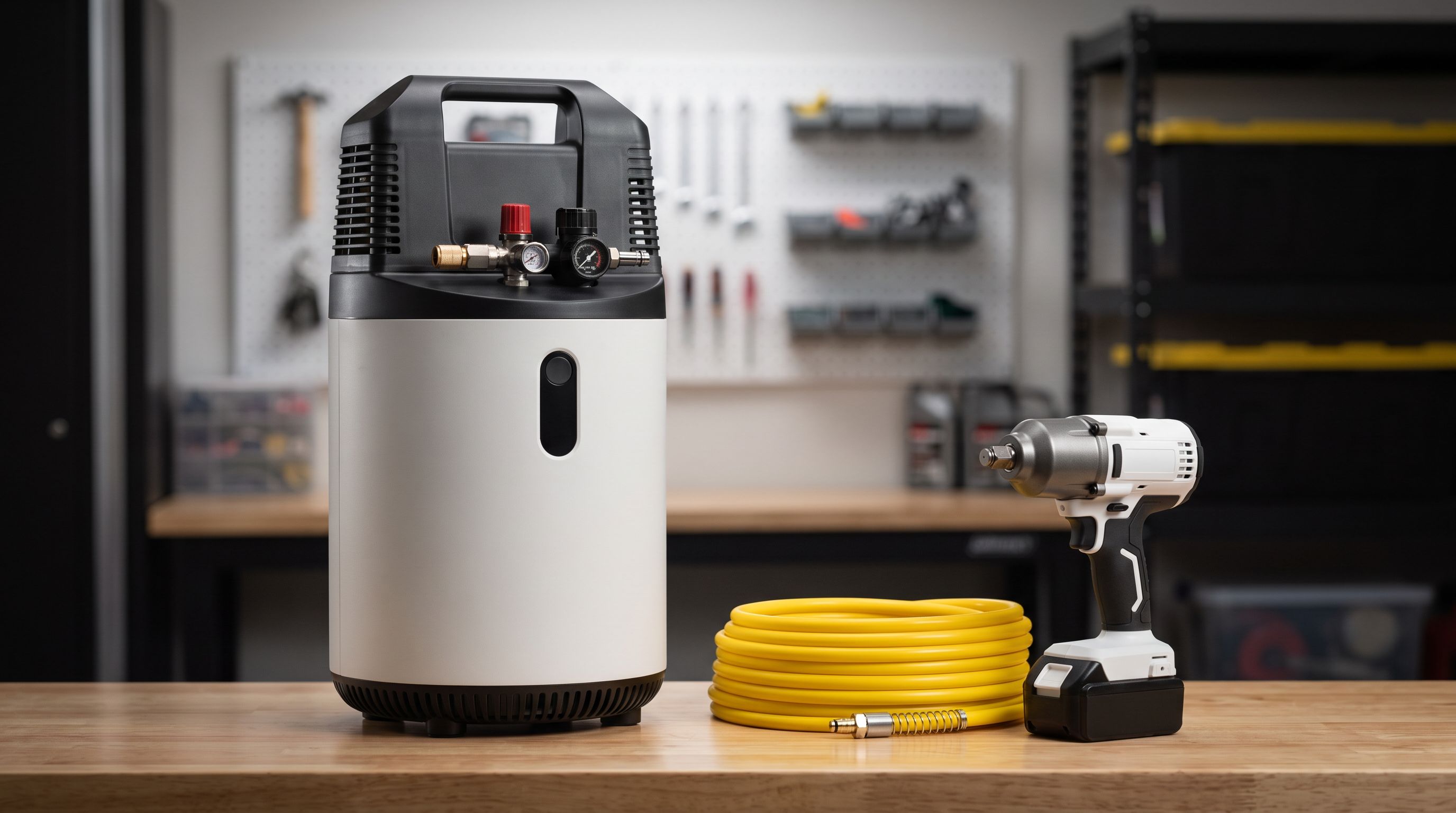
Reader-supported: we may earn a commission from links on this page, at no extra cost to you. It never affects our picks. Learn more.
Most people buy the wrong air compressor for the same reason: they shop by tank size and max PSI, which are the two numbers that matter least. The number that decides whether your impact wrench spins a seized lug nut or wheezes to a halt is SCFM at 90 PSI — how much air the pump can actually deliver, continuously, at working pressure.
This guide matches the three common home-garage formats — pancake, twin-stack and vertical — to real jobs, and explains exactly how to read a spec sheet so you don't end up waiting 40 seconds between every bolt. GarageProof researches and compares products using manufacturer specifications, independent reviews and verified owner feedback; we don't physically test units.
The short version
- Best overall for a home garage: California Air Tools 8010
- Best pancake compressor: DeWalt DWFP55126
- Best twin-stack for impact wrenches: Metabo HPT EC1315S
- Budget pick: Craftsman CMEC6150K
- Best vertical tank: Industrial Air ILA3606056
 Best vertical tank · Industrial Air ILA3606056 — Check price on Amazon →
 Best pancake compressor · DeWalt DWFP55126 — Check price on Amazon →
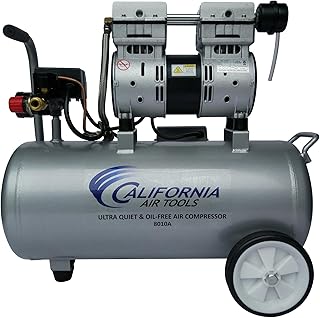 Best overall for a home garage · California Air Tools 8010 — Check price on Amazon →
The CFM reality check
Air tools are rated in CFM, but that rating assumes a duty cycle. A 1/2-inch impact wrench is typically rated somewhere around 4–5 CFM at 90 PSI, yet manufacturers quote that figure at roughly a 25% duty cycle — short bursts, not continuous trigger. That's why a 2.6 SCFM pancake can crack lug nuts: you pull the trigger for three seconds, the tank drains, and the pump catches up while you move the socket.
What doesn't work is pretending that's a solution for continuous-draw tools. Here's the rough hierarchy:
| Tool | Typical demand at 90 PSI | Duty cycle | Minimum compressor you'll be happy with |
|---|---|---|---|
| Blow gun / tire inflation | 2–4 CFM in bursts | Very low | Any 6-gallon pancake |
| 3/8" impact wrench | ~3 CFM | Intermittent | 6-gallon pancake, 2.5+ SCFM |
| 1/2" impact wrench | ~4–5 CFM | Intermittent | 4+ SCFM, 8+ gallon tank |
| Air ratchet | ~3–4 CFM | Semi-continuous | 4+ SCFM, 8–20 gallon |
| Die grinder / cut-off tool | ~4–6 CFM | Continuous | 5+ SCFM, 20+ gallon |
| DA sander | ~7–12 CFM | Continuous | 10+ SCFM, 60 gallon, 240V |
| HVLP spray gun | ~8–14 CFM | Continuous | 12+ SCFM, 60 gallon, 240V |
Read that table honestly and the decision usually makes itself. If your list stops at impacts, ratchets, blow guns and tires — which describes 90% of home garages — you need somewhere between 3 and 5 SCFM at 90 PSI. If sanding or painting is on the list, nothing portable will do, and you should be budgeting for a 60-gallon vertical on a dedicated 240V circuit.
One more thing: SCFM and CFM aren't interchangeable. SCFM is standardised to defined temperature and humidity conditions and is the number worth comparing between brands. "Displacement CFM" is a theoretical pump figure that can be 30–40% higher than real delivered air. If a listing quotes a suspiciously big CFM number with no pressure attached, treat it as marketing.
How to choose
SCFM at 90 PSI, not max PSI
Almost every consumer compressor tops out at 150 PSI, so max pressure tells you nothing. What you want is the delivered-air figure at 90 PSI, the pressure most air tools are designed around. Find your most demanding tool's CFM requirement and add about 30–50% headroom. A compressor running flat-out to keep up will run hot, cycle constantly and wear its pump prematurely.
Tank size is a buffer, not a power source
The tank doesn't make air; it stores it so you can briefly draw more than the pump produces. A bigger tank means longer bursts and fewer motor starts, but it can't rescue an undersized pump — it just takes longer to empty and much longer to fill. For impacts, the sweet spot is the overlap: a 4+ SCFM pump with at least 8 gallons behind it will handle suspension and brake work without drama. A 60-gallon tank paired with a weak pump is a classic mismatch.
Oil-free vs oil-lubricated
Oil-free pumps are lighter, need no maintenance and start reliably in a cold garage — but they're louder in most designs and have shorter rated pump life. Oil-lubricated cast-iron pumps run cooler, quieter and far longer, at the cost of periodic oil changes and the need to keep the unit level. For occasional weekend use, oil-free is fine. If the compressor is going to run for hours at a stretch, oil-lubricated cast iron is the durability play.
Noise, because you have neighbours
This is the spec most buyers underestimate. A conventional direct-drive oil-free pancake can run around 78–82 dBA — loud enough that you'll want hearing protection and your neighbours will know exactly what you're doing. Low-RPM "quiet" designs like the California Air Tools range operate near 60 dBA, roughly the difference between a vacuum cleaner and a conversation. If your garage is attached to the house or you work evenings, this matters more than a gallon or two of tank.
Power supply and portability
Anything above roughly 2 running HP generally wants a 240V circuit, and 60-gallon verticals almost always do. Check what's actually in your garage panel before you shop. On 120V, also check the amp draw against your circuit breaker — some larger portables will nuisance-trip a shared 15A circuit, especially on a long extension cord. And if you only have one 120V outlet, use a short, heavy-gauge cord or no cord at all; voltage drop is a leading cause of "my compressor won't start".
The picks
California Air Tools 8010 — best overall for a home garage
Prices last checked October 14, 2026. Amazon prices change frequently, so treat these as a guide and check the live price before you buy.
California Air Tools 8010
Ultra-quiet oil-free 8-gallon steel tank with enough sustained CFM for short impact-gun bursts.
The 8010 pairs an 8-gallon steel tank with an oil-free dual-piston pump that runs at low RPM, which is why it lands around 60 dBA — quiet enough to hold a conversation next to. Delivered air is in the mid-2 SCFM range at 90 PSI, which is genuinely comfortable for blow guns, tyre inflation, air ratchets and intermittent 3/8-inch impact work. The 8-gallon buffer gives you enough stored air for short 1/2-inch impact bursts too.
What it gives up: it isn't a continuous-duty machine. Die grinders and sanders will outrun it, and the oil-free pump won't match cast iron for lifespan under heavy use. Owners also note the plastic shroud and wheels feel less rugged than the steel tank suggests. For a quiet, maintenance-free garage workhorse, it's still the best all-round compromise.
DeWalt DWFP55126 — best pancake compressor
DeWalt DWFP55126
6-gallon pancake with strong 2.6 SCFM at 90 PSI and fast recovery for tires, nailers and light impact work.
The DWFP55126 is the pancake that other pancakes get measured against. It's a 6-gallon, 165 PSI oil-free unit rated at 2.6 SCFM at 90 PSI — toward the top of its class — with a high-efficiency motor that starts reliably in cold weather and a comparatively restrained noise rating for a direct-drive design. At around 30 lb it's genuinely one-hand portable, so it moves between the garage, the driveway and a job site without complaint.
What it gives up: 6 gallons is a small buffer, so a 1/2-inch impact on stubborn fasteners will drain it and leave you waiting. There's no real continuous-duty capability here. Think tyres, nailers, blow guns, bike and sports gear, and occasional lug nuts — all of which it does well.
Metabo HPT EC1315S — best twin-stack for impact wrenches
Metabo HPT EC1315S
Cast-iron twin-stack delivering high CFM at 90 PSI — the smallest format that comfortably feeds a 1/2-inch impact.
If impact wrenches are the reason you're buying, the twin-stack format is the honest answer. The EC1315S uses a cast-iron, oil-lubricated twin-cylinder pump feeding two stacked 4-gallon tanks, and its delivered air at 90 PSI is roughly double what typical pancakes manage. That's the difference between breaking a bolt loose and watching the gauge collapse. The cast-iron pump also runs cooler and is rated for a far longer service life than oil-free equivalents.
What it gives up: weight and noise. It's a two-hands-and-a-grunt lift compared with a pancake, it needs occasional oil checks, and it must stay level in operation and transport. It's also a bigger footprint. But for suspension, brake and wheel work, it's the smallest format that genuinely keeps up.
Craftsman CMEC6150K — budget pick
Craftsman CMEC6150K
Inexpensive 6-gallon oil-free pancake kit with hose and accessories for tires, blow guns and occasional lug nuts.
The CMEC6150K is the entry point: a 6-gallon oil-free pancake rated at 150 max PSI and roughly 2.6 SCFM at 90 PSI, usually bundled as a kit with a hose, blow gun, inflation accessories and chucks. For someone who mainly wants to top up tyres, clear brake dust, blow out an air filter and occasionally run a nailer, this covers the job without overthinking it — and the included accessories mean you're working the day it arrives.
What it gives up: it's loud, the pump is a maintenance-free-but-finite item, and the included hose is usually the first thing owners replace with something less kink-prone. Don't expect it to feed a 1/2-inch impact through a rusty exhaust bolt. As a first compressor that you'll later demote to the portable role, it's sensible money.
Industrial Air ILA3606056 — best vertical tank
Industrial Air ILA3606056
60-gallon oil-lubricated vertical with the duty cycle to run sanders, grinders and impacts all afternoon.
When the tool list includes sanders, grinders or a spray gun, you cross a line that portables can't. The ILA3606056 is a 60-gallon vertical with a cast-iron, oil-lubricated, belt-driven pump — a configuration that's quieter and dramatically longer-lived than direct-drive — and it delivers the kind of sustained CFM at 90 PSI that lets you run continuous-draw tools without constant cycling. The vertical footprint also reclaims floor space in a tight single-car garage.
What it gives up: everything related to convenience. It's a 240V machine in most configurations, it's heavy enough that you'll want help positioning it, and belt-drive pumps need periodic oil changes and belt checks. Factor in the cost of a dedicated circuit if you don't already have one. But it's the only category here that genuinely won't be outgrown.
Setup details that make a bigger difference than you'd think
- Hose ID matters. A 1/4-inch hose chokes a 1/2-inch impact. Use 3/8-inch ID hose for impacts and anything high-demand, and keep runs as short as practical.
- Upgrade your couplers. Standard industrial quick-connects are a surprising restriction. High-flow couplers can recover noticeable CFM at the tool for very little money.
- Drain the tank. Every session, or at minimum weekly. Condensate rusts tanks from the inside out, and a rusted tank is a safety issue, not a cosmetic one. A ball-valve drain conversion makes this a two-second job you'll actually do.
- Add a water separator if you're painting or running anything precision. Humid garages put a lot of moisture into the line.
- Set the regulator to the tool, not the tank. Most impacts want around 90 PSI at the tool while running — which usually means setting the regulator a bit higher to account for hose loss.
FAQ
How much CFM do I need for a 1/2-inch impact wrench? Plan for at least 4 SCFM at 90 PSI with an 8-gallon or larger tank for comfortable intermittent use. Many 1/2-inch impacts are rated around 4–5 CFM at a 25% duty cycle, so a smaller pancake can manage short bursts — you'll just spend time waiting for the pump to catch up.
Is a bigger tank better than more CFM? No. CFM is production; tank is storage. A large tank behind a weak pump just means long fill times and the same stalling once the buffer empties. Match the pump to your most demanding tool first, then choose tank size for how long you want to work between recovery cycles.
Can I run an air compressor on a regular 120V garage outlet? Pancakes, twin-stacks and most compressors up to roughly 2 running HP, yes — check the amp draw against your breaker and avoid long or thin extension cords. Most 60-gallon verticals need a dedicated 240V circuit. Confirm what's in your panel before buying.
Oil-free or oil-lubricated for a home garage? Oil-free for occasional weekend use: lighter, no maintenance, happy in the cold. Oil-lubricated cast iron if the compressor will run for extended periods — it runs cooler, quieter and lasts considerably longer, in exchange for oil changes and keeping the unit level.
Do quiet compressors actually make a difference? Yes, and it's the upgrade owners most often say they'd repeat. Roughly 60 dBA versus roughly 80 dBA is a very large perceived difference — the kind that determines whether you reach for the compressor on a Sunday morning or leave it switched off.
Will any of these run a DA sander or spray gun? Only the 60-gallon vertical. Sanders and HVLP guns draw continuously at 7–14 CFM, which is outside the range of every portable format here. If bodywork or painting is in your plans, buy the vertical from the start rather than twice.
Get the best car care deals in your inbox
Join the GarageProof newsletter for hand-picked car care deals and new buying guides. No spam, unsubscribe anytime.
Related reads
Oil Filter Wrench Fitment 2026: Cap, Cup or Claw?
Cap, cup, claw or strap? Match the right oil filter wrench to your engine's filter size and flute count in 2026 — plus five picks that actually fit.
Brake Caliper Piston Tool Kit 2026: Match the Pin Pattern
Pick a brake caliper piston tool kit that actually fits your rear calipers in 2026 — adapter coverage, pin patterns, EPB cars and build quality compared.
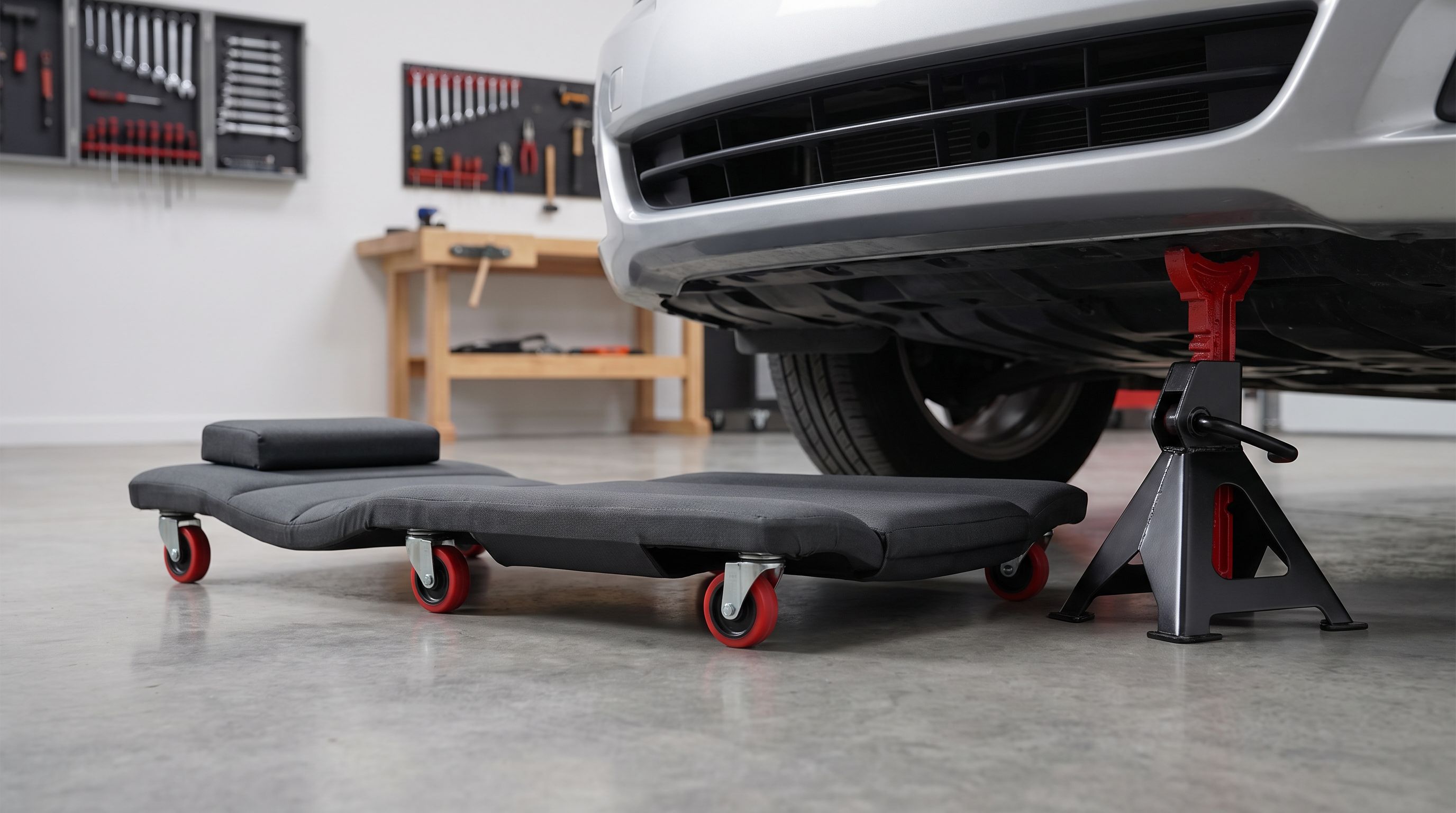
Garage Creeper vs Mechanic Stool in 2026: Clearance Guide
Measure your jacked-up clearance before you buy. Our 2026 garage creeper guide compares low-profile, Z-folding and stool options by deck height and caster size.