Brake Caliper Piston Tool Kit 2026: Match the Pin Pattern
Pick a brake caliper piston tool kit that actually fits your rear calipers in 2026 — adapter coverage, pin patterns, EPB cars and build quality compared.
Reader-supported: we may earn a commission from links on this page, at no extra cost to you. It never affects our picks. Learn more.
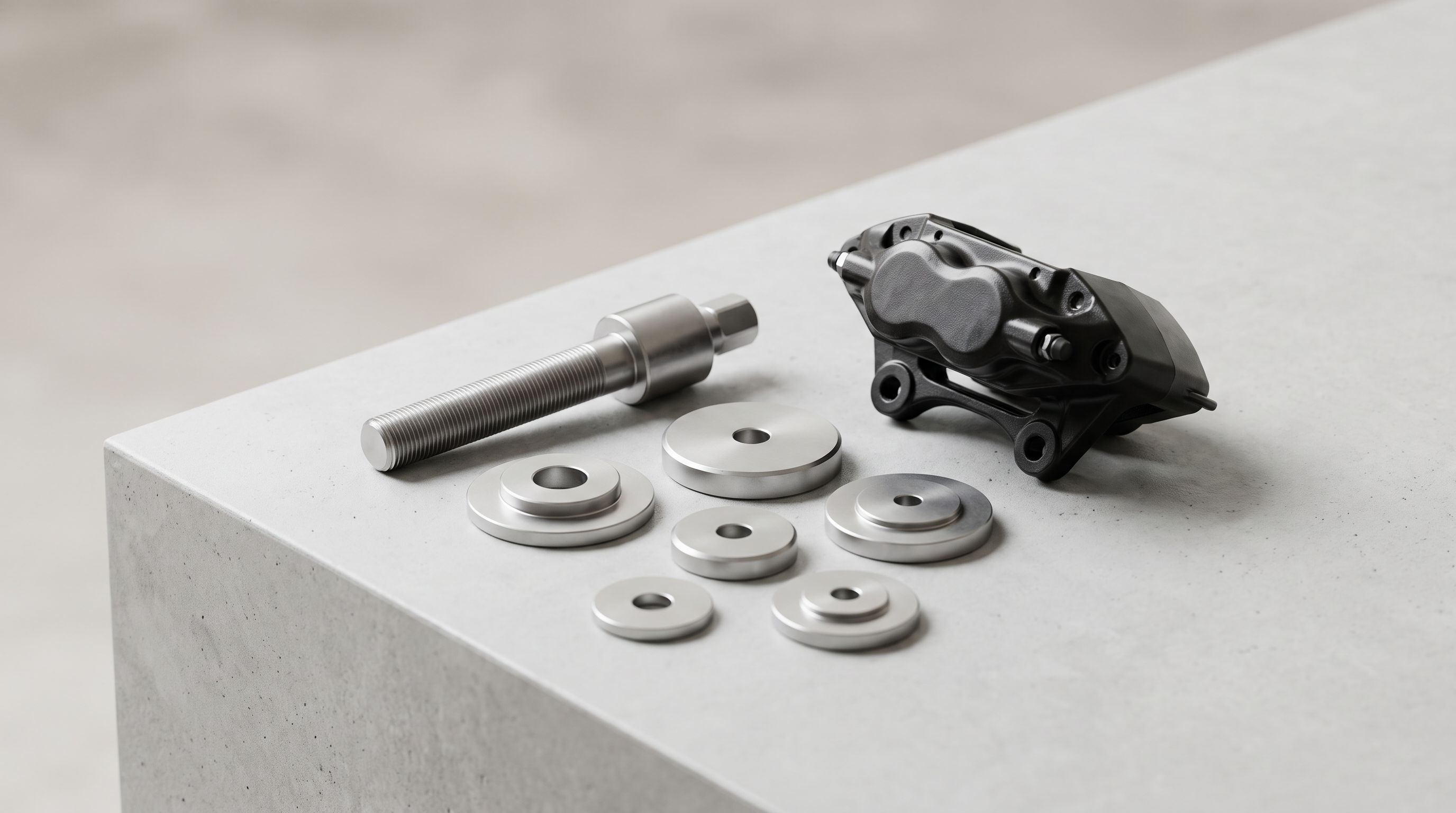
Rear brake jobs go sideways for one reason more than any other: the piston won't push back. On most rear calipers with an integrated parking brake, the piston rides on a threaded screw mechanism. Press it straight in with a C-clamp and you'll either accomplish nothing, bend the parking brake strut, or quietly damage the internal thread. It has to be rotated back in — usually clockwise, usually while applying inward pressure — and that means an adapter plate whose pins drop into the dimples on the piston face.
The catch is that pin patterns aren't standardized. Two-pin, three-pin, four-pin, square drive, cross-slot, offset pins at odd spacings — manufacturers do their own thing. So "which brake caliper piston tool kit should I buy" is really "which adapter plates does my car need, and does this kit include them."
Below we've compared the kits that come up most often in owner feedback and professional tool lineups, plus how to read your own calipers before you order anything.
The short version
- Best overall: OMT 23pc Brake Caliper Press Tool Set
- Best budget wind-back set: ABN Disc Brake Caliper Wind Back Tool Kit (22-Piece)
- Best for front calipers and quick pad swaps: Lisle 28600 Disc Brake Pad Spreader
- Best in tight wheel wells: Performance Tool W80696 Ratcheting Brake Caliper Tool
- Best single-tool solution: Symentis Gen2 Plus Brake Caliper Compression Tool
How to choose
1. Identify your rear caliper piston face first
Before anything else, pull a rear wheel and look at the piston. You're looking for:
- Two slots or two pins/dimples opposite each other — common on many European and Asian rear calipers.
- Three pins in a triangle — frequent on GM, Chrysler and some Ford applications.
- Four pins or a cross/square recess — some VW/Audi, Subaru, Honda units.
- A smooth, featureless piston face — that's a straight-push front-style caliper, or a rear caliper with an electric parking brake motor (more on that below).
Photograph it, count the pins, note roughly how far apart they are relative to piston diameter. Then check that the kit you're buying shows an adapter matching that pattern. Most multi-piece sets publish a photo of all plates — compare it to your photo, not to a vague "fits most vehicles" claim.
2. Decide whether you have an electric parking brake
This is the single biggest 2026 fitment question. If your car has a button or switch for the parking brake rather than a lever or foot pedal, there's an electric motor on the back of each rear caliper. Mechanical wind-back tools often still work after you retract the actuator with a scan tool — but on many of these calipers you must put the system into service/maintenance mode first, retract the motor electronically, then push (not wind) the piston.
Some EPB calipers still need rotation; others only need a straight press. There's no universal rule. Check a service manual or a marque-specific forum for your exact year, make and model before you buy. And budget for a scan tool with EPB service mode, because no mechanical kit substitutes for it.
3. Mechanical spreader vs. threaded press vs. cube tool
Three different tool architectures solve three different problems:
- Pad spreaders (scissor or screw type) push both pistons on a floating caliper by bearing against the old pads or the caliper body. Fast, cheap, great for fronts.
- Threaded wind-back presses use a spindle, a back plate that hooks over the caliper, and a rotating adapter. These give the controlled inward force plus rotation that rear screw-type pistons need.
- Cube/key tools (a small 3D block with various drive patterns) engage the piston but supply no inward pressure — you still need a clamp. Compact, but fiddly.
Most people end up owning a spreader and a wind-back press. They're complementary, not alternatives.
4. Build quality: where cheap kits fail
Owner feedback converges on the same failure points. Stamped or soft-cast adapter plates round off their pins on a seized piston. Thin pressure plates flex and cam the adapter out of the dimples. Thread quality on the spindle determines how much force you can apply before it binds. And plastic storage cases that don't hold 20+ small plates in place mean you lose the one you need.
Signs of a better kit: forged or properly machined steel adapters, a thick reversible pressure plate, a knurled or hex-driven spindle you can turn with a ratchet, and a hanger hook so the caliper never dangles from the flex hose.
5. Coverage vs. clutter
A 23-piece kit covers more cars than a 12-piece one, but if you only ever work on two family vehicles, half those plates will stay in the case forever. One-car owners are often better served by a quality single tool plus the one correct adapter. Anyone servicing friends' cars, a mixed fleet, or buying-and-flipping should take the broadest adapter set they can.
Comparison table
| Tool | Type | Best for | Rotates piston? | Watch out for |
|---|---|---|---|---|
| OMT 23pc Brake Caliper Press Tool Set | Threaded press + adapter plates | Mixed vehicles, rear screw-type pistons | Yes | Bulkier than single tools; check plate list vs. your piston |
| ABN Disc Brake Caliper Wind Back Tool Kit (22-Piece) | Threaded press + adapter plates | Budget-conscious DIY, common 2/3-pin patterns | Yes | Adapter hardness is the weak point on seized pistons |
| Lisle 28600 Disc Brake Pad Spreader | Screw-type spreader | Front calipers, fast pad swaps | No | Won't service rear screw-in pistons at all |
| Performance Tool W80696 Ratcheting Brake Caliper Tool | Ratcheting press | Tight wheel wells, limited swing room | Yes (with adapters) | Fewer adapters than large kits |
| Symentis Gen2 Plus Brake Caliper Compression Tool | Multi-function spreader/press | One- or two-car households | Limited | Not a substitute for a full adapter set on odd pin patterns |
The picks
OMT 23pc Brake Caliper Press Tool Set — best overall
Prices last checked October 15, 2026. Amazon prices change frequently, so treat these as a guide and check the live price before you buy.
OMT 23pc Brake Caliper Press Tool Set
Broad adapter coverage, solid cast plates and a hanger hook — the safest bet for mixed-fleet garages.
This is the kit most people should buy if they don't yet know every caliper they'll meet. The 23-piece layout covers the mainstream two-pin, three-pin and four-pin rear patterns plus square and cross drives, and it includes a caliper hanger hook — a small thing that saves a lot of brake hoses. Owner feedback consistently praises the thickness of the pressure plate and the fact that the spindle can be driven with a ratchet rather than only by hand, which matters on a piston that's been sitting for five years.
What you give up: bulk. It's a case you'll store, not a tool you pocket. And like every multi-adapter set, you should still verify your specific piston pattern appears in the plate photo before ordering.
ABN Disc Brake Caliper Wind Back Tool Kit (22-Piece) — best budget wind-back set
ABN Disc Brake Caliper Wind Back Tool Kit (22-Piece)
Cheap way to get the common 2-pin and 3-pin rear adapters plus a reversible pressure plate.
If you need the function and not the pedigree, the ABN kit gets you a reversible pressure plate, a threaded spindle and a spread of adapters covering the common rear patterns. For a once-every-few-years rear pad and rotor job on a mainstream sedan or crossover, it does the work without a professional-tool outlay.
The compromise is metallurgy. Reviewers who've fought genuinely seized pistons report pin rounding and adapter wear sooner than on premium sets. Use plenty of penetrating oil, don't shock-load it with an impact, and keep the adapter square to the piston. Treated gently it's fine; treated like a breaker bar it isn't.
Lisle 28600 Disc Brake Pad Spreader — best for front calipers and quick pad swaps
Lisle 28600 Disc Brake Pad Spreader
Simple screw-type spreader that pushes both pistons evenly without pinching the pad or boot.
A wind-back kit is the wrong tool for a front caliper, and this is the right one. The Lisle 28600 is a screw-type spreader that bears against the caliper and pushes the piston in squarely — no pinched dust boot, no C-clamp slipping off a wet piston face, and enough mechanical advantage to move a piston one-handed while you hold the caliper with the other. On twin-piston fronts it keeps both moving together if you position it correctly.
It does nothing for rear screw-type pistons, so treat it as the companion tool rather than the main event. Pair it with one of the wind-back kits above and you've covered a full four-corner brake job.
Performance Tool W80696 Ratcheting Brake Caliper Tool — best in tight wheel wells
Performance Tool W80696 Ratcheting Brake Caliper Tool
Ratcheting handle and compact head let you wind pistons with the knuckle and ABS line in the way.
Some cars simply don't give you room to swing a T-handle behind the knuckle — think compact crossovers with the ABS sensor lead and parking brake cable crowding the caliper. A ratcheting press lets you work in short strokes instead of full rotations, which is the difference between a ten-minute job and an hour of swearing.
The head is compact and the ratchet mechanism saves knuckles, but the trade-off is adapter count: you're getting a focused tool rather than a 20-plus-plate library. If your piston pattern is a common one and your problem is access, this is the smarter buy. If you need coverage across several vehicles, start with the OMT set instead.
Symentis Gen2 Plus Brake Caliper Compression Tool — best single-tool solution
Symentis Gen2 Plus Brake Caliper Compression Tool
5-in-1 spreader/press combo with hooks and lube for people who mostly service one or two cars.
The Symentis Gen2 Plus is the 2026-updated take on the all-in-one approach: a multi-function spreader/press that handles straight-push calipers, ships with hooks for hanging the caliper and includes brake lubricant sachets so you're not hunting for caliper grease mid-job. For someone who services one or two family cars and wants one thing in the toolbox rather than a case of plates, it's a sensible purchase.
The honest limitation is adapter breadth. If your rear pistons use an unusual pin pattern, a compact combination tool won't replace a dedicated wind-back plate. Check your piston face first; if it's a smooth-faced or simple pattern, this covers it neatly.
Doing the job without damaging anything
A few habits that owner reports suggest separate clean jobs from expensive ones:
- Open the bleeder or crack the reservoir cap when pushing pistons back, so you're not forcing old fluid backward through the ABS module. Pushing fluid back into a contaminated ABS valve block is a real way to turn a pad swap into a module replacement.
- Clean the piston face and dust boot before the adapter touches it. Grit between the plate and piston chews both.
- Watch for alignment slots. Many rear pistons must finish with a slot or cut-out in a specific clock position so the parking brake strut or the pad's anti-rattle nib seats correctly. Note the original orientation before you wind.
- Never hang the caliper by the flex hose. Use the included hook or a bungee.
- Retract electric parking brakes with a scan tool, then re-run the calibration afterwards. Forcing an EPB motor mechanically is how people end up buying calipers.
FAQ
Do all rear calipers need a wind-back tool? No. Rear calipers without an integrated parking brake — common on cars with a separate drum-in-hat parking brake — use straight-push pistons and only need a spreader or clamp. Look for pin dimples on the piston face: pins mean wind, smooth means push.
Which way does the piston turn? Clockwise on the large majority of applications, while applying steady inward pressure. A minority of vehicles, including some left/right-specific calipers, wind counter-clockwise. Check your service information rather than forcing it.
Can I just use a C-clamp and an old brake pad? On front and straight-push rear calipers, yes — that's a perfectly valid method, and the old pad spreads the load evenly. On screw-type rear pistons it will not work and risks internal damage.
Will a mechanical kit work on a car with an electric parking brake? Sometimes, after electronic retraction. You still need a scan tool with EPB service mode to retract and recalibrate the actuator. Some owners improvise by disconnecting the motor and turning the drive manually, but it's model-specific and risks fault codes.
How do I confirm the kit fits my car before buying? Remove a rear wheel, photograph the piston face, count the pins or slots, and compare against the manufacturer's adapter photo. Marque forums for your exact year, make and model are the fastest sanity check — someone has almost certainly posted which plate number works.
Is a cube-style key tool enough on its own? Only if you can supply inward pressure another way, usually with a clamp. Cube tools rotate but don't press, and most screw-type pistons need both at once.
Get the best car care deals in your inbox
Join the GarageProof newsletter for hand-picked car care deals and new buying guides. No spam, unsubscribe anytime.
Related reads
Oil Filter Wrench Fitment 2026: Cap, Cup or Claw?
Cap, cup, claw or strap? Match the right oil filter wrench to your engine's filter size and flute count in 2026 — plus five picks that actually fit.
Air Compressor for Garage 2026: CFM That Runs an Impact Gun
How much CFM at 90 PSI do you really need for impact wrenches? We compare pancake, twin-stack and vertical air compressors for home garages in 2026.
Garage Creeper vs Mechanic Stool in 2026: Clearance Guide
Measure your jacked-up clearance before you buy. Our 2026 garage creeper guide compares low-profile, Z-folding and stool options by deck height and caster size.