Spot Weld Cutters in 2026: What Panel Prep Actually Needs
Spot welding drill bits aren't a real thing — spot weld cutters are. Here are the panel prep tools worth buying in 2026, compared for rust repair and panel swaps.
Reader-supported: we may earn a commission from links on this page, at no extra cost to you. It never affects our picks. Learn more.
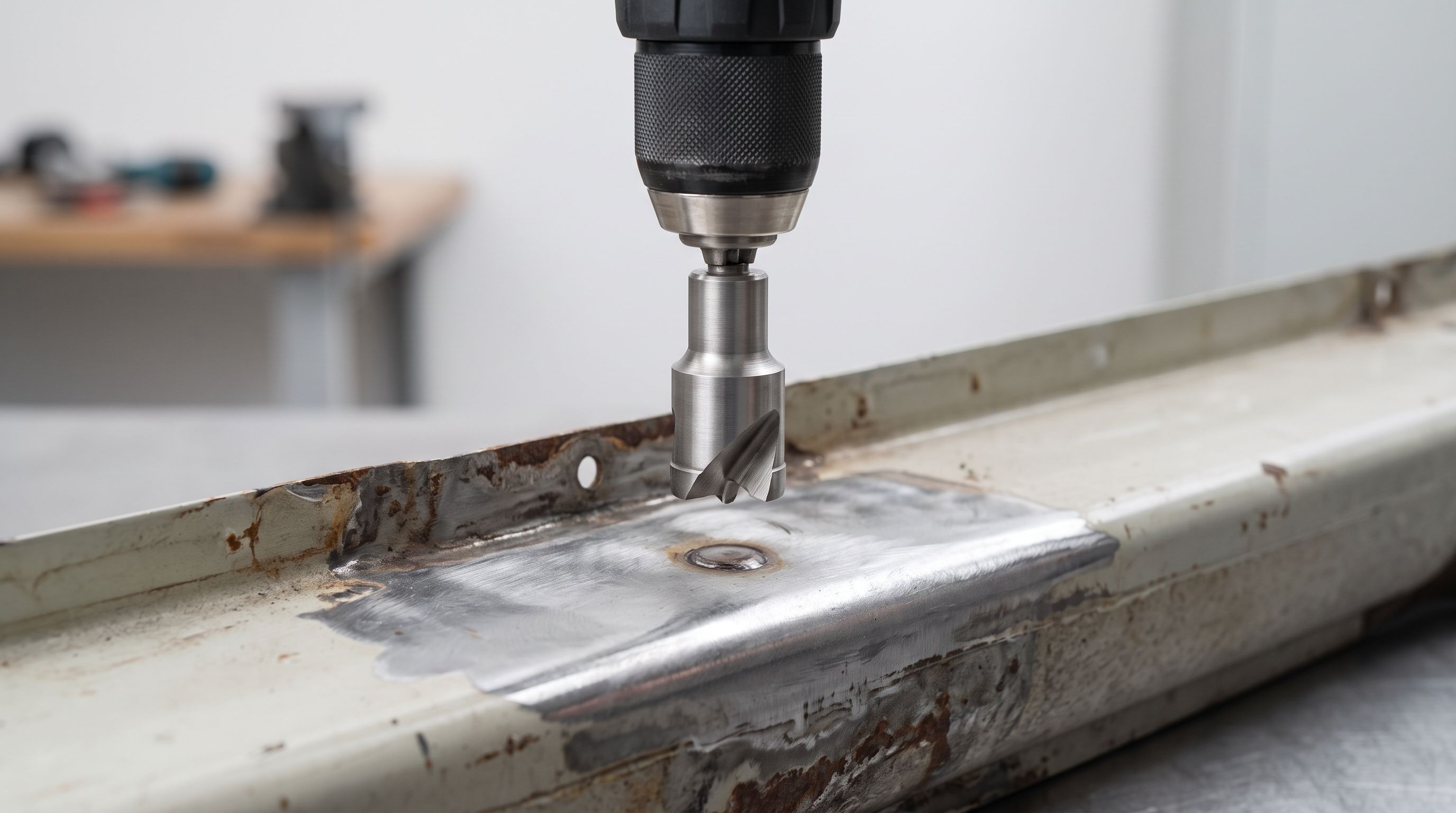
Search "spot welding drill bits" and you'll find a lot of listings that don't quite match what you're imagining. There's no drill bit that makes a spot weld — spot welds are made with a welder that squeezes two sheets of steel between copper electrodes and dumps current through them. What people are usually looking for is the opposite: a spot weld cutter (sometimes called a spot weld drill or Rotabroach-style cutter) that removes factory welds so a panel can come off.
That distinction matters, because buying the wrong thing wastes a weekend. A twist drill will wander, overheat, and punch through both layers of steel. A proper spot weld cutter has a pilot and an annular cutting edge designed to cut through the top layer only, leaving the lower flange intact so you can weld a new panel back onto it.
This guide covers the tools that actually earn their place on the bench for panel prep in 2026 — cutting welds, separating seams, and cleaning flanges — based on comparing manufacturer specs, professional body-shop feedback, and long-term owner reviews.
The short version
- Best overall: Blair Rotabroach 11096-3 Spot Weld Cutter Kit
- Best refill/consumable: Blair 13214 Rotabroach Cutter 3-Pack (3/8")
- Best budget pick: Astro Pneumatic 1750 Double-Sided Spot Weld Cutter
- Best for separating panels: Steck 20005 Seam Buster
- Best for weld and flange cleanup: 3M Roloc Bristle Disc Kit (Purple/Green)
Why "spot welding drill bits" is the wrong search
Three different tools get lumped under that phrase, and they do genuinely different jobs:
- Spot weld cutters / Rotabroach-style cutters. Hollow, toothed cutters with a spring-loaded centering pilot. They core out the weld nugget through one layer of steel. This is what you want 90% of the time.
- Spot weld drill bits (step/pilot style). Short, stubby bits — often 8mm or 3/8" — with a flat or brad point. Cheaper, faster to dull, and more likely to drill straight through both panels if you aren't watching depth.
- Spot weld removers for welding, not cutting. Some tools are sold alongside plug-weld nozzles and copper backing spoons. Those are for making the replacement welds, not removing the originals.
If your goal is replacing a quarter panel, rocker, door skin, floor pan, or cab corner, you want category one — plus something to separate the seam and something to clean the flange afterward.
Comparison table
| Tool | Type | Best for | Replaceable cutter | Drive | Main compromise |
|---|---|---|---|---|---|
| Blair Rotabroach 11096-3 | Annular cutter kit with arbor + pilot | Full panel replacement, repeated use | Yes | Corded or high-torque cordless drill | Highest up-front cost of the cutting tools |
| Blair 13214 3-Pack | Replacement 3/8" cutters | Keeping an existing Blair arbor fed | N/A (is the refill) | Fits Blair arbor | Useless without the arbor/kit |
| Astro Pneumatic 1750 | Double-ended spot weld cutter | One-off jobs, small patch panels | Flip to second end | Drill | Fewer total welds before it's done |
| Steck 20005 Seam Buster | Pneumatic chisel attachment | Splitting welded/bonded seams | N/A | Air hammer | Needs a compressor; can deform thin steel if rushed |
| 3M Roloc Bristle Discs | Abrasive bristle discs | Paint, sealer and weld residue on flanges | Discs are consumable | Die grinder or cordless, 1/4" Roloc holder | Won't remove heavy weld proud metal |
The picks
Blair Rotabroach 11096-3 — best overall
Prices last checked November 7, 2026. Amazon prices change frequently, so treat these as a guide and check the live price before you buy.
Blair Rotabroach 11096-3 Spot Weld Cutter Kit
The shop standard: replaceable cutters, a proper pilot, and clean separation without eating the lower panel.
The Blair Rotabroach system is the reference point almost every body tech compares other cutters to, and it's still the one to beat in 2026. The kit pairs a arbor with a spring-loaded pilot and replaceable annular cutters — typically 3/8" — so the pilot centers in a punched or center-drilled dimple and the cutter crowns the weld out of the top panel only. The geometry is the real value: it cuts rather than drills, so it's far less prone to wandering across a hardened weld nugget, and it leaves a cleaner hole for plug welding the new panel.
What it gives up: it's the priciest option here, it strongly prefers a drill that can hold steady low RPM with real torque, and it genuinely does not like high speed. Run it fast and dry and you'll glaze the teeth.
Blair 13214 Rotabroach Cutter 3-Pack (3/8") — best refill/consumable
Blair 13214 Rotabroach Cutter 3-Pack (3/8")
Replacement 3/8-inch cutters so a dull edge costs you a cutter, not a whole kit.
If you already own a Blair arbor, this is the part you should stock before a project, not after. Spot weld cutters are consumables. Modern vehicles use a lot of high-strength and ultra-high-strength steel in rockers, B-pillars, and floor structures, and those welds chew edges faster than the mild steel on a 1970s quarter panel. Having a fresh cutter mid-job is the difference between a clean separation and an afternoon of frustration.
What it gives up: nothing — provided you own the matching arbor. It's not a standalone tool, and buying a 3-pack without the kit is a classic cart mistake. Check your arbor size before ordering, and confirm the cutter diameter matches the holes you want for plug welding.
Astro Pneumatic 1750 — best budget pick
Astro Pneumatic 1750 Double-Sided Spot Weld Cutter
Flip-over double-ended cutter that gets a small job done without committing to a full kit.
Not every job justifies a full kit. If you're cutting a dozen welds to let a patch panel into a cab corner or a lower door, the Astro Pneumatic 1750 is a sensible way in. It's a double-sided cutter: run one end until it dulls, flip it in the chuck, and keep going. That effectively doubles the usable life of a single inexpensive tool, and it chucks into any standard drill.
What it gives up: total weld count. It won't match a Rotabroach kit over a full quarter panel, and once both ends are done, it's done — there's no refill path. It's also less forgiving of off-angle entry, so take the extra second to square the drill to the panel.
Steck 20005 Seam Buster — best for separating panels
Steck 20005 Seam Buster
Pneumatic chisel tool that splits bonded and welded seams after the welds are drilled.
Cutting the welds is only half the job. Factory seams are usually also held with seam sealer, adhesive, or just friction and paint, and prying with a screwdriver dents the flange you need to weld to. The Steck 20005 Seam Buster is a chisel-style attachment for an air hammer with a wide, blunt wedge profile designed to walk along a seam and split it without carving into either layer.
What it gives up: it needs a compressor and an air hammer, which adds cost if you don't have them. It also rewards patience — hammer too hard on thin or rusty steel and you'll stretch the flange. Work in short bursts and let the wedge do the splitting.
3M Roloc Bristle Disc Kit — best for weld and flange cleanup

3M Roloc Bristle Disc Kit (Purple/Green)
Strips paint, seam sealer and weld-through residue from flanges without gouging the steel.
Once the panel is off, the flange underneath is covered in paint, primer, seam sealer, and the remains of the old welds. You need bare, clean metal for a decent plug weld and for weld-through primer to do anything useful. 3M Roloc bristle discs — the purple and green grades in particular — are the least destructive way to get there. The molded abrasive bristles flex into the contour and strip coatings without removing much base metal, which matters on thin flanges that have already lost thickness to corrosion.
What it gives up: they won't level a proud weld — that's a grinder's job — and the discs wear down with use. You'll want a 1/4" Roloc holder and a die grinder or decent cordless tool.
How to choose
Match the cutter to the steel, not to the price
Pre-2000s mild steel bodies are forgiving. Anything with structural high-strength steel — most unibodies from the last two decades, plus modern truck cab structures — is not. Harder welds dull cheap cutters quickly and can snap pilots. If you're working on a newer vehicle, bias toward a replaceable-cutter system and buy a spare cutter up front.
Think about the hole you're leaving behind
The hole your cutter makes is usually the hole you'll plug weld through when the new panel goes on. 5/16" to 3/8" is the common range for plug welds in sheet steel. A cutter that's too large leaves a gap your MIG has to bridge; too small and the weld won't fuse properly to the lower flange. Pick a diameter you're comfortable filling with your welder settings.
Check what your drill can actually deliver
Annular cutters want low RPM and high torque, usually well under 1000 RPM. Many compact cordless drills top out too fast in high gear and stall in low. A corded drill with a speed control, or a cordless on its low-speed setting with a fresh battery, is the right pairing. Cutting fluid or even a dab of oil extends cutter life meaningfully.
Buy the whole workflow, not just the cutter
Removing a panel is a four-step sequence: locate the welds, cut them, split the seam, clean the flange. Skipping any step moves the pain somewhere else. A seam separator and a set of bristle discs cost less than a replacement panel you ruined by prying.
Confirm vehicle-specific fitment where it applies
Cutters and abrasives are universal — they don't care what you drive. The panels absolutely do. Patch panels, cab corners, rockers, and floor pans are sold by year, make, model, body style, and sometimes cab configuration. Before ordering any replacement sheet metal, verify fitment against your VIN or the seller's year/make/model lookup, and check whether the part is for a two-door or four-door, short bed or long bed. Also check whether your vehicle uses structural adhesive at that seam — some modern repair procedures specify adhesive plus welds, and the manufacturer's repair information is the authority there.
A quick word on safety and technique
Spot weld removal throws hot chips, and you'll be working near fuel lines, wiring, airbag components, and sound deadening that burns. Disconnect the battery before cutting or welding near a vehicle's structure. Wear eye protection and gloves. Check both sides of the panel before you cut — a cutter that punches through can hit a brake line or a wiring harness you didn't know was there.
Technique-wise: find the welds first. Hit the seam with a wire wheel or bristle disc and the dimples usually show up as faint circles. Center punch each one so the pilot has somewhere to sit. Cut slowly, apply steady pressure, and stop as soon as you feel the cutter break through the top layer — the sound and resistance change noticeably. Then let the seam separator do the prying.
FAQ
Is there such a thing as a spot welding drill bit? Not really. Spot welds are made with a resistance spot welder, not a drill. The tools sold under that name are spot weld cutters or removers, designed to remove existing factory welds.
Can I just use a regular drill bit? You can, but it's a poor substitute. Twist bits wander on hardened weld nuggets and tend to drill through both layers of steel, damaging the flange you need to weld the new panel to. A center punch plus a proper spot weld cutter is faster and cleaner.
What size spot weld cutter should I use? 3/8" is the most common general-purpose size and matches typical plug weld practice in sheet steel. Smaller cutters around 5/16" work for thinner panels. Match the size to the hole you want to fill with your MIG welder.
How many welds will one cutter last? It depends entirely on the steel hardness, your RPM, and whether you use cutting fluid. On older mild steel you may get through a whole panel; on modern high-strength steel, far fewer. Treat cutters as consumables and keep a spare on hand.
Do I need an air hammer to separate panels? Not strictly, but it makes the job much cleaner. A seam separator in an air hammer splits seams without deforming the flange, whereas prying with hand tools often stretches or dents the metal you need to weld to.
Will these tools work on my specific car? The cutters, seam separators, and abrasives are universal — they work on steel panels regardless of vehicle. The replacement panels themselves are not. Always verify patch panel or skin fitment by year, make, model, and body style before ordering.
Get the best car care deals in your inbox
Join the GarageProof newsletter for hand-picked car care deals and new buying guides. No spam, unsubscribe anytime.
Related reads
Jack Pad Pinch Weld Adapter 2026: Match It to Your Car First
A fitment-first guide to jack pad pinch weld adapters, EV jack pads and wheel chocks in 2026 — how to find your lift points before you buy anything.
Transmission Jack Buying Guide 2026: Telescoping vs Low Profile
Telescoping or low profile? Match saddle tilt, lift range and capacity to your pan size and garage ceiling with our 2026 transmission jack buying guide.
EVAP Smoke Machine Leak Tester 2026: Pressure & Port Fit
How to pick an EVAP smoke machine leak tester in 2026: safe output pressure, adapter cone sizing, gas cap vs. service port fit, and four picks for DIY garages.