Home Tire Changer in 2026: Does It Beat Shop Fees?
Manual tire changer for home garage vs per-tire shop fees in 2026: rim diameter limits, low-profile bead handling, bead breakers and real payback math.
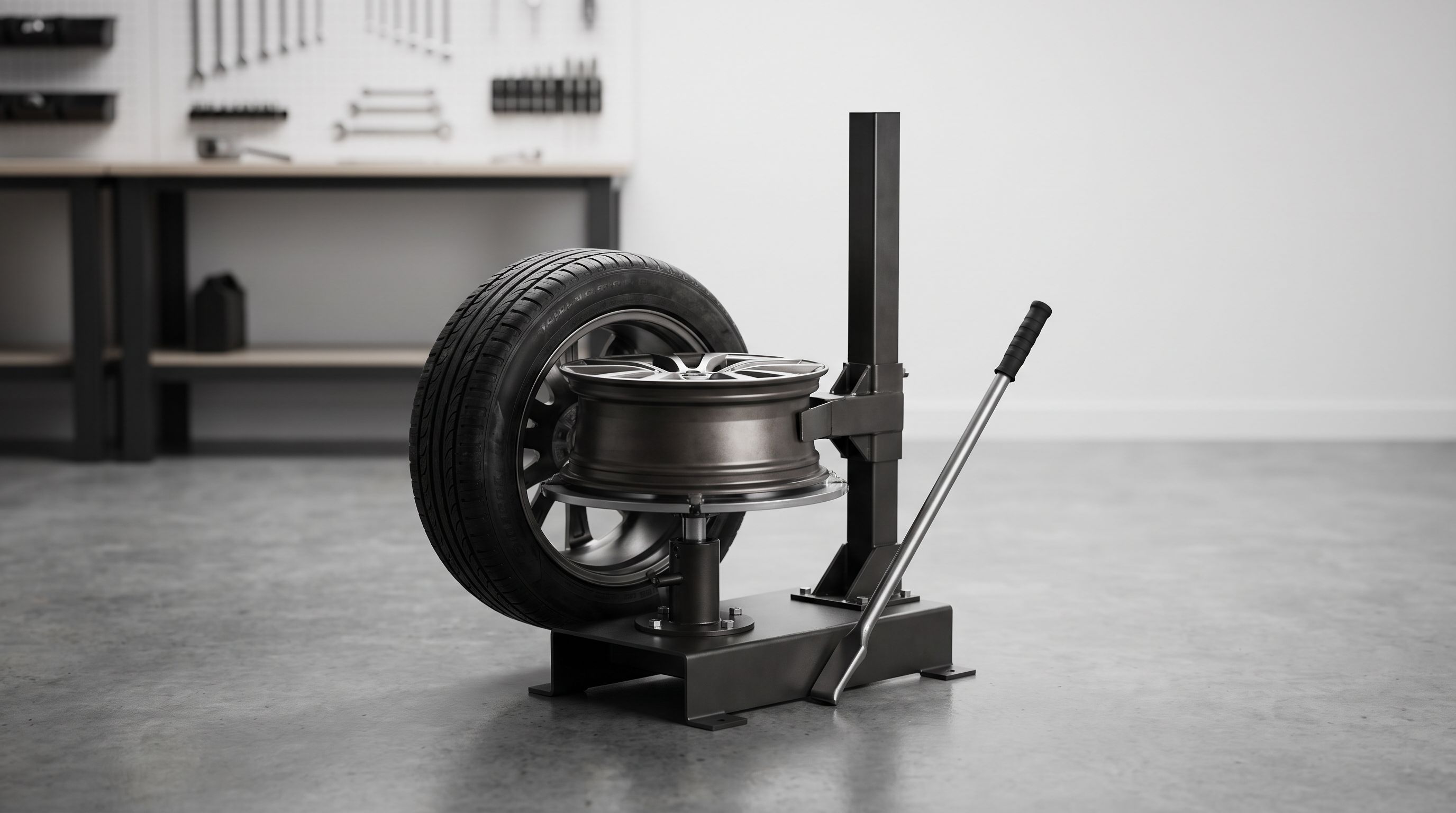
Reader-supported: we may earn a commission from links on this page, at no extra cost to you. It never affects our picks. Learn more.
Changing your own tires looks like an obvious win on paper. A shop charges per tire to mount and balance, you pay that four times, and a manual changer costs about what one or two sets of that labor costs. Buy the tool once, change tires forever, keep the money.
The reality is more conditional. A manual tire changer for a home garage is excellent at some jobs, mediocre at others, and genuinely bad at a few — particularly stiff low-profile sidewalls on big-diameter wheels. Balancing is a separate problem that most home setups don't solve. And the payback math swings wildly depending on whether you're doing seasonal swaps on steel wheels or occasional new rubber on 20-inch alloys.
Here's how we'd frame the decision, and which tools make sense for which garage.
The short version
- Best overall for most home garages: VEVOR Manual Tire Changer Bead Breaker
- Best built manual unit: KATOOL KT-T800 Manual Tire Changer
- Budget pick: Harbor Freight Portable Tire Changer
- Best companion tool: KATOOL KT-S200 Tire Spreader
- Best dedicated bead breaker: ESCO 20464 Tire Bead Breaker
 Best built manual unit · KATOOL KT-T800 Manual Tire Changer — Check price on Amazon →
Does a home tire changer actually pay for itself?
Run the numbers with your own local pricing rather than a national average, because mount-and-balance labor varies enormously by region and by wheel size — most shops charge a premium for anything over 18 inches, for low-profile tires, for TPMS service kits and for run-flats.
The honest breakdown looks like this:
It pays back fast if you:
- Run a dedicated winter set and swap twice a year (though swapping mounted wheels needs no changer at all — just a jack and a torque wrench)
- Own trailers, a side-by-side, ATVs, a tractor, or a project car fleet
- Buy used tires or take-offs and need them mounted on your own rims
- Live far enough from a shop that each trip costs you half a day
It pays back slowly or never if you:
- Own one modern car with 19-inch+ wheels and buy a new set every four years
- Have run-flats or very stiff low-profile sidewalls
- Don't have a balancer and will pay a shop to balance anyway
That last point is the one people underestimate. Dismounting and mounting is only part of the job. A wheel that isn't balanced will vibrate above roughly 45–50 mph, and static bubble balancers — the cheap home option — are far less precise than a dynamic spin balancer, which measures both inner and outer plane imbalance. If your plan is "I'll change them at home then drive to a shop for balancing," you've saved the mounting fee only, and some shops charge a higher rate to balance a wheel they didn't mount.
Hidden costs people forget
- Floor mounting. Most manual changers want to be bolted to concrete or to a sturdy base plate. Expansion anchors, a hammer drill, or a weighted/portable base all cost something.
- Consumables. Tire mounting lube (not dish soap — soap can promote rim corrosion and dries sticky), valve stems, TPMS service kits (grommet, nut, cap) for sensor-equipped wheels.
- Protection. Nylon or plastic duckhead covers and rim protectors if you care about your alloy finish. A bare steel duckhead will mark a wheel.
- Your time and back. Manual changing is genuine physical work. A stiff 275-section sidewall is not a two-minute job.
How to choose
Rim diameter and width limits — read the spec, not the headline
This is the single most common mismatch. Budget portable changers are typically rated for something like 8–16 inch rims; mid-tier manual bolt-down units commonly cover roughly 12–21 inches; powered shop machines go further. If your daily driver wears 19s or 20s, a 16-inch-max unit is useless for it even though it'll happily do your trailer and mower wheels.
Check three numbers before you buy: maximum rim diameter, minimum rim diameter (yes — very small wheels can be awkward on a large-cone changer), and maximum tire width/overall diameter. Then measure what's actually in your garage. Rim diameter is stamped on the tire sidewall as the last number in the size code: a 225/45R17 is a 17-inch rim.
Low-profile and run-flat capability
Low aspect ratios (45 and below) mean short, stiff sidewalls with very little flex to help the bead drop into the drop centre. Manual changers struggle here for two reasons: breaking the bead takes more force, and there's less sidewall to lever over the rim flange without damaging either the bead bundle or the rim lip.
If low-profile is your reality, plan on two things: a serious bead breaker — hydraulic rather than a stomp bar — and patience with lubrication and bead positioning. Run-flats with reinforced sidewalls are harder still, and many DIYers simply outsource those. There's no shame in it; professional machines use a helper arm and a bead press roller precisely because the job needs them.
Bead breaking method
Bead breaking is where most home jobs go wrong. Common approaches:
- Integrated lever/shoe on the changer — fine for average passenger tires, adequate on many light-truck tires, marginal on stiff low-profile.
- Standalone hydraulic bead breaker — far more force, far less drama, and it works on tires still on the vehicle or on wheels off a changer.
- Improvised methods (driving over the sidewall, Hi-Lift against the bumper) — occasionally effective, routinely a good way to damage a sidewall or a wheel. We'd skip them.
Old, corroded beads on steel wheels can be genuinely locked on. Soaking the bead area with lubricant and letting it sit before applying force saves a lot of effort.
Mounting style: bolt-down vs portable
Bolt-down units transmit all your leverage into the floor, which is what you want. Portable stands either use a weighted base or require you to stand on a foot plate — workable, but they can shift under load. If you rent, or your garage floor is sealed/epoxied and you don't want anchors, look for models that accept a bolt-on base plate you can load with weight.
Wheel protection
Steel wheels forgive everything. Painted and machined alloys do not. Look for nylon duckheads/inserts, plastic rim protectors, and a mount head that can be adjusted away from the rim flange. Budget units often ship with bare steel contact points; aftermarket nylon covers are cheap insurance.
Comparison table
| Tool | Type | Typical rim range | Bead breaking | Best for | Main compromise |
|---|---|---|---|---|---|
| VEVOR Manual Tire Changer Bead Breaker | Bolt-down manual | Roughly 12–21 in (verify model) | Integrated lever | Mixed car + light-truck home use | Hard work on stiff low-profile |
| KATOOL KT-T800 Manual Tire Changer | Bolt-down manual, heavier build | Common car to light-truck sizes | Integrated | Frequent changers, small shops | Heavier, needs solid floor anchoring |
| Harbor Freight Portable Tire Changer | Portable stand | Small rims, commonly up to ~16 in | Integrated bar | Trailers, ATV, mower, small cars | Won't fit modern 18 in+ wheels |
| KATOOL KT-S200 Tire Spreader | Spreader (not a changer) | Most passenger sizes | N/A | Puncture repair, inner inspection | Doesn't mount or dismount tires |
| ESCO 20464 Tire Bead Breaker | Dedicated hydraulic | Wide range incl. truck | Hydraulic, high force | Stubborn beads, low-profile, trucks | One job only; pair with a changer |
The picks
VEVOR Manual Tire Changer Bead Breaker — best overall for most home garages
Prices last checked October 17, 2026. Amazon prices change frequently, so treat these as a guide and check the live price before you buy.

VEVOR Manual Tire Changer Bead Breaker
Bolt-down manual changer with integrated bead breaker that handles common car and light-truck rim sizes.
The sweet spot for a general-purpose garage. A bolt-down manual changer with an integrated bead breaker covers the realistic span of passenger car and light-truck wheels, needs no air or electricity, and stores in a corner. Owner feedback consistently describes it as capable once anchored properly and once you've learned bead positioning — and frustrating if you try to use it unanchored or skip lubricant.
What it gives up: speed and finesse. There's no helper arm and no bead press, so aggressive low-profile tires take real effort. Verify the exact rim range on the specific model listing before buying, as VEVOR sells several variants, and budget for nylon rim protectors if you're working on alloys.
KATOOL KT-T800 Manual Tire Changer — best built manual unit
KATOOL KT-T800 Manual Tire Changer
Heavier swing-arm style manual changer aimed at people who change tires often, not once a year.
If you're changing tires monthly rather than annually, step up. The KT-T800 is a heavier swing-arm style manual machine aimed at serious home users and small independent shops, and the extra mass and rigidity translate directly into less flex when you're leaning on the bar. It's the kind of tool that feels over-specified for one set of tires a year and exactly right for a project-car household or a small rural operation.
The trade-off is commitment: more weight, more floor space, and a real need for proper concrete anchoring. It's still a manual machine, so low-profile and run-flat work remains a test of technique rather than a button press.
Harbor Freight Portable Tire Changer — budget pick
Harbor Freight Portable Tire Changer
The cheapest realistic entry point for trailer, ATV and small car wheels if you can live with the limits.
The lowest sensible entry point. Portable manual stands in this class typically top out around 16-inch rims, which rules out most modern cars but covers trailer wheels, ATV and UTV tires, mowers, small utility trailers and older compact cars. For a lot of people that's actually the job — the car gets done at a shop, the trailer gets done at home.
What you give up is obvious and worth stating plainly: limited rim capacity, more flex than a bolt-down unit, bare metal contact points that can mark alloys, and no chance against a stiff 20-inch low-profile tire. Treat it as a trailer-and-toys tool and it's good value; expect it to replace a tire shop and you'll be disappointed.
KATOOL KT-S200 Tire Spreader — best companion tool
KATOOL KT-S200 Tire Spreader
Spreads the carcass for plug-patch repairs and sidewall inspection without fully dismounting the tire.
Not a changer — a complementary tool. A spreader holds the tire open so you can inspect the inner liner, locate a puncture precisely, and install a proper plug-patch combination repair from inside, which is the method tire industry guidance considers correct for a tread puncture. Without a spreader, you're working blind through a narrow gap.
If your main pain point is repairing punctures rather than mounting new rubber, this plus a hand bead breaker may be all you actually need. It won't help you mount a new tire on a rim, and it takes up floor or bench space, so it's an addition to a changer rather than a substitute.
ESCO 20464 Tire Bead Breaker — best dedicated bead breaker
ESCO 20464 Tire Bead Breaker
Hydraulic bead breaking for stubborn low-profile and truck tires that defeat manual duckhead bars.
Where manual changers lose, hydraulics win. A dedicated hydraulic bead breaker applies far more controlled force than a foot-operated lever, which matters on corroded steel wheels, light-truck tires and short stiff low-profile sidewalls. ESCO is a known name in tire service tooling, and the appeal here is simple: it turns the worst part of the job into a routine part of the job.
It does only one thing. You still need a changer to dismount and mount, and it's an additional purchase on top. But if you've already fought one bead and lost, this is the tool that stops it happening again.
A realistic workflow for a home setup
- Deflate fully and remove the valve core — not just the cap.
- Break both beads, inner and outer, with generous lubricant and a pause to let it work.
- Mount the wheel on the changer with rim protection in place.
- Push the opposite side of the bead into the drop centre before levering. This is the technique that separates easy jobs from broken tire irons.
- Fit a new valve stem or TPMS service kit every time you have the tire off. They're cheap; a slow leak is not.
- Mount the new tire with the bead lubed, seat the beads with a burst of air (use an inflation cage or stand clear — seating can be violent), then set final pressure.
- Balance. Static bubble balancing is better than nothing; a shop spin balance is better still.
FAQ
Can a manual tire changer handle 20-inch wheels? Some can, many can't. Mid-tier bolt-down manual units commonly reach around 21 inches, while budget portable stands often stop near 16. Always check the stated maximum rim diameter on the exact model and compare it to the last number in your tire size code.
Do I still need a balancer? Almost certainly, yes. Mounting without balancing produces vibration at highway speed. A bubble balancer is a cheap static option; dynamic spin balancing is more accurate and is what most shops use. Factor balancing into your cost comparison before assuming the changer pays for itself.
Will a home changer damage my alloy wheels? It can, if you use bare steel contact points, skip lubricant, or lever against the rim flange. Nylon duckhead covers, plastic rim protectors and correct drop-centre technique make scratching avoidable but not automatic.
What about TPMS sensors? Work slowly and know where the sensor sits — usually at the valve. Break the bead away from the sensor, position the mount head clear of it, and replace the service kit (grommet, nut, cap) whenever the tire comes off. Sensor batteries are typically good for several years, so a sensor that's already old may be worth replacing while the tire is off.
Is it worth it for just one car? Usually not, if that car wears large low-profile wheels and gets new tires every few years. It becomes worth it once you add trailers, powersports, a second set of winter tires on separate rims, or a project car — or if the nearest shop is a long drive.
Can I break a bead without any special tool? You can sometimes, and we'd still advise against the usual improvised methods. The force required is substantial and poorly controlled, and the failure modes are a damaged sidewall, a bent rim flange or an injury. A hydraulic bead breaker or an integrated changer lever is the right tool.
Get the best car care deals in your inbox
Join the GarageProof newsletter for hand-picked car care deals and new buying guides. No spam, unsubscribe anytime.
Related reads
Long Reach Floor Jack for Trucks 2026: Reach Before Tonnage
A 2026 guide to long reach floor jacks for trucks and lifted SUVs — how chassis reach, max lift height, and saddle design decide whether a jack actually works.
Oil Filter Wrench Fitment 2026: Cap, Cup or Claw?
Cap, cup, claw or strap? Match the right oil filter wrench to your engine's filter size and flute count in 2026 — plus five picks that actually fit.
Hydraulic Shop Press Buying Guide 2026: 12 vs 20 Ton
Picking between a 12 and 20 ton hydraulic shop press? Our 2026 buying guide compares frame width, daylight, ram travel and bench height for home garage work.