Wiper Blades Size Fitment 2026: Beam vs Hybrid, Clip by Clip
How to confirm wiper blades size fitment and arm connector type before buying — plus when beam blades beat hybrid and conventional designs in snow and ice.
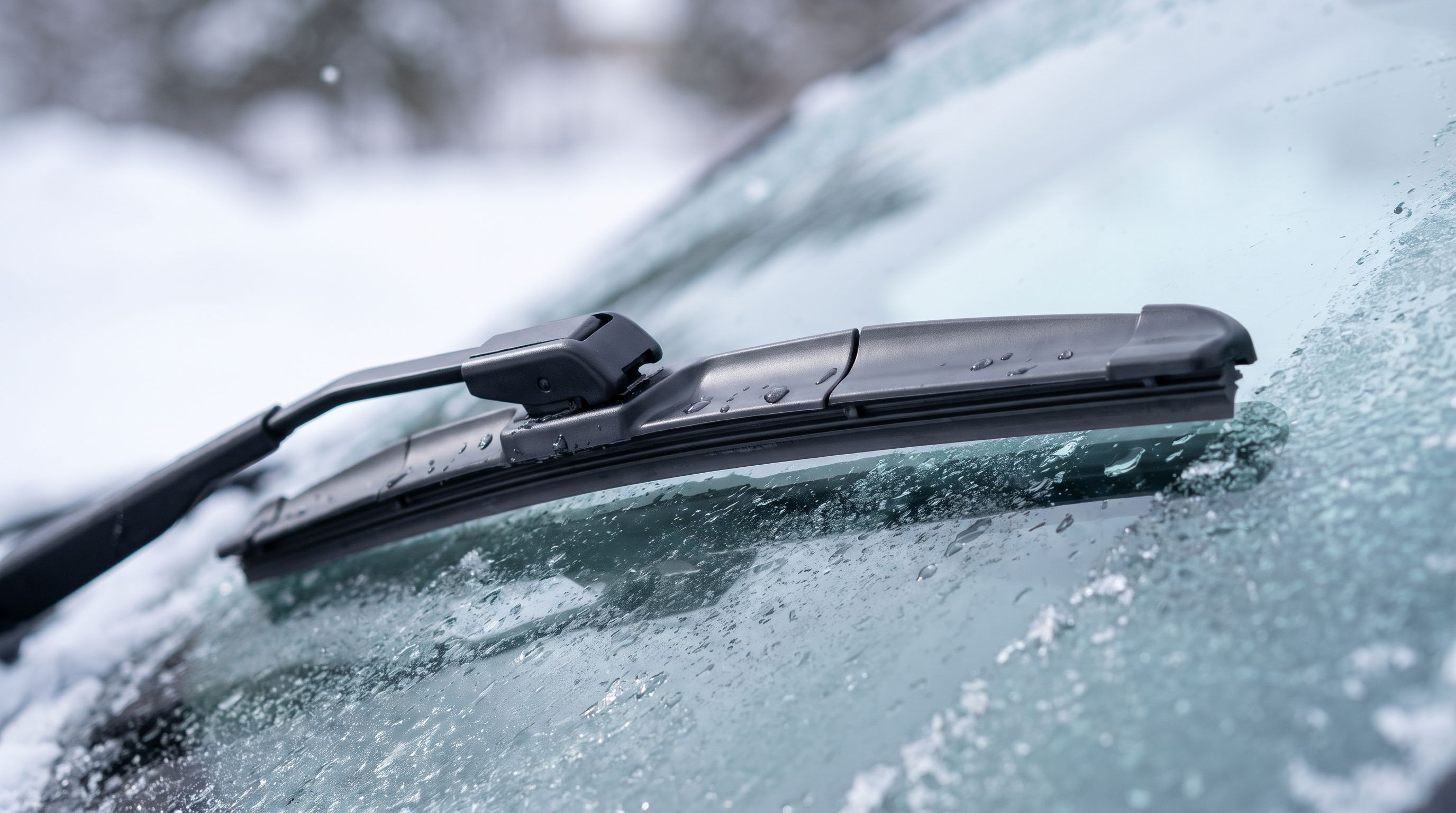
Reader-supported: we may earn a commission from links on this page, at no extra cost to you. It never affects our picks. Learn more.
The short version
- Best overall beam blade: Bosch ICON
- Best hybrid blade: Michelin Stealth Ultra
- Best for heavy snow and ice: Rain-X Latitude Water Repellency
- Best budget beam: Rain-X Silicone AdvantEdge
- Best conventional/winter bracket blade: ANCO 30-Series
 Best budget beam · Rain-X Silicone AdvantEdge Wiper Blade — Check price on Amazon →
 Best for snow and ice · Rain-X Latitude Water Repellency Wiper Blade — Check price on Amazon →
 Best hybrid blade · Michelin Stealth Ultra Wiper Blade — Check price on Amazon →
 Best overall beam blade · Bosch ICON Wiper Blade — Check price on Amazon →
Wiper blades are one of the few parts where the buying decision is 80% fitment and 20% product. The best blade in the world is useless if it's 2 inches too long and slaps the A-pillar, or if the connector on the box doesn't match the hook on your arm. So this guide front-loads the boring part — connector type and blade length — and then gets into where beam blades genuinely beat hybrids and conventional frames, and where they don't.
GarageProof researches and compares products using manufacturer specs, independent test results, and verified owner feedback. We don't physically test blades ourselves, and you should be skeptical of anyone claiming a 12-month durability verdict after a weekend.
Wiper blades size fitment: get this right first
Step 1 — Find your two lengths (they're usually different)
Driver and passenger blades are rarely the same size. A common pattern is something like 26 inches on the driver's side and 17 or 18 inches on the passenger side, but there is no universal rule — plenty of vehicles run near-equal lengths, and some run a longer passenger blade.
Three reliable ways to confirm:
- Owner's manual. The maintenance or specifications section lists both lengths, and it's the manufacturer's own number.
- Brand fitment tools. Rain-X's Blade Size Finder, Bosch's lookup, and the fitment tools at AutoZone, O'Reilly, and RockAuto all take year/make/model/trim and return both lengths plus the connector type. Cross-check two of them — they occasionally disagree on trim-specific arms.
- Measure the old blade. Pull the wiper arm off the glass, lay a tape measure along the blade from tip to tip (the rubber and frame, not the arm). Round to the nearest inch. This is the tiebreaker when the online tools conflict.
One caveat: if the previous owner installed the wrong size, measuring the old blade just reproduces their mistake. If a measured length doesn't match what the fitment tool says, trust the tool and the manual.
Step 2 — Identify your wiper arm connector
This is where most wrong-part returns come from. The common connector types:
- J-hook (hook arm): By far the most common on older and mainstream vehicles. The arm ends in a hook shaped like a "J" or "U." Sizes are usually listed as 9x3 or 9x4 mm. Nearly every aftermarket blade includes a J-hook adapter.
- Push button: A rectangular tang with a button you press to release. Common on many domestic and European vehicles from roughly the mid-2000s onward.
- Pinch tab / side pin: A flat arm with a squeeze tab on the side, or a pin that passes sideways through the blade. Widely used on European vehicles.
- Bayonet: A narrow flat arm that slides into a slot. Less common.
- Top lock / side lock: Various OEM-specific variants found on many newer vehicles, including a lot of recent Toyota, Honda, and Hyundai/Kia applications.
Most premium aftermarket blades ship with a multi-adapter kit covering J-hook plus two to four others. But not all of them cover everything, and some late-model connectors are only served by an application-specific blade. Read the connector list on the specific part number you're buying, not the brand's general marketing page.
Step 3 — Check for sweep and cowl clearance
Longer isn't better. If you upsize a blade beyond what the vehicle specifies, the tips can hit the A-pillar trim, overlap the other blade at the top of the sweep, or ride off the edge of the glass and chatter. Stick with the listed lengths.
Also check clearance under the cowl. Some vehicles park the wipers deep under the hood lip, and a tall beam blade with a chunky spoiler can bind at the park position. This is rare but real — if your current OEM blades are low-profile beam blades, staying with a beam blade is the safe call.
Step 4 — Don't forget the rear wiper
Rear blades on hatchbacks, wagons, and SUVs use their own dedicated sizes and often a proprietary connector. Do not assume a front blade adapter kit covers it. Look up the rear-specific part number.
Beam vs hybrid vs conventional: what actually differs
Conventional (bracket/frame) blades use a metal or plastic tension frame with multiple pressure points. They're cheap, widely available, and easy to find in obscure sizes. The downside: the exposed frame collects snow and ice, which freezes the joints solid and turns the blade into a rigid bar that skips across the glass. At highway speed, the open frame also catches air and can lift.
Beam blades are a single curved spring steel strip laminated into the rubber, with no external joints. Pressure is distributed continuously along the length, which is why they conform better to the curved windshields on modern vehicles. Nothing to pack with snow, nothing to freeze up. Most add an integrated spoiler so aero load pushes the blade down at speed instead of lifting it. This is the default choice for most drivers in 2026.
Hybrid blades are a beam-style pressure structure wrapped in an aerodynamic shell that looks like a conventional blade's cover. The idea is beam-like contact with a stiffer, more protected profile and often quieter operation. They tend to be a bit heavier and a bit pricier, and the shell can still collect slush in bad conditions — though far less than an open frame.
Winter/bracket blades are a separate category: a conventional frame fully encased in a rubber boot. They're excellent at refusing to ice up, but they're heavy, they're loud, and their aerodynamics are poor above about 50 mph. They're a seasonal tool, not a year-round blade.
Where beam blades win in snow and ice
- No exposed joints to freeze, so the blade keeps its curve after an overnight ice storm.
- Even pressure along the whole length means better contact on curved glass when the rubber is cold and stiff.
- Less surface area for snow to pack onto compared with an open frame.
Where beam blades lose
- If the rubber is a soft all-season compound, extended sub-zero exposure still stiffens it and you'll get chatter until the defroster warms the glass.
- Ice bonded to the windshield will still tear a beam blade's edge. Scrape first; never use wipers to clear ice.
- In very heavy wet snow, a fully booted winter blade still sheds better than anything else — but you give up highway aero performance.
Comparison table
| Design | Best for | Snow/ice behavior | Highway aero | Typical tradeoff |
|---|---|---|---|---|
| Beam (Bosch ICON, Rain-X Silicone AdvantEdge) | Most modern vehicles, curved glass, mixed climates | Very good — no joints to freeze | Excellent with integrated spoiler | Costs more than conventional; some cowl-clearance edge cases |
| Hybrid (Michelin Stealth Ultra) | Drivers who want quiet operation plus beam-style contact | Good — shell resists packing better than open frames | Very good | Heavier; shell can hold slush in extreme conditions |
| Water-repellent beam (Rain-X Latitude Water Repellency) | Heavy rain and slush, drivers who hate reapplying coatings | Very good | Excellent | Repellent coating depletes over time |
| Conventional frame (ANCO 30-Series) | Older vehicles, odd sizes, budget replacement, rear wipers | Poor in freezing conditions — joints ice up | Fair; can lift at speed | Cheapest and most widely stocked |
| Winter/booted bracket | Sustained deep-winter driving | Excellent | Poor above ~50 mph | Heavy, noisy, seasonal only |
How to choose
Match the connector before the brand
Decide on connector compatibility first, brand second. If your vehicle uses a common J-hook, almost everything fits and you can shop on performance. If you have a newer top-lock or a European pinch tab, narrow the list to blades whose adapter kit explicitly names your connector, then pick the best of what's left.
Pick a rubber compound for your climate
Natural rubber gives excellent initial wipe quality but degrades faster under UV and ozone. Halogen-hardened or graphite-coated rubber lasts longer and runs quieter. Silicone compounds resist temperature extremes best and tend to hold up longer in hot, sunny climates — and silicone also transfers a water-repellent film to the glass over time.
Decide how much you care about noise
Hybrids are generally the quietest of the three designs because the shell damps vibration and the profile is stiffer. If wiper noise bothers you — common on vehicles with large, steeply raked windshields — a hybrid like the Michelin Stealth Ultra is worth the premium over a basic beam.
Buy in pairs, and replace on a schedule
Both front blades wear at similar rates. Replacing one and leaving the other means you'll be back in three months. Plan on roughly every 6 to 12 months depending on climate and parking (garaged cars go longer). Streaking, chattering, and a hazy smear in the sweep path are the signals.
Bosch ICON — best overall beam blade
Prices last checked September 26, 2026. Amazon prices change frequently, so treat these as a guide and check the live price before you buy.
Bosch ICON Wiper Blade
Benchmark beam design with dual-rubber edge and multi-adapter fit; top of most independent comparisons.
The ICON is the benchmark most comparison tests default to, and it consistently ranks at or near the top for wipe quality and longevity in independent roundups. It's a true beam design with a tensioned steel spine, an asymmetric spoiler, and a dual-rubber compound that holds its edge well. The multi-adapter approach covers most common connectors, including J-hook, and installation is straightforward. What you give up: it's among the pricier mainstream options, the spoiler profile isn't for everyone aesthetically, and like any beam blade, it can't fix a bent or weak wiper arm that isn't applying enough down-force.
Michelin Stealth Ultra — best hybrid blade
Michelin Stealth Ultra Wiper Blade
Hybrid shell plus Smart-Flex articulation for quiet, stable wiping on large raked windshields.
The Stealth Ultra pairs a hybrid shell with Michelin's Smart-Flex articulation and an included adapter set covering several common connectors. It's the pick if you want the quiet, stable feel of a hybrid without dropping to conventional-frame performance in bad weather. The shell also protects the spine from road debris. Tradeoffs: it's heavier than a pure beam, which on a marginal wiper motor can very slightly slow the sweep, and in wet-snow conditions the shell will still collect some slush. Confirm the connector list for your specific application before ordering.
Rain-X Latitude Water Repellency — best for heavy snow and ice
Rain-X Latitude Water Repellency Wiper Blade
Jointless beam that won't ice up, with water-repellent coating built into the blade for sleet and slush.
This is a beam blade with Rain-X's water-repellent coating built into the blade, so it transfers repellent onto the glass every sweep. In sleet, slush, and freezing rain that matters: water beads and sheds instead of sheeting, and the jointless beam structure won't ice up the way a bracket frame does. Rain-X's Blade Size Finder makes fitment lookup easy, which is a genuine convenience. The catch is that the repellent effect fades as the coating depletes, so the "extra" benefit is strongest in the first months. Treat it as a bonus, not a permanent glass coating.
Rain-X Silicone AdvantEdge — best budget beam
Rain-X Silicone AdvantEdge Wiper Blade
Silicone edge handles heat and cold well and leaves a light repellent film, at a lower price than premium beams.
If you want beam-blade behavior without premium pricing, the Silicone AdvantEdge is the value play. The silicone edge handles heat and cold better than standard rubber and lays down a light repellent film over time. It's a straightforward beam profile with a universal-style adapter setup that covers the most common arm types. What you give up versus the ICON: slightly less refined wipe on heavily curved glass and less consistent top-tier ranking in independent comparisons. For a second vehicle, a commuter, or anything parked outside in a hot climate, it's a sensible choice.
ANCO 30-Series — best conventional blade
ANCO 30-Series Wiper Blade
Cheap, widely stocked J-hook frame blade for flat older glass, odd sizes, and rear wipers.
Sometimes the right answer is a cheap conventional blade: older vehicles with flat glass, oddball sizes no beam blade covers, rear wipers, or a car you're about to sell. The ANCO 30-Series is the long-running, widely stocked example — simple frame, easy J-hook install, available in a wide range of lengths. It gives up a lot in freezing weather, since the exposed joints will pack with ice, and it doesn't have the aero stability of a spoilered beam at highway speed. But for flat windshields and mild climates, it wipes fine and costs a fraction of the alternatives.
FAQ
How do I know if my wiper arm is J-hook or push button? Lift the arm off the glass and look at the end. A J-hook curls back on itself like a candy cane and the blade slides into the curve. A push button is a flat tang that inserts into the blade, with a visible button you press to release. If you're unsure, take a photo and compare against the connector diagrams on the blade packaging or the brand's fitment tool.
Can I put a longer wiper blade on than the factory size? Don't. Upsizing risks the blades overlapping at the top of the sweep, the tip contacting the A-pillar, or the blade running off the edge of the glass. Stick to the lengths in the owner's manual or a reputable fitment tool.
Are beam blades always better than conventional ones? For most vehicles built in the last 15 years, yes — curved windshields and freezing weather both favor beam designs. The exceptions are flat older glass, unusual sizes only available in conventional frames, and rear wipers.
Do hybrid blades work better than beam blades in snow? Not usually. The hybrid shell resists packing better than an open conventional frame, but a pure beam blade has the least to freeze. Hybrids win on noise and stiffness, not on ice performance.
How often should I replace wiper blades? Roughly every 6 to 12 months, sooner in intense sun or heavy winter use. Replace when you see streaking, hear chattering, or notice a hazy film left behind in the sweep path. Always do both fronts together.
Will a "universal" blade fit my car? Usually, but verify. Multi-adapter blades typically cover J-hook plus two to four other connectors. Some newer OEM top-lock and side-lock arms require an application-specific blade. Check the connector list on the exact part number and confirm with your year, make, model, and trim.
Get the best car care deals in your inbox
Join the GarageProof newsletter for hand-picked car care deals and new buying guides. No spam, unsubscribe anytime.
Related reads
Wiper Blade Lifespan, Explained: Why Yours Fail Fast
Wiper blades rarely wear out — they degrade. Here's how rubber compounds, UV, and winter blade design decide whether yours last six months or three years.
Mud Flaps for Trucks 2026: Fit the Wheel Well, Not the Badge
Heavy-duty mud flaps for trucks in 2026: how wheel-well lip, lift height and flare type decide whether drill-in or no-drill kits actually fit.
Hub Centric Wheel Spacers 2026: Get the Bore Right First
Hub centric wheel spacers in 2026: how to match hub bore, bolt pattern and stud engagement to your vehicle — plus four spacer brands worth considering.