Winter Tires for EVs in 2026: Load Index Before Tread
Why EV weight and torque demand XL or HL winter tires in 2026, how to read sidewall load codes against your door placard, and four winter tires worth buying.
Reader-supported: we may earn a commission from links on this page, at no extra cost to you. It never affects our picks. Learn more.
Electric vehicles break a habit most of us picked up from gas cars: grabbing whatever winter tire the shop has in your size and calling it done. An EV in the same nominal size as a comparable combustion car can weigh 400 to 1,000 lb more, delivers peak torque from a standstill, and often rides on tires chosen originally for rolling resistance rather than grip. Get the load rating wrong and you don't just wear tires faster — you can exceed the tire's rated capacity at your vehicle's own placard pressures.
This guide covers the part most winter tire articles skip: how to read the load index, XL and HL markings on a sidewall, check them against your door placard, and understand what a winter set will realistically do to your range in 2026.
The short version
- Best overall: Michelin X-Ice Snow
- Best on ice and slush: Bridgestone Blizzak 6
- Quietest ride: Continental VikingContact 8
- Best for severe winters: Nokian Hakkapeliitta R5 EV
- Best performance winter tire: Goodyear UltraGrip Performance +
 Best performance winter tire · Goodyear UltraGrip Performance + — Check price on Amazon →
 Best for severe winters · Nokian Hakkapeliitta R5 EV — Check price on Amazon →
 Quietest ride · Continental VikingContact 8 — Check price on Amazon →
 Best on ice and slush · Bridgestone Blizzak 6 — Check price on Amazon →
 Best overall · Michelin X-Ice Snow — Check price on Amazon →
Why EVs change the winter tire math
Three things make EVs different, and all three point the same direction.
Curb weight. Battery packs add mass low in the chassis. A mid-size electric crossover frequently lands in the 4,700–5,500 lb range, and full-size electric trucks go well past that. Load capacity per tire is not a suggestion — it's the number the vehicle manufacturer used to calculate your placard pressures. Fitting a standard-load (SL) tire where the original was extra-load (XL) means the tire reaches its rated capacity at a lower inflation pressure than your placard assumes.
Instant torque. EVs put maximum twist at zero RPM. On a winter compound — which is deliberately soft and heavily siped — that accelerates wear at the tread block edges. It also means traction control gets a workout, and a tire with weak block stability will squirm and chunk under repeated launches.
Regenerative braking. One-pedal driving loads the drive axle constantly rather than in short braking events. Combined with weight, that's why EV owners routinely report winter sets wearing faster than the same tire on a combustion car.
The practical result: on an EV you should treat the load index as a hard minimum, not a rounding target, and you should expect to pay a modest efficiency penalty for real winter grip.
How to read your sidewall and door placard
Step 1: Find the placard, not the current tire
Open the driver's door and look at the jamb. The placard lists the original tire size, the front and rear cold inflation pressures, and often the load rating. If a previous owner or shop changed sizes, the tires on the car right now may not match the placard. The placard wins.
Step 2: Decode the service description
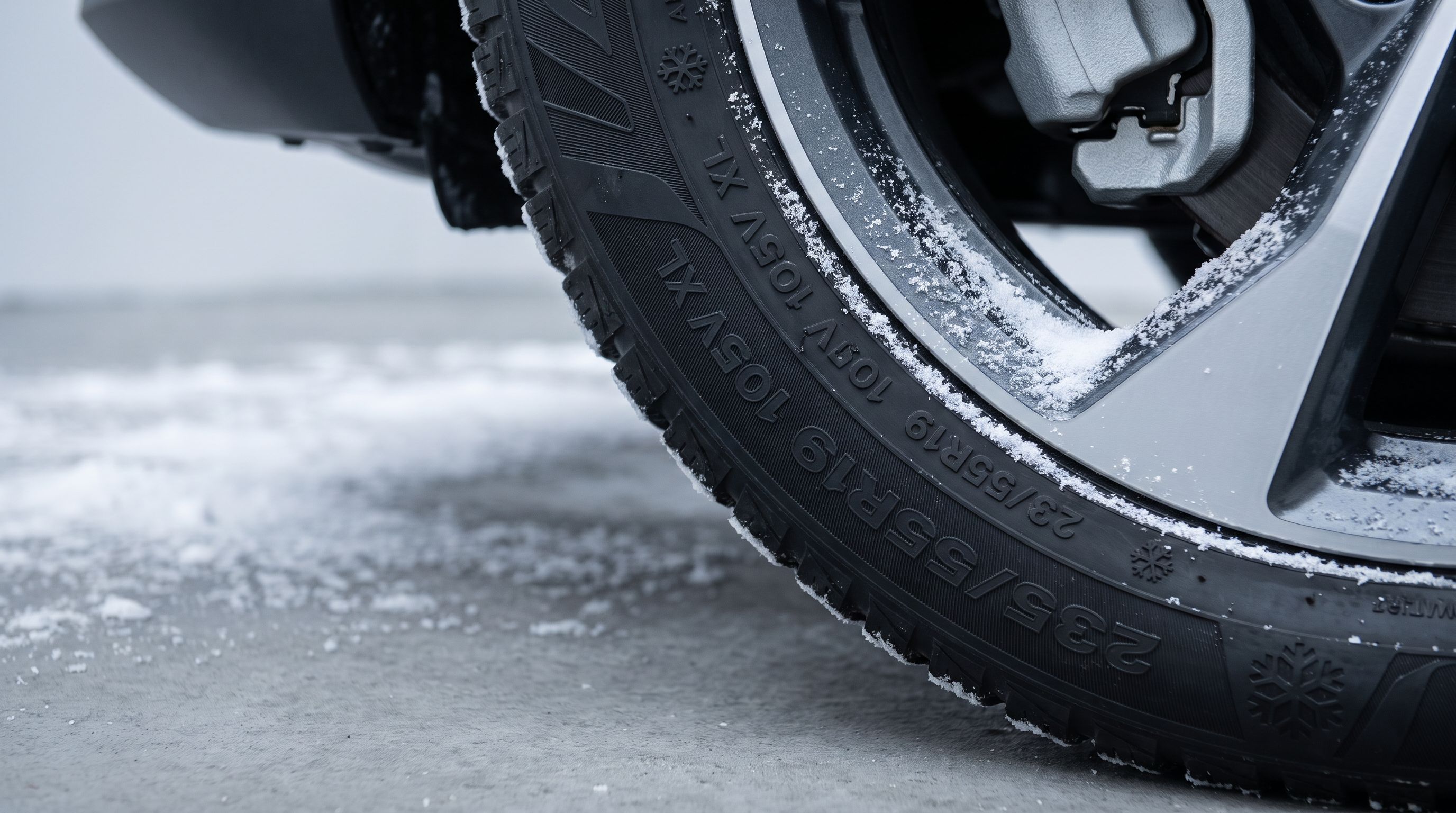
A sidewall code like 255/45R19 104V XL breaks down as:
255— section width in millimetres45— aspect ratio (sidewall height as a percentage of width)R19— radial construction, 19-inch wheel104— load index, the per-tire capacityV— speed ratingXL— extra load
Load index is a lookup table, not a linear scale. A few reference points: 95 ≈ 1,521 lb, 100 ≈ 1,764 lb, 104 ≈ 1,984 lb, 108 ≈ 2,205 lb, 112 ≈ 2,469 lb. One index point is worth roughly 25–60 lb depending on where you are in the table, so dropping even two points matters on a heavy EV.
Step 3: Understand SL, XL and the newer HL
- SL (Standard Load) — rated at a maximum of 35 psi (some markets note 36).
- XL / Reinforced (RF) — rated at up to 41–42 psi, giving more capacity at the same size.
- HL (High Load) — a newer designation that appears before the size, as in
HL255/45R20. It carries more load than XL at the same size and was introduced largely because of heavy EVs. HL and XL are not interchangeable: an HL tire can usually replace an XL in the same size and index, but an XL cannot replace HL.
Step 4: Match or exceed — never go down
Rule of thumb: the replacement tire's load index must equal or exceed the original, and the construction class must be equal or higher (SL → XL → HL). Going up a couple of load index points is generally harmless; going up a lot can stiffen the ride noticeably, since higher-capacity casings are stiffer.
Speed rating is the one place you may legitimately step down for winter. Many winter tires top out at H (130 mph) or V (149 mph) where the summer original was W or Y. That's accepted practice in most markets, but check your owner's manual — some manufacturers and some jurisdictions require you to note the lower rating, and your handling character will soften slightly.
Step 5: Check TPMS and wheel fitment
If you're buying a dedicated winter wheel-and-tire package, you need sensors that your car will learn. Most 2026 EVs use direct TPMS and many require a scan tool or a drive cycle to relearn. Confirm bolt pattern, centre bore, offset and — critically on EVs with big brake packages — brake caliper clearance before ordering aftermarket wheels.
Fitment caveat: every size and load index below varies by year, trim and wheel diameter. Verify against your own door placard and a retailer's fitment tool for your exact year, make, model and trim before ordering. Dual-motor and performance trims frequently use different sizes front and rear.
What winter tires actually do to EV range
Expect a range reduction, and expect most of it to come from physics rather than the tire itself.
Three effects stack in winter:
- Battery chemistry. Lithium-ion cells deliver less usable energy when cold, and the pack heater draws power.
- Cabin heating. Heat pumps help enormously; resistive heaters hurt a lot.
- Tire rolling resistance. A winter compound and aggressive siping genuinely cost efficiency compared with a low-rolling-resistance OE all-season.
Published third-party testing and large-scale owner data consistently put total winter range loss in the 20–40% band in cold climates, with the tire portion of that typically a single-digit to low-double-digit percentage. In other words: your winter tires are a real but minority contributor. Choosing a low-rolling-resistance winter tire (the Continental VikingContact 8 and Michelin X-Ice Snow are both strong here) claws back some of it.
Two things you control:
- Don't downsize to a narrower wheel and then over-inflate to compensate. A narrower winter tire is often a good idea for snow traction and can reduce rolling resistance, but only if the load index still clears the placard requirement.
- Check pressures monthly. Cold air drops roughly 1 psi per 10°F. An under-inflated heavy EV is the worst case for both range and tire wear.
Comparison table
| Tire | Best for | Type | Typical EV availability | Trade-off |
|---|---|---|---|---|
| Michelin X-Ice Snow | All-round winter use | Studless winter | Broad, incl. XL in common EV sizes | Not the absolute ice-grip leader |
| Bridgestone Blizzak 6 | Ice and slush braking | Studless winter | Good, expanding XL coverage | Softer steering feel at speed |
| Continental VikingContact 8 | Quiet, efficient commuting | Studless winter | Good in European-sized fitments | Less outright deep-snow bite |
| Nokian Hakkapeliitta R5 EV | Severe winter climates | Studless winter, EV-specific | Narrower size range | Limited sizes; premium positioning |
| Goodyear UltraGrip Performance + | Fast, heavy performance EVs | Performance winter | Good in larger diameters | Less snow traction than studless |
The picks
Michelin X-Ice Snow — best overall
Prices last checked October 24, 2026. Amazon prices change frequently, so treat these as a guide and check the live price before you buy.
Michelin X-Ice Snow
Long-wearing studless winter tire with XL sizes in most EV fitments and low rolling resistance for its class.
The X-Ice Snow is the default recommendation for most EV owners because it does the two things heavy electric cars punish hardest: it wears well and it holds its shape under torque. Michelin's full-depth siping keeps grip as the tire ages, which matters when an EV chews through tread faster than a comparable gas car. Rolling resistance is competitive for a studless winter tire, so the range penalty is on the lower end. Availability in XL load indexes across common EV sizes is excellent. What it gives up: on sheer glare ice, a few Nordic-focused rivals edge it, and it isn't the quietest option here.
Bridgestone Blizzak 6 — best on ice and slush
Bridgestone Blizzak 6
Bridgestone's newest studless compound, strong wet/ice braking, widely available in XL EV sizes.
Blizzak 6 is Bridgestone's current studless flagship and the pick if your winter is defined by freeze-thaw cycles, wet ice and slush rather than deep snow. Independent European testing has rated it strongly for wet and ice braking, which is the scenario where an extra 800 lb of battery mass is least forgiving. Sizes in XL ratings suit most electric crossovers and sedans. The compromise is steering feel: it trades a little high-speed precision for compliance, and on a stiff performance EV some drivers find it vague compared with a performance winter tire. Confirm the exact load index for your trim before ordering.
Continental VikingContact 8 — quietest ride
Continental VikingContact 8
Low noise and good rolling resistance make it a sensible match for quiet EV cabins.
EV cabins have no engine noise to mask tire roar, so winter tread patterns can sound coarse in a way they never did in a gas car. The VikingContact 8 is among the quieter studless winter tires and pairs that with respectable rolling resistance, making it a sensible commuter choice for anyone who logs highway miles in a quiet EV. Snow and ice performance is solidly mid-to-upper pack rather than class-leading. The main catch is size coverage: Continental's strength is European fitments, so some North American EV sizes and larger diameters may not be offered. Check availability in your specific size and load rating.
Nokian Hakkapeliitta R5 EV — best for severe winters
Nokian Hakkapeliitta R5 EV
Purpose-built for EV loads and torque, with Nokian's deep-winter grip in heavy-duty load ratings.
Nokian built this variant specifically around EV requirements — higher load capacity, a compound and block structure intended to survive instant torque, and lower rolling resistance than the standard R5. If you live somewhere with months of packed snow and sub-zero temperatures, this is the specialist choice. It's also an honest answer to the "do I need an EV-specific tire?" question: not always, but when the engineering target is explicitly EV load and torque, you get a tire sized and rated for it. The trade-offs are size availability, which is narrower than Michelin or Bridgestone, and a premium position in the market.
Goodyear UltraGrip Performance + — best performance winter tire
Goodyear UltraGrip Performance +
Keeps steering response for heavy, fast EVs while adding real snow traction in XL sizes.
Some EVs — performance sedans and larger electric crossovers on 20-inch-plus wheels — feel genuinely sloppy on a soft studless winter tire. The UltraGrip Performance + is a performance winter tire: stiffer casing, more steering response, higher speed ratings, and good availability in XL sizes and large diameters. For milder winters with cold wet roads and occasional snow, it's the better-driving choice. What you give up is real: compared with a studless tire like X-Ice Snow or Blizzak 6, it's weaker on packed snow and ice. Pick it only if your winter is cold and wet rather than consistently white.
Buying and fitting notes
- Buy a full set of four. Mixing winter and all-season tires on an AWD EV is a stability risk and can confuse torque-vectoring systems.
- Dedicated winter wheels usually pay for themselves. Two mount-and-balance jobs per year add up, and smaller winter wheels with taller sidewalls are kinder to potholes.
- Reset TPMS correctly. Many EVs will throw a persistent warning until sensors are relearned.
- Record the swap date and odometer. Winter sets typically last three to five seasons on an EV; tracking mileage makes the replacement decision obvious.
- Check the DOT date code on anything bought at a discount. Winter compounds harden with age, and a tire more than a few years old from new has lost some of its edge.
FAQ
Do I actually need an EV-specific winter tire? No. You need a winter tire with the correct load index and construction class for your vehicle. EV-specific lines such as the Nokian Hakkapeliitta R5 EV are engineered around EV loads and torque, which is a genuine advantage, but a conventional winter tire in the right XL or HL rating is perfectly valid.
Can I fit a standard-load tire if the index number matches? Match the number and the class. An SL tire reaching the same index does so at a different maximum pressure, and your placard pressures were calculated for the original construction. If the original is XL or HL, stay XL or HL.
How much range will I lose? Total winter range loss is commonly 20–40% in cold climates, but most of that is battery temperature and cabin heating. The tire contribution is usually the smaller share. A low-rolling-resistance winter tire reduces, but does not eliminate, that portion.
Is it safe to drop from a W speed rating to an H or V winter tire? Generally yes, and it's standard practice, but confirm in your owner's manual and check local regulations. Your car's maximum safe speed becomes the tire's rating, not the car's.
Should I go narrower for winter? Often a good idea for snow traction and efficiency — but only if a narrower size exists with a load index that meets or exceeds the placard. On heavy EVs that constraint rules out a lot of downsizing options.
When should I swap them on? Use 7°C / 45°F as the trigger, not the first snowfall. Winter compounds work better below that temperature; all-seasons start hardening.
Get the best car care deals in your inbox
Join the GarageProof newsletter for hand-picked car care deals and new buying guides. No spam, unsubscribe anytime.
Related reads
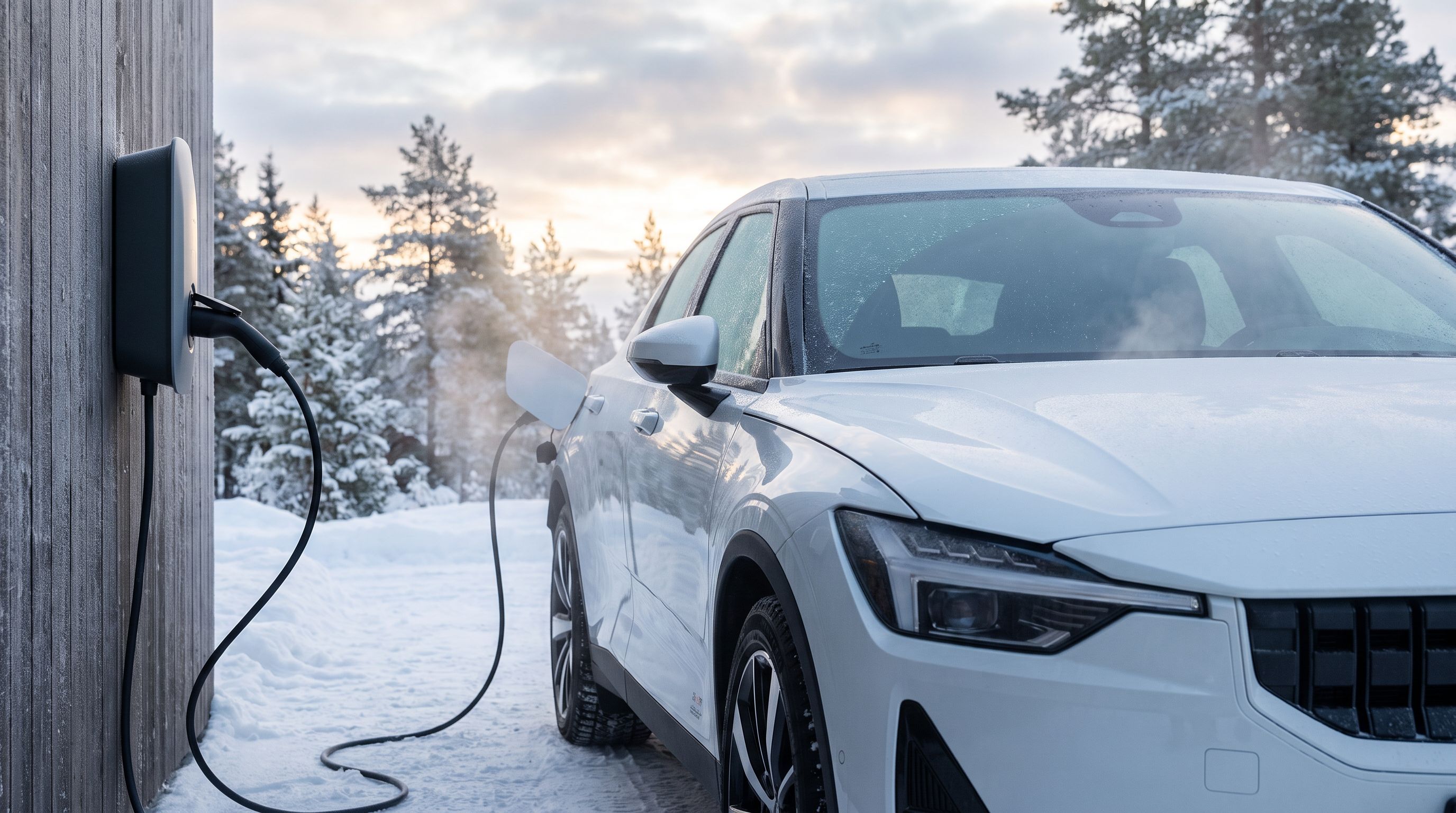
Cold Weather and EV Range in 2026, Explained
Why EVs lose range in the cold, what preconditioning and heat pumps actually change, and which tires and accessories measurably help winter driving in 2026.
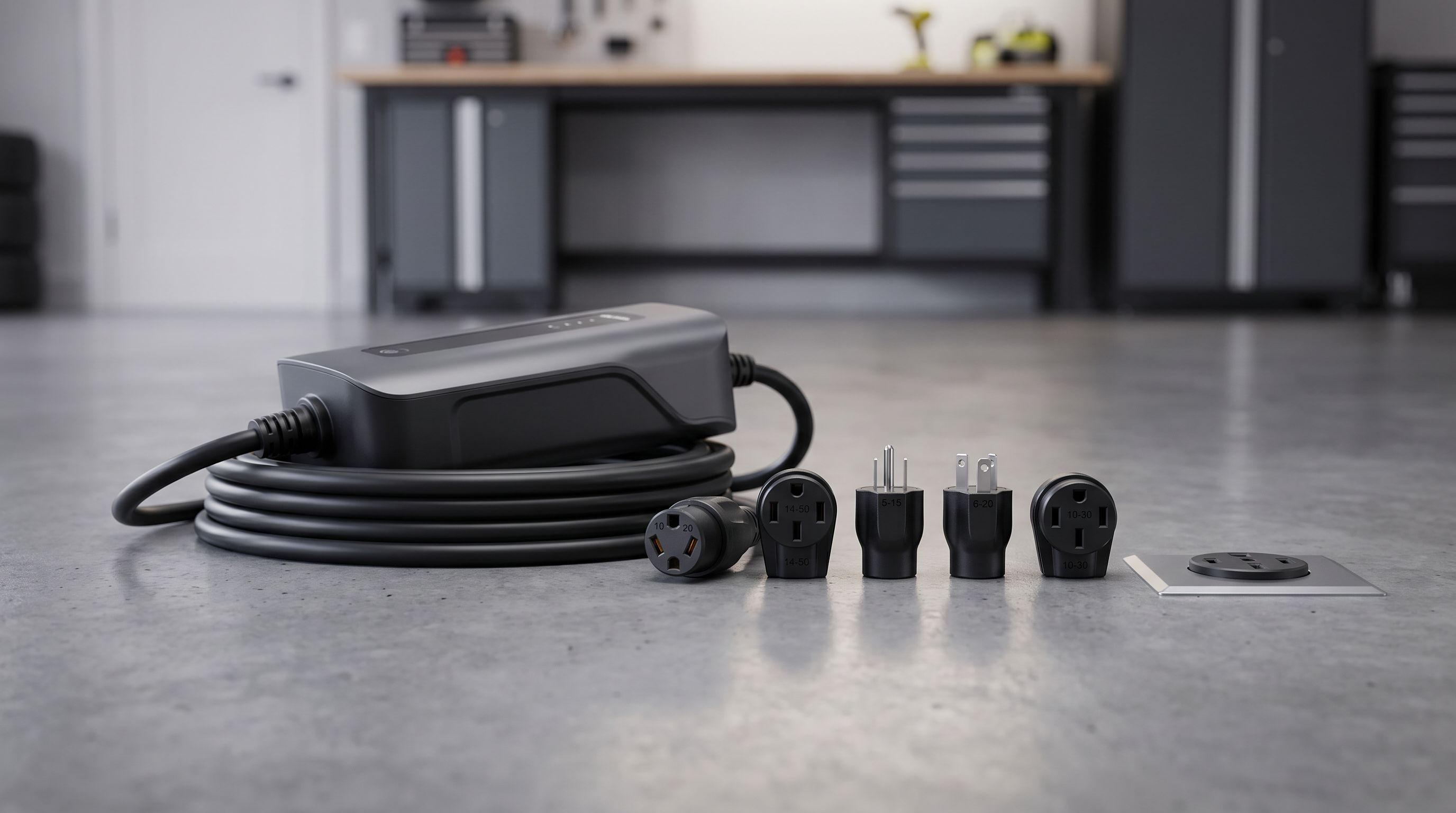
Portable EV Charger Adapter Guide 2026: Match Your Outlet
Portable EV charger adapter guide for 2026: which NEMA plugs travel chargers ship with, how to identify your outlet, and the amperage limits that actually matter.
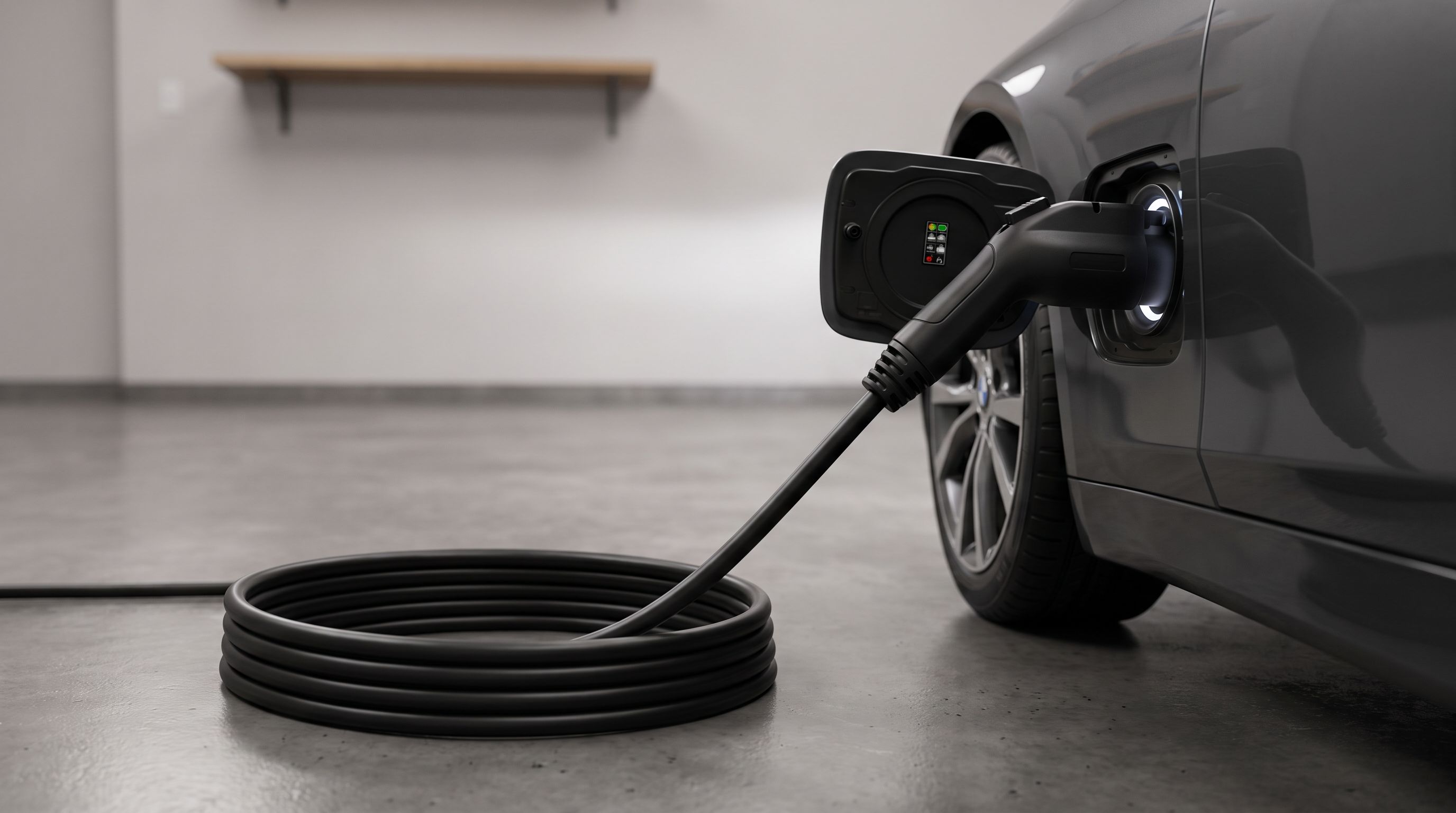
EV Charging Cable Extension 2026: What's Actually Safe
Most EV charging cable extensions aren't code-compliant. Here's what NEC and automakers actually say, plus safer ways to add reach in 2026.