Winter Car Emergency Kit 2026: Build It or Buy It?
Prebuilt winter car emergency kit vs. a component build in 2026: what boxed kits leave out, what a jump starter, inflator and traction boards really cover.
Reader-supported: we may earn a commission from links on this page, at no extra cost to you. It never affects our picks. Learn more.
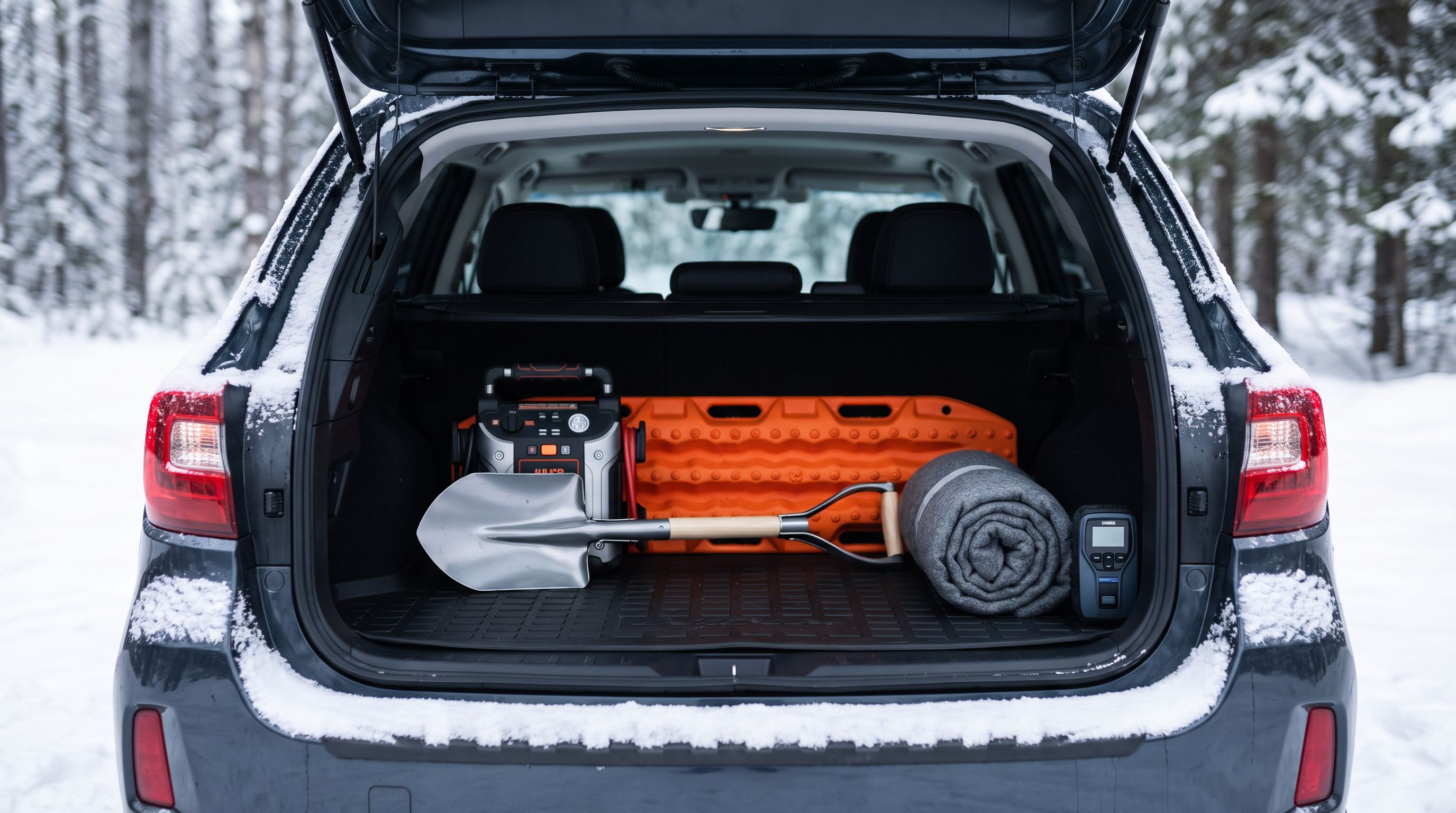
Every November, the same question lands in our inbox: is a boxed winter car emergency kit good enough, or should you assemble your own? The honest answer is that most prebuilt kits are excellent at the cheap stuff — gloves, a scraper, a reflective vest, a basic first aid pouch — and almost universally weak at the three things that actually get a stranded driver moving again in winter: starting power, air, and traction.
We compared the contents of widely sold prebuilt kits against a component-by-component build, using manufacturer specs, third-party testing and verified owner feedback. Below is what each approach costs you in weight, trunk space and capability, and where the gaps are.
The short version
- Best overall: NOCO Boost X GBX55 1750A — the jump starter that covers the most common winter failure.
- Best prebuilt kit: AAA Winter Roadside Emergency Kit — the fastest, cheapest way to cover the basics.
- Best tire inflator: VIAIR 88P Portable Air Compressor — direct-to-battery air that works in real cold.
- Best traction aid: Maxsa Escaper Buddy Traction Mats — gets a stuck two-wheel-drive car out of a snowbank.
- Best warmth layer: Arcturus Military Wool Blanket — insulation that still works when it's damp.
 Best warmth layer · Arcturus Military Wool Blanket — Check price on Amazon →
 Best traction aid · Maxsa Escaper Buddy Traction Mats — Check price on Amazon →
 Best tire inflator · VIAIR 88P Portable Air Compressor — Check price on Amazon →
 Best prebuilt kit · AAA Winter Roadside Emergency Kit — Check price on Amazon →
Build vs. buy: the real math
A prebuilt kit's value is in curation and packaging. You get a zippered bag, a sensible inventory list and jumper cables, for roughly the price of two or three individual items bought separately. For someone who currently has nothing in the trunk, that is a genuinely good trade.
But look at what's actually inside. Across the kits we reviewed, the common pattern is:
- Jumper cables, not a jump starter. Cables require a second vehicle and a willing stranger. At 10°F on a rural road at 11 p.m., neither is guaranteed. Kit cables also tend to be thin-gauge (8 or 10 AWG) and short, which struggles with a cold-soaked battery in a larger engine.
- A mylar "emergency blanket." It reflects radiant heat and weighs nothing. It also tears, doesn't insulate from the seat beneath you, and does little once it's damp from melted snow.
- No air source. Cold air contracts; tire pressure drops roughly 1 PSI per 10°F. A slow leak that was a nuisance in October becomes a flat in January. Very few boxed kits include any way to add air.
- No traction aid. Sand, cat litter, chains, or boards — pick one. Most kits include none.
- A tow strap you probably shouldn't use. Several kits include a strap but no rated shackles, and many modern unibody cars have no safe recovery point without screwing in the threaded eyelet from the factory tool kit.
So the practical answer for most drivers is a hybrid: buy a prebuilt kit for the low-cost consumables and visibility gear, then add the three high-value components it skips.
What each approach actually covers
| Capability | Typical prebuilt kit | Component build | Why it matters in winter |
|---|---|---|---|
| Dead battery | Jumper cables only | Lithium jump starter | Cold cuts available cranking amps sharply; a second car may not be available |
| Low/flat tire | Rarely included | 12V compressor + plug kit | Pressure drops with temperature; sidewall damage from potholes and curbs spikes |
| Stuck in snow | Rarely included | Traction boards or chains | Two-wheel-drive cars get stuck on inches, not feet, of snow |
| Visibility | Vest, triangles, flares | Same (buy the kit) | Being seen on a snowy shoulder is a survival issue |
| Warmth | Mylar sheet | Wool blanket, hat, gloves, hand warmers | You may wait hours; mylar alone is marginal overnight |
| First aid | Basic pouch | Upgraded kit + meds | Kit pouches are thin on trauma supplies |
| Snow removal | Scraper | Scraper + folding shovel | Clearing the exhaust pipe prevents CO buildup |
| Phone power | Rarely included | Jump starter with USB-C PD | A dead phone makes every other problem worse |
| Cost to assemble | One purchase | Several purchases | Build costs more up front, covers far more |
| Trunk space | One bag | One bag + 2–3 items | Boards are the bulkiest addition |
The picks
NOCO Boost X GBX55 1750A — best overall
Prices last checked October 4, 2026. Amazon prices change frequently, so treat these as a guide and check the live price before you buy.
NOCO Boost X GBX55 1750A
Cold-rated 12V jump starter with USB-C PD in and out — the single biggest gap in boxed winter kits.
If you buy one thing this winter, buy a lithium jump starter. The Boost X GBX55 is rated at 1750 amps and is specified for use down to -4°F, with NOCO's spark-proof reverse-polarity protection on the clamps — important when you're working with cold hands by flashlight. It also charges over USB-C Power Delivery, both in and out, so it doubles as a sizable phone and laptop bank while you wait for a tow.
What it gives up: it's a lithium pack, so it self-discharges and loses capacity in deep cold. You must top it up every few months and ideally store it in the cabin rather than an unheated trunk. It also won't help a battery with a dead cell or a failed alternator — it buys you one start, not a repair.
AAA Winter Roadside Emergency Kit — best prebuilt kit
AAA Winter Roadside Emergency Kit
The cheapest honest starting point: scraper, blanket, cables, first aid and visibility gear in one bag.
This is the kit we'd point a new driver, a college student, or a second household car toward. It bundles the winter-specific basics — ice scraper, blanket, gloves, jumper cables, first aid supplies, flashlight and reflective warning gear — in one zippered bag at a price well below buying the pieces individually. AAA also sells a larger Excursion kit for year-round coverage if you want more first aid and tool content.
What it gives up: everything in the "gaps" list above. No compressor, no jump starter, no traction aid, and the included blanket and cables are economy-grade. Treat it as a foundation layer, not a finished kit — and check the contents list before ordering, since AAA ships several similar kits at different piece counts.
VIAIR 88P Portable Air Compressor — best tire inflator
VIAIR 88P Portable Air Compressor
Direct-to-battery compressor that keeps working in deep cold where cheap 12V plug units stall.
Winter is when slow leaks become flats. The 88P is a direct-to-battery compressor with alligator clamps rather than a cigarette-lighter plug, which matters because a 12V accessory socket is usually fused around 10–15A and many cheap inflators overheat or trip it before they finish a tire. VIAIR rates the 88P for passenger car and light truck tires up to 33 inches, with a duty cycle that lets you actually top up all four corners.
What it gives up: it's bulkier than a palm-sized inflator, and you need to open the hood and clip to the battery, which is less convenient in a blizzard. It also won't seal a puncture — pair it with a tire plug kit and learn how to use it before you need it.
Maxsa Escaper Buddy Traction Mats — best traction aid
Maxsa Escaper Buddy Traction Mats
Compact recovery boards that get a stuck front-driver out of a snowbank without a tow.
Most drivers who get "stuck" in winter aren't buried — they're a front-wheel-drive sedan with one wheel spinning on packed ice at the end of a driveway. A pair of traction mats wedged under the drive wheels solves that in about two minutes. The Escaper Buddy mats are molded plastic with aggressive studs, they stack flat, and they don't require you to rely on a stranger with a tow strap or a recovery point your car may not have.
What they give up: bulk. They take real trunk space, which is a tough sell in a small hatchback. They also only work when the tires can reach them — if the car is high-centered on a snowbank, you need a shovel first, and if you're on a long icy grade, you need winter tires, not boards.
Arcturus Military Wool Blanket — best warmth layer
Arcturus Military Wool Blanket
Heavy 80% wool blanket that still insulates when damp — unlike the mylar sheet in most kits.
The mylar sheet in a boxed kit is a last resort, not a plan. A heavy wool blanket is the single biggest comfort-and-safety upgrade in a winter kit because wool retains a large share of its insulating value when damp, doesn't melt near a heat source, and is big enough to cover two people. The Arcturus blanket is an 80% wool blend sized generously enough to wrap up in rather than drape over.
What it gives up: weight and volume. It's several pounds and takes up a milk crate's worth of space compressed. It's also not a sleeping bag — if you regularly drive remote highways in sub-zero conditions, add a rated sleeping bag, a warm hat and real boots on top.
How to choose
Match the kit to your actual winter risk
A commuter doing 12 miles of plowed suburban road has a different risk profile than someone crossing a mountain pass or driving 40 miles between towns. Short urban commutes justify the prebuilt kit plus a jump starter. Rural, remote or mountain driving justifies the full build, plus food, water, extra fuel planning and a shovel. Be honest about which one you are.
Prioritize by failure frequency, not drama
Rank your spending by what's most likely to happen: dead battery, then flat or low tire, then stuck in snow, then everything else. That ordering is why a jump starter beats a tow strap, and why a compressor beats a hatchet. Buy in that order and stop when the trunk is full.
Check cold-weather ratings, not just peak numbers
Jump starter marketing leads with peak amps, which is a nearly meaningless number across brands. Look instead for a stated operating temperature range, a protected clamp design, and USB-C PD input so you can actually recharge it from the same brick as your phone. For compressors, look at duty cycle and how it connects to power.
Verify vehicle-specific items fit
A few pieces of a winter kit are genuinely vehicle-specific: tire chains (sized to your exact tire size, and prohibited or restricted on some vehicles — check the owner's manual for clearance), the threaded tow eyelet that lives with the spare tire tools, and the spare itself. Before buying chains, confirm your tire size from the sidewall and cross-reference the manufacturer's fitment chart for your year, make and model. Also confirm your car even has a spare — many 2026 models ship with a sealant kit instead.
Store it where it'll work
Lithium jump starters lose capacity in the cold and should ride in the cabin, recharged every three to four months. Water bottles burst when frozen; use a partially filled bottle or a metal one. Keep the scraper, brush and a small shovel accessible from the driver's door, not buried under the boards in the trunk.
FAQ
Is a prebuilt winter car emergency kit worth buying at all? Yes, if you currently have nothing. The per-item value on gloves, a scraper, a vest, triangles and first aid supplies is hard to beat. Just plan on adding a jump starter and a compressor separately.
Do I need a jump starter if my kit already has cables? Cables only work if another vehicle stops and its driver is willing and able to help. A jump starter works alone. If you drive at night, in rural areas, or anywhere you'd rather not flag down a stranger, the jump starter is the better tool.
Will traction boards work on ice? They work well on packed snow and loose snow, and reasonably on glare ice if the studded surface can bite. They're not a substitute for winter tires on sustained icy grades — they're a tool for getting unstuck from a specific spot.
How much does a full component build cost versus a boxed kit? A component build runs several times the price of a basic boxed kit, since a jump starter and a quality compressor each cost more than an entire budget kit. The tradeoff is that the build actually resolves the three most common winter breakdowns instead of just documenting them.
What's the one item people forget? A small folding shovel. If you're stuck in snow with the engine running, you need to keep the exhaust pipe clear — carbon monoxide buildup in a snow-packed tailpipe is a real and recurring winter fatality cause. A shovel also makes traction boards usable.
Should the kit live in the trunk all winter? Mostly yes, with two exceptions: the lithium jump starter and any medications do better in the cabin. Set a calendar reminder each fall and spring to recharge the jump starter, check the first aid expiry dates, and swap in fresh gloves.
Get the best car care deals in your inbox
Join the GarageProof newsletter for hand-picked car care deals and new buying guides. No spam, unsubscribe anytime.
Related reads
LED Road Flares for Cars in 2026: Do You Still Need Triangles?
LED road flares for cars vs reflective triangles in 2026: visibility distance, DOT-style rules, cold-weather battery life, and five kits worth keeping in the trunk.
Cordless Tire Inflator Valve Stem Fitment in 2026: 4 Picks
Match cordless tire inflator chucks and hose lengths to your valve stems — rubber, metal, TPMS or recessed alloys — with 2026 picks, specs and owner feedback.
12V Air Compressor for Truck Tires in 2026: 4 That Handle 80 PSI
Need a 12V air compressor for truck tires or RV duals? We compare duty cycle, max PSI and clamp vs socket power so your roadside kit can actually reach 80–110 PSI.