Windshield Sun Shade Fitment in 2026: Measure First, Buy Once
Universal sun shades leave gaps on raked and panoramic glass. Here's how to measure windshield sun shade fitment in 2026 and pick custom-cut, folding or retractable.
Reader-supported: we may earn a commission from links on this page, at no extra cost to you. It never affects our picks. Learn more.
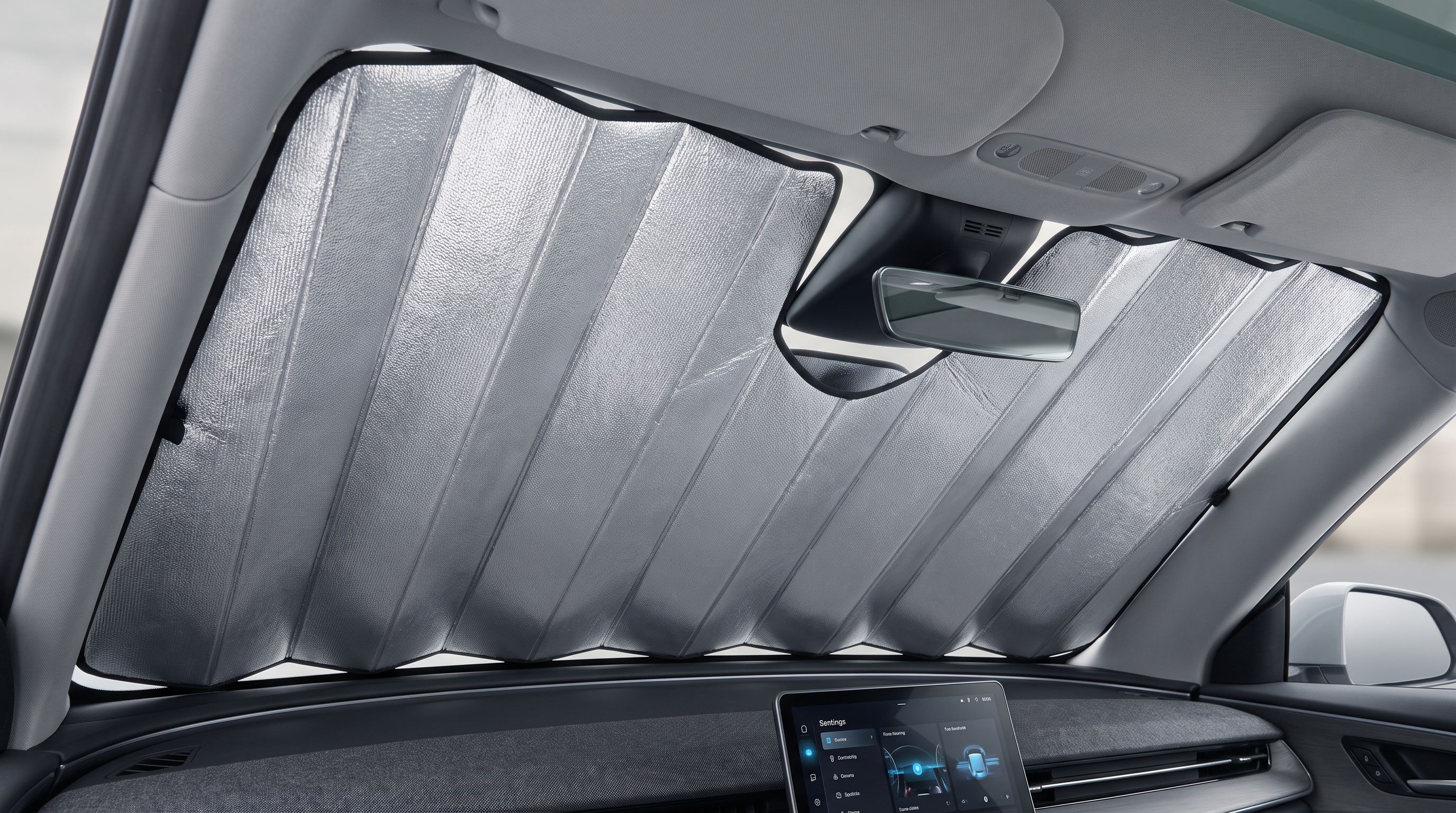
Most sun shades don't fail because the material is bad. They fail because they're the wrong size. A shade that leaves a four-inch crescent of bare glass at the top of the windshield is still letting the sun cook your dashboard every afternoon — and on modern vehicles with steeply raked glass, panoramic windshields and camera housings sprouting from the mirror mount, "universal" sizing misses more often than it hits.
This guide is about windshield sun shade fitment: how to measure your glass properly, how to decode the sizing charts that brands publish, and which style — custom-cut, folding accordion, or retractable — makes sense for your vehicle and your patience level.
The short version
- Best overall: WeatherTech SunShade
- Best custom-cut alternative: Covercraft UVS100 Custom Sunscreen
- Best universal folding pick: EcoNour Foldable Windshield Sun Shade
- Best retractable: A1 Shades Retractable Windshield Sunshade
- Best budget accordion: Kinder Fluff Car Windshield Sun Shade
 Best retractable · A1 Shades Retractable Windshield Sunshade — Check price on Amazon →
 Best universal folding pick · EcoNour Foldable Windshield Sun Shade — Check price on Amazon →
 Best custom-cut alternative · Covercraft UVS100 Custom Sunscreen — Check price on Amazon →
 Best overall · WeatherTech SunShade — Check price on Amazon →
GarageProof researches and compares products using manufacturer specs, independent reviews and verified owner feedback — we don't physically test units. Everything below is based on published fitment data, published test results from other outlets, and patterns in long-term owner reports.
Why universal sizing fails on modern windshields
Three things changed over the last decade and broke the old one-size-fits-most assumption.
Rake angle got steeper. Aerodynamic targets pushed windshields closer to horizontal. A flat rectangle of reflective material, sized by width and height alone, now has to cover a surface that is far longer top-to-bottom than the driver's eye suggests. People routinely measure the vertical height as they see it rather than the actual glass surface distance and end up a few inches short.
Curvature got more aggressive. Glass now wraps into the A-pillars. A flat shade that's technically "wide enough" still won't press into those corners, so you get two triangular gaps where the sun comes straight in at the dash corners — exactly where cracked vinyl and faded trim tend to start.
Hardware moved onto the glass. Lane-keep cameras, rain sensors, humidity sensors, toll transponder mounts and heated wiper park zones all live on the inside face of the windshield now. Universal shades handle this with a generic notch, which often doesn't line up. Custom-cut shades are laser-measured around the actual sensor pod for your vehicle.
Panoramic and extended windshields — common on EVs and newer crossovers — stretch the glass up into what used to be roof. A standard folding shade simply has no answer for that; the top 8–12 inches stay uncovered unless the shade was cut for that specific vehicle.
How to measure your windshield without guessing
Do this before you shop. It takes five minutes and it's the difference between a shade that wedges in place and one that slumps onto the dash every time you shut the door.
1. Measure the widest point, inside the glass
Sit in the passenger seat, run a soft tape measure across the inside of the windshield at its widest point — usually a few inches above the dash, not at the very bottom. Note that number. Then measure the top width where the glass meets the headliner. Modern windshields are noticeably narrower at the top, which is why trapezoid-shaped shades fit better than rectangles.
2. Measure the glass surface, not the air gap
Run the tape along the glass itself from the bottom edge where it meets the dash seal up to the top edge at the headliner. Follow the curve. Do not measure point-to-point through the air — on a steeply raked windshield that can under-report by three or four inches.
3. Note your obstructions
Measure from the top edge of the glass down to the bottom of your mirror/sensor housing, and measure the housing's width. If that pod is wide (common on vehicles with front-facing ADAS cameras), a shade with a small generic slot won't seat flat.
4. Check your sun visor gap
Flip your visors down. If they sit very close to the glass, a thick foam-core custom shade may be a tight squeeze when you try to tuck the top edge behind them. Thinner folding shades are easier to wedge.
5. Compare against the maker's chart — then size up, not down
Brands publish size ranges (e.g. "fits windshields up to 63 x 34 inches"). If you're within an inch of the top of a range, step up a size. Excess material tucks into the A-pillars and behind the visors; missing material does nothing but expose glass.
How to choose
Custom-cut vs universal
Custom-cut shades — WeatherTech SunShade and Covercraft UVS100 Custom Sunscreen are the two dominant names — are made per year/make/model and cover corner to corner with sensor cutouts in the right places. They are the correct answer if your vehicle has panoramic glass, an unusually steep rake, or a large camera pod. The tradeoff is cost and the fact that they don't transfer to your next car.
Universal shades win on price and flexibility. They're fine on conventional sedans and compact SUVs with moderate rake, and they're the sensible choice for a lease, a second car, or a vehicle you're about to sell.
Shade style: accordion, roll-up/retractable, or rigid
Accordion (folding) shades are the most common. They pack flat, hold shape well, and most have a fabric or reflective face over a stiff core. The downside is bulk when folded and a tendency to crease permanently.
Retractable shades, like the A1 Shades Retractable Windshield Sunshade, roll onto a bar or tube. They deploy and stow in seconds and store in a narrow cylinder rather than a fat rectangle — genuinely better if your back seat is full or you deploy the shade daily. They tend to be less rigid, so they rely on suction cups or visor pressure to stay put.
Rigid custom board shades are the stiffest and seal best in the corners, but they're the bulkiest to store.
Material and heat performance
Independent testing by outlets that do run thermal comparisons consistently finds that fit matters more than the headline material claim. A reflective silver face bounces incoming radiation back out; a dark backing absorbs; multi-layer foam cores slow conduction into the cabin. But a premium material with a two-inch gap at the top underperforms a cheap panel that actually covers the glass.
Look for: a genuinely reflective outer face (not pale gray fabric), a defined core rather than a single floppy sheet, and stitched or bound edges that won't delaminate after a season of 150°F dash temperatures.
How it stays up
Three mechanisms: visor pressure (tuck the top edge behind flipped-down visors), suction cups, and sheer stiffness wedging into the A-pillars. Visor pressure is the most reliable and the least likely to fail in heat. Suction cups are convenient but tend to release once the glass gets hot — which is precisely when you need them. Prefer a shade that doesn't depend on cups alone.
Comparison table
| Pick | Style | Fitment approach | Sensor/mirror cutout | Storage footprint | Best for |
|---|---|---|---|---|---|
| WeatherTech SunShade | Rigid custom panel | Laser-measured per year/make/model | Cut for your vehicle | Large, flat | Panoramic or steeply raked glass, long-term ownership |
| Covercraft UVS100 Custom Sunscreen | Multi-layer custom board | Patterned per vehicle | Cut for your vehicle | Large, rolls or folds | Owners who want thickness and durability |
| EcoNour Foldable Sun Shade | Accordion | Universal, multiple size options | Generic notch | Medium, folds flat | Conventional sedans and SUVs |
| A1 Shades Retractable Sunshade | Roll-up / retractable | Universal, size-selected | Varies by size | Small, cylindrical | Daily deploy, tight cabin storage |
| Kinder Fluff Sun Shade | Accordion | Universal, multiple size options | Generic notch | Medium, folds flat | Budget buyers, second vehicles |
The picks
WeatherTech SunShade — best overall
Prices last checked October 8, 2026. Amazon prices change frequently, so treat these as a guide and check the live price before you buy.
WeatherTech SunShade
Laser-measured to your exact year, make and model, so coverage runs edge to edge with no guessing.
This is the straightforward fix for every fitment problem described above. WeatherTech builds the shade from a laser-measured pattern for your specific year, make and model, so it reaches into the A-pillar corners and works around the actual mirror and camera housing rather than a generic slot. Reviewers who compare shades side by side repeatedly put it at the top specifically because coverage is complete — there's no crescent of exposed glass at the top. What you give up: it's among the pricier options, it's bulky to stow, and it's useless the day you change vehicles. Order by selecting your 2026 (or older) vehicle on the fitment selector, not by dimensions.
Covercraft UVS100 Custom Sunscreen — best custom-cut alternative
Covercraft UVS100 Custom Sunscreen
Thick multi-layer board cut per vehicle; long-standing favorite for durability and a snug A-pillar fit.
Covercraft's UVS100 has been the enthusiast default for years, and owner feedback is unusually consistent: thick multi-layer construction, snug patterned fit, holds its shape season after season. It's the choice if you want something substantial between the sun and your dash rather than a thin reflective sheet. Trade-offs: that thickness makes it harder to tuck behind close-mounted sun visors on some cars, it's a bulkier item to live with in the back seat, and like any custom shade it's vehicle-specific. Verify your exact year, make, model and trim — windshield shapes sometimes change mid-generation.
EcoNour Foldable Windshield Sun Shade — best universal folding pick
EcoNour Foldable Windshield Sun Shade
Multiple size options and a stiff reflective panel that holds shape on steeply raked glass.
If custom-cut is overkill, EcoNour is the sensible universal option because it's sold in several sizes rather than one hopeful rectangle, and the panel is stiff enough to wedge into the pillars instead of slumping. Measure your glass using the method above, then pick the size that exceeds your measurement rather than matching it. Compromises are the usual universal ones: the mirror notch is generic, and the top edge won't follow the trapezoid taper of a modern windshield exactly, so you may see slim corner gaps. Still a big step up from a one-size shade, at a fraction of custom pricing.
A1 Shades Retractable Windshield Sunshade — best retractable
A1 Shades Retractable Windshield Sunshade
Roll-up design stows in seconds and avoids the bulky folded puck that accordion shades leave behind.
The argument for retractable is friction. If deploying a shade takes fifteen seconds and leaves a bulky folded slab on the passenger seat, you'll stop doing it. A roll-up design pulls across the glass and winds back into a slim tube that lives in a door pocket or behind a seat. A1 Shades is the better-known name in this category and sizes its shades to windshield dimensions, so measuring still matters. The compromise: roll-up material is less rigid than a foam board, so coverage at the extreme corners is weaker and retention depends more on visor pressure and mounts than on the shade wedging itself in place.
Kinder Fluff Car Windshield Sun Shade — best budget accordion
Kinder Fluff Car Windshield Sun Shade
Cheap, light, several sizes, and easy to replace when heat eventually warps the panel.
A no-drama accordion shade in multiple sizes, light enough to fold one-handed, cheap enough that replacing it after two brutal summers isn't a decision. It's the right call for a commuter car, a teen's first vehicle, or anything you'll sell before long. Expect what the price implies: thinner construction than a custom board, a generic mirror cutout, and a panel that will eventually hold its folded creases. Buy the size above your measured width, and don't expect it to seal the A-pillar corners on a heavily curved windshield.
Fitment checklist before you order
- Confirm your exact year, make, model and body style on the manufacturer's fitment selector for any custom shade — not just "F-150," but the correct generation and cab configuration.
- For universal shades, compare both your widest measurement and your along-the-glass height to the published range, and size up.
- Check whether your vehicle has a large ADAS camera pod; if the mirror housing is wide, custom-cut is strongly preferred.
- If you have panoramic or extended windshield glass, assume universal sizing will not cover it.
- Confirm the shade is held by visor pressure or wedge fit, not suction cups alone.
FAQ
Does a sun shade actually lower cabin temperature? Yes, meaningfully — third-party thermal comparisons consistently show lower dash and steering-wheel surface temperatures with a reflective shade in place. The air temperature drop is smaller than the surface temperature drop, which is still the point: the dash, wheel and seats are what burn you and what degrade.
Custom-cut or universal — is the upcharge worth it? If your windshield is panoramic, steeply raked, or has a large camera housing, yes. If you drive a conventional sedan or compact SUV with moderate rake and you measured carefully, a well-sized universal shade covers nearly as much for far less.
Will a sun shade damage my windshield sensors or defroster? No. Shades sit against the inside glass and don't interfere with rain sensors or camera function when parked. Just make sure the cutout clears the housing so the shade lies flat rather than tenting over the pod.
Why does my shade keep falling down? Almost always suction cups releasing on hot glass, or a shade that's too small to wedge against the A-pillars. Flip your visors down over the top edge — that single habit fixes most retention problems.
Can I use one shade across two cars? Only if both windshields fall in the same universal size band. Custom-cut shades are patterned for one vehicle and won't seal properly on another.
Does a windshield shade replace window tint? No. A shade only protects while parked and only covers the front glass. Tint works continuously on the side and rear windows. They solve different parts of the same problem, and many owners run both.
Get the best car care deals in your inbox
Join the GarageProof newsletter for hand-picked car care deals and new buying guides. No spam, unsubscribe anytime.
Related reads
Car Seat Gap Filler Organizer 2026: Fit It First, Buy It Second
A car seat gap filler organizer only works if it fits your console and seat rails. Here's how to measure, avoid vented-seat conflicts, and which 2026 picks suit which seats.
Cargo Liner for SUV in 2026: Fitment by Body Style
Cargo liners vs trunk mats in 2026: how seat-fold geometry, load-floor lips and body style decide which liner family actually fits your SUV, hatch or truck.
All-Weather Floor Liners in 2026: Get Fitment Right
How to verify all weather floor liners fitment in 2026: laser-measured vs universal-trim liners, year/trim/row coverage, retention hooks, and four liners worth buying.