Undercoating Spray for Cars in 2026: Match It to Your Climate
Wax, lanolin-oil or rubberized? Compare undercoating spray for cars on durability, reapplication intervals and salt-belt owner feedback — plus picks for rusty frames.
Reader-supported: we may earn a commission from links on this page, at no extra cost to you. It never affects our picks. Learn more.
The short version
- Best overall for salt-belt vehicles: Fluid Film Rust & Corrosion Protection
- Thickest lanolin coating: Woolwax Lanolin Undercoating
- Best rubberized pick: 3M Professional Grade Rubberized Undercoating
- Best for already-rusty metal: POR-15 Rust Preventive Coating
- Budget rubberized option: Rust-Oleum Automotive Rubberized Undercoating
 Budget rubberized option · Rust-Oleum Automotive Rubberized Undercoating — Check price on Amazon →
 Best for already-rusty metal · POR-15 Rust Preventive Coating — Check price on Amazon →
 Best rubberized pick · 3M Professional Grade Rubberized Undercoating — Check price on Amazon →
 Thickest lanolin coating · Woolwax Lanolin Undercoating Aerosol — Check price on Amazon →
Undercoating is one of the few car-care jobs where buying the wrong product can actively make things worse. A hard rubberized shell sprayed over a damp, lightly rusted frame doesn't stop corrosion — it hides it, traps moisture against the steel and keeps working on your frame rails for years while you can't see a thing. Meanwhile an oil-based coating sprayed on a garage-kept California commuter is mostly a messy waste of a Saturday.
So the real question isn't "which undercoating spray for cars is best," it's "which chemistry suits my climate, my vehicle's current condition, and how often I'm willing to redo it." We compared the three main families — lanolin/oil, wax, and rubberized/asphaltic — against manufacturer claims, independent corrosion commentary, and a large body of owner feedback from salt-belt forums and Rust Belt truck communities.
The three chemistries, honestly compared
Lanolin and oil-based (Fluid Film, Woolwax, Krown-style)
Prices last checked October 17, 2026. Amazon prices change frequently, so treat these as a guide and check the live price before you buy.

Fluid Film Rust & Corrosion Protection (Black or Clear) Aerosol
Lanolin-based, self-healing, creeps into seams — the salt-belt default, but plan on annual reapplication.
These never fully cure. That's the point. They stay soft and slightly mobile, which means they creep into seams, pinch welds, frame rail drain holes and body cavities — exactly where road salt collects and where hard coatings can't reach. Because they stay wet, minor scrapes from road debris "self-heal" rather than creating a chip that lets water underneath.
The trade-off is longevity. Owner feedback from heavy salt regions is consistent: expect to reapply roughly every 12 months, usually in late autumn before salt trucks come out. The first season is also messy — oil weeps from seams, drips on driveways for a week or two, and attracts a layer of road dust that eventually forms a protective grime film.
Wax-based (Cosmoline, Waxoyl-type)
Wax coatings go on warm and thin, then set into a soft, waxy film. They're a middle ground: cleaner and less drippy than lanolin oils, longer-lasting than a thin oil, but with less creep into tight seams. They handle hot climates reasonably well since they don't run as readily once set, and they hold up better to pressure washing than lanolin. Reapplication is typically every one to two years depending on exposure. The catch is prep sensitivity — wax over a dirty or wet surface delaminates in sheets, which is the worst possible failure mode.
Rubberized and asphaltic (3M, Rust-Oleum)
Rust-Oleum Automotive Rubberized Undercoating
Inexpensive aerosol for wheel wells and small repairs where you just need a tough, chip-resistant film.
These cure into a hard, chip-resistant, paintable film that also kills a surprising amount of road noise and gravel ping. On clean, dry, rust-free metal — new wheel wells, fresh bodywork, a replaced rocker panel, a restored floor pan — they're excellent and can last many years untouched.
On anything with existing corrosion, they're a liability. Owners in the salt belt repeatedly describe pulling back cracked rubberized coating from a ten-year-old undercarriage and finding scaling rust that had been quietly expanding underneath. Rubberized coatings don't self-heal; once a rock chip breaks the film, moisture wicks in and sits.
Comparison table
| Product | Type | Best for | Reapplication (typical) | Paintable | Main trade-off |
|---|---|---|---|---|---|
| Fluid Film | Lanolin oil | Salt-belt daily drivers, trucks, seams and cavities | ~Annually | No | Drips for weeks; attracts dirt |
| Woolwax | Thick lanolin | Severe salt exposure, those wanting fewer reapplications | ~1–2 years | No | Heavier body means less creep into fine seams |
| 3M Professional Grade Rubberized | Rubberized | Clean, rust-free wheel wells and fresh panels | Several years | Yes | Traps moisture over existing rust |
| POR-15 Rust Preventive | Moisture-cured coating | Prepped surface rust, frames, floor pans | Long-term when topcoated | Needs compatible topcoat | Prep-intensive; UV-sensitive uncoated |
| Rust-Oleum Rubberized | Rubberized | Budget touch-ups, wheel wells, small areas | Few years | Yes | Thinner film than pro-grade options |
How to choose
Start with your vehicle's current rust condition
This matters more than climate. Be honest after a flashlight inspection of the frame rails, rear spring perches, rocker bottoms and subframe.
- Clean metal, no visible corrosion: anything works. Rubberized is a valid long-term choice if you prep properly.
- Light surface rust (orange dust, no pitting): go lanolin or wax. These penetrate and displace moisture rather than sealing it in.
- Scaling or flaking rust: mechanical removal first — wire wheel, needle scaler — then an encapsulating coating like POR-15, or lanolin if you just want to slow it and accept the vehicle's fate.
- Perforation: no spray fixes a hole. That's a welding job or a decision about the vehicle's future.
Match the chemistry to your actual climate
Heavy salt belt (Northeast, Midwest, Ontario, Quebec, mountain passes with brine): lanolin wins on owner feedback, mostly because liquid brine is far more aggressive than rock salt and gets everywhere. Creeping coverage beats hard-shell coverage.
Coastal salt air without road salt: wax-based or lanolin, applied less frequently. Salt-laden humidity is persistent but less abrasive.
Hot, dry climates: you likely don't need undercoating at all. If you want chip protection for wheel wells and rocker panels, a rubberized product is the right tool, and in that role it's genuinely good.
Mixed / humid South: wax-based coatings suit this well — stable in heat, decent longevity, less mess than oil.
Decide how much mess and maintenance you'll tolerate
This is where most people choose wrong. Lanolin products are the most effective in the worst conditions, and they are also the ones that drip on your garage floor, smell faintly of sheep for a week, and need doing again next year. If you know you won't redo it annually, a wax-based coating on a two-year cycle beats a lanolin coating you apply once and forget for five years.
Plan the application method before you buy
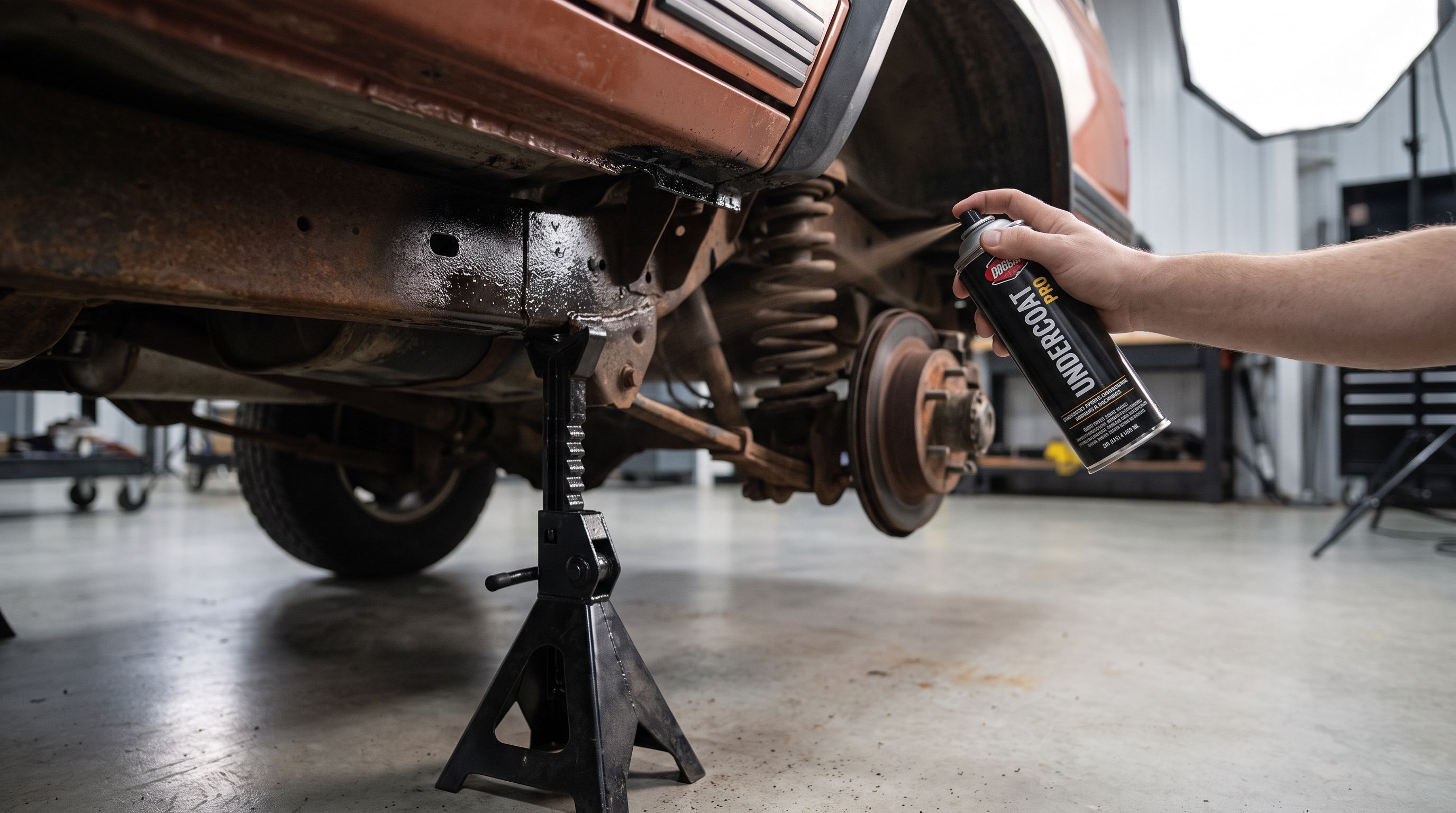
Aerosol cans with extension straws are fine for a car's wheel wells, rockers and visible frame sections. For a full truck undercarriage or body cavities, a gallon of material plus an undercoating gun and a 360-degree wand tip gives dramatically better coverage per dollar and reaches inside frame rails. Both Fluid Film and Woolwax are sold in bulk formats for exactly this. Budget for ramps or jack stands and a full afternoon — and never work under a vehicle supported only by a jack.
The picks
Fluid Film — best overall for salt-belt vehicles
Fluid Film is the default recommendation in salt-belt owner communities for good reason: it's a lanolin-based, non-drying coating that creeps into pinch welds and seams, displaces moisture, and stays soft enough to self-heal after stone strikes. It's also genuinely forgiving on prep — you want the surface free of loose scale and reasonably dry, but it tolerates light surface rust rather than sealing it in. Available in clear and black aerosols as well as bulk for gun application.
What you give up: longevity and tidiness. It drips for the first couple of weeks, collects road grime, and realistically needs redoing every autumn. It's also not paintable and will wash off areas hit directly by pressure washing.
Woolwax — thickest lanolin coating
Woolwax is the heavier-bodied answer for people who found Fluid Film thins out too quickly over a hard winter. It's the same lanolin family but formulated with more body, so it clings to vertical frame surfaces and resists wash-off better. Owners in severe salt regions frequently describe stretching intervals toward two years with it, and it comes in a straw-tip aerosol plus a 360-degree spray version that's useful for the inside of frame rails.
The trade-off is physics: thicker material creeps less into hairline seams than a thin oil does, and cold-weather application needs the can warmed to spray properly. It's also messier to clean off tools and hands.
3M Professional Grade Rubberized Undercoating — best rubberized pick
3M Professional Grade Rubberized Undercoating
Paintable, sound-deadening rubberized film for clean wheel wells and fresh panels — not for rusty frames.
If your metal is clean and dry — a restored floor pan, new rockers, factory-fresh wheel wells — 3M Professional Grade Rubberized Undercoating does what rubberized coatings are supposed to do. It builds a tough, paintable, sound-deadening film that shrugs off gravel and lasts years without attention, and the aerosol lays down more evenly than most budget rubberized sprays.
What it gives up: it's the wrong product for anything already corroding. It also demands real prep — degrease, scuff, fully dry — and once it's down, it's hard to remove if you later change strategies. Treat it as a chip-and-noise solution, not a rust-reversal one.
POR-15 Rust Preventive Coating — best for already-rusty metal
POR-15 Rust Preventive Coating
Moisture-cured coating designed to go over prepped surface rust and seal it under a hard shell.
POR-15 is the specialist pick for rusty frames, floor pans and suspension components you've decided to save rather than replace. It's a moisture-cured coating formulated to bond to prepped rusted steel and cure into a hard, non-porous shell that starves the corrosion of oxygen and water. For a restoration-grade result on a frame you've wire-wheeled back to sound metal, nothing in an aerosol can matches it.
The trade-off is effort and discipline. The full prep system — degrease, metal prep, then coat — isn't optional, the cured film is UV-sensitive and needs a topcoat where sunlight reaches it, and it's effectively permanent. Open-can shelf life is short, so plan the job in one go.
Rust-Oleum Automotive Rubberized Undercoating — budget rubberized option
For a quick wheel-well refresh, a repaired quarter panel, or protecting a patch you just welded in, Rust-Oleum's rubberized aerosol is a sensible low-cost choice. It sprays easily, builds a chip-resistant black film, and takes paint once cured — fine for targeted areas where you mainly want abrasion protection.
It gives up film thickness and durability compared with pro-grade rubberized products, so it's not what you'd choose for a whole-underbody job intended to last a decade. And the same warning applies with extra force: don't use it to cover corrosion you haven't removed.
A realistic application plan
- Wash the underbody thoroughly and let it dry completely — ideally a dry day after several dry days. Trapped moisture is the enemy of every coating here.
- Mask or avoid exhaust components, brake rotors and pads, driveshaft, O2 sensors, and any rubber bushings or boots the manufacturer warns about.
- Scrape loose scale with a wire brush before coating. Anything flaking off will take your coating with it.
- Spray seams, pinch welds and drain holes first, then flat surfaces. Use the extension straw inside rockers and frame rails if your product supports it.
- Set a calendar reminder for your reapplication interval. The single biggest predictor of whether undercoating works is whether the owner keeps up with it.
A note on fitment: undercoating sprays themselves are universal chemistry, not vehicle-specific parts. What is vehicle-specific is where you can safely spray. Check your owner's manual and your manufacturer's service information — some vehicles have aluminum body structures, exposed sensors, active aero panels or EV battery enclosures with specific restrictions. On EVs in particular, keep coatings off battery pack cooling surfaces and never spray into high-voltage connector areas. If you're unsure, confirm against documentation for your exact year, make and model before you pull the trigger.
FAQ
Is undercoating spray for cars worth it outside the salt belt? Usually not for corrosion reasons. In dry or warm climates, factory coatings and galvanizing are typically enough. A rubberized product in the wheel wells for chip and noise control is still a reasonable upgrade.
Can I spray undercoating over existing rust? Over light surface rust, lanolin and oil-based products are designed to work — they displace moisture and penetrate. Over scaling rust, remove the loose material first and use an encapsulating coating like POR-15. Never seal active rust under a rubberized shell.
How often should I reapply? Lanolin products: roughly annually in heavy salt regions. Thicker lanolin like Woolwax: one to two years. Wax-based: one to two years. Rubberized: several years, but inspect annually for cracks and chips.
Will undercoating void my new-car warranty? Aftermarket undercoating doesn't automatically void a warranty, but if an application causes damage — blocked drains, contaminated sensors, melted material on exhaust — that specific damage won't be covered. Check your manufacturer's guidance for your model year first.
Can I mix products — rubberized on the floor pan, lanolin on the frame? Yes, and that's often the smart approach. Hard coating where impact resistance matters and metal is clean; creeping oil in seams, cavities and anywhere corrosion has started. Just don't layer lanolin under something you later want to paint — nothing sticks to it.
Do I need a spray gun, or are aerosols enough? For a passenger car's visible underbody, aerosols with straws are fine. For a full-size truck or any cavity work, a gallon plus an undercoating gun with a 360-degree wand covers more, costs less per area, and reaches inside frame rails where aerosols can't.
Our picks
Woolwax Lanolin Undercoating Aerosol
Heavier-bodied lanolin that clings longer than thinner oils, with straw and 360-degree spray options.
Get the best car care deals in your inbox
Join the GarageProof newsletter for hand-picked car care deals and new buying guides. No spam, unsubscribe anytime.
Related reads
Mud Flaps for Trucks 2026: Fit the Wheel Well, Not the Badge
Heavy-duty mud flaps for trucks in 2026: how wheel-well lip, lift height and flare type decide whether drill-in or no-drill kits actually fit.
Hub Centric Wheel Spacers 2026: Get the Bore Right First
Hub centric wheel spacers in 2026: how to match hub bore, bolt pattern and stud engagement to your vehicle — plus four spacer brands worth considering.
Ceramic Coating for Wheels in 2026: Heat Rating Matters
Which ceramic coating for wheels survives real brake heat? We compare temperature tolerance, cure time and durability for alloy, painted and powder-coated wheels.