Trailer Brake Controllers in 2026: Proportional vs Time-Delay
Proportional or time-delay trailer brake controller? Compare Tekonsha, Redarc and CURT picks for 2026, plus how to match the right wiring harness to your truck.
Reader-supported: we may earn a commission from links on this page, at no extra cost to you. It never affects our picks. Learn more.
If your trailer has electric drum brakes and a gross weight over roughly 3,000 lb, a brake controller isn't optional — it's the device that tells those trailer brakes how hard to work, and in most states it's legally required. The question isn't whether to fit one. It's whether you need a proportional unit, a time-delay unit, and which wiring harness plugs into your specific truck without you splicing into anything.
This guide breaks down the difference, matches controller types to real towing situations, and explains how to check the tow-package port on your year, make and model before you buy. GarageProof compares products using manufacturer documentation, expert reviews and verified owner feedback — we don't physically test units.
The short version
- Best overall: Tekonsha Prodigy P3
- Best for clean installs: Redarc Tow-Pro Elite
- Best value: Tekonsha Voyager 9030
- Best for rental and swap trucks: CURT Echo Mobile
- Best time-delay alternative: CURT TriFlex
 Best time-delay alternative · CURT TriFlex — Check price on Amazon →
 Best for rental and swap trucks · CURT Echo Mobile — Check price on Amazon →
 Best for clean installs · Redarc Tow-Pro Elite — Check price on Amazon →
Proportional vs time-delay: what actually differs
Both types send current to the trailer's electromagnets when you hit the brake pedal. How they decide how much current is the whole argument.
Time-delay (also called solid-state or user-controlled) controllers apply a preset amount of braking power on a ramp. You press the pedal, the controller starts at a low output and ramps up to the level you dialed in, over a delay you set. It doesn't know whether you're easing to a stop at a light or standing on the pedal. It just runs the same ramp every time. The upside: no accelerometer, no leveling, no calibration, and they tolerate being mounted almost anywhere. The downside: either it's too aggressive in gentle stops or too soft in hard ones, because one setting has to cover both.
Proportional (inertia-based) controllers contain an accelerometer that measures how fast the tow vehicle is actually decelerating, then sends matching current to the trailer. Easy stop, light trailer braking. Panic stop, full output almost immediately. The result is a rig that feels like one vehicle instead of a truck being shoved by a trailer. Proportional units also apply trailer braking during engine braking and downhill descents in a way time-delay units simply can't replicate.
For anything over about 5,000 lb, anything you tow weekly, or any trailer with surge-sensitive cargo (boats, livestock, a loaded car hauler), proportional is the right answer. Time-delay still makes sense for a light utility or small boat trailer towed a few times a year, or for a vehicle where the controller has to live in an odd orientation.
One more wrinkle for 2026: the Redarc Tow-Pro Elite is both. A dash dial switches it between proportional mode for highway towing and user-controlled (time-delay style) mode for loose surfaces, boat ramps and off-road work where you want a fixed, gentle output. That dual-mode flexibility is why it keeps winning overland and marine recommendations.
How the comparison stacks up
| Model | Type | Max axles | Mounting | Best suited to |
|---|---|---|---|---|
| Tekonsha Prodigy P3 | Proportional | 4 (8 brakes) | Any angle, no leveling | Heavy travel trailers, fifth wheels, frequent towing |
| Redarc Tow-Pro Elite | Switchable proportional / user-controlled | 3 (6 brakes) | Remote module, dash-mounted dial | Clean dash installs, boat ramps, off-road |
| Tekonsha Voyager 9030 | Proportional | 4 (8 brakes) | Any angle | Budget-conscious buyers who still want proportional |
| CURT Echo Mobile | Proportional | 2 (4 brakes) | Plugs into 7-way, no install | Rentals, borrowed trucks, occasional towing |
| CURT TriFlex | Proportional with self-leveling | 3 (6 brakes) | Any angle | Mid-weight trailers, simple setup |
Note that axle limits matter. A tandem-axle travel trailer is two axles / four brakes — nearly anything handles that. A triple-axle fifth wheel or a heavy equipment trailer needs a controller rated for three or four axles, which rules out the plug-in Echo for that duty.
How to choose
Match the controller to trailer weight and axle count
Count brake-equipped axles first, not total axles — some utility trailers only brake one of two. Then check the controller's rated output amperage against the number of magnets it has to drive. Two-axle electric drum setups are the mainstream case and every pick here covers them. Triple-axle or electric-over-hydraulic disc setups narrow the field fast; electric-over-hydraulic in particular needs a controller explicitly rated for it, because the actuator pump draws differently than brake magnets. Check the trailer's actuator documentation before assuming compatibility.
Find your truck's factory tow-package port
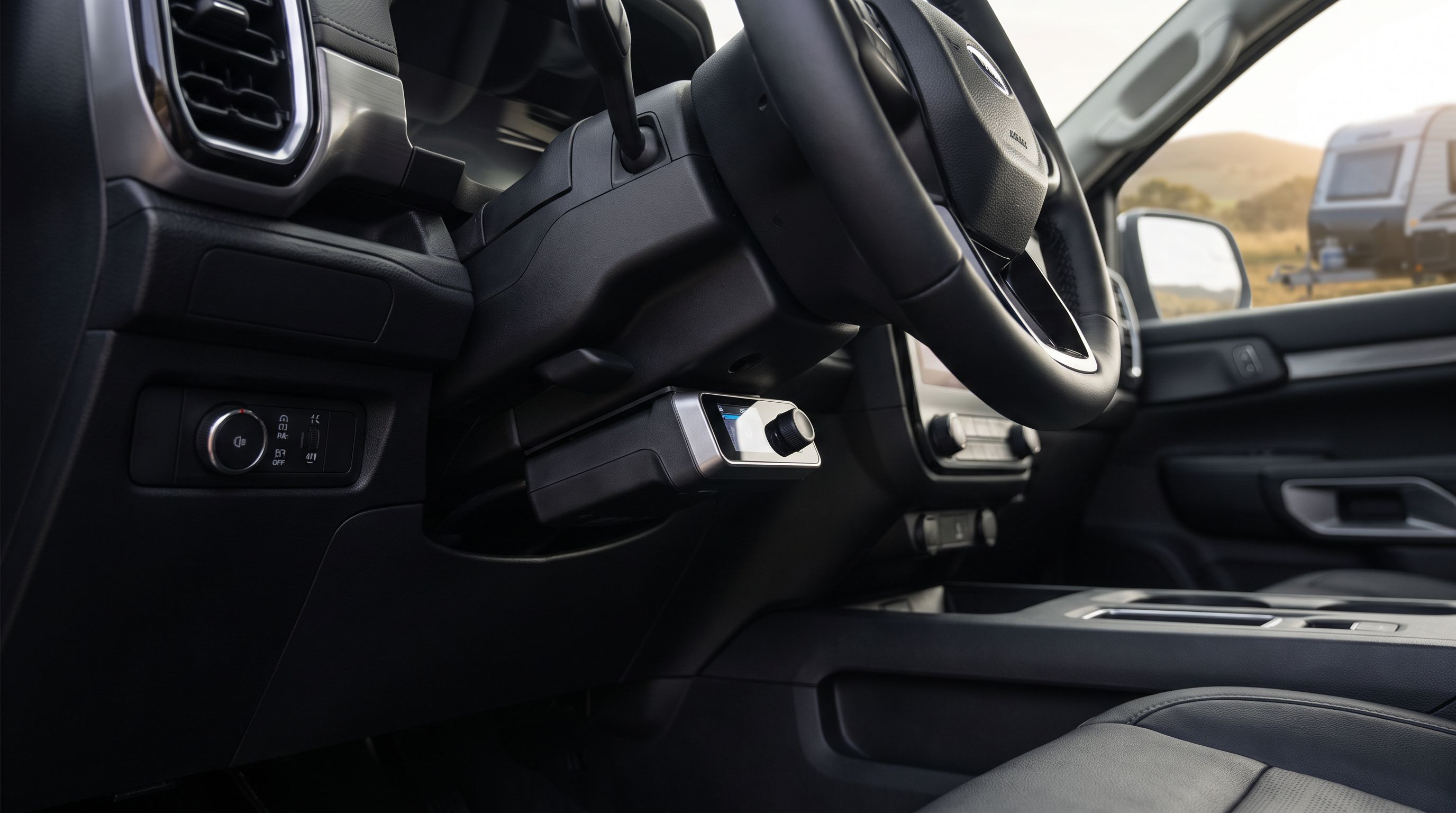
This is where most installs go sideways. Since roughly the mid-2000s, nearly every half-ton and up pickup with a factory tow package has a dedicated brake controller connector tucked under the dash, usually near the steering column or the driver's kick panel — often blue, often taped up and tucked into the harness. If it's there, you buy a vehicle-specific plug-and-play harness and the wiring job takes minutes: the harness carries battery power, ground, brake switch signal and the trailer brake output, all pre-terminated.
Harnesses are vehicle-specific. A harness for a 2019 Ram 1500 will not fit a 2019 F-150, and in some cases the connector changed mid-generation. Before ordering, confirm three things: your exact year, make and model; whether your truck has the factory towing package (a truck with a 7-way socket usually does, but not always with the in-cab plug); and the harness part number the controller manufacturer lists for that combination. Tekonsha, CURT and Redarc all publish vehicle lookup tables — use them rather than guessing. If you can't locate a port, you're doing a hardwire install: battery feed with an inline fuse, chassis ground, brake switch tap and output to the 7-way pin. Not hard, but budget an hour or two.
Decide how much dash you're willing to give up
Modern truck interiors leave very little flat real estate under the dash, and knee clearance is real. The Prodigy P3 and TriFlex are conventional boxes that bracket-mount under the dash. The Redarc Tow-Pro Elite splits the difference — the brains live behind the dash and only a small rotary knob is visible, which many owners mount in a blank switch position for a factory look. The CURT Echo Mobile takes no dash space at all because it lives in the 7-way socket.
Think about how many vehicles you tow with
If you own one truck and one trailer, hardwire the best proportional controller you can and forget about it. If you borrow trucks, rent, or run a fleet, a plug-in Bluetooth unit that moves between vehicles in under a minute is worth the compromise in axle capacity and the fact that you're relying on your phone as the display.
The picks
Tekonsha Prodigy P3 — best overall
Prices last checked October 7, 2026. Amazon prices change frequently, so treat these as a guide and check the live price before you buy.
Tekonsha Prodigy P3
The accepted aftermarket standard: true proportional braking, boost settings and a readable diagnostic display.
The Prodigy P3 is what most towing forums default to, and for defensible reasons: genuine proportional braking, a backlit display that reports output amperage and diagnoses shorts or open circuits on the trailer side, three stored boost levels for different load weights, and multiple trailer memory profiles. It mounts at any angle with no manual leveling. It handles up to four axles, which covers nearly every consumer trailer on the road.
What it gives up: it's a visible box under the dash, the interface is menu-driven rather than instantly obvious, and it costs more than entry proportional units. If your towing is twice a year with a 2,500 lb utility trailer, it's more controller than you need.
Redarc Tow-Pro Elite — best for clean installs
Redarc Tow-Pro Elite
Hides the module out of sight and leaves only a small dial in the dash — switchable proportional or user-controlled mode.
The Tow-Pro Elite is the choice when you don't want a box hanging under the dash. The control module mounts out of sight and the only visible component is a small illuminated dial that fits a blank switch panel or a drilled hole. Flip it and you switch between proportional mode for towing on pavement and user-controlled mode, which applies a fixed, driver-set output — genuinely useful backing a boat down a wet ramp or descending a loose grade where you don't want the accelerometer calling the shots.
Trade-offs: it's rated for up to three axles rather than four, the dial gives you less diagnostic feedback than a full display, and the two-piece install takes longer than bolting a single box under the dash.
Tekonsha Voyager 9030 — best value
Tekonsha Voyager 9030
Proportional braking at an entry price, with a simple LED readout and up to four axles.
The Voyager delivers the core benefit — proportional, inertia-based braking — without the display, boost profiles and memory settings of the Prodigy. You get an LED readout, adjustable gain, a manual override lever, and support for up to four axles. For a tandem-axle travel trailer or a mid-size boat, it does the job that matters.
What you give up is the diagnostic richness. The Prodigy will tell you why the trailer isn't braking; the Voyager mostly tells you that something is off. It also needs to be mounted within its specified angle range rather than truly anywhere. For a second truck or a budget build, it's the sensible proportional entry point.
CURT Echo Mobile — best for rental and swap trucks
CURT Echo Mobile
Plugs into the 7-way and runs from your phone over Bluetooth — no wiring, moves between vehicles in seconds.
The Echo plugs into the 7-way socket between truck and trailer and pairs to your phone, where the app becomes the display and gain control. There's no drilling, no harness to buy, no wiring. Move it to another truck in seconds. For anyone who tows with rented or borrowed vehicles, that alone justifies it.
The compromises are honest ones: it's rated for two axles / four brakes, so heavy triple-axle rigs are out; your phone has to be charged and paired before you drive; and manual override means reaching for the phone rather than a lever. It also sits exposed at the hitch, so weather sealing matters. As a supplementary or occasional-use controller, it's excellent.
CURT TriFlex — best time-delay alternative
CURT TriFlex
Mounts at almost any angle, self-levels and offers straightforward setup for occasional towers.
For readers who want something closer to the simplicity of a time-delay unit without giving up responsiveness, the TriFlex splits the difference. It uses triple-axis self-leveling, meaning it figures out its own orientation and can be mounted at essentially any angle without calibration — a real advantage in cramped modern dashes. Setup is simple: set gain, go. It handles up to three axles.
It gives up the deep diagnostics and multi-trailer memory of the Prodigy P3, and the dash-discreet packaging of the Redarc. But if your priority is a controller that installs without fuss and behaves predictably, it's a strong mid-tier choice.
Installation reality check
Plan on these steps regardless of which unit you choose: confirm the in-cab tow port or plan a hardwire, order the correct vehicle-specific harness, mount the controller where your knee won't hit it, then — critically — calibrate the gain on an empty road. Hitch the loaded trailer, get to around 25 mph, apply the manual override lever only, and raise gain until the trailer brakes just begin to grab, then back off slightly. Re-check whenever the trailer load changes significantly. A correctly set gain does more for stopping distance than upgrading the controller.
FAQ
Do I need a brake controller for a single-axle trailer? If that axle has electric brakes, yes. Requirements vary by state but commonly kick in somewhere between 1,500 and 3,000 lb gross trailer weight. Check your state's threshold and the state you're towing through.
Will a proportional controller work with electric-over-hydraulic disc brakes? Only if the controller is specifically rated for it. Electric-over-hydraulic actuators draw differently than brake magnets, and some controllers list them as incompatible. Confirm against both the controller's and the actuator's documentation.
My truck already has a factory integrated brake controller. Should I add one? No. Factory integrated controllers on recent trucks are proportional and tied into the vehicle's own stability and ABS data. Adding an aftermarket unit alongside one creates conflicts.
How do I know which wiring harness to order? Look up your exact year, make, model and cab configuration in the controller manufacturer's harness guide. Don't assume the same harness carries across model years — connectors change mid-generation. If the truck lacks a factory tow package, there may be no plug-and-play option at all.
Can I leave the controller unplugged when I'm not towing? With a hardwired unit, leave it installed — current draw with no trailer connected is negligible. With a plug-in unit like the Echo, remove it and store it dry; it's not meant to live in the socket year-round.
Get the best car care deals in your inbox
Join the GarageProof newsletter for hand-picked car care deals and new buying guides. No spam, unsubscribe anytime.
Related reads
Hitch Cargo Carriers 2026: Match Tongue Weight First
A hitch cargo carrier guide for 2026: match receiver class, tongue weight rating and shank rise to your truck or SUV before you buy a 2-inch basket.
Hitch Bike Rack 2 Inch Receiver vs Bed Mount in 2026
Bed-mounted or hitch bike rack? Compare 2-inch receiver classes, tongue weight limits and real 2026 racks so you confirm fitment before you buy.
Towing Mirrors for Trucks in 2026: Clamp-On vs Bolt-On
Clamp-on or vehicle-specific towing mirrors for trucks in 2026? We compare stability, vibration, DOT-legal width and fitment for real tow setups.