Towing Mirrors for Trucks in 2026: Clamp-On vs Bolt-On
Clamp-on or vehicle-specific towing mirrors for trucks in 2026? We compare stability, vibration, DOT-legal width and fitment for real tow setups.
Reader-supported: we may earn a commission from links on this page, at no extra cost to you. It never affects our picks. Learn more.
The short version
- Best overall for most trucks: CIPA Custom Towing Mirrors (Slip-On)
- Best fit-and-forget clamp-on: K Source Snap-On Custom Towing Mirrors
- Budget pick: K Source Universal Clip-On Towing Mirror
- Best for vibration control: Milenco Aero 3 Grand Towing Mirror
- Best minimalist add-on: Boyo VTM74M Clip-On Blind Spot Mirror
 Best for vibration control · Milenco Aero 3 Grand Towing Mirror — Check price on Amazon →
 Budget pick · K Source Universal Clip-On Towing Mirror — Check price on Amazon →
 Best fit-and-forget clamp-on · K Source Snap-On Custom Towing Mirrors — Check price on Amazon →
 Best overall for most trucks · CIPA Custom Towing Mirrors (Slip-On) — Check price on Amazon →
If your truck already has factory extendable tow mirrors — common on 2026 Silverado/Sierra HD, Ram HD and Super Duty trims — you probably don't need any of this. If you have a half-ton with standard body-color mirrors, a mid-size truck, or an SUV, an add-on mirror is the cheapest legal way to see past a wide trailer.
Why add-on towing mirrors still matter in 2026
New trucks have more camera tech than ever. Trailer-view camera packages, blind-spot monitoring that extends for trailer length, and 360-degree bird's-eye systems are all available on 2026 models. None of them replace a mirror.
The reason is legal, not just practical. Most state vehicle codes require the driver to have a clear rearward view along both sides of the vehicle and trailer — typically phrased as a view of at least 200 feet behind. A camera feed on a center screen doesn't satisfy that language in many jurisdictions, and it doesn't help you at all when you're reversing at an angle into a site and need to watch the trailer's rear corner.
The second reason is width. A standard pickup mirror on a 2026 F-150, Silverado 1500, Ram 1500 or Tundra gives you a fine view of your own bed sides. Put a 8-foot-wide travel trailer or enclosed cargo trailer behind it and that mirror is now aimed at trailer sheet metal. You lose the lane beside you entirely.
The width rule everyone gets wrong
Federal guidance and most state laws allow mirrors to project beyond the legal vehicle width only as far as necessary to see past the trailer. In practice that's usually interpreted as: extended tow mirrors are legal while towing, and should be folded in or removed when you're not.
That's the single biggest argument for clamp-on mirrors over permanently bolted replacements on a half-ton. A clamp-on comes off in 30 seconds. A bolted-on tow mirror is out there all the time, catching garage door frames and parking-garage pillars.
Clamp-on vs vehicle-specific: the real trade-off
There are three broad categories, and the naming in the aftermarket is genuinely confusing.
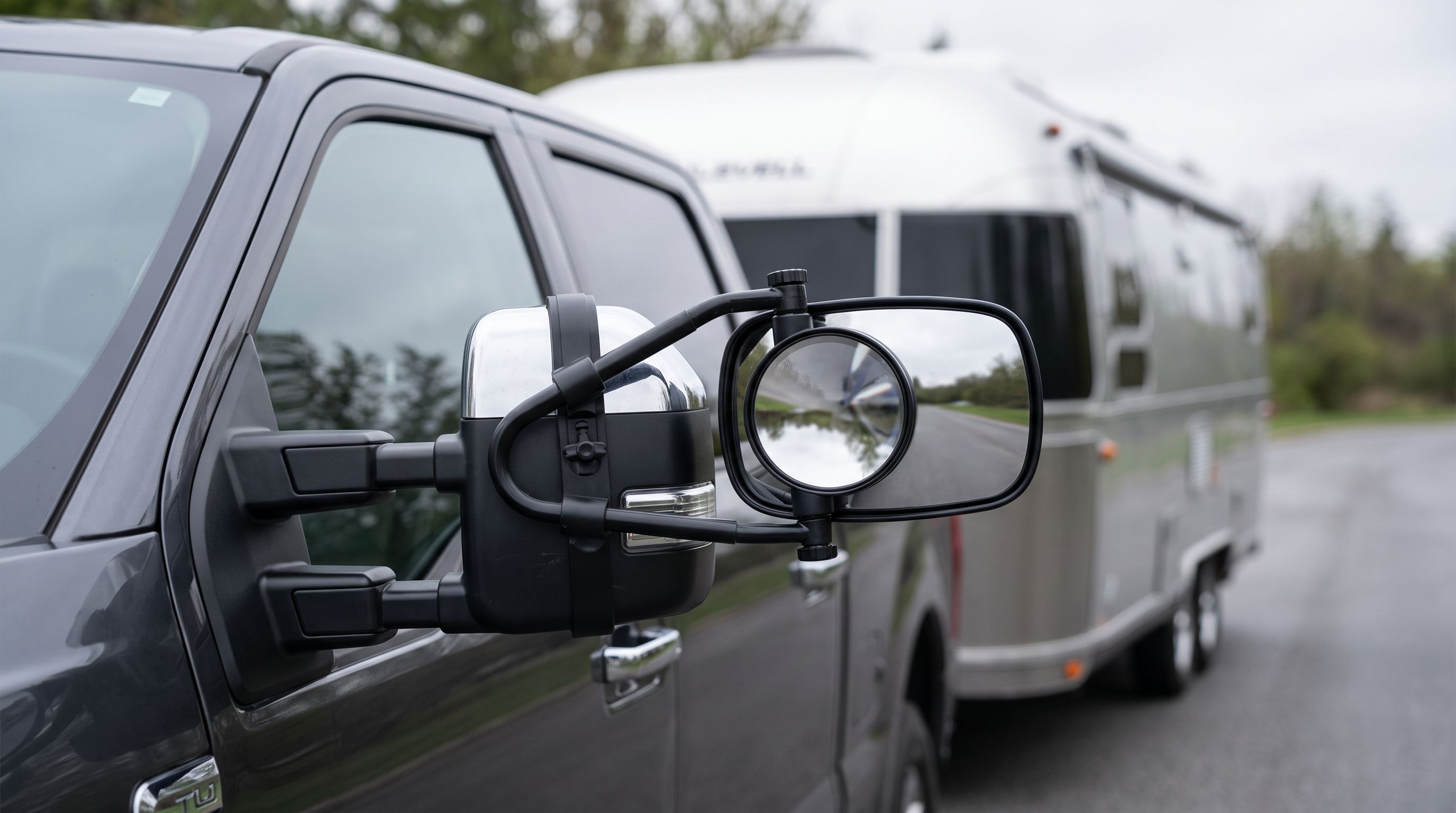
Universal clip-on / strap-on. Fits almost anything with a mirror housing it can grab. Held by rubber-padded hooks plus one or two tensioning straps. Cheapest, most portable, most prone to vibration because the contact patch is small and the load is cantilevered.
Custom slip-on / snap-on. A molded shell sized to a specific truck's mirror housing — you slide it over the factory mirror and cinch it. Far more stable than a universal because the shell mates to the housing shape across a large area. Still removable in under a minute. This is the sweet spot for most half-ton owners. Both CIPA and K Source build these, and each uses vehicle-specific part numbers you must match to your year, make, model and factory mirror style.
Vehicle-specific bolt-on replacement. You remove the factory mirror and install a true tow mirror in its place, usually with power, heat, turn signal and sometimes puddle lamp and blind-spot sensor pass-through. Rock solid, factory-looking, and on many 2026 trucks it can be paint-matched. Also the most expensive route by a wide margin, and increasingly complicated because modern mirrors carry cameras and radar modules that have to be transferred or re-coded.
| Universal clip-on | Custom slip-on / snap-on | Bolt-on replacement | |
|---|---|---|---|
| Install time | 1–2 min | 30–60 sec once fitted | 1–3 hrs, sometimes a scan tool |
| Vibration at highway speed | Most | Low to moderate | Lowest |
| Removable for daily driving | Yes | Yes | No |
| Keeps heat/signal/BSM function | Uses factory mirror underneath | Uses factory mirror underneath | Depends on part; verify |
| Risk of paint/clearcoat rub | Moderate | Low with clean surfaces | N/A |
| Typical fitment precision | Loose | Model-specific | Model-specific |
| Best for | Occasional, mixed vehicles | Regular weekend towing | Full-time / heavy towing |
Where each one fails
Universal clip-ons fail on shape. Many 2026 trucks and SUVs use a tapered, aero-sculpted mirror housing with a sharp lower edge — a universal hook has very little flat area to grab, and the mirror rotates under aero load. If your factory mirror housing is heavily curved, skip straight to a custom-fit option.
Custom slip-ons fail on availability. Application lists lag new model years. A 2026 truck on a carryover body (Silverado 1500, Tundra) is usually covered by an existing part number; a redesigned mirror housing may not have an application for months. Check the manufacturer's fit guide by entering your exact year, cab configuration and factory mirror type before ordering.
Bolt-ons fail on electronics. On trucks with blind-spot radar, approach lighting, or side cameras built into the mirror, a cheap replacement can throw dash faults or kill features. If your 2026 truck has any camera or sensor in the mirror, either buy the OEM tow mirror kit for that exact trim or stay with a clamp-on.
How to choose
1. Measure your trailer width, not your truck width
The rule of thumb: you need enough mirror projection that you can see the trailer's rear tires and a sliver of the lane beside them. Measure your trailer at its widest point — usually the fenders or an awning rail, not the body. Subtract your truck's mirror-to-mirror width. That difference, divided by two, is roughly how much extra reach you need per side, and add a couple inches so you're not looking straight down the trailer's flank.
For a typical half-ton with a single-axle utility trailer, a modest clip-on or even just a well-aimed convex add-on is plenty. For a 8'6" travel trailer or a fifth-wheel, you want a full extendable mirror with real projection.
2. Match the mount to your actual mirror housing
This is where people waste money. Before buying, note:
- Whether your mirror is power-folding (clamp-ons can interfere; never fold a mirror with one attached)
- Whether the housing has a turn signal strip, puddle lamp, or camera lens you'd be covering
- Whether the housing is flat-sided or heavily tapered
- Whether you have the standard or upgraded/tow factory mirror on your trim — many 2026 trucks offer both, and they use different part numbers
Then use the manufacturer's vehicle fit guide. CIPA and K Source both publish application charts. Don't buy on "should fit my truck."
3. Decide how much vibration you'll tolerate
Convex glass magnifies shake. A mirror that seems fine in the driveway can turn into a blur at 65 mph with a crosswind. The physics are simple: stability depends on the rigidity of the connection and how far the glass sits from the mount. Designs with two spaced contact points and a short, thick arm shake less than a long single-arm clamp.
Milenco's Aero 3 Grand is the clearest example of design-for-stability: twin straps, a broad rubber-faced cradle and a stubby arm. European caravan towing is done at motorway speeds with narrow lanes, and the design reflects that.
4. Think about glass type and adjustability
Flat glass gives accurate distance judgment; convex gives width. The best add-ons give you both — a large main flat or slightly convex panel plus a small spot mirror in a corner. Look for independently adjustable spot mirrors. Also check whether the main glass can be adjusted after mounting; some cheap universals lock the angle to the arm, which means you're aiming the whole assembly rather than just the glass.
5. Protect your paint
Every clamp-on rides on your factory mirror's finish. Wash and dry both surfaces before mounting, and inspect the rubber pads for embedded grit. A strip of clear paint protection film on the contact points is cheap insurance. Never leave a clamp-on mounted through a car wash or for weeks at a time — trapped dirt plus vibration is how clearcoat gets sanded off.
The picks
CIPA Custom Towing Mirrors (Slip-On) — best overall for most trucks
Prices last checked September 27, 2026. Amazon prices change frequently, so treat these as a guide and check the live price before you buy.
CIPA Custom Towing Mirrors (Slip-On)
Model-specific slip-on shells hug the factory housing for minimal shake and easy on/off.
CIPA's custom slip-ons are the default recommendation for a half-ton owner who tows a few times a month. The shell is molded for a specific truck mirror, so it seats with far more contact area than a universal — that translates directly into less vibration. Install is a slide-and-cinch operation, and removal is just as fast, which matters if you park in a tight garage. Dual glass gives you a wide main view plus a convex spot. What you give up: it's model-specific, so you must verify the application for your exact 2026 truck and factory mirror style, and it covers your factory turn-signal strip on some fitments.
K Source Snap-On Custom Towing Mirrors — best fit-and-forget clamp-on
K Source Snap-On Custom Towing Mirrors
Snap-on cradle design keyed to specific truck mirror shapes, with a wide dual-glass view.
K Source (the parent of several OEM mirror brands) builds snap-on shells keyed to specific truck mirror shapes, and the cradle design is the most secure-feeling of the removable options. Once it's fitted to the right truck, it snaps on positively rather than relying on strap tension alone, which is why owners report it staying put over rough road and repeated wind buffeting. The large dual-panel glass is well suited to wide, boxy trailers where you need to catch the rear corner. Trade-offs: heavier than a universal, limited to the trucks on the application list, and the larger shell adds noticeable wind noise at highway speed.
K Source Universal Clip-On Towing Mirror — budget pick
K Source Universal Clip-On Towing Mirror
Strap-and-clip universal mirror for occasional towing on trucks, SUVs and vans.
If you tow twice a year, or you swap the mirror between a truck and a van, the universal clip-on is the sensible answer. Rubber-padded hooks plus tensioning straps let it grab a wide range of housings, and it stores in a door pocket. Be realistic about its limits: a smaller contact patch means more shake, and it's fussier to aim because you're often adjusting the whole assembly rather than just the glass. On heavily sculpted 2026 mirror housings it may not sit flat at all. Check your housing shape first, cinch the straps firmly, and re-check tension after the first few miles.
Milenco Aero 3 Grand — best for vibration control
Milenco Aero 3 Grand Towing Mirror
Twin-strap European design with convex glass and a rigid arm that resists highway flutter.
Milenco is a British caravan-accessory maker, and the Aero 3 Grand exists because European towing happens at sustained motorway speeds in narrow lanes. Twin straps and a broad rubber cradle spread the load across the factory housing, and the short, thick arm keeps the glass close to the mount — the two things that most reduce flutter. The large convex glass gives a genuinely wide field of view down the side of a trailer. Downsides: convex-only glass takes adjustment if you're used to judging distance on flat glass, and the strap-based system takes longer to fit than a snap-on shell.
Boyo VTM74M — best minimalist add-on
Boyo VTM74M Clip-On Blind Spot Mirror
Adjustable stick-free blind spot mirror for small trailers when full tow mirrors are overkill.
Not everyone needs a full tow mirror. If you're pulling a single-axle utility trailer, a small boat, or a narrow cargo trailer that stays within your mirror-to-mirror width, a clip-on blind spot mirror recovers the corner you lost without adding a foot of projection per side. The Boyo VTM74M clips to the existing glass and adjusts to aim at the trailer's rear wheel. It's cheap, weighs nothing, and can stay on year-round for general blind-spot help. It gives up everything a real tow mirror offers: no extra width, no help seeing past a wide trailer body, no large flat panel for backing.
Setup notes worth two minutes of your time
Aim in the driveway, hitched. Mirrors aimed unhitched are always wrong. Hook up the trailer, sit in your normal driving position, and set each mirror so the trailer's rear corner sits at the inside edge of the glass and the rest shows lane.
Re-torque after the first stop. Straps stretch and clamps settle. Check tension at your first fuel stop on a long tow.
Fold-in check. If your truck has power-folding mirrors, disable auto-fold before mounting a clamp-on. Motors will strain or strip against the added weight and clamp interference.
Fifth-wheel and gooseneck. These sit closer to the truck and often block more of the mirror's near field than a bumper-pull. You generally need more projection, not less — lean toward the larger custom shells.
FAQ
Are extended towing mirrors legal when I'm not towing? In many states, no — mirrors may only project beyond the vehicle's legal width as far as necessary to see past a trailer. Enforcement varies and it's rarely a primary stop, but it's another reason removable clamp-ons make sense on a daily-driven truck.
Will a clamp-on damage my factory mirror or paint? Not if you clean both surfaces first, check the pads for grit, and remove the mirror when you're not towing. Damage almost always comes from mounting over dirt or leaving them on for weeks. Clear protective film on the contact points removes most of the risk.
Do I still need tow mirrors if my 2026 truck has trailer cameras and blind-spot monitoring? The cameras are genuinely useful for hitching and for watching trailer traffic, but they don't replace the direct rearward view most state codes require, and screen-based views are poor for angled backing. Treat cameras as a supplement.
My truck has blind-spot radar in the mirror. Can I install bolt-on tow mirrors? Only with a part specifically designed for that trim, and often only the OEM kit. Generic replacements can disable blind-spot monitoring or throw dash faults. On sensor-equipped trucks, clamp-on mirrors that leave the factory mirror in place are the lower-risk path.
How do I confirm fitment for my exact truck? Use the manufacturer's vehicle fit guide and enter year, make, model, cab style and factory mirror type (standard vs. upgraded/tow). Then compare a photo of the listed application against your actual housing — trim-level mirror differences within the same model year are common on 2026 trucks.
Can I use truck tow mirrors on an SUV or van? Universal clip-ons often work on SUVs and vans, but only if the housing has enough flat area to grab. Custom slip-on shells are truck-specific and won't fit. Measure your housing and check the application list before ordering.
Get the best car care deals in your inbox
Join the GarageProof newsletter for hand-picked car care deals and new buying guides. No spam, unsubscribe anytime.
Related reads
Hitch Cargo Carriers 2026: Match Tongue Weight First
A hitch cargo carrier guide for 2026: match receiver class, tongue weight rating and shank rise to your truck or SUV before you buy a 2-inch basket.
Hitch Bike Rack 2 Inch Receiver vs Bed Mount in 2026
Bed-mounted or hitch bike rack? Compare 2-inch receiver classes, tongue weight limits and real 2026 racks so you confirm fitment before you buy.
Mud Flaps for Trucks 2026: Fit the Wheel Well, Not the Badge
Heavy-duty mud flaps for trucks in 2026: how wheel-well lip, lift height and flare type decide whether drill-in or no-drill kits actually fit.