Tire Tread Depth Gauge 2026: What 4/32" Really Means
Tire tread depth gauge picks for 2026, plus torque sticks and rotation-day gear — and what 4/32", 2/32" and uneven wear readings actually mean for your tires.
Reader-supported: we may earn a commission from links on this page, at no extra cost to you. It never affects our picks. Learn more.
The short version
- Best overall: GODESON 88702 Smart Color Coded Tire Tread Depth Gauge
- Best digital: JACO TreadPro Digital Tire Tread Depth Gauge
- Budget pick: Milton S-448 Tire Tread Depth Gauge
- Best for rotation day: Neiko 02449A Torque Stick Set
- Best torque wrench for lug nuts: Tekton 24335 1/2-Inch Drive Click Torque Wrench
 Best for rotation day · Neiko 02449A Torque Stick Set — Check price on Amazon →
 Budget pick · Milton S-448 Tire Tread Depth Gauge — Check price on Amazon →
 Best digital · JACO TreadPro Digital Tire Tread Depth Gauge — Check price on Amazon →
 Best overall · GODESON 88702 Smart Color Coded Tire Tread Depth Gauge — Check price on Amazon →
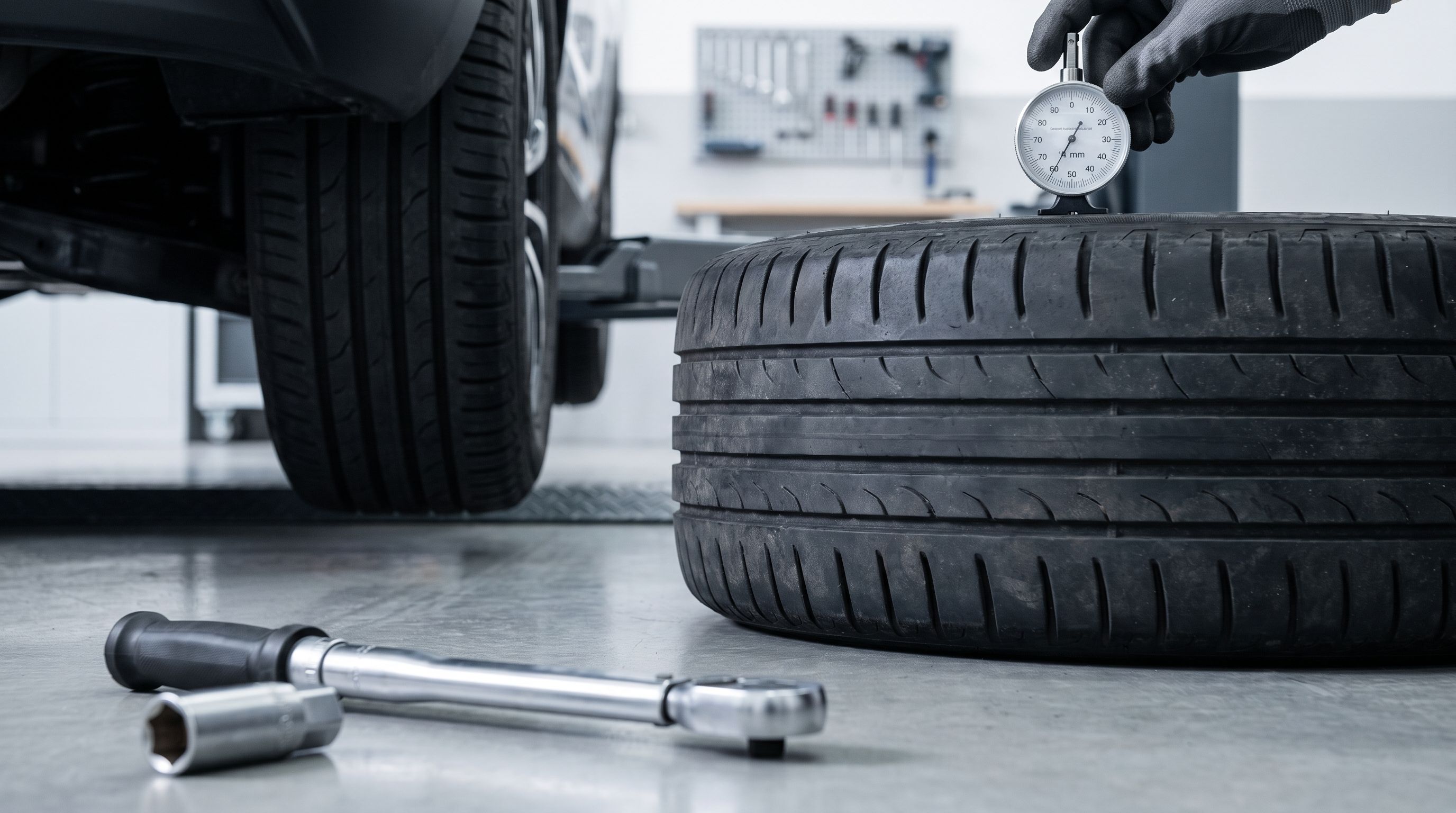
The penny trick is not wrong, it is just coarse. Abraham Lincoln's head gives you a single pass/fail at roughly 2/32", which is the legal minimum in most US states and also the point where a tire has been dangerous in the rain for a long while already. What it cannot tell you is whether your front tires are wearing 3/32" faster than the rears, whether the inner shoulder is cupping from a bad alignment, or whether you have enough tread left to survive one more winter.
A proper tire tread depth gauge costs about as much as a fast-food lunch and turns tire maintenance from guesswork into a trend line. Pair it with rotation-day gear that lets you torque lug nuts correctly instead of hammering them with an impact gun, and you have the two halves of the job that actually extend tire life.
Here is what we'd buy in 2026, and more importantly, what the numbers mean once you have them.
What tread depth readings actually mean
New passenger tires typically start between 10/32" and 11/32". Light truck and all-terrain tires often start deeper, 12/32" to 16/32" or more. Winter tires usually start around 11/32" to 13/32" because the deep siping is the whole point.
Here is the practical interpretation ladder:
| Reading | What it means | Action |
|---|---|---|
| 8/32"–11/32" | Essentially new to lightly worn | Rotate on schedule, record baseline |
| 6/32"–7/32" | Half life. Wet grip still good | Rotate, check wear evenness closely |
| 5/32" | Common recommended replacement point for winter/snow tires | Winter tires lose snow traction fast below this |
| 4/32" | Wet braking distances climb noticeably | Start shopping. Replace before a rainy season |
| 3/32" | Marginal. Hydroplaning risk is real | Replace now |
| 2/32" | Legal minimum in most US states, wear bars flush | Replace immediately — this is a limit, not a target |
The often-cited Consumer Reports and AAA testing on wet braking found meaningful stopping-distance penalties well above the 2/32" legal line, which is why the 4/32" guidance has become the mainstream recommendation rather than a conservative outlier. Treat 2/32" as the point where the tire is legally done, not the point where it was still doing its job.
Why the spread between readings matters more than any single number
Take four readings per tire minimum: outer shoulder, two center points, inner shoulder. The pattern tells you the story:
- Both shoulders low, center high: chronic overinflation, or just a lot of highway miles on a tire that likes it.
- Center low, shoulders high: chronic underinflation.
- One shoulder low only: camber or toe problem. A rotation will not fix this; an alignment might.
- Scalloped/cupped patches: worn dampers or unbalanced wheels.
- Front pair 2/32" lower than rear pair on a FWD car: completely normal, and exactly why you rotate.
A difference of more than about 2/32" across a single tire's face means something is wrong mechanically. A difference of more than 4/32" between axles on an AWD vehicle is the one that gets expensive — many AWD and 4WD systems specify a tight maximum rolling-circumference difference, and some manufacturers call for replacing all four tires if one is damaged early in its life. Check your owner's manual before you replace a single tire on an AWD car.
Tire size changes the math
A 225/45R17 on a sport sedan has a shallower starting tread depth than a 265/70R17 all-terrain on a pickup. If you only track "32nds remaining," a truck tire at 8/32" might be half worn while a summer performance tire at 8/32" is nearly new. Record the new depth when you install tires, then track percentage of usable tread consumed (new depth minus 2/32" is your usable budget). That is the number that predicts replacement timing accurately across wildly different tire sizes.
How to choose a tire tread depth gauge
Dial, digital, or simple probe
A simple probe gauge — a sliding pin in a barrel with 32nds marked on it — is accurate, cheap, indestructible, and never needs a battery. The weakness is reading a tiny scale in a dim garage and the fact that you must set the base flat on the tread blocks, not on a sipe.
A dial gauge gives a big analog needle that is far easier to read at arm's length while crouched by a wheel well, and good ones include color-coded zones (green/yellow/red) so you can eyeball condition without doing math.
A digital gauge resolves to 0.01" or 0.1 mm, zeroes anywhere, and switches between inches, 32nds, and millimeters. That resolution is genuinely useful if you are trending wear over multiple rotations or measuring in metric for European-spec tires, where 1.6 mm is the legal minimum.
Probe shape and base width
The base needs to bridge across tread blocks cleanly. Very wide bases struggle on narrow ribs and aggressive mud-terrain lugs; very narrow bases can slip into a sipe and read deep. A probe that is too thick won't drop into a narrow groove on a low-profile performance tire. If you measure both a truck and a sports car, a gauge with a slim pin and a moderately sized base is the versatile answer.
Readability and units
If you think in 32nds, get a gauge that is marked in 32nds — converting 0.19" in your head while kneeling in a driveway is how mistakes happen. If you run European tires or want finer trending, millimeters are better. Dual-unit digital gauges sidestep the argument.
Durability and storage
Tread gauges get dropped, driven over, and lost. Metal-bodied gauges survive garage life; plastic-bodied ones are fine if they live in a toolbox drawer. Pocket clips sound trivial until you are measuring 18 tires on a fleet.
How to choose rotation-day gear
Torque sticks vs a torque wrench
Torque sticks are flexible extension bars calibrated to deflect at a target torque when used with an impact wrench. They are a speed tool: they prevent gross over-torquing, which is what warps brake rotors and snaps studs. They are not precision instruments. Independent shop testing consistently shows torque sticks land in a band around their rating rather than on it, and results vary with impact gun power and how long you hold the trigger.
A click torque wrench is the accurate tool. Use torque sticks to run nuts down fast, then verify with the click wrench in a star pattern. That is how good shops do it, and it is the right process for a home garage too.
Know your spec and your socket
Lug torque varies enormously — many compact cars sit around 80 lb-ft, full-size trucks can be 140 lb-ft or higher, and some aluminum wheels have their own spec. Look it up for your exact year, make, and model; do not assume. Use thin-wall protective lug sockets on alloy wheels, and never use a six-point impact socket that is one size too big "because it fits."
The picks
GODESON 88702 — best overall
Prices last checked October 22, 2026. Amazon prices change frequently, so treat these as a guide and check the live price before you buy.
GODESON 88702 Smart Color Coded Tire Tread Depth Gauge
Big color-coded dial reads 32nds and millimeters at a glance — no math, no battery anxiety.
The 88702 is the one we'd put in most people's glovebox. It is a dial-type gauge with a large, easy-to-read face and color-coded zones that make the green/yellow/red call instantly obvious without doing conversions. Readings are in both 32nds and millimeters, the probe is slim enough for performance-tire grooves, and the base sits flat across typical tread blocks. It suits anyone who checks tires a few times a year and wants a definitive answer rather than a coin-flip. What it gives up: it is bulkier than a pocket probe, the dial mechanism is more vulnerable to abuse than a solid metal stick, and it does not offer the 0.01" resolution a digital gauge provides for long-term trending.
JACO TreadPro — best digital
JACO TreadPro Digital Tire Tread Depth Gauge
Fine resolution and dual units make it the right tool for trending wear across rotations.
If you keep a maintenance log or you want to catch a 1/32" difference between the inner and outer shoulder before it becomes an alignment bill, the digital TreadPro is the better instrument. Digital gauges let you zero on any surface, swap between inches, millimeters, and fractional readouts, and read clearly in a dark garage. That matters for AWD owners who need to prove their four tires are within spec, and for anyone tracking wear across a set of staggered-size tires. The trade-offs are real though: a battery that will be dead the one time you need it, and more plastic in the housing than a simple probe gauge. Keep it in the toolbox, not the door pocket.
Milton S-448 — budget pick
Milton S-448 Tire Tread Depth Gauge
Pocketable probe-style gauge with nothing to break and no battery to die.
Milton has been making pneumatic and tire tools forever, and the S-448 is the classic no-nonsense answer: a compact probe-style gauge with a sliding scale, built to live in a pocket or a glovebox and survive it. There is no battery, no dial to knock out of calibration, and effectively nothing to break. For checking whether you are above or below 4/32", it is as accurate as anything here. What you give up is readability — the scale is small, and taking four readings per tire on a cold morning is less pleasant than glancing at a color-coded dial. It is also inch/32nds-focused rather than a dual-unit tool.
Neiko 02449A — best for rotation day
Neiko 02449A Torque Stick Set
Color-coded torque limiting extensions stop impact guns from over-torquing lug nuts.
A torque stick set is what turns an impact wrench from a stud-snapping liability into a legitimate rotation tool. The Neiko 02449A set covers the common lug torque values across a range of drive sizes, color-coded so you grab the right one without squinting. Use the stick to run the nuts down quickly in a star pattern, then come back with a click wrench. For a home garage doing rotations every 5,000 to 7,500 miles across a couple of vehicles, it saves real time. What it gives up: torque sticks are approximate by nature, their accuracy shifts with the power of your impact gun, and they are not a substitute for a calibrated wrench on the final pass.
Tekton 24335 — best torque wrench for lug nuts

Tekton 24335 1/2-Inch Drive Click Torque Wrench
Covers the lug torque range of most cars and light trucks with a clear, audible click.
This is the tool that actually sets your lug torque. The Tekton 24335 is a 1/2" drive click wrench covering the range most passenger cars and light trucks live in, with a clear dual-scale handle and a positive, audible click. It suits anyone who rotates their own tires, swaps to winter wheels seasonally, or just wants to re-torque after 50 to 100 miles — which you should do, because lug nuts settle. Downsides: click wrenches need to be dialed back to their lowest setting for storage, they should be treated as a precision tool rather than a breaker bar, and periodic recalibration is a real maintenance item if accuracy matters to you.
A rotation-day routine that actually uses the data
- Measure all four tires before you lift the car — four points per tire — and write it down with the odometer reading.
- Note tire pressures cold, before driving.
- Rotate per the pattern in your owner's manual. Directional tires swap front-to-back on the same side; non-directional usually use a cross pattern; staggered sizes often cannot be rotated front-to-back at all.
- Run lug nuts down with torque sticks in a star pattern, then verify every nut with the click wrench.
- Reset pressures and your TPMS if required.
- Re-torque after 50 to 100 miles.
- Compare this session's depths to the last. The delta per 5,000 miles tells you, with real precision, how many miles you have left before 4/32".
That last step is the whole reason to own a gauge instead of a penny. Two data points and a little arithmetic will tell you in October whether your tires will make it through winter — which is a far better time to find out than in January.
FAQ
Is the penny test still valid in 2026? It is valid as a legal-minimum check. If Lincoln's head is fully visible, you are at or near 2/32" and the tire is finished. The problem is that it only detects the end state. The quarter test (Washington's head, roughly 4/32") is a better safety threshold, and a real gauge beats both.
What tread depth should I replace tires at? 4/32" is the widely recommended replacement point for all-season and summer tires based on wet-braking performance. For winter and snow tires, 5/32" to 6/32" is the practical limit because snow traction depends on deep tread biting into snow. 2/32" is the legal minimum, not a target.
How often should I measure tread depth? Every rotation — so every 5,000 to 7,500 miles for most vehicles — plus a quick check before any long road trip or at the start of a wet or snowy season.
Do I need a torque wrench if I have torque sticks? Yes. Torque sticks prevent over-torquing but are not precise. Use sticks for speed and a click wrench for the final, accurate pass. Over-torqued lug nuts cause rotor warping complaints and stretched studs; under-torqued ones come loose.
My AWD car has one damaged tire. Can I replace just that one? Check your owner's manual first. Many AWD systems specify a maximum tread-depth or circumference difference across axles, and exceeding it can stress the center differential or transfer case. If the other three tires are significantly worn, some manufacturers require replacing all four — or you can have the new tire shaved to match. A gauge gives you the actual numbers to make that call.
Where exactly should I place the gauge on the tread? In a main circumferential groove, with the base resting flat on the surrounding tread blocks — not in a sipe, not on a wear bar, and not on the tread wear indicator bar itself (those sit at 2/32" and will make a healthy tire look dead). Take at least three to four readings across the tire's width.
Get the best car care deals in your inbox
Join the GarageProof newsletter for hand-picked car care deals and new buying guides. No spam, unsubscribe anytime.
Related reads
ECU Coding Scan Tool in 2026: Do You Actually Need One?
ECU coding scan tool vs mid-tier bidirectional in 2026: which tier you actually need, what coding really unlocks, and 5 tools ranked by module coverage.
Scan Tools That Read Transmission Fluid Temp in 2026
Most modern automatics have no dipstick. We compare scan tools by whether they read live transmission fluid temperature PIDs for your make in 2026.
Brake Fluid Tester 2026: Pens vs Strips, Honestly
Brake fluid tester guide for 2026: how electronic moisture pens and chemical test strips differ on DOT 3/4/5.1 fluid, plus five picks and how to read results.