Tire Storage Rack Garage Guide 2026: Load Limits First
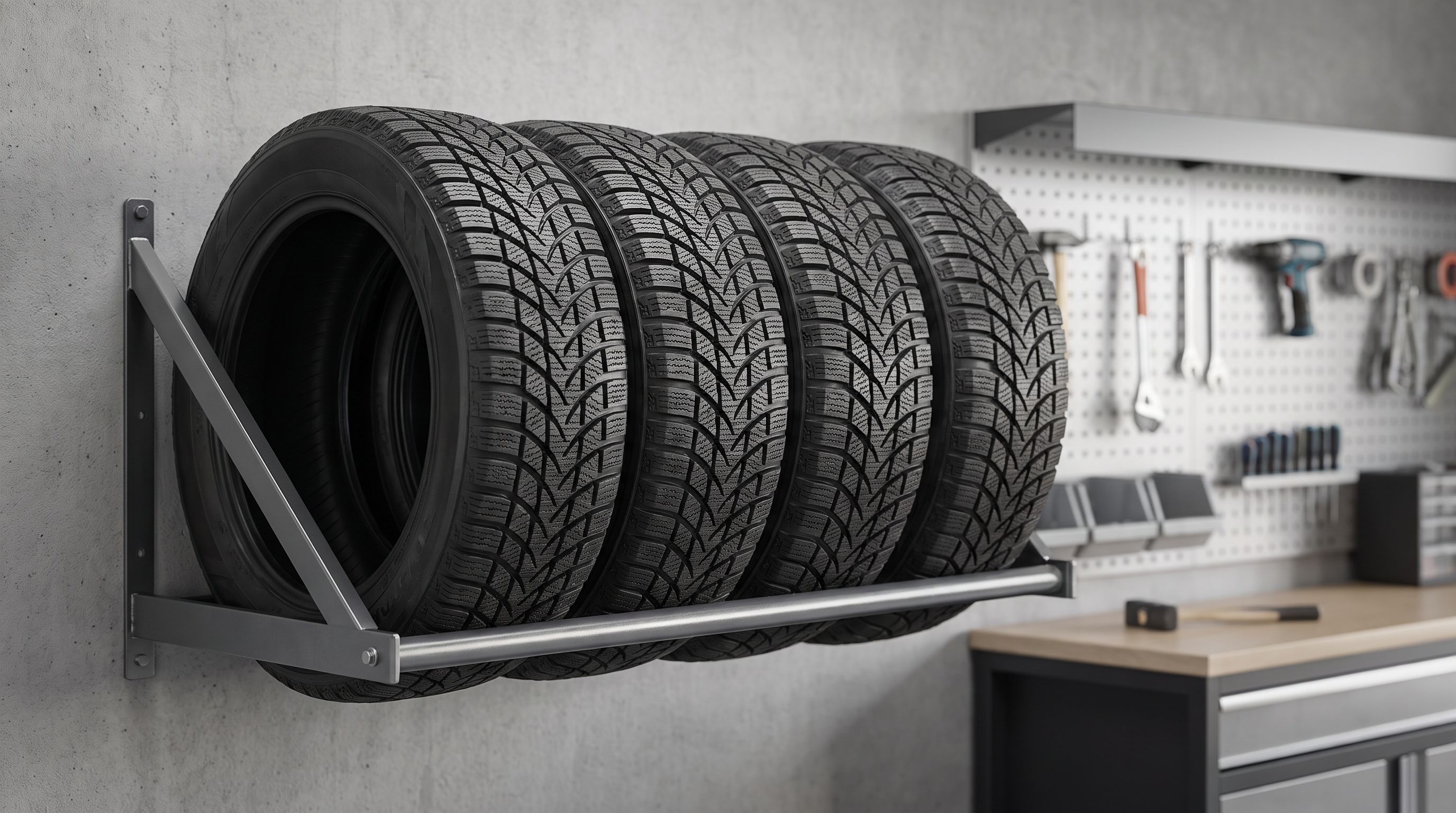
Tire storage rack for garage buyers: per-shelf load ratings, stud spacing, and tire diameter explained, plus four wall-mount and rolling racks for truck and SUV wheels.
Reader-supported: we may earn a commission from links on this page, at no extra cost to you. It never affects our picks. Learn more.
Seasonal tires are the single heaviest thing most people try to hang on a garage wall. A mounted 275/65R18 on an alloy wheel can run well past 70 lb, and a set of four easily clears 280 lb before you add the rack itself. That is why the most important number on a tire storage rack for garage use is not the price or the finish — it is the stated load capacity, and whether you can actually transfer that load into wood studs rather than drywall.
This guide covers what to measure before you buy, how wall-mount, rail, and rolling racks differ, and four specific racks worth short-listing in 2026. We compared published manufacturer specs, installation documentation, and verified owner feedback rather than physically installing each unit, so treat the capacity figures below as the manufacturer's claims — always confirm them on the product page for the exact SKU you order, since brands sell multiple sizes under similar names.
The short version
- Best overall: SafeRacks Wall Mount Tire Rack
- Best wall shelf for mixed storage: FLEXIMOUNTS WR24 Wall Shelf
- Best for single-tire flexibility: Gladiator GearTrack Tire Hooks
- Best rolling pick: Titan Ramps Rolling Tire Rack
- Budget pick: Amazon Basics 5-Shelf Storage Unit
 Budget pick · Amazon Basics 5-Shelf Storage Unit — Check price on Amazon →
 Best rolling pick · Titan Ramps Rolling Tire Rack — Check price on Amazon →
 Best for single-tire flexibility · Gladiator GearTrack Tire Hooks — Check price on Amazon →
 Best overall · SafeRacks Wall Mount Tire Rack — Check price on Amazon →
Measure these four things first
Most returned tire racks are returned for one of four reasons. Spend ten minutes with a tape measure and a stud finder and you will avoid all of them.
1. Overall tire diameter, not the tire size code
A rack rated "for tires up to 34 inches" is quoting overall diameter of the mounted assembly, not section width or rim size. Stand the tire up and measure tread-to-tread across the center. A common 265/70R17 light-truck tire lands around 31.6 in; a 35x12.50R20 is nominally 35 in and will overhang most four-tire wall racks. Also measure section width — a 12.5-inch-wide tire eats shelf depth fast and may force you to store three per shelf instead of four.
2. Stud spacing and wall construction
Nearly every heavy wall-mount tire rack assumes 16-inch on-center wood studs. If your garage was framed at 24-inch centers, or the wall is a concrete block or a steel-stud demising wall, you need a different mounting plan: longer rails that span multiple studs, a plywood backer board lag-screwed into studs, or concrete sleeve anchors rated for shear load. Drywall anchors are never acceptable for tire loads. Find your studs, mark them, and confirm the rack's mounting holes line up before you open the hardware bag.
3. Per-shelf load rating vs. total rating
This trips people up constantly. A shelving unit advertised at "1,500 lb capacity" usually means total across all shelves, often on a leveled floor, evenly distributed. The per-shelf number may be 300 lb. Four truck tires on one shelf can exceed that. For wall racks, the rating is for the whole rack as installed into solid studs — and it is a static rating, not an impact rating, so don't swing tires onto it.
4. Clearance above, below, and in front
Measure the height from the floor to the bottom of the rack you plan to install. You want tires above whatever lives under them (garage door track, workbench, hood of a parked car) while staying inside your reach. Also check the projection: a wall rack holding 12.5-inch-wide tires can stick out 16–18 in from the wall once loaded, which may be enough to interfere with a car door or a garage door panel when it's open and sitting flat against the ceiling.
How to choose
Wall-mount vs. rolling vs. shelving
Wall-mount racks are the most space-efficient and keep the floor clear, but they are permanent and demand solid studs. Rolling racks need no wall at all and let you push a set out to the driveway on swap day — ideal for rented garages or finished walls you don't want to drill. Standard wire or steel shelving is the cheapest route and the most flexible, but you have to respect per-shelf limits and the shelves rarely have a lip to stop a tire from rolling off.
Mounted wheels vs. bare tires
Mounted tire-and-wheel assemblies should be stored stacked flat or hung, and they are heavy. Unmounted tires should be stored upright on their tread to avoid distorting the sidewall, and they're much lighter. If you're storing bare tires only, your capacity math gets a lot easier and a basic shelf will do. If you're storing mounted assemblies — the usual winter-set scenario — go heavy-duty.
Adjustability
Telescoping arms and adjustable shelf heights matter more than they sound. If you change vehicles, your tire diameter changes with it. A rack with extending tubing or a rail system you can reposition is cheap insurance against buying twice.
Finish and environment
Unheated garages swing through dew points, and bare steel racks will surface-rust at scratches. Powder-coated or epoxy-coated steel holds up better. If your garage floor floods or you park on salted roads in winter, keep the bottom shelf off the slab and let the rack breathe.
Comparison table
| Rack | Type | Typical capacity claim | Best for | Watch out for |
|---|---|---|---|---|
| SafeRacks Wall Mount Tire Rack | Wall-mount, telescoping | 400 lb, four tires up to 34 in | Truck and SUV winter sets | Needs 16 in on-center wood studs |
| FLEXIMOUNTS WR24 Wall Shelf | Wall-mount bracket shelf | High stated shelf rating; check SKU | Tires plus bins and fluids | Flat shelf, no tire cradle lip |
| Gladiator GearTrack Tire Hooks | Rail-mounted hooks | Per-hook rating, one wheel each | Odd counts, spares, trailer tires | Requires GearTrack/GearWall rail |
| Titan Ramps Rolling Tire Rack | Freestanding, wheeled | Full set of passenger/LT tires | Renters and finished walls | Takes floor space; check caster lock |
| Amazon Basics 5-Shelf Unit | Freestanding wire shelving | Per-shelf rating well under total | Bare tires, light-duty sets | Per-shelf limit, no retaining lip |
The picks
SafeRacks Wall Mount Tire Rack — best overall
Prices last checked October 24, 2026. Amazon prices change frequently, so treat these as a guide and check the live price before you buy.
SafeRacks Wall Mount Tire Rack
Telescoping 12-gauge arms hold four tires up to 34 in with a 400 lb rated capacity.
This is the default recommendation for anyone storing a mounted winter set off a stud wall. The published spec is four tires up to 34 in overall diameter with a 400 lb capacity, built from 12-gauge telescoping tubing that extends out to roughly 56 in — so you can run it narrow for passenger tires or wide for staggered or truck rubber. The telescoping design is the real differentiator: it adapts to a new vehicle without a new rack. What it gives up is installation flexibility. You need genuine wood studs on standard spacing or a concrete wall with appropriate anchors, and you'll want a helper for the lift. Verify the exact capacity on the SKU you order; SafeRacks sells several wall-rack variants.
FLEXIMOUNTS WR24 Wall Shelf — best wall shelf for mixed storage
FLEXIMOUNTS WR24 Wall Shelf
24 x 48 in bracket shelf that stores tires or bins, with a high stated weight rating.
If you want one wall system that handles tires in winter and totes the rest of the year, a bracket-style wall shelf is more useful than a dedicated tire cradle. The WR24 is a 24 x 48 in shelf on heavy steel brackets, mounted into studs, with a load rating high enough for typical passenger and light-truck sets when you follow the installation instructions exactly. It's also easier to live with visually than open tire arms. The compromise: it's a flat deck, so tires can shift and there is no cradle to stop a wheel from walking off the front edge. Load it with the tires standing on tread and snug them against the wall.
Gladiator GearTrack Tire Hooks — best for single-tire flexibility
Gladiator GearTrack Tire Hooks
Rail-mounted hooks let you hang one wheel at a time and reposition them in seconds.
Not everyone is storing four matched tires. If you have a full-size spare, a track set, a trailer tire, or you rotate three-at-a-time while one gets patched, hooks on a rail beat a fixed rack. Gladiator's GearTrack/GearWall system lets you hang each wheel individually and slide hooks along the channel as needs change — and the same rails hold everything else in the garage. The catch is twofold: you must install the rail system into studs first, which is an added cost and project, and each hook carries one wheel, so a heavy LT set means four hooks spread across the rail rather than concentrated at one point. Check the per-hook rating before loading 70 lb wheels.
Titan Ramps Rolling Tire Rack — best rolling pick
Titan Ramps Rolling Tire Rack
Wheeled steel cart that holds a full set of truck or SUV tires and moves out of the way.
Renters, finished-drywall garages, and anyone who hates drilling should start here. A wheeled steel tire cart holds a full set of passenger or light-truck tires and rolls out of the corner on swap day, which saves your back more than any wall rack does. Some rolling racks in this class offer adjustable baskets or an upper shelf for lug nuts, TPMS tools, and jack stands. The trade-offs are floor space — it occupies real estate a wall rack wouldn't — and caster quality. Look for locking casters and check that the frame doesn't rack side-to-side when loaded on an uneven slab. Confirm the stated tire capacity matches your diameter.
Amazon Basics 5-Shelf Storage Unit — budget pick
Amazon Basics 5-Shelf Storage Unit
Adjustable steel wire shelving that doubles as tire storage when spaced correctly.
Plenty of people store tires on plain steel wire shelving, and it works if you do the math. Independent reviewers consistently rate the Amazon Basics 5-Shelf Adjustable Shelving Unit as a solid value in garage shelving roundups, and the adjustable shelf posts let you set spacing for tire height. Keep the tires on a low shelf so the center of gravity stays down, respect the per-shelf rating rather than the headline total, and consider anchoring the unit to a stud with an L-bracket. What you give up: no retaining lip, no tire-specific geometry, and heavy mounted truck assemblies will push a budget shelf harder than it was designed for. Best for bare tires or passenger-car sets.
Installation notes worth following
Use the lag screws the manufacturer supplies, drill pilot holes, and hit the center of the stud — not the edge. A stud finder plus a small test hole with a finishing nail beats guesswork. If you're mounting to concrete block, use sleeve anchors into the solid web, not the hollow cell, and be honest about the reduced capacity.
Finally, store tires clean and dry, away from direct sunlight and ozone sources like an older electric motor or a welder, and bag mounted assemblies if you can. The rack protects your garage floor; the storage habits protect the rubber.
FAQ
How much weight does a four-tire wall rack actually need to hold? Weigh one assembly on a bathroom scale and multiply by four. Passenger sets often total 150–220 lb; truck and SUV sets on alloys can exceed 280 lb. Pick a rack with a stated rating comfortably above that number, and remember the rating assumes correct installation into structural framing.
Can I mount a tire rack into drywall with anchors? No. Toggle and screw-in drywall anchors are not rated for this kind of sustained static load, and the failure mode is a stack of wheels falling on whatever is parked below. Mount into studs, into a plywood backer that is lag-screwed to studs, or into masonry with proper anchors.
My studs are 24 inches on center. What now? Choose a rack with a mounting rail long enough to span two studs at that spacing, or install a horizontal 3/4-inch plywood backer board across several studs and fasten the rack to the plywood with through-bolts or heavy lag screws. Many wall-mount tire racks only provide hole patterns for 16-inch spacing.
Should tires be stored standing up or stacked flat? Unmounted tires should stand upright on their tread. Mounted tire-and-wheel assemblies can be stacked flat or hung, which is why wall racks and hooks work well for a winter set. Avoid hanging unmounted tires from a hook — it can distort the bead area over months.
Is a rolling rack strong enough for 35-inch truck tires? Some are, many aren't. Check the stated maximum tire diameter and total capacity, and look at caster size — small plastic casters struggle with 70 lb wheels on a rough slab. If you run 35s, a heavy-duty wall rack with telescoping arms or a pair of rail hooks per wheel is usually the more reliable route.
Do I need a tire-specific rack, or will garage shelving do? Shelving is fine for bare tires and lighter passenger sets, as long as you honor the per-shelf limit and set shelf spacing to your tire height. Dedicated tire racks earn their money with heavy mounted assemblies, large diameters, and tight garages where floor space is the scarce resource.
Get the best car care deals in your inbox
Join the GarageProof newsletter for hand-picked car care deals and new buying guides. No spam, unsubscribe anytime.
Related reads
Mechanic Tool Chest Buying Guide 2026: Read the Drawer Ratings
Drawer load ratings, slide type and footprint separate a good mechanic tool chest from a sagging one. Compare 2026's best rolling tool cabinets before you buy.
12V Air Compressor for Truck Tires in 2026: 4 That Handle 80 PSI
Need a 12V air compressor for truck tires or RV duals? We compare duty cycle, max PSI and clamp vs socket power so your roadside kit can actually reach 80–110 PSI.

EVAP Smoke Machine Leak Tester 2026: Pressure & Port Fit
How to pick an EVAP smoke machine leak tester in 2026: safe output pressure, adapter cone sizing, gas cap vs. service port fit, and four picks for DIY garages.