Scissor vs Bottle vs Floor Jack in 2026: What to Carry
Scissor, bottle, or low-profile floor jack? Compare capacity, lift range, and trunk space to pick the best emergency car jack for your vehicle in 2026.
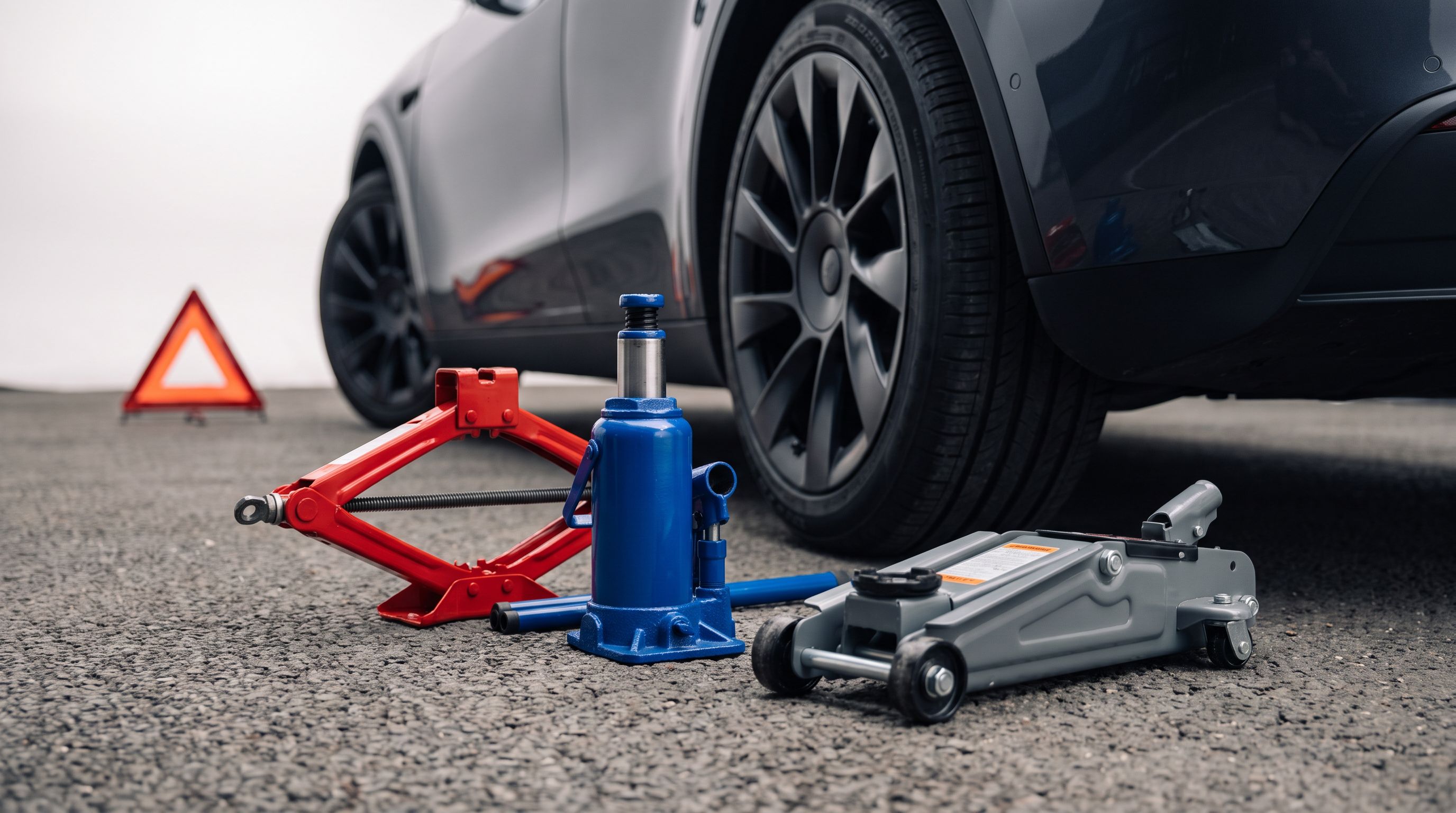
Reader-supported: we may earn a commission from links on this page, at no extra cost to you. It never affects our picks. Learn more.
Your car probably came with a jack. It probably also came with a jack that weighs two pounds, has a crank handle the length of a pencil, and was engineered to meet a legal minimum rather than to make a roadside tire change on a slanted shoulder feel safe. That's the gap this guide covers.
The right answer isn't one jack type — it's the jack type that matches your vehicle's weight, its ride height, and how much space you're genuinely willing to give up. A low-profile floor jack that's perfect for a lowered coupe in the garage is a terrible thing to haul in a hatchback trunk. A bottle jack that lifts a half-ton pickup effortlessly physically won't fit under a Civic's pinch weld. We compared the major jack formats and the models that keep showing up in independent reviews and owner feedback, and sorted out which belongs where.
The short version
- Best overall for trunk storage: Torin Big Red T10152 Scissor Jack
- Best space-saving design: Powerbuilt 620422 Unijack
- Best for trucks and SUVs: Torin Big Red T90213 Hydraulic Bottle Jack
- Best floor jack for garage and driveway: Blackhawk B6350 Fast Lift Service Jack
- Best portable floor jack: Arcan A20015 Aluminum Floor Jack
The three formats, honestly compared
Scissor jacks
A scissor jack is a mechanical screw mechanism inside a diamond-shaped linkage. Turn the screw, the diamond flattens, the car goes up. No hydraulics means no seals to leak and nothing to bleed down overnight.
The upside is packaging: a good aftermarket scissor jack collapses to a few inches tall, weighs under ten pounds, and drops into a spare tire well without eating cargo space. The downside is effort and speed. You will be cranking for a while, and on soft ground or a crowned road the narrow base can feel twitchy. Capacity is also modest — most trunk-sized units land in the 1 to 1.5-ton range, which is fine for a corner lift on a passenger car but not for a loaded SUV.
Best for: sedans, hatchbacks, small crossovers, anyone with a spare tire well to fill.
Bottle jacks
A hydraulic bottle jack is a vertical ram in a cylinder. Pump the handle, the ram extends. These are the capacity champions per pound: 2, 4, even 20-ton units are compact enough to carry.
Their limitation is geometry. Because the ram is vertical, a bottle jack has a tall minimum collapsed height — often 7 to 10 inches. On a low car, that simply won't slide under the jack point, especially with a flat tire already dropping that corner an inch or two. On a truck or body-on-frame SUV with 8-plus inches of clearance, they're ideal, and the long ram stroke means you can lift a tall vehicle far enough to get an inflated spare under it.
Best for: pickups, body-on-frame SUVs, vans, lifted vehicles.
Floor jacks (service jacks)
The horizontal hydraulic jack with wheels and a long handle. The lowest minimum height, the widest stable footprint, the fastest lift, and by far the easiest to use. Also the heaviest and bulkiest — a steel 3-ton service jack can weigh 70 to 90 pounds.
Floor jacks are the right tool for planned maintenance in a garage or driveway. Aluminum versions make a floor jack genuinely portable for an SUV or wagon, but almost nobody should be carrying a full-size steel one as emergency gear.
Best for: home maintenance, track days, brake jobs, anyone with cargo room and a low car.
Comparison table
| Format | Typical capacity | Typical collapsed height | Weight class | Trunk-friendly? | Best vehicle match |
|---|---|---|---|---|---|
| Scissor (Torin T10152) | ~1.5 ton | Very low | Under ~10 lb | Yes — fits most spare wells | Sedans, hatchbacks, small crossovers |
| Bottle/stand combo (Powerbuilt Unijack) | 3 ton | Mid | Moderate | Yes, with cargo space | Cars to mid-size SUVs |
| Bottle (Torin T90213) | 2 ton | Tall | Light for capacity | Yes | Trucks, frame SUVs, vans |
| Steel floor jack (Blackhawk B6350) | 3.5 ton | Low | Heavy | No | Garage/driveway use |
| Aluminum floor jack (Arcan A20015) | 1.5 ton | Very low | Light for a floor jack | In an SUV/wagon, yes | Low cars, track days |
Capacities and heights vary by exact model and production run — always confirm the current spec sheet for the unit you're buying, and remember that jack capacity ratings describe the corner load, not the whole vehicle.
How to choose
1. Match capacity to corner weight, not curb weight
A common mistake is buying a 1-ton jack for a 4,000 lb car and assuming it's marginal. In reality, you're lifting one corner — roughly 30 to 40% of total weight for the heavy end. A 4,000 lb car puts somewhere around 1,400 to 1,600 lb on a front corner. A 1.5-ton (3,000 lb) jack has real headroom there.
That said, buy margin anyway. Hydraulic jacks run smoother and bleed down slower when they're not near their limit, and if you tow, haul, or ever lift from a central frame point, the load doubles fast. For a half-ton pickup, 2 tons is a sensible floor. For anything three-quarter-ton or above, go 3 tons or more.
2. Measure your actual jack point clearance — with a flat tire
This is the step almost everyone skips. Get the car on level ground, find the manufacturer's jack point in the owner's manual (usually a reinforced pinch weld notch behind the front wheel and ahead of the rear), and measure from the ground to that point with a tape. Then subtract one to two inches to simulate a deflated tire on that corner.
If the result is under about 6 inches, a bottle jack is likely out. Under 5 inches and you need a low-profile scissor or a true low-profile floor jack. This single measurement eliminates more bad purchases than any spec sheet comparison.
3. Decide where it lives
Storage drives the decision more than most people admit. A jack in the garage when you're on the shoulder of an interstate is worth nothing.
Spare tire well: scissor jack, every time. Trunk floor or cargo area with room to spare: a bottle jack or the Unijack-style combo. SUV or wagon cargo bay with a load floor: an aluminum floor jack is viable. Sports car with a 4-cubic-foot frunk: you're carrying a compact scissor and nothing else.
4. Plan for the ground you'll actually be on
Roadside shoulders are soft, crowned, and gravelly. A narrow-footprint jack on a soft shoulder is the single most dangerous part of a roadside tire change. Carry a piece of 3/4-inch plywood roughly 12 by 12 inches to spread the load — it costs almost nothing and transforms stability on grass, dirt, or hot asphalt. Chocks for the opposite wheel are the other cheap upgrade. If you only buy one accessory alongside the jack, make it the board.
5. Never work under a vehicle on a jack alone
A jack lifts; a stand holds. For a roadside wheel swap you're never under the car, so a jack alone is acceptable. For anything that puts a body part beneath the vehicle — oil change, exhaust work, suspension — you need stands, or a unit like the Unijack that integrates a mechanical lock.
The picks
Torin Big Red T10152 Scissor Jack — best overall for trunk storage
Prices last checked October 2, 2026. Amazon prices change frequently, so treat these as a guide and check the live price before you buy.
Torin Big Red T10152 Scissor Jack
Compact 1.5-ton scissor jack that stows in a wheel well and still beats most factory jacks on stability.
This is the upgrade that makes sense for most sedan and hatchback drivers: a 1.5-ton scissor jack that's noticeably more substantial than a factory-supplied unit but still disappears into a spare tire well. Reviewers and roadside-kit roundups consistently flag it as a sturdier alternative to the stamped-steel jack from the glovebox, with a broader base and a cranking mechanism that doesn't feel like it's flexing under load.
What it gives up: speed and ease. Cranking a car up by hand takes real effort, the contact saddle is designed for pinch welds rather than frame rails, and it's not a jack you'd choose for repeated garage work. As emergency equipment that's always with you, though, it's hard to beat on packaging.
Powerbuilt 620422 Unijack — best space-saving design
Powerbuilt 620422 Unijack
Bottle jack and jack stand in one 3-ton unit — lift and hold without carrying a separate stand.
The Unijack's trick is combining a 3-ton hydraulic bottle jack with a built-in mechanical jack stand in one housing. You pump it to height, then the structure holds the load on a wide, stable base rather than relying on hydraulic pressure. That's a meaningful safety story for anyone doing brake or suspension work away from a full garage setup, and it's why it keeps appearing in "best space-saving" awards.
It's not weightless, and it still carries a bottle jack's tall collapsed height, so check clearance on a low car before committing. It also works best in pairs if you want to raise a whole axle. But for one tool that both lifts and holds, nothing else in this price class does it.
Torin Big Red T90213 Hydraulic Bottle Jack — best for trucks and SUVs
Torin Big Red T90213 Hydraulic Bottle Jack
A 2-ton hydraulic bottle jack with a tall lift range suited to high-clearance frames and solid axles.
If your vehicle sits high enough to accept it, a bottle jack is the most efficient use of trunk or under-seat space you can buy. This 2-ton Torin pumps a truck corner up quickly with modest handle effort, and the ram stroke handles the generous lift range a pickup needs when a flat tire has dropped one corner.
The compromises are specific: the small saddle demands a flat, solid frame contact point, so know where yours is before you need it; the tall collapsed height rules out low cars entirely; and hydraulic jacks can weep over years of storage, so check it annually. For half-ton trucks, body-on-frame SUVs, and vans, it's the right format.
Blackhawk B6350 Fast Lift Service Jack — best floor jack for garage and driveway

Blackhawk B6350 Fast Lift Service Jack
A 3.5-ton steel service jack with a wide saddle range — the one to keep at home, not in the trunk.
The B6350 is the classic answer when someone asks for a serious home-use floor jack. A 3.5-ton steel service jack with a fast-lift dual pump and a wide saddle height range, it covers everything from a sedan to a full-size SUV and lifts in a handful of strokes. It's the jack that makes rotating your own tires feel like a 20-minute job instead of an afternoon.
Make no mistake about placement: this is garage equipment. It's heavy, it rolls on casters that hate gravel, and it is not what you carry for roadside use. Buy it alongside a trunk jack, not instead of one.
Arcan A20015 Aluminum Floor Jack — best portable floor jack
Arcan A20015 Aluminum Floor Jack
Aluminum 1.5-ton low-profile jack light enough to actually carry in an SUV or wagon cargo area.
Aluminum construction is what makes a floor jack portable. The Arcan A20015 is a 1.5-ton low-profile unit designed for low cars — sports cars, lowered sedans, anything where a standard service jack won't clear the rocker. It's light enough that lifting it into an SUV cargo bay or taking it to a track day is realistic.
The trade-offs are capacity and durability under abuse. At 1.5 tons it's sized for cars, not trucks, and aluminum frames don't love being dragged across concrete. But for owners of low vehicles who want floor-jack ease without a 90 lb anchor, it's the format that fits.
FAQ
Can I use the jack that came with my car? For a single emergency tire change on level ground, yes — that's what it's certified for. But factory jacks are minimal by design, slow to operate, and often have narrow bases that feel unstable on a road shoulder. Treat the OEM jack as a backup, not your primary.
Is a scissor jack safe? A quality scissor jack used at the manufacturer's designated jack point, on firm level ground, with the opposite wheel chocked, is safe for a wheel change. It is not safe for working under a vehicle. Mechanical screw jacks can also slip if the saddle isn't square to the pinch weld, so take ten seconds to confirm seating before you lift.
How do I find my car's jack points? Check the owner's manual first — it will show the reinforced lift points, usually marked with notches or arrows on the pinch weld. Many manufacturers also publish diagrams in the online manual for your exact year, make, and model. Never lift on floor pans, plastic underbody panels, or control arms unless the manual specifically permits it.
Do I need a jack if I have a tire inflator and sealant? A sealant kit handles small tread punctures but does nothing for a sidewall tear or a destroyed tire — and many vehicles sold today ship with sealant instead of a spare. If you carry a spare, carry a jack and a lug wrench. If you don't carry a spare, a jack is less essential, but roadside assistance coverage becomes mandatory.
What else belongs in the kit? A proper lug wrench or breaker bar (factory wrenches are short and torque-starved), wheel chocks, a square of plywood for soft ground, gloves, a headlamp, and a reflective triangle or flares. The jack is maybe half the problem; being visible and able to break loose over-torqued lug nuts is the rest.
Can one jack cover both roadside and garage duty? Rarely, well. The Powerbuilt Unijack comes closest because it lifts and holds in a storable package. Most people end up happiest with two: a compact scissor or bottle jack that permanently lives in the car, and a proper floor jack at home.
Get the best car care deals in your inbox
Join the GarageProof newsletter for hand-picked car care deals and new buying guides. No spam, unsubscribe anytime.
Related reads
Portable Tire Inflators in 2026: Cordless vs 12V Socket
Cordless lithium or 12V socket? We compare the best portable tire inflator options for 2026 on duty cycle, real fill times for truck and car tires, and gauge accuracy.
Car Window Breaker Escape Tool 2026: Spring vs Hammer
Spring-loaded punches fail on laminated side glass. Compare car window breaker escape tools for 2026 and learn which windows in your car can actually be broken.
Battery Terminal Replacement 2026: Top Post vs Side Post
Battery terminal replacement in 2026: how to match top-post, side-post and GM stud fitments, size cable gauge correctly, and which clamp kits are worth buying.