Rotary, DA, or Forced Rotation Polishers, Explained
Rotary, dual action, and forced rotation polishers do the same job three different ways. Here's how the mechanics actually differ — and what a first-timer should own in 2026.
Reader-supported: we may earn a commission from links on this page, at no extra cost to you. It never affects our picks. Learn more.
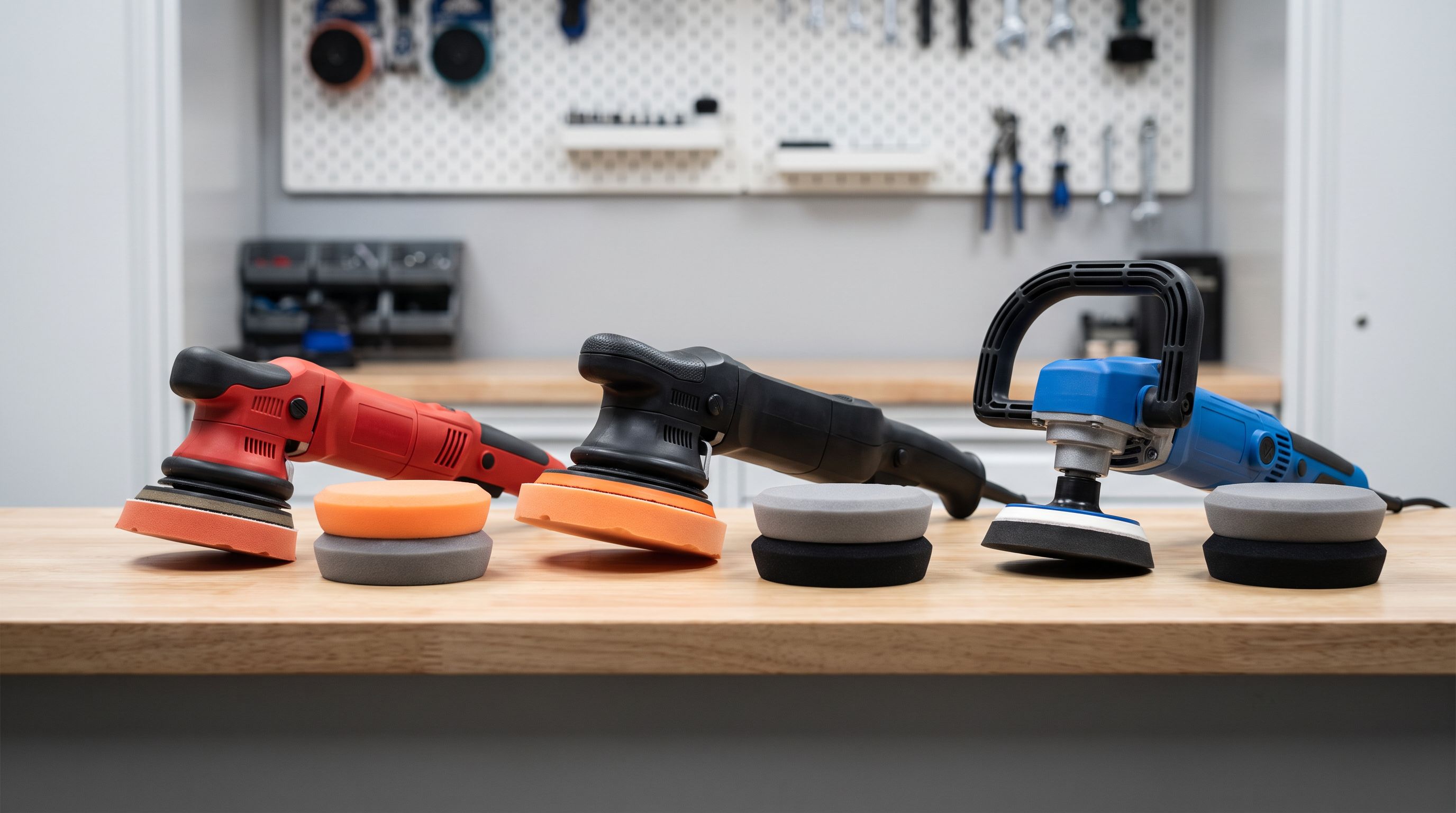
Buy your first polisher and you immediately run into a three-way argument that has been running in detailing forums for roughly two decades. One camp says a rotary is the only tool that truly corrects paint. Another says a dual action is the only tool a beginner should touch. A third says forced rotation splits the difference and makes the other two arguments obsolete.
They're all describing the same physical problem — how do you drag abrasive across clear coat fast enough to level defects, without generating enough heat to destroy it — and solving it with three different drive mechanisms. Understanding those mechanisms is the whole game. Once you know what's happening at the backing plate, the "which should I buy" question mostly answers itself.
What's actually happening at the backing plate
A rotary polisher does one thing: it spins the pad around a fixed axis, driven directly by the motor. Every point on the pad travels a predictable circular path, the abrasive cuts continuously in one direction, and the energy going into the paint is high and concentrated. That's why rotaries cut faster than anything else, and why they're also the tool that burns through clear coat and strikes edges when technique lapses. As one 2026 comparison put it plainly, the rotary's single forced rotation means faster cutting, more heat, and a higher risk of burning through if you don't know what you're doing.
A dual action (also called random orbital, or free-spinning DA) adds a second movement. The backing plate orbits around an offset counterweight and is free to rotate on its own spindle — but that rotation isn't driven. It happens because of friction between pad and paint. Push too hard, hit a curved panel, or angle the tool, and the rotation stalls while the orbit continues. That stall is the built-in safety valve: when the pad stops spinning, cutting collapses and heat buildup stays low. It's also the single biggest source of beginner frustration, because a stalled pad feels like it's working while it's doing almost nothing.
A forced rotation polisher is the hybrid. It orbits like a DA, but the rotation is gear-driven rather than friction-driven, so the pad physically cannot stall. Detailing shops describe it as a gear-driven tool offering more correction than a DA while staying safer than a rotary. The nuance that matters: because the rotation is forced and the tool carries more power, it is possible to overheat paint with a forced-rotation machine — it just takes considerably longer and more carelessness than it would with a rotary.
Here's the mechanical difference in one view:
| Rotary | Dual action (free spinning) | Forced rotation | |
|---|---|---|---|
| Pad movement | Direct spin only | Orbit + friction-driven spin | Orbit + gear-driven spin |
| Can the pad stall? | No | Yes, easily | No |
| Relative cut | Highest | Lowest to moderate | High |
| Heat risk | Highest | Lowest | Moderate |
| Holograms/buffer trails | Common without skill | Essentially none | Rare, possible on soft paint |
| Learning curve | Steep | Shallow | Moderate |
| Works on curves/edges | Requires real skill | Forgiving but stalls | Keeps cutting on curves |
Note the row that forum users actually argue about: stalling. On flat hoods and doors, a free-spinning DA rotates happily. On A-pillars, fender arches, bumper corners and spoiler edges — exactly where swirls hide — it slows or stops. That's the honest case for forced rotation, and it's why experienced detailers who own both say they find themselves reaching for the forced-rotation tool.
The real players and the machines shipping now
The free-spinning DA category is the crowded one. Griot's Garage G9 is the archetypal entry point — a 9mm-throw random orbital that is widely recommended as a first machine precisely because its short stroke and free-spinning design make catastrophic mistakes hard. Step up in stroke and you reach the long-throw class: the Rupes LHR 15 Mark III, with a 15mm orbit, is the tool that essentially created the long-stroke segment and remains the reference point for covering large panels quickly while retaining DA safety. FLEX plays here too with the XFE 7-15 150, a 15mm free-spinning orbital positioned more toward refining and finishing work than heavy defect removal.
 Closest you can buy today · Griot's Garage G9 Random Orbital Polisher — Check price on Amazon →
Forced rotation's flagship is the FLEX XC 3401 VRG, the gear-driven orbital that most forum discussions use as shorthand for the category. It's the machine people mean when they say "forced rotation" without naming anything. Rupes has also pushed hard into gear-driven tools with its Mille line, and the broader market now includes forced-rotation options from several detailing brands — the category is no longer a one-machine curiosity.
Rotaries, meanwhile, haven't gone anywhere. The FLEX PE 14-2 150 is still widely cited by working detailers, and discussions from 2026 note users returning to a Flex rotary specifically for comfort and the near-absence of the vibration that long-throw orbitals generate. That's an underrated point: orbital machines shake. Rotaries are smooth. Over a full car, that difference is physical.
What it means if you're shopping today
If this is your first polisher, buy a free-spinning dual action. Not because it's the "best" tool — it isn't, by any cutting metric — but because the failure mode is wasted time rather than a repaint. A stalled pad costs you an hour. A rotary held too long on a body line costs you a panel.
Within that, the throw decision is the real one. A 9mm machine like the Griot's Garage G9 is more controllable on tight panels and easier to keep flat; a 15mm machine like the Rupes LHR 15 Mark III clears a hood dramatically faster but is unwieldy around mirrors and pillars. Plenty of people end up owning both strokes eventually; almost nobody regrets starting short.
Forced rotation is the right second machine, not the first — unless you already understand pad pressure, panel temperature and how to read a polish as it breaks down. The FLEX XC 3401 VRG class of tool rewards someone who has already been frustrated by stalling and knows why it matters. Buy it before you've had that frustration and you've paid for a capability you can't yet evaluate.
The rotary is a specialist tool. It earns its place on heavily oxidized single-stage paint, on wet-sanding cleanup, and in the hands of someone who corrects cars for money. For a weekend owner removing swirls from a daily driver, it solves a problem you probably don't have while creating one you definitely can't fix.
What to watch next
Three things are quietly shifting the category. First, cordless. Battery orbitals have moved from novelty to credible, and as platform batteries get denser, the tether argument for corded machines weakens — particularly for small-area and spot-correction work. Second, the stroke war is maturing: with 9mm, 12mm, 15mm and 21mm options all shipping, brands have started competing on ergonomics, vibration and head size rather than raw throw numbers. Third, forced rotation keeps moving down-market as more manufacturers ship gear-driven heads, which should narrow the price gap that currently makes the category feel semi-professional.
What hasn't changed, and probably won't: the pad-and-polish combination still determines most of your result. A capable DA with the right cutting pad and a modern abrasive will out-correct a rotary used badly, every time. The tool sets your ceiling. Technique decides where you actually land.
FAQ
Can a DA polisher remove deep scratches? Only within limits. If a scratch catches a fingernail, it's likely through the clear coat and no polisher will remove it safely. DAs handle swirls, light oxidation and wash marring well, especially with a cutting pad and a compound.
Is forced rotation dangerous for beginners? Less dangerous than a rotary, more than a free-spinning DA. Because the pad can't stall, it keeps cutting even when you've made a mistake — detailers note that overheating paint is possible, just slower to happen than with a rotary.
Why does my DA pad stop spinning? That's the friction-driven design working as intended. Too much pressure, too steep an angle, or a curved panel breaks the friction the tool needs. Reduce pressure and keep the plate flat.
Do I still need a rotary if I have a forced-rotation machine? For most DIY work, no. Rotaries retain an edge on severe defect removal and sanding-mark cleanup, and some users prefer them for lower vibration — but that's a comfort and specialist-capability argument, not a beginner one.
Does a bigger throw mean better correction? Not automatically. A longer stroke covers more area per pass, but it also increases vibration and makes tight panels harder. Correction comes from abrasive, pad and pressure as much as from orbit size.
Our picks
Prices last checked October 21, 2026. Amazon prices change frequently, so treat these as a guide and check the live price before you buy.
Griot's Garage G9 Random Orbital Polisher
A 9mm-throw free-spinning DA — the forgiving, hard-to-ruin-paint starting point for a first polisher.
Rupes LHR 15 Mark III Random Orbital Polisher
The 15mm-throw Rupes is the long-stroke benchmark: fast panel coverage with free-spinning safety.
FLEX XFE 7-15 150 Random Orbital Polisher
A 15mm free-spinning orbital from FLEX, aimed at refining and jeweling rather than heavy cutting.

FLEX XC 3401 VRG Dual Action Orbital Polisher
Gear-driven forced rotation: the pad can't stall, so correction speed is predictable panel to panel.
Get the best car care deals in your inbox
Join the GarageProof newsletter for hand-picked car care deals and new buying guides. No spam, unsubscribe anytime.
Related reads
Interior Detailer vs Protectant 2026: Stop Dash Cracking
Interior detailer or UV protectant? We compare the best interior car protectant options for 2026 by finish, greasiness and real UV-blocking claims.
Torque Wrench Calibration, Explained (2026 Reality Check)
How fast torque wrenches drift, what ±4% accuracy actually buys you, and why fastener friction ruins the number long before your wrench does.
No-Start Diagnosis in 2026: Testers vs. Guessing
Load testing, conductance testers and parasitic draw checks explained — why a battery can "test good" and still leave you stranded, and which cheap tools actually find the fault.