Roof Cargo Box Fitment in 2026: Measure Before You Buy
A 2026 roof cargo box fitment guide: crossbar spread, roof weight limits, hatch clearance and ski length, plus four boxes that fit the widest range of racks.
Reader-supported: we may earn a commission from links on this page, at no extra cost to you. It never affects our picks. Learn more.
Most roof box regret isn't about the box. It's about the roof. People order a 21-cubic-foot shell, bolt it on, then discover the rear hatch smacks into it, or the front lip shadows the windshield and howls at 65 mph, or the crossbars sit so close together that the mounting clamps barely straddle them.
Cargo box fitment comes down to four numbers you can measure in about ten minutes: your crossbar spread, your vehicle's dynamic roof load limit, the clearance arc of your rear hatch, and the usable length of your roof between the windshield and the back edge. Get those, and choosing a box becomes straightforward. Skip them, and you're gambling with a bulky item that's miserable to return.
This guide walks through the measurements first, then recommends boxes that fit the widest range of real-world racks, based on manufacturer fit specs, independent reviews and verified owner feedback.
The short version
- Best overall: Thule Force XT L
- Best for tight crossbar spreads: Yakima SkyBox NX 16
- Best for small cars and short roofs: Yakima RocketBox Pro 12
- Best value: SportRack Vista XL
- Premium pick: Thule Motion 3 XXL
 Premium pick · Thule Motion 3 XXL — Check price on Amazon →
 Best value · SportRack Vista XL — Check price on Amazon →
 Best for tight crossbar spreads · Yakima SkyBox NX 16 — Check price on Amazon →
 Best overall · Thule Force XT L — Check price on Amazon →
Measure your roof before you shop
1. Crossbar spread (the number that kills most orders)
Measure center-to-center between your front and rear crossbars. That's your spread. Every cargo box lists a minimum spread — typically somewhere in the 22–36 inch range depending on model — and if your bars are closer together than the minimum, the box's clamps physically can't reach both bars in a stable position.
Factory "integrated" roof rails on compact crossovers are the usual problem. The crossbars that come with them are often fixed at a spread in the low 20s, and some fixed-point systems can't be moved at all. If your spread is under about 24 inches, filter hard for boxes that advertise short-spread compatibility.
Also measure bar width (the usable span between the towers) and bar profile. Square bars, round bars, factory aero bars and wing bars all have different cross-sections, and thick aftermarket aero bars can exceed the clamp opening on budget boxes. Note the bar height and width in millimeters if you can — most manufacturers publish a maximum bar dimension for their clamps.
2. Dynamic roof load limit
This is the number in your owner's manual, and it's the one most people never look up. Dynamic load — the weight your roof can carry while driving — is commonly in the 100–165 lb range for passenger cars and crossovers, and it includes the rack, the box, and everything inside.
Do the subtraction: a mid-size box can weigh 40–55 lb empty, and a crossbar set adds another 10–20 lb. On a 150 lb limit, that leaves roughly 75–100 lb of actual cargo. That's sleeping bags, jackets, duffels and camp chairs — not tools, firewood or books. Many boxes also carry their own internal load rating (often around 110–165 lb), so your real ceiling is whichever number is lower.
Static load (parked, as with a rooftop tent) is a different, much higher figure. Don't confuse the two.
3. Hatch and garage clearance
Two clearance checks matter:
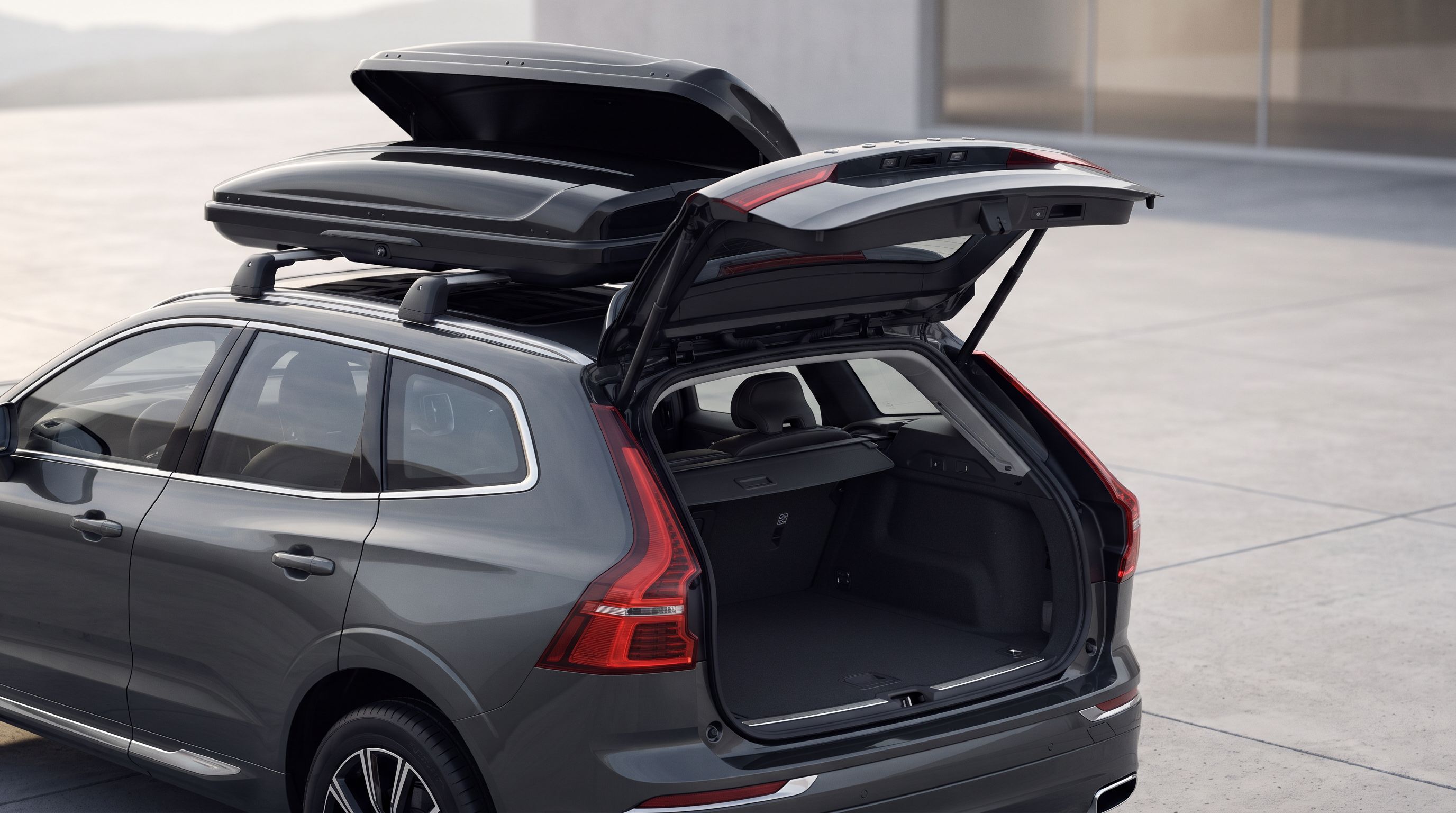
- Rear hatch swing. Open your liftgate fully and look at where the top edge travels. Boxes that overhang the rear of the roof can get clipped. Mounting the box slightly forward usually fixes it, but that pushes you into the next problem.
- Windshield and sunroof. Push the box too far forward and you create a wind scoop, amplify noise, and may block a sunroof or shade a roof-mounted antenna. Leave a few inches behind the windshield's top edge.
Then measure your garage door opening and the height of your vehicle with the box fitted. Add roughly 14–18 inches to your roof height for most boxes. Parking garages with 6'6" clearance bars become off-limits quickly.
4. Opening side and ski length
Dual-side opening (available on the Thule Force XT L, Thule Motion 3 XXL, Yakima SkyBox NX 16 and Yakima RocketBox Pro 12) means you can load from the curb instead of standing in traffic. It's the single most appreciated convenience feature in owner reviews.
If you ski, check the box's maximum ski length, not just its overall length — the usable internal channel is always shorter than the shell. Longer skis and snowboards need the longest boxes in a range, which loops right back to your roof length and hatch clearance.
Comparison
| Box | Size class | Opening | Mounting | Best suited to |
|---|---|---|---|---|
| Thule Force XT L | Large | Dual-side | PowerClick quick-mount | Mid-size crossovers and SUVs with average bar spread |
| Yakima SkyBox NX 16 | Mid-large | Dual-side | Wide-range clamps | Short or awkward factory crossbar spreads |
| Yakima RocketBox Pro 12 | Small-mid | Dual-side | Clamp-on | Sedans, hatchbacks, low roof load limits |
| SportRack Vista XL | Large | Single-side (passenger) | U-bolt style hardware | Budget builds on square or round bars |
| Thule Motion 3 XXL | Extra large | Dual-side | PowerClick quick-mount | Long-roof SUVs, vans, long skis |
Always confirm against the manufacturer's current fit guide for your exact year, make and model — both Thule and Yakima publish vehicle-specific fit lookups, and rack configurations change between model years even on the same nameplate.
The picks
Thule Force XT L — best overall
Prices last checked October 3, 2026. Amazon prices change frequently, so treat these as a guide and check the live price before you buy.
Thule Force XT L
Dual-side opening, PowerClick mounts and a shape that clears most hatches on mid-size crossovers.
The Force XT L is the default answer for a reason: it's a large-capacity box with a footprint that still clears the hatch on a lot of mid-size crossovers, and the PowerClick mounting system tightens by hand until it clicks, which removes the guesswork of "is this tight enough?" Dual-side opening and a central locking system that won't release the key unless the lid is latched are genuinely useful details on a road trip.
What it gives up: it's not the quietest or sleekest shell in Thule's catalog — the Motion line is smoother and slightly more aerodynamic — and the textured ABS finish shows scuffs. It's also heavy enough that one-person installation is awkward. Verify your crossbar spread meets Thule's stated minimum for this model before ordering.
Yakima SkyBox NX 16 — best for tight crossbar spreads
Yakima SkyBox NX 16
Narrow footprint and wide-range clamps make it one of the easiest boxes to fit on short factory racks.
The SkyBox family has long been the go-to when a roof is uncooperative. The NX generation's clamps accommodate a broad range of bar shapes — round, square, factory and aero — and the box's relatively narrow, tall profile means it occupies less lateral roof space, which matters if you also carry bikes or a kayak alongside it.
The 16 sits in a useful middle ground: real family capacity without the rear overhang of the larger SkyBoxes. The trade-off is interior shape. A tall, narrow box swallows duffels well but is less friendly to wide, rigid items, and the taller silhouette adds more to your overall height than a low-profile box. Check garage clearance carefully.
Yakima RocketBox Pro 12 — best for small cars and short roofs
Yakima RocketBox Pro 12
Low, slim and light, so it suits sedans and compact hatchbacks with modest roof load limits.
If you drive a sedan, a compact hatchback or anything with a modest roof load limit, the RocketBox Pro 12 is the sensible choice. It's low, slim and comparatively light, so a bigger share of your dynamic load budget goes to actual cargo rather than the shell. The low profile also keeps wind noise and fuel-economy penalties down, and it fits short crossbar spreads more readily than full-size boxes.
The obvious concession is capacity — this is a weekend-for-four box, not a two-week-for-five box. Skiers should note that the 12 is the shortest in the RocketBox range and won't take longer skis; step up in length if that's your use case.
SportRack Vista XL — best value
SportRack Vista XL
Full-size capacity with simple U-bolt style mounting at a far lower outlay than premium boxes.
SportRack is Thule's budget-oriented sibling brand, and the Vista XL delivers large-box capacity for substantially less outlay. Owner feedback consistently describes it as spacious, weather-resistant for normal road use, and perfectly adequate for hauling soft goods on family trips.
Where it economizes is in the details. Mounting uses simpler U-bolt style hardware that takes longer to install and adjust than the quick-mount systems on premium boxes, and it opens from one side only — fine if you always load curbside, annoying otherwise. Fit flexibility across exotic factory aero bars is narrower too, so check bar dimensions against the spec before committing.
Thule Motion 3 XXL — premium pick
Thule Motion 3 XXL
Longest ski capacity and a slick, quiet shell for long-roof SUVs and vans with generous bar spread.
For long-roof SUVs, three-row vehicles and vans, the Motion 3 XXL is the top of the practical range: maximum length for skis and snowboards, a refined low-drag shell, dual-side opening and the same PowerClick mounting as the Force. The lid feel, latch quality and finish are a visible step up.
The catch is simple physics. An XXL box needs a long roof and a generous crossbar spread, and it will almost certainly interfere with a rear hatch unless mounted well forward — which means you must also confirm windshield clearance. It's the most demanding box here on fitment, and the one most likely to be returned if you skip the measuring step.
Installation and living with it
Load distribution matters more than people expect. Aim to concentrate the bulk of the weight in the middle of the box, between the crossbars, rather than at the nose or tail — roughly 60% centered is a widely used rule of thumb. Weight hanging out past the bars levers on the rack and makes the car feel more nervous in crosswinds.
Expect a fuel economy penalty. Independent testing has repeatedly shown roof-mounted cargo boxes cost real mpg at highway speeds, often in the double-digit percentage range. Take the box off when you're not using it; it also halts the slow wear on seals and clamps.
Finally, re-torque after the first drive. Clamps settle. Check them at your first fuel stop, then periodically on a long trip.
FAQ
What's the minimum crossbar spread for a roof cargo box? It varies by model, but many boxes specify a minimum somewhere in the low-to-mid 20s of inches, measured center-to-center. Short-spread-friendly designs like the Yakima SkyBox NX line tend to be the most accommodating. Always check the specific figure in the manufacturer's spec sheet for the model and size you're considering.
Can I fit a cargo box with only factory roof rails and no crossbars? No. Roof-mounted boxes clamp to crossbars, not to the side rails. If your vehicle has raised rails, you need a crossbar set designed for them; if it has flush rails or a bare roof, you need the corresponding fixed-point or clip-based system. Buy the crossbars first, confirm the spread, then choose the box.
How much weight can I actually put in a roof box? Take your vehicle's dynamic roof load limit from the owner's manual, then subtract the weight of your crossbars and the empty box. Whatever's left is your cargo allowance — frequently 70–100 lb on a typical crossover. Also check the box's own maximum load rating and use the lower of the two numbers.
Will a roof box hit my rear hatch when it opens? It can, especially with large and extra-large boxes on shorter roofs. Open your liftgate fully before mounting and note the top edge's travel path. Sliding the box forward usually solves it, but confirm you still have clearance behind the windshield and aren't blocking a sunroof.
Is a dual-side opening box worth paying for? If you ever load alone or at the curb, yes — it's one of the most consistently praised features in owner reviews. Single-side boxes like the SportRack Vista XL are fine if you always have driveway access, but the convenience gap shows up fast in a parking lot.
Do roof boxes hurt fuel economy much? Yes, measurably, and more so at highway speeds. Lower, slimmer boxes such as the Yakima RocketBox Pro 12 cost less than tall, large-volume shells. Removing the box between trips is the simplest fix.
Get the best car care deals in your inbox
Join the GarageProof newsletter for hand-picked car care deals and new buying guides. No spam, unsubscribe anytime.
Related reads
Roof Rack Crossbars 2026: Fitment by Roof Type First
Roof rack crossbars fitment made simple: identify raised rails, flush rails, fixed points or a naked roof, then pick the right foot pack and load rating.
Hitch Cargo Carriers 2026: Match Tongue Weight First
A hitch cargo carrier guide for 2026: match receiver class, tongue weight rating and shank rise to your truck or SUV before you buy a 2-inch basket.
Mud Flaps for Trucks 2026: Fit the Wheel Well, Not the Badge
Heavy-duty mud flaps for trucks in 2026: how wheel-well lip, lift height and flare type decide whether drill-in or no-drill kits actually fit.