Ratcheting Wrench Sets 2026: Flex-Head vs Fixed Clearance
Pick a ratcheting wrench set by swing arc, head profile and SAE/metric spread — not piece count. Flex-head vs fixed compared, with 4 picks for 2026.
Reader-supported: we may earn a commission from links on this page, at no extra cost to you. It never affects our picks. Learn more.
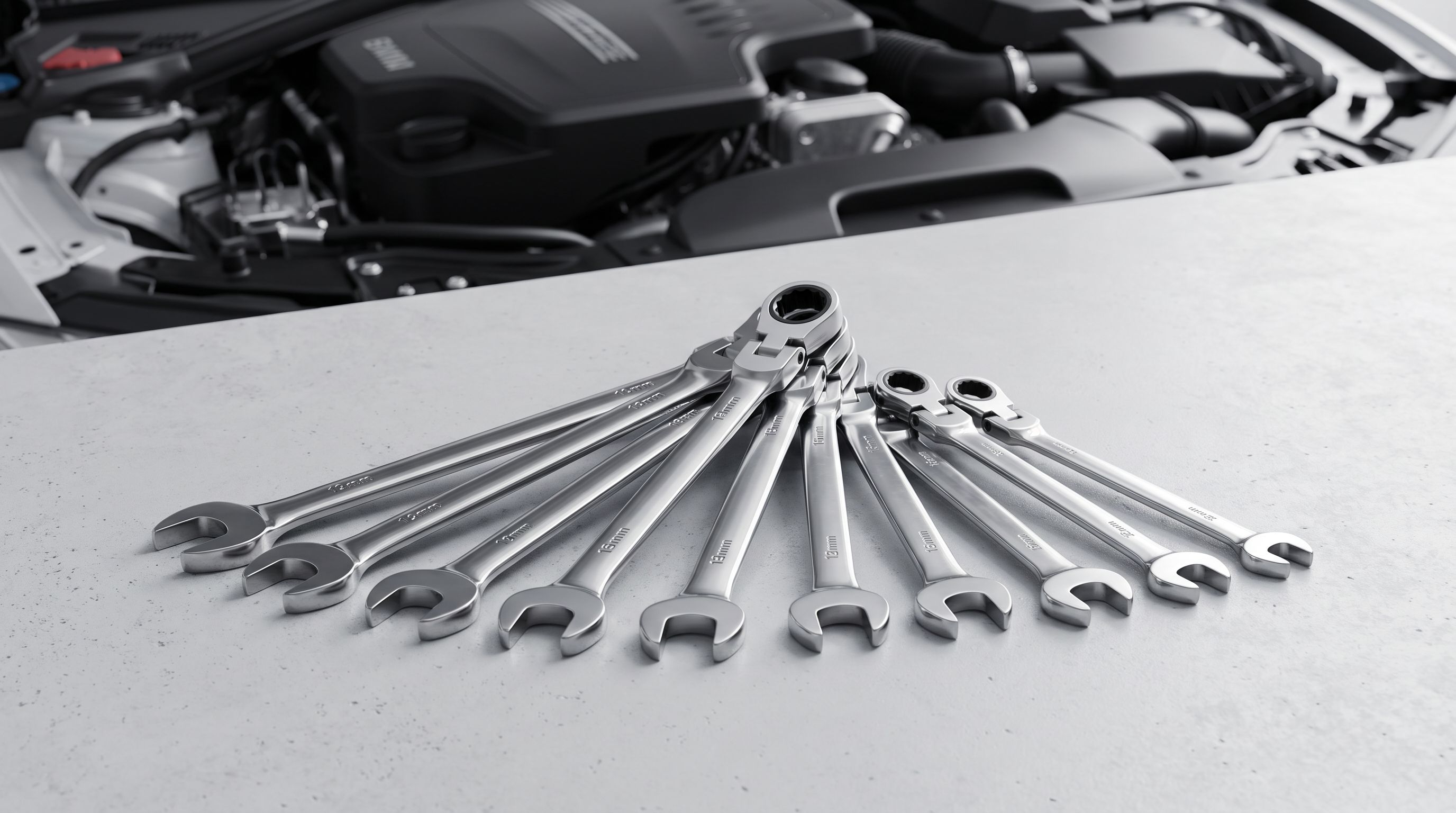
Piece count is the worst way to shop for a ratcheting wrench set. A 34-piece set that duplicates sizes you already own in sockets is worth less than a 12-piece set whose heads actually fit behind the alternator bracket. What determines whether a wrench earns its slot in the drawer is swing arc, head thickness, head profile, and whether the size you need is actually in the box.
This guide ranks sets by access clearance first — flex-head versus fixed, 72-tooth versus 120-position — then by SAE/metric spread. GarageProof researches and compares using manufacturer spec sheets, independent tool-publication testing, and verified owner feedback; we don't physically test units ourselves.
The short version
- Best overall: GearWrench 86929 20-Piece Flex-Head Ratcheting Wrench Set (SAE/Metric)
- Best organization: Tekton WRC95301 Ratcheting Combination Wrench Set 30-Piece
- Best tight-clearance pick: GearWrench 9412 12-Piece 120XP Flex-Head Ratcheting Wrench Set (Metric)
- Best budget set: DEWALT DWMT75113 20-Piece Ratcheting Combination Wrench Set
Flex-head vs fixed: what you're actually trading
This is the central decision, and it isn't a quality question — it's a geometry question.
Fixed-head ratcheting wrenches have the box end rigidly in line with the handle. They're thinner through the head, stronger in the ratchet mechanism (nothing is cut away for a pivot), and they cost less. On a fastener you can approach straight-on — exhaust manifold studs with the heat shield off, suspension hardware on a lift, most engine-bay work with the intake out — a fixed head is the better tool. It also slides into narrow slots between a bracket and a casting where a pivoting head would bind.
Flex-head ratcheting wrenches pivot the box end through a wide arc (typically around 180 degrees of total travel, detented along the way). That lets you reach over an obstruction and get the handle out into open air, which is the single most common access problem on a modern transverse-mounted engine. The costs are real: the head is taller, the pivot adds flex under heavy torque, and some designs will flop under their own weight unless the detents are firm. Owner feedback consistently separates sets by detent stiffness — loose detents are the most-complained-about flex-head failing.
The honest answer for most DIYers: buy flex-head as your primary set if you only buy one, because you can always pull the pivot straight and use it like a fixed wrench. Buy fixed-head if you already own flex and want a thinner, tougher backup — or if your work is mostly farm, trailer, and chassis hardware where torque matters more than angles.
Tooth count is really about swing arc
"72-tooth" is marketing shorthand for a 5-degree swing arc — the smallest handle sweep that will advance the ratchet one click. Lower-cost sets often run 60-tooth (6 degrees) or even 45-tooth (8 degrees). High-count designs like GearWrench's 120XP use a pawl arrangement that delivers a 3-degree arc.
Here's the practical translation:
| Mechanism | Swing arc | What it clears | Trade-off |
|---|---|---|---|
| 45–60 tooth | 6–8° | Open bays, bench work | Cheapest, most durable pawls |
| 72 tooth | 5° | The realistic sweet spot for most car work | Standard on most quality sets |
| 90 tooth | 4° | Tight brackets, firewall fasteners | Slightly finer pawl teeth |
| 120 position (120XP) | 3° | Fasteners boxed in on three sides | Premium price; fewer sizes per set |
Beyond about 72 teeth, you're paying for the last few degrees — which only matters in genuinely boxed-in spots. That's exactly why a 120XP set works better as a supplement than as your only set.
Head thickness and profile matter as much as arc
Two wrenches can both be 72-tooth and still behave completely differently. The dimension that decides whether a wrench fits into a recessed bolt well is the head height (thickness through the box end), and the dimension that decides whether it clears an adjacent casting is the head width across the box. Manufacturers rarely advertise either prominently, but they do publish them in spec PDFs — worth a look if you have a specific job in mind.
Also check the box end point count. Twelve-point box ends engage every 30 degrees, which halves the repositioning you have to do in a restricted arc and works on both hex and square fasteners. Six-point is stronger and far less likely to round a corroded head. Most ratcheting wrenches are 12-point by necessity; if you work on rusted chassis hardware, keep a six-point non-ratcheting set or deep sockets alongside.
SAE/metric spread beats piece count
Count the sizes, not the pieces. A good general-purpose automotive spread is roughly 8mm through 19mm with no gaps (10, 12, 13, 14, 15, 16, 17, 18 are the workhorses), plus 5/16" through 3/4" if you touch American trucks, trailers, or older equipment. Sets that advertise big numbers sometimes do it by including a rack, a pouch, and three sizes you'll never put on a bolt.
Two specific gaps to watch for: 22mm (common on axle-adjacent and some suspension hardware) is missing from most mid-size sets, and 23mm is skipped by many manufacturers entirely — the Reddit r/Tools buying threads for 2026 call this out on several popular sets, including DeWalt's ToughSeries 6–24mm run. Know before you buy whether your vehicles need those.
How to choose
1. Start with your access problem, not your budget
Walk out to the car and look at the three fasteners that annoy you most. Are they blocked above (flex head wins) or beside (thin fixed head wins)? Is there room for a 5-degree sweep or barely a wiggle (120-position territory)? That five-minute survey is worth more than any spec sheet.
2. Decide whether you need both SAE and metric — now
Combined SAE/metric sets cost less than buying two separate sets and keep everything in one roll. But if you only ever work on Japanese, Korean, or modern European vehicles, a metric-only set gets you more usable sizes per dollar and takes up half the drawer space. Mixed-fleet garages (a domestic truck plus an import) should go combined.
3. Check the detent and anti-flop behavior
On flex heads, firm detents are everything. Loose pivots mean the wrench droops as you reach into a bay and you lose the angle you set. This rarely appears on spec sheets, so lean on owner reviews — search specifically for "flop" or "loose head" in the reviews of any set you're considering.
4. Plan storage before you buy
Loose wrenches in a drawer are a daily tax. Trays, rolls, and modular racks aren't a luxury — they're how you notice a wrench is missing before you close the hood on it. Tekton's modular organizer approach is the clearest example of this done well, and it's a legitimate reason to pick one set over another with similar steel.
5. Ignore "lifetime warranty" as a tiebreaker
Nearly every brand here offers one. The thing that varies is how painless the claim is. Big-box and direct-brand warranties (GearWrench, DeWalt, Tekton) are generally straightforward; house brands from smaller sellers are where owner reports get inconsistent.
The picks
GearWrench 86929 — best overall
Prices last checked November 1, 2026. Amazon prices change frequently, so treat these as a guide and check the live price before you buy.

GearWrench 86929 20-Piece Flex-Head Ratcheting Wrench Set (SAE/Metric)
72-tooth flex heads with a slim box profile — the most access per dollar for mixed SAE/metric work.
This is the default recommendation for a reason: a combined SAE and metric flex-head set built on GearWrench's 72-tooth mechanism, which independent tool testing has repeatedly singled out for smooth, slip-free operation with minimal play. The flex heads give you the over-the-obstruction reach that fixed sets can't, the box profiles are slim enough for most recessed fasteners, and the size spread covers the day-to-day automotive range in both systems. What it gives up: the pivots add head height, so there are low-clearance spots where a thin fixed wrench still wins, and the 5-degree arc won't save you in the very tightest corners. For one set that handles 90% of driveway work, this is it.
Tekton WRC95301 — best organization

Tekton WRC95301 Ratcheting Combination Wrench Set 30-Piece
Fixed-head 12-point wrenches with a genuinely complete SAE/metric spread and modular storage.
Tekton's approach is the opposite of minimalism: a genuinely complete 12-point fixed-head spread across both SAE and metric, delivered in modular organizers that keep every size visible and accounted for. Because the heads are fixed, they're thinner and stiffer than any flex equivalent — better for high-torque chassis and suspension work, and better for sliding into slots. The compromise is obvious: no pivot means no reaching over brackets, so you'll occasionally be swapping to a socket and wobble extension. Buy this if you want one set that covers every size you'll realistically meet, and you're willing to solve access a different way.
GearWrench 9412 120XP — best tight-clearance pick

GearWrench 9412 12-Piece 120XP Flex-Head Ratcheting Wrench Set (Metric)
120-position head needs just a 3-degree swing arc — the one to grab when nothing else will move.
The 120XP mechanism needs only a 3-degree swing arc, which is the difference between turning a fastener and giving up on it. Combined with a flex head, this metric set is purpose-built for fasteners boxed in on multiple sides — firewall-adjacent bolts, bracket hardware buried behind accessories, anything you currently reach with a quarter-inch ratchet and a prayer. What it gives up: it's metric-only and a smaller size count, so it's a specialist rather than a first set, and the finer pawl engagement is less tolerant of brute force than a coarse 45-tooth design. Pair it with a broader set rather than replacing one.
DEWALT DWMT75113 — best budget set
DEWALT DWMT75113 20-Piece Ratcheting Combination Wrench Set
Fixed-head 72-tooth wrenches covering both SAE and metric for a first full set.
A straightforward fixed-head 72-tooth set spanning SAE and metric — the right starting point if you're building a first toolbox and don't yet know which sizes you'll live in. You get a usable swing arc, a familiar warranty path, and both measurement systems without a two-set purchase. The compromises are the ones you'd expect at the price: fixed heads only, so access is purely straight-on; the storage tray is functional rather than great; and finishing details like chamfered box ends aren't as refined as on pro-grade sets. If you later add a flex set, this one becomes a perfectly good thin-profile backup instead of dead weight.
Quick comparison
| Set | Head type | Arc | Coverage | Best for |
|---|---|---|---|---|
| GearWrench 86929 | Flex | 5° (72T) | SAE + metric | One-set buyers, mixed fleets |
| Tekton WRC95301 | Fixed | 5° (72T) | SAE + metric, wide spread | Complete coverage + storage |
| GearWrench 9412 120XP | Flex | 3° (120 pos.) | Metric | Boxed-in fasteners |
| DEWALT DWMT75113 | Fixed | 5° (72T) | SAE + metric | First set on a budget |
A note on fitment and torque
Ratcheting wrenches are not torque tools. The pawl mechanism — especially high-tooth-count designs — is the weakest link in the wrench, and the published torque ratings are well below what the same-size box end could take if it were solid. Use the ratchet function to run fasteners down and spin them off; do final tightening and initial breaking loose with a non-ratcheting wrench, a breaker bar, or a socket on a proper ratchet. Never put a pipe on a ratcheting wrench.
Fastener sizes also vary by year, make, and model even within a single platform — a manufacturer may change a bracket bolt mid-generation. Before buying a set to solve one specific job, confirm the size against a service manual or a reputable model-specific forum rather than assuming.
FAQ
Is a higher tooth count always better? No. More teeth means a smaller swing arc but finer, individually weaker pawl teeth. A 72-tooth (5-degree) set is the practical sweet spot for most car work; go to 120-position only for genuinely restricted access, and keep a coarser set for heavy stuff.
Can I use ratcheting wrenches to torque fasteners to spec? Use them to run fasteners down, then finish with a torque wrench. The ratchet mechanism limits how much torque the wrench can safely transmit, and spec values should always come from a calibrated torque wrench.
Do I need both SAE and metric? Only if you work on American trucks, trailers, older equipment, or aftermarket hardware. Modern imports are essentially all metric, and a metric-only set gives you more useful sizes for the same money.
Flex-head wrenches keep flopping around. Is mine defective? Possibly, but more often it's a design-level detent weakness. Firm, clicky detents are what separate good flex sets from frustrating ones — check reviews for the words "flop" or "loose" before buying.
Should I buy 6-point or 12-point box ends? Ratcheting wrenches are nearly always 12-point, which is fine for most work and helps in restricted arcs. For rusted or rounded fasteners, reach for a 6-point socket or non-ratcheting wrench instead — 12-point contact is more likely to slip on damaged corners.
Is a 30-plus piece set worth it over a 12-piece? Only if the extra pieces are sizes you'll actually use. Count distinct sizes, not pieces, and check for the specific gaps that matter to you — 22mm and 23mm are the ones most commonly missing.
Get the best car care deals in your inbox
Join the GarageProof newsletter for hand-picked car care deals and new buying guides. No spam, unsubscribe anytime.
Related reads
Wheel Lock Removal Tool Kit 2026: Match Your Spline First
Lost your wheel lock key? Learn how to identify your lock pattern and pick a wheel lock removal tool kit that actually grips — sized by lug diameter and depth.
Oil Filter Wrench Fitment 2026: Cap, Cup or Claw?
Cap, cup, claw or strap? Match the right oil filter wrench to your engine's filter size and flute count in 2026 — plus five picks that actually fit.
Cordless Impact Ratchet Kit 2026: 3/8" or 1/2" Anvil?
Cordless impact ratchet kit guide for 2026: how 3/8" vs 1/2" anvils match fastener torque, plus battery platform lock-in advice for home mechanics.