Portable Power Station for Car Emergency: 2026 Reality Check
Can a portable power station for car emergency use actually rescue a stranded EV? We compare usable Wh, 12V output and inverter surge across 5 top 2026 units.
Reader-supported: we may earn a commission from links on this page, at no extra cost to you. It never affects our picks. Learn more.
The short version
- Best overall: Bluetti Elite 200 V2 — big usable capacity, strong 12V output, and a surge-friendly inverter.
- Best value: Jackery Explorer 1000 v2 — the sweet spot of weight, price-per-watt-hour and real-world road use.
- Best for ruggedness: Goal Zero Yeti 500 — the one that actually lives in a vehicle year-round without complaint.
- Best compact: EcoFlow RIVER 3 Plus — small enough to stay in the trunk, big enough to matter.
- Best high-output: Anker SOLIX C1000 Gen 2 — fastest recharge and serious surge headroom for tools and compressors.
 Best high-output · Anker SOLIX C1000 Gen 2 — Check price on Amazon →
 Best compact · EcoFlow RIVER 3 Plus — Check price on Amazon →
 Best value · Jackery Explorer 1000 v2 — Check price on Amazon →
 Best overall · Bluetti Elite 200 V2 — Check price on Amazon →
A portable power station is one of the most misunderstood pieces of car emergency gear being sold right now. Marketing images show a stranded EV plugged into a sleek box in the snow, and the implication is that you'll be back on the road in minutes. That is not what happens. But that same box genuinely solves a long list of other roadside problems — and understanding the difference is the whole point of this guide.
We compared the large power stations most commonly marketed for vehicle emergencies based on manufacturer specifications, independent lab results, and verified owner feedback, focusing on three things that actually matter in a car: usable watt-hours after conversion losses, the quality and current rating of the 12V output, and how much inverter surge headroom you get before the unit trips.
First, the hard truth about charging a stranded EV
Let's clear this up before anyone spends money on the wrong assumption.
A typical modern EV battery holds somewhere between 60 and 100+ kWh. A large "portable" power station holds roughly 1 to 2 kWh. Even a 2,000 Wh unit, discharged completely into a Level 1 charging cable at best-case efficiency, puts maybe 1.5 kWh into the traction battery. On a reasonably efficient EV, that's in the neighborhood of 4 to 6 miles of range — and it takes hours to transfer, because a 120V Level 1 cable draws around 1.2–1.4 kW and most power stations' AC inverters won't sustain that for long without the fan screaming and the state of charge collapsing.
There are additional wrinkles:
- Many EVSE cables will not accept power from a power station at all. Level 1 chargers expect a properly grounded, bonded neutral circuit. A lot of portable power stations use floating neutral designs, and the EVSE throws a ground fault and refuses to start. Some units offer a neutral-bonding setting or you can use a bonding plug — check your specific unit's documentation before assuming it works.
- The EV has to be awake. Charging draws parasitic load from thermal management and the onboard charger, which eats into an already tiny budget.
- It's slow enough that calling for a tow or a mobile charging service is usually faster.
So: a power station is not an EV range extender. Treat the "limp to the next charger" scenario as a last-ditch, multi-hour fallback — and only if you've confirmed your EVSE will actually handshake with your unit.
What it genuinely does well in a car emergency
Here's where these things earn their keep, for EV and ICE drivers alike:
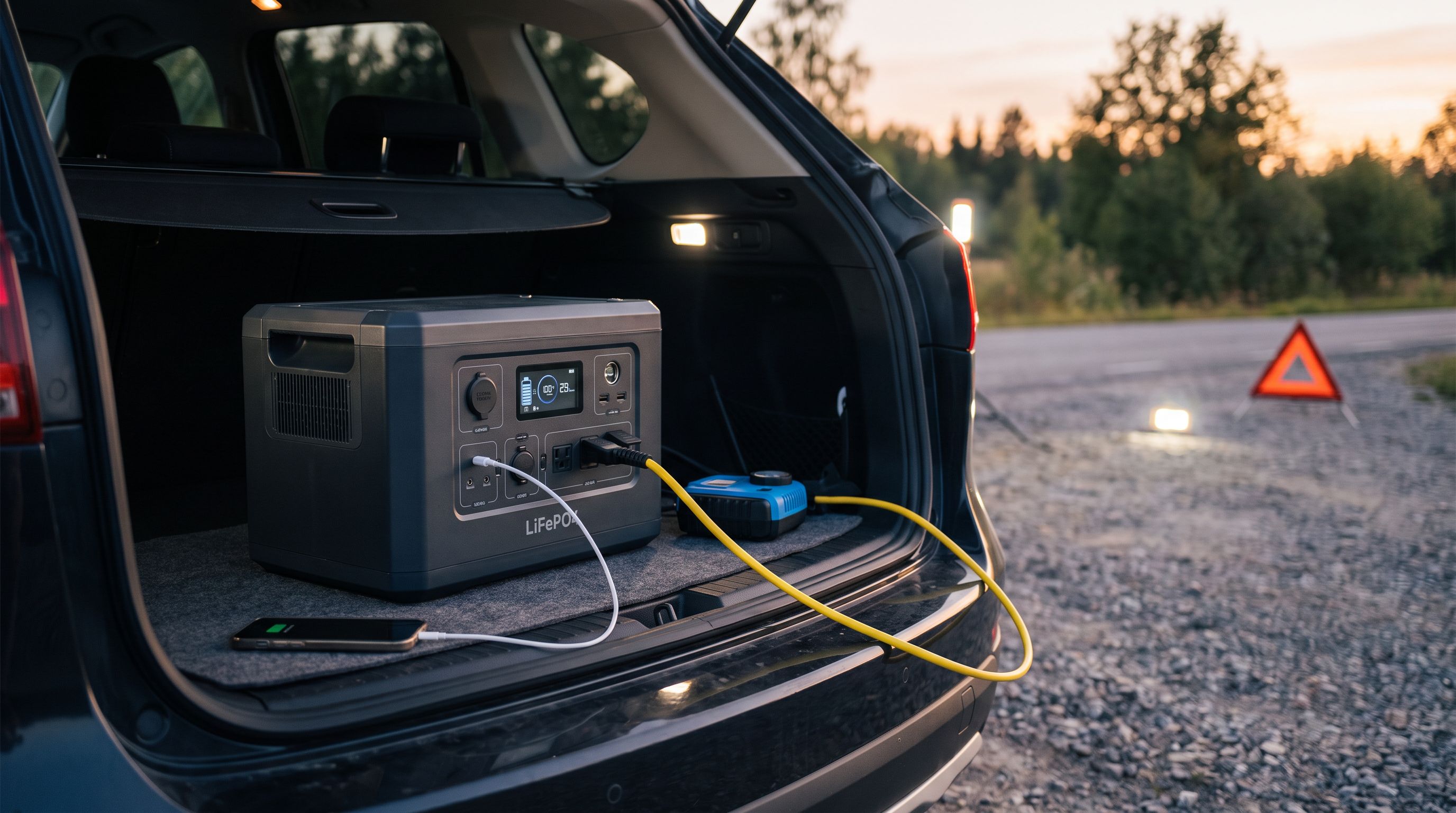
- Running a 12V tire inflator to fix a slow leak without draining the car's own battery.
- Powering a portable jump starter's recharge, or in some cases feeding a 12V jumper setup — though a dedicated lithium jump pack is still the right tool for actually cranking an engine.
- Keeping a 12V fridge, CPAP, heated blanket, or fan running while you wait for a tow, or during a winter storm shelter-in-place.
- Charging phones, laptops, tablets, and a Starlink Mini for the entire family through a multi-day outage.
- Running the car's cabin accessories without idling — which matters enormously for an ICE vehicle in a flood or snow situation where idling is dangerous.
- Powering corded tools — an impact wrench, a work light, a soldering iron on a trail repair.
That last category is where inverter surge rating matters most, and it's the spec most buyers ignore.
How to choose
Usable watt-hours, not nameplate capacity
The number on the box is the battery's rated energy. What you get out of the AC outlets is less, because the inverter loses some to heat and the BMS reserves a buffer. Round-trip efficiency on good LiFePO4 units generally lands in the high 70s to mid 80s percent; CNET's 2026 lab testing measured the Bluetti Elite 200 V2 at roughly 81% RTE, which is excellent for a large unit. DC output — the 12V ports and USB — is meaningfully more efficient than AC because it skips the inverter entirely.
Practical takeaway: if a job can be done on 12V or USB, do it on 12V or USB. You'll get 15–25% more runtime out of the same battery.
12V output quality and current rating
This is the single most car-relevant spec and the one buried deepest in the datasheets. Look for:
- A regulated 12V barrel or Anderson-style output, not just a cigarette-lighter socket that sags under load.
- At least 10A sustained on the 12V socket. Many tire inflators pull 10–15A; a cheap socket rated 8A will cut out mid-inflation.
- Multiple DC paths so you can run a fridge and inflate a tire without unplugging things.
If your emergency plan is built around 12V gear, prioritize this over raw capacity.
Inverter surge headroom
Continuous wattage tells you what the unit can hold. Surge tells you whether it can start a motor. Compressors, pumps, and corded power tools briefly draw 2–4x their running wattage at startup. A 1,000W inverter with a 2,000W surge will start most small tools; a 1,000W inverter with a 1,200W surge will trip on a lot of them. Several brands now include an "X-Boost" style mode that reduces voltage to run higher-rated resistive loads — useful for heaters and kettles, useless and potentially harmful for motors and electronics.
Chemistry, cold tolerance, and living in a trunk
For a vehicle kit, LiFePO4 (LFP) is the right choice: 3,000+ cycle ratings, far better thermal stability, and much less self-discharge anxiety. The caveat is cold. Almost no lithium chemistry can accept a charge below freezing without damage, so good units include low-temperature charge cutoff and some include self-heating. Discharging in the cold is generally fine — you just lose capacity.
If the station lives in your car through a Minnesota winter, confirm the unit has a documented low-temp charge protection and plan to bring it inside to recharge.
Recharge speed and how you'll refill it
In a multi-day outage, recharge speed determines whether the station is a one-shot or a renewable resource. Three paths matter: wall AC (fastest), solar (check the MPPT input voltage and wattage ceiling), and 12V from the car's alternator — the one most overlooked. Many stations accept only 100–120W over a cigarette-lighter input, which is painfully slow. Some support higher-current 12V input that can meaningfully refill a unit on a two-hour drive.
Comparison at a glance
| Model | Chemistry | Best for | Key strength | Main compromise |
|---|---|---|---|---|
| Bluetti Elite 200 V2 | LiFePO4 | Overall roadside + home backup | Measured ~81% round-trip efficiency; large capacity with strong inverter headroom | Heavy — this is a two-hands, stays-in-the-trunk unit |
| Jackery Explorer 1000 v2 | LiFePO4 | Value and everyday road trips | Best balance of weight, capacity, and cost-per-Wh | Mid-tier surge; won't start the biggest tools |
| Goal Zero Yeti 500 | LiFePO4 | Living permanently in a vehicle | Rugged build, genuinely carryable, vehicle-kit sized | Smallest capacity here; limited AC runtime |
| EcoFlow RIVER 3 Plus | LiFePO4 | Compact trunk backup | Very fast AC recharge, small footprint, expandable | Modest inverter; not a tool-running unit |
| Anker SOLIX C1000 Gen 2 | LiFePO4 | Tools, compressors, high draw | Big surge headroom and rapid recharge | Larger and heavier than the compact class |
The picks
Bluetti Elite 200 V2 — best overall
Prices last checked October 17, 2026. Amazon prices change frequently, so treat these as a guide and check the live price before you buy.
Bluetti Elite 200 V2
Big LiFePO4 capacity with lab-verified high efficiency and enough inverter headroom for real loads.
If you want one unit that covers roadside emergencies and becomes your house backup when the grid goes down, this is the one we'd point most people toward. It carries enough capacity to run a 12V fridge for days, keep a CPAP going through multiple nights, and handle real AC loads without the inverter throwing in the towel. CNET's 2026 lab testing named it a top performer for efficiency among large units, which matters more than it sounds — higher round-trip efficiency means more of the rated capacity actually reaches your devices.
What you give up is portability. This is not a grab-and-go item; it's a trunk resident you lift with intent. For a daily-driver emergency kit in a small car, it may simply be more unit than you want to haul.
Jackery Explorer 1000 v2 — best value
Jackery Explorer 1000 v2
The sweet spot of weight, capacity and cost-per-watt-hour for road trips and roadside waits.
The Explorer 1000 v2 hits the ratio most drivers actually want: roughly a kilowatt-hour of LiFePO4 capacity in a package one person can carry one-handed, at a cost per watt-hour that's hard to argue with. It's the natural default for someone who wants to cover phones, laptops, a fan, a CPAP, and a 12V fridge without overthinking it. Jackery's app and display are straightforward, and recharge options are flexible.
The compromise is surge headroom. It'll run most of what you plug in, but high-startup-draw loads like a big compressor or a circular saw are outside its comfort zone. If your emergency plan involves corded power tools, step up to the C1000 Gen 2.
Goal Zero Yeti 500 — best for ruggedness
Goal Zero Yeti 500
Tough, genuinely carryable and built to live in a trunk or bug-out bag year-round.
This is the unit built for the way car gear actually gets treated: tossed in a trunk, slid around, forgotten about for six months. Goal Zero's build quality and weather-resistant design make the Yeti 500 the most credible candidate here for permanently living in a vehicle or a bug-out bag, and it's light enough that you'll actually carry it to the problem instead of dragging the car to the unit.
The trade is capacity. Half a kilowatt-hour covers device charging, lights, and a long CPAP night — it won't run a space heater or hold a fridge for a long weekend. Buy it as a reliable always-there supplement, not your only power source.
EcoFlow RIVER 3 Plus — best compact
EcoFlow RIVER 3 Plus
Small enough to keep permanently in a hatchback, with fast AC recharge and expandable capacity.
For drivers with limited trunk space — small hatchbacks, loaded family vehicles, anyone who refuses to lose cargo room — the RIVER 3 Plus is the most sensible compromise. It's genuinely small, recharges from a wall outlet remarkably quickly, and the expandable-battery design means you can scale capacity later without buying a whole new unit. The USB and 12V output are plenty for the most common roadside scenarios: dead phone, dead tire, long wait.
The inverter is the limiting factor. Treat it as a device-and-DC machine rather than an appliance machine, and keep expectations off anything with a motor in it.
Anker SOLIX C1000 Gen 2 — best high-output
Anker SOLIX C1000 Gen 2
Serious surge headroom for compressors and corded tools, plus very fast wall recharging.
When the emergency involves work rather than waiting, this is the pick. The C1000 Gen 2 pairs a kilowatt-class LiFePO4 pack with the kind of surge headroom that actually starts a 12V-to-AC compressor, an impact wrench, or a heat gun on a trailside repair. Anker's rapid AC recharge is a genuine advantage in rolling blackouts — plug in during a restored window and you're back near full fast.
It's bigger and heavier than the compact options, and overkill if your entire use case is charging phones. But for anyone who works on vehicles away from a garage, the extra surge capability is the difference between a tool that works and a tool that trips.
Building the kit around it
A power station is one layer, not the whole plan. For a stranded-vehicle scenario, pair it with:
- A dedicated lithium jump starter. Power stations are generally the wrong tool for cranking an engine; a purpose-built jump pack delivers the right short-burst current.
- A 12V tire inflator, run off the station's DC port rather than AC.
- A 12V car-charging cable for the station itself, so a long drive refills it.
- For EV drivers specifically: a charge-port-compatible Level 1 EVSE and verified knowledge of whether your station's neutral configuration will handshake with it. Test this in your driveway, not on a shoulder at night.
FAQ
Can a portable power station actually charge my EV? Technically, sometimes — practically, barely. A 2 kWh station might add 4–6 miles of range over several hours, assuming your EVSE accepts power from it at all. Many Level 1 cables reject floating-neutral inverters with a ground fault. Treat it as an absolute last resort, not a plan.
Will it jump-start my car? Not well. Most power stations lack the high-current short-burst output that engine cranking demands, and using one through an inverter and a 12V adapter is inefficient and risky. Carry a dedicated lithium jump pack for that job.
Is it safe to leave one in a hot car? LiFePO4 handles heat better than older lithium chemistries, but sustained high cabin temperatures still age any battery. If you can, store it in the cabin or trunk rather than on a sunny parcel shelf, and check the state of charge every few months.
What state of charge should I store it at? Most manufacturers recommend somewhere around 50–80% for long-term storage, with a top-up every three to six months. Check your specific unit's manual — recommendations vary by brand.
Can I charge it from my car while driving? Yes, but check the input rating. Many units accept only around 100W from a cigarette-lighter socket, which is slow. Some support higher-current 12V input that can add meaningful charge on a long drive.
Does it work in freezing weather? Discharging in the cold is usually fine with reduced capacity. Charging below freezing is the problem — it damages lithium cells. Look for documented low-temperature charge protection, and bring the unit indoors to recharge in winter.
Get the best car care deals in your inbox
Join the GarageProof newsletter for hand-picked car care deals and new buying guides. No spam, unsubscribe anytime.
Related reads
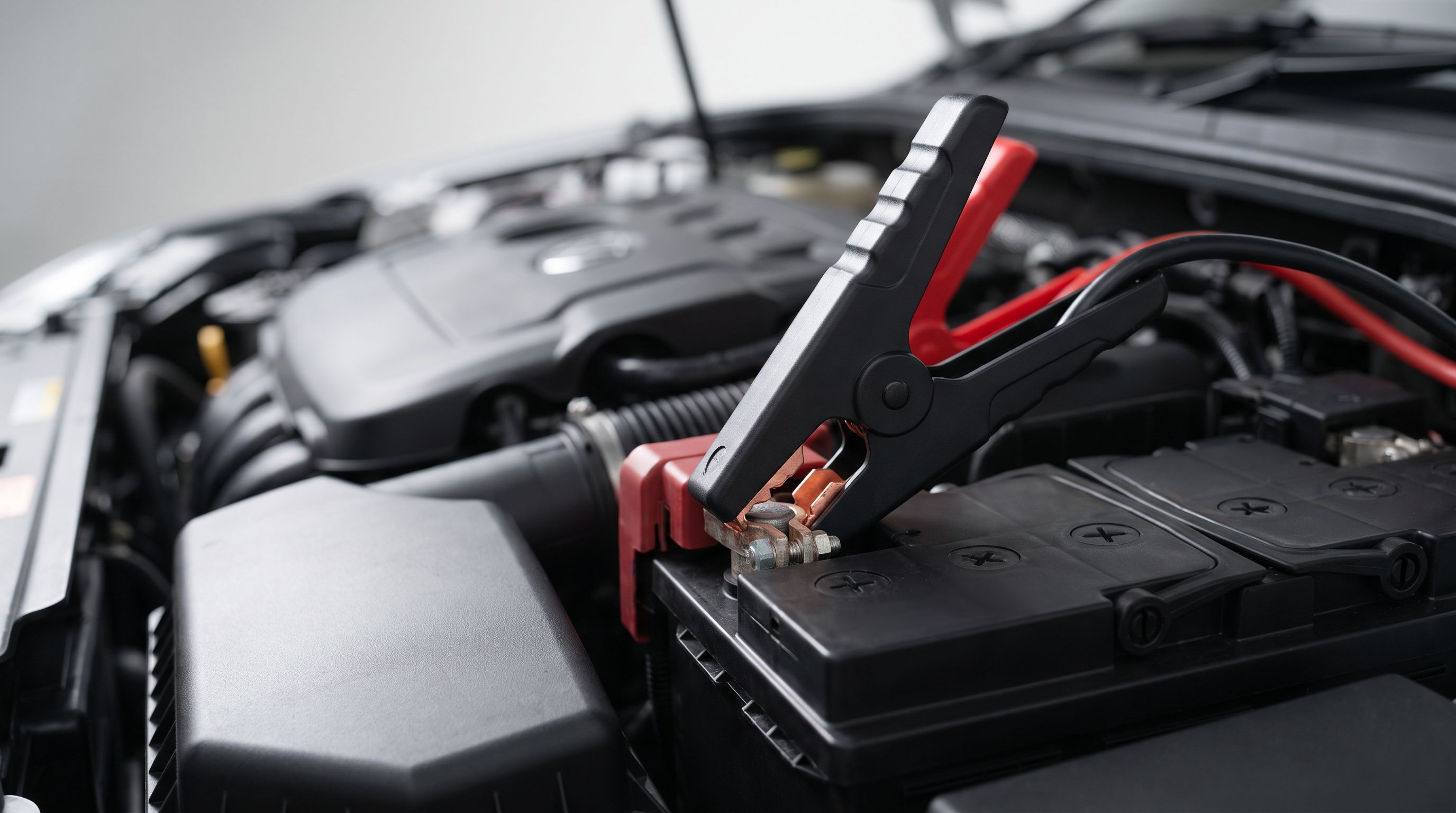
Jump Starter Clamps in 2026: Will They Fit Your Posts?
Jump starter clamps vs battery terminals: compare jaw openings, cable gauge and reach for top-post, side-post and recessed truck batteries before you buy in 2026.
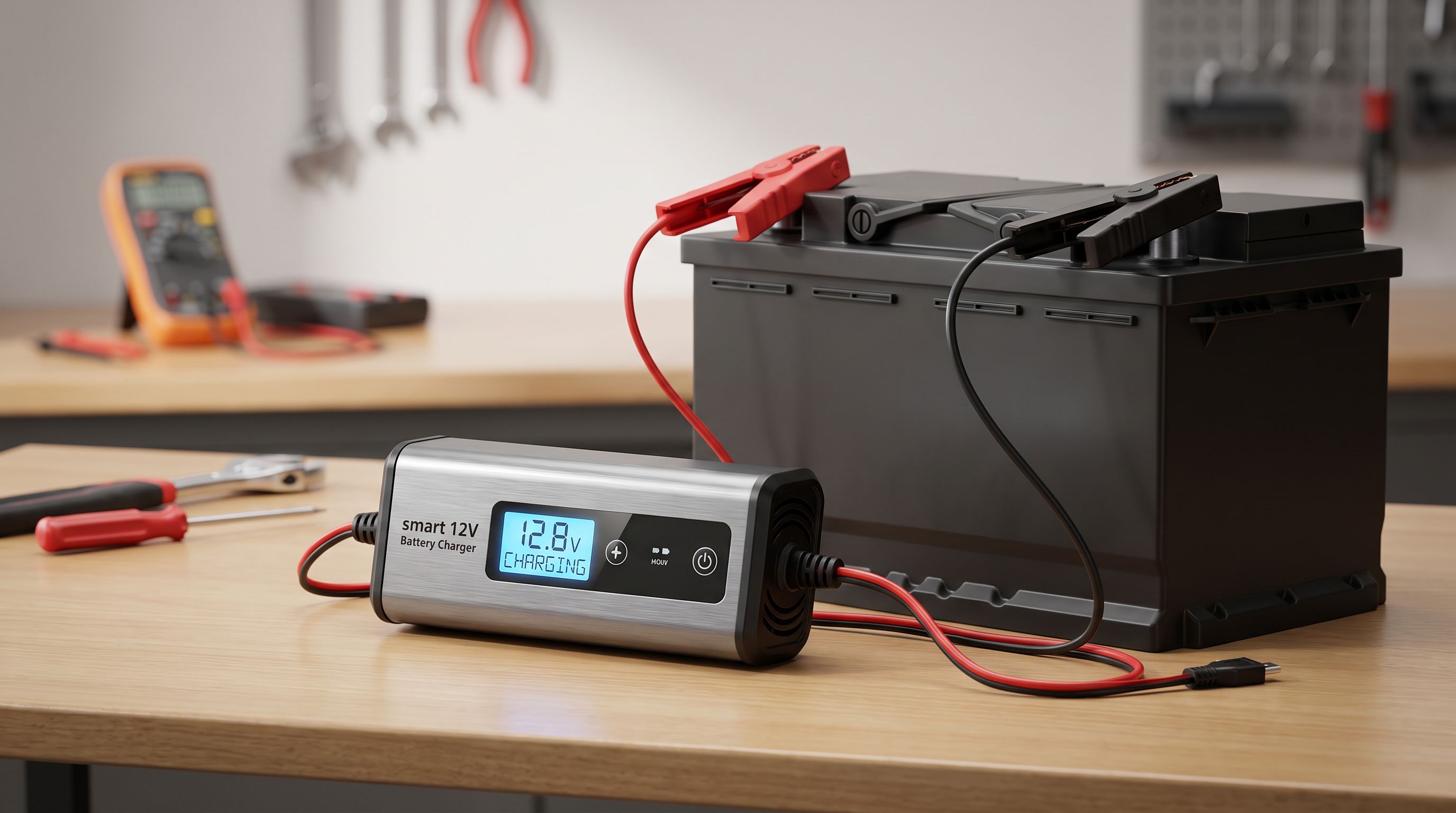
Battery Charger Maintainer Guide 2026: AGM vs Lithium Modes
AGM and lithium batteries need different charge profiles. Here's how to pick a smart battery charger maintainer in 2026, plus amps, desulfation and repair modes explained.
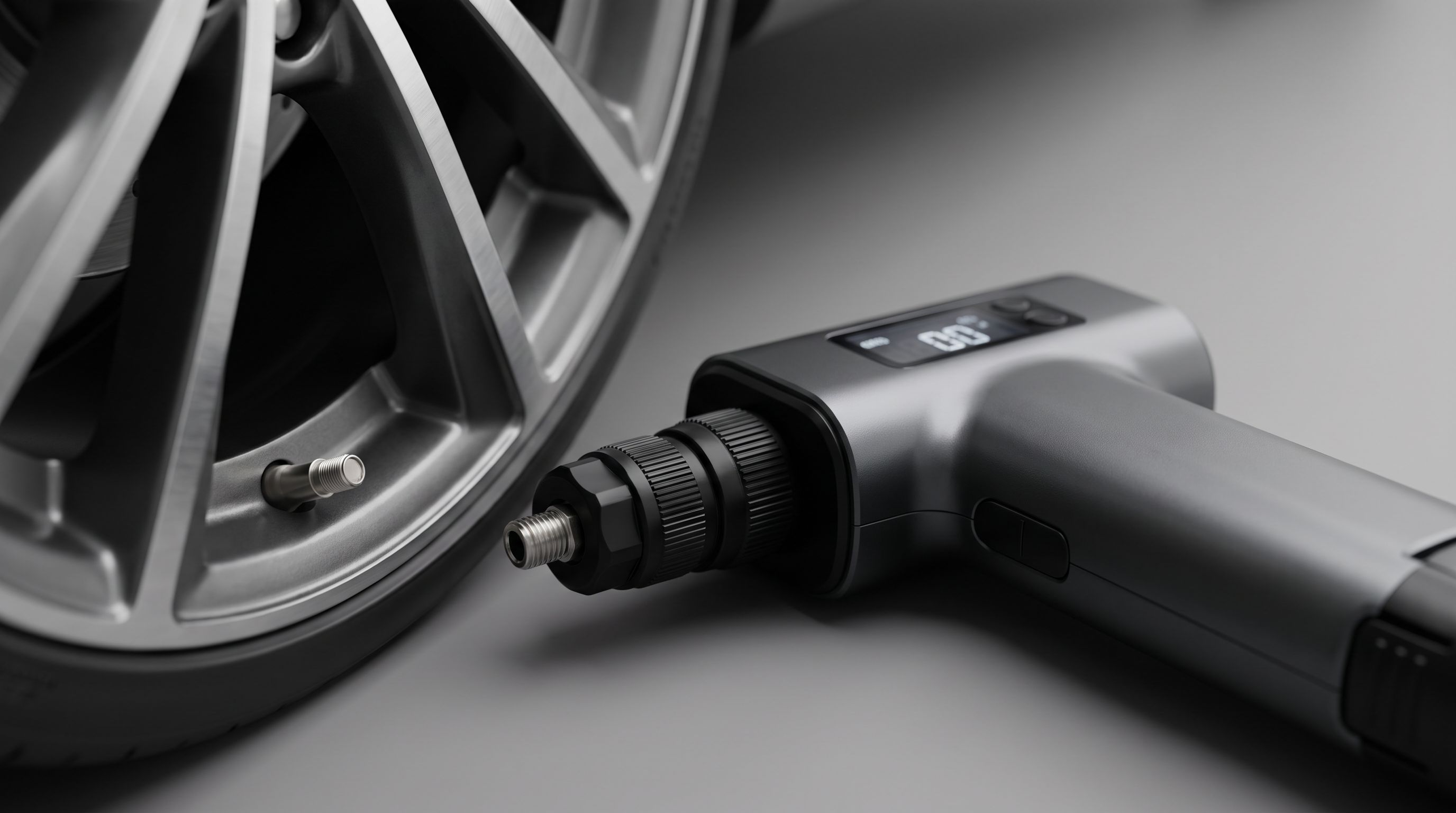
Cordless Tire Inflator Valve Stem Fitment in 2026: 4 Picks
Match cordless tire inflator chucks and hose lengths to your valve stems — rubber, metal, TPMS or recessed alloys — with 2026 picks, specs and owner feedback.