Portable EV Charger NEMA 14-50 vs 6-20: What to Buy in 2026
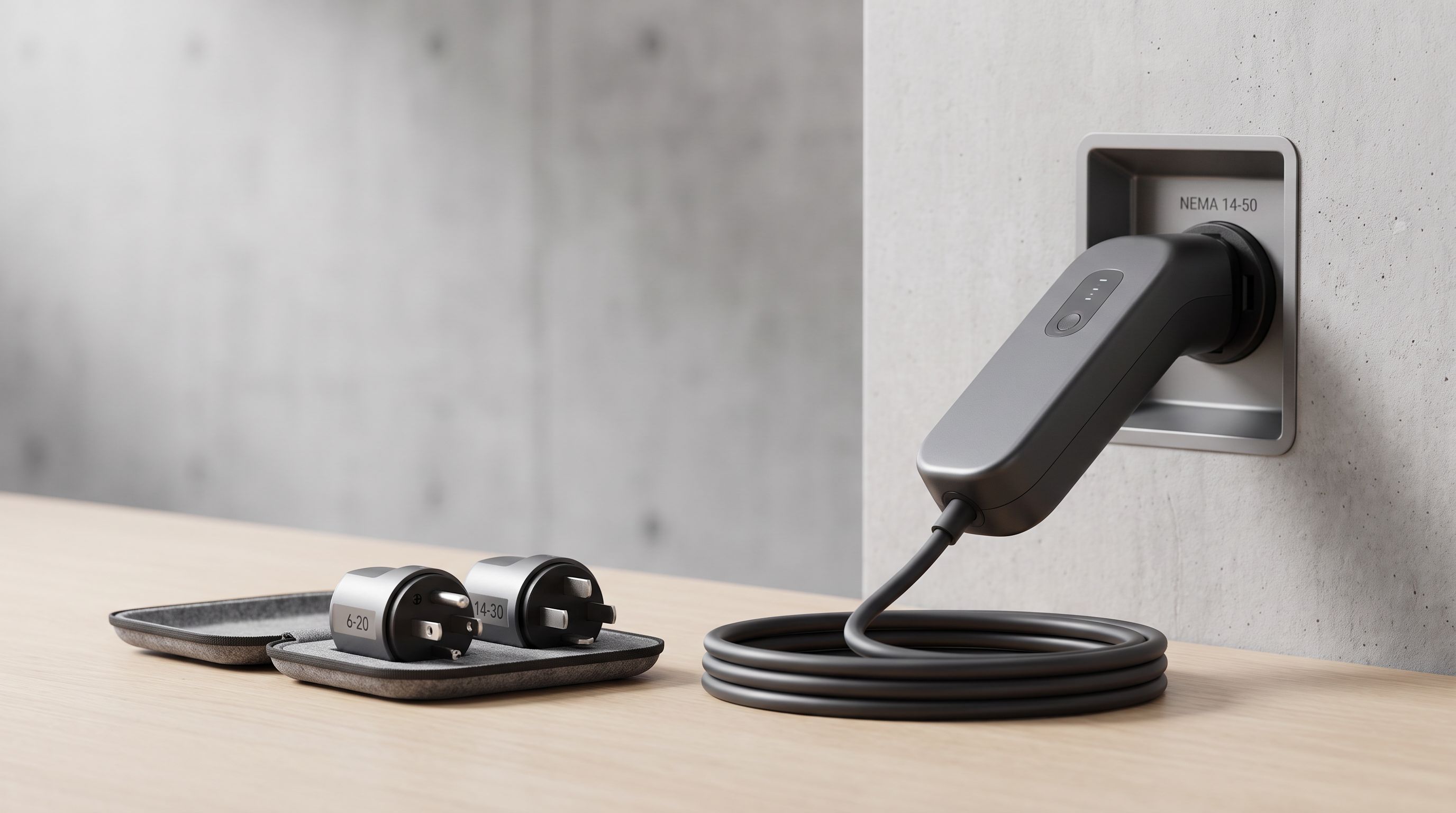
Portable EV charger NEMA 14-50 vs 6-20 explained for 2026: match plug tails and amperage to your real outlet, plus picks that ship swappable adapters.
Reader-supported: we may earn a commission from links on this page, at no extra cost to you. It never affects our picks. Learn more.
The short version
- Best overall: Lectron 48A Level 2 Portable EV Charger (NEMA 14-50)
- Best adapter system: Tesla Universal Wall Connector — see note below; for true adapter flexibility, the Grizzl-E Mini is our pick
- Best for mixed outlets: Grizzl-E Mini Level 1/2 Portable EV Charger
- Best smart/app pick: Emporia Level 2 EV Charger (NEMA 14-50 plug)
- Best budget 240V option: Megear Level 1/Level 2 Portable EV Charger
 Budget pick · Megear Level 1/Level 2 Portable EV Charger — Check price on Amazon →
 Best for mixed outlets · Grizzl-E Mini Level 1/2 Portable EV Charger — Check price on Amazon →
 Best overall · Lectron 48A Level 2 Portable EV Charger (NEMA 14-50) — Check price on Amazon →
If you only read one line: a portable EV charger with a NEMA 14-50 plug is the default right answer for most garages, but it is useless at a rental, a friend's house, or an older workshop where the only 240V receptacle is a 6-20, 10-30, or 14-30. The chargers worth buying in 2026 either ship with swappable plug tails or have a well-supported adapter ecosystem.
Why the plug on the end of the cord matters more than the amp rating
Almost everyone shops for a portable EV charger by looking at the headline number: 32A, 40A, 48A. That number is close to meaningless until you know what you're plugging into.
A charger is limited by the weakest link in the chain: the breaker, the wire, the receptacle, the plug tail, the charger's own electronics, and the car's onboard AC charger. A 48A unit hanging off a 20A circuit is a 16A charger. A 40A unit plugged into a NEMA 14-50 on a 50A breaker is a 40A charger — which is the sweet spot, because continuous loads are limited to 80% of the breaker rating by code.
So the real question is not "how many amps do I want?" It's "what receptacle do I actually have, and what will I actually encounter?"
The four plugs that cover 95% of real-world situations
NEMA 14-50 — the big four-prong 240V/50A receptacle used for electric ranges and RV pedestals. Two hots, a neutral, a ground. This is the de facto standard for plug-in EV charging and the one most electricians will install if you ask for an EV outlet. A charger on a 14-50 typically draws 32A or 40A continuous, which is roughly 7.7–9.6 kW — enough to fully refill most EVs overnight with hours to spare.
NEMA 6-50 — three-prong 240V/50A, no neutral. Common in welding shops and older garages. Electrically equivalent for EV charging purposes (EVSEs don't use the neutral anyway), so a 6-50 adapter is one of the most useful things to own.
NEMA 6-20 — 240V/20A, three-prong, looks like a regular outlet turned sideways. You'll find these behind window A/C units, in older apartment buildings, in workshops, and increasingly as a cheap "EV-ready" install because it can often be done with existing wiring. Max continuous draw: 16A at 240V, about 3.8 kW. That is roughly four times faster than a standard 120V wall outlet and genuinely enough for most commuters — around 12–15 miles of range per hour for an efficient EV.
NEMA 14-30 / 10-30 — the dryer outlets. 240V/30A, limiting you to 24A continuous (~5.8 kW). A huge number of people charge off a dryer outlet with a splitter or a simple swap. The 10-30 is the older three-prong version with no separate ground; it still exists in millions of homes and some EVSE adapter kits support it.
What this means for how you shop
If your garage has a 14-50 and always will, buy a solid 14-50 charger and stop reading. If you rent, travel, share a house, or your "EV outlet" is whatever the previous owner left behind, buy for adapter flexibility first and peak amperage second. The difference between 40A and 48A charging is usually 30–45 minutes of overnight sleep you'll never notice. The difference between having a 6-20 adapter and not having one is being stranded at your in-laws' place with a 120V trickle.
Plug and speed comparison
| Receptacle | Voltage / breaker | Max continuous draw | Typical power | Range added per hour* | Where you'll find it |
|---|---|---|---|---|---|
| NEMA 5-15 | 120V / 15A | 12A | ~1.4 kW | 3–4 mi | Any wall outlet |
| NEMA 5-20 | 120V / 20A | 16A | ~1.9 kW | 4–6 mi | Garages, workshops |
| NEMA 6-20 | 240V / 20A | 16A | ~3.8 kW | 12–15 mi | Older homes, A/C circuits, cheap EV installs |
| NEMA 10-30 / 14-30 | 240V / 30A | 24A | ~5.8 kW | 18–22 mi | Dryer outlets |
| NEMA 6-50 | 240V / 50A | 40A | ~9.6 kW | 28–34 mi | Welders, shop circuits |
| NEMA 14-50 | 240V / 50A | 40A | ~9.6 kW | 28–34 mi | Ranges, RV pedestals, EV installs |
| Hardwired | 240V / 60A | 48A | ~11.5 kW | 35–40 mi | Dedicated installs only |
*Rough estimates for a mainstream EV at roughly 3–3.5 mi/kWh. Heavy trucks and SUVs will be lower; an efficient sedan will be higher. Your car's onboard charger also caps the rate — many EVs top out at 7.7 kW or 11 kW AC regardless of what you plug into.
The picks
Lectron 48A Level 2 Portable EV Charger — best overall
Prices last checked October 6, 2026. Amazon prices change frequently, so treat these as a guide and check the live price before you buy.
Lectron 48A Level 2 Portable EV Charger (NEMA 14-50)
Rugged molded cable, broad adapter ecosystem, and 40A real-world speed on a standard 14-50 outlet.
Lectron has become the default recommendation in EV forums for a reason: the hardware is rugged, the molded cable handles cold without turning into a garden hose, and the company sells a wide range of plug adapters and connector adapters (including J1772-to-NACS and NACS-to-J1772) in the same ecosystem. The 48A version is really a 40A-on-a-14-50 charger for most buyers, since the full 48A requires hardwiring or a 60A-rated setup. Take it as future-proofing rather than an everyday number.
What it gives up: smart features. There's no sophisticated app, no utility demand-response program integration, no energy reporting beyond the basics. If you want scheduling, you'll use your car's built-in charge timer — which, honestly, most EV owners do anyway.
Grizzl-E Mini — best for mixed outlets
Grizzl-E Mini Level 1/2 Portable EV Charger
Interchangeable plug tails cover 5-15, 6-20, 14-30 and 14-50 — ideal for renters and travelers.
The Grizzl-E Mini is the one to buy if your charging life is unpredictable. It's built around an interchangeable plug-tail concept: a compact, weatherproof aluminum-bodied unit that connects to NEMA 5-15, 5-20, 6-20, 14-30, 6-50, and 14-50 via adapters depending on the kit you buy. It's made in Canada, rated for outdoor use, and it's deliberately simple — no Wi-Fi radio to fail, no app account to maintain.
The trade-off is amperage and polish. The Mini is a lower-amperage unit than a full-size Grizzl-E, so it won't saturate a 50A circuit. If you own a long-range truck and drive 200 miles a day, you want the bigger sibling or a hardwired unit. For apartment dwellers, renters, and travelers, that ceiling matters far less than the ability to use whatever outlet is in front of you.
Emporia Level 2 EV Charger — best smart pick
The Emporia is the unit that keeps showing up at the top of independent home-charger roundups, and it's one of the few at its price point that is UL listed, ENERGY STAR certified, and genuinely useful as a smart device. It ships configured for either a NEMA 14-50 plug or hardwiring, supports up to 48A hardwired, and the app does real scheduling, cost tracking, and load management — which matters if you pair it with Emporia's energy monitor and want to avoid tripping your main panel.
What it gives up: portability. The cable is long and the unit is designed to live on a wall bracket, not ride in a frunk. There's no official swappable plug-tail system, so moving between outlet types means third-party adapters. Buy it as a plug-in home charger that can travel, not a travel charger.
Megear Level 1/Level 2 Portable EV Charger — best budget 240V option
Megear Level 1/Level 2 Portable EV Charger
Cheap, compact trunk backup that steps you up from 120V trickle to real 240V charging.
If the goal is "I have a 6-20 or a dryer outlet and I want to stop charging at 1.4 kW," the Megear is the cheap, well-reviewed way to get there. These units typically ship with a 120V plug plus a 240V adapter, come in a travel bag, and are compact enough to leave in the trunk permanently as a backup. Owner feedback is broadly positive on reliability for the money.
What it gives up: build quality margin and support. The housings aren't as beefy as a Grizzl-E, the amperage is modest, and warranty service is less established than the bigger brands. Treat it as an emergency/secondary charger rather than the one that handles 100% of your charging for eight years.
Tesla Mobile Connector (Gen 2) — best for Tesla and NACS owners

Tesla Mobile Connector (Gen 2)
Original swappable-tail design, compact and tidy; 32A on a 14-50 and native NACS plug.
Best for NACS owners · Tesla Mobile Connector (Gen 2) — Check price on Amazon →
Tesla's own Mobile Connector is the original swappable-tail design: one body, a bayonet-style adapter at the wall end, and officially supported adapters for NEMA 5-15, 14-50, and others sold separately. It's compact, it coils neatly, and on a 14-50 it delivers 32A — not the fastest, but plenty overnight. For NACS-native vehicles (Teslas, and increasingly Ford, GM, Rivian, Hyundai, and Kia models shipping with native NACS ports), it plugs straight in with no connector adapter.
What it gives up: 32A is the ceiling, the adapters are sold individually and add up, and J1772 owners need a separate adapter on the car end. Also check what's in the box — Tesla has changed included-adapter bundles over the years.
How to choose
1. Inventory your outlets before you shop
Walk the garage with a phone camera. Photograph every 240V receptacle you can find and note the breaker number and rating in the panel. Then do the same mental exercise for the places you regularly park overnight — a parent's house, a vacation rental, a job site. Buy the charger whose adapter set covers that list. A 48A charger you can only use in one building is worse than a 32A charger you can use in five.
2. Check your car's onboard AC limit
Your EV's onboard charger sets a hard ceiling on Level 2 speed. Many EVs max out at 7.2–7.7 kW (about 32A); some do 11 kW (48A); a few budget models cap at 6.6 kW. If your car is a 7.7 kW vehicle, paying extra for a 48A EVSE buys you nothing today. Look it up in the owner's manual under "AC charging" or "onboard charger."
3. Decide between swappable tails and dumb adapters
Swappable tails (Tesla Mobile Connector, Grizzl-E Mini kits) are engineered as a system: the EVSE often auto-detects the adapter and sets the current limit accordingly. Generic pigtail adapters — say a 14-50 female to 6-20 male — do not communicate anything, so you must manually dial the charger's amperage down to a safe level for the smaller circuit. If your charger has no amperage selector, do not use a step-down adapter. That's the single most common dangerous mistake in portable EV charging.
4. Verify connector type: J1772 vs NACS
2026 is the messy middle of the NACS transition. Many new EVs ship with a native NACS port; most 2018–2024 non-Teslas use J1772. Portable chargers come in both. Before you buy, confirm which port your car has, and budget for a connector adapter if you expect to use both. This is vehicle-specific — check your exact year, make, and model, because some nameplates changed port type mid-generation.
5. Look for UL/ETL listing and a real warranty
A portable EVSE carries 240V continuously for hours, often outdoors. Insist on UL or ETL listing (not just "UL-certified components"), a NEMA-rated enclosure if it'll live outside, and a manufacturer with a US/Canada support presence. ENERGY STAR certification, which Emporia and several others carry, is a reasonable secondary signal of quality.
Practical setup notes
- Use a good receptacle. Cheap 14-50 receptacles are a known failure point — EV charging is a continuous high-current load that ordinary range outlets were never designed for. Industrial-grade receptacles from Hubbell, Bryant, or Leviton are consistently recommended by electricians and EV forums. The cost difference is small; the consequence of a melted outlet is not.
- Don't use extension cords. If you need more reach, buy a charger with a longer cable (20–25 ft is common) rather than extending a 240V circuit.
- Mind the GFCI requirement. Modern code generally requires GFCI protection on 240V receptacles in garages. Some EVSEs have internal ground-fault protection that can nuisance-trip a GFCI breaker. Hardwiring sidesteps this but kills portability.
- Weatherproof outdoor outlets properly. An in-use ("bubble") cover rated for the plug size is non-negotiable if the receptacle lives outside.
- Dial down manually on small circuits. Worth repeating: on a 6-20, set the charger to 16A maximum. On a 14-30 dryer circuit, 24A maximum.
FAQ
Is a NEMA 14-50 always better than a 6-20? Faster, yes — roughly 2.5x. Better, not necessarily. A 6-20 can often be installed cheaply using existing wiring, while a 14-50 usually needs a new 6-gauge run and a 50A breaker. If you drive under 40 miles a day, a 6-20 refills your daily use in about three hours overnight.
Can I plug a 40A charger into a 20A outlet with an adapter? Only if the charger lets you manually limit current to 16A, and only with a properly rated adapter. Without that amperage setting, you're asking a 20A circuit to carry twice its rating. Don't.
Does the missing neutral on a 6-50 matter? No. EVSEs use the two hots and ground; the neutral on a 14-50 is unused for EV charging. That's why 14-50 to 6-50 adapters are safe and common.
Will a portable charger work with my car? Check your port type first — J1772 or NACS — then check your car's onboard AC limit. Both are listed in the owner's manual. Connector adapters exist in both directions, but confirm they're rated for your amperage.
Can I leave a portable charger plugged in outside year-round? Only if it's rated for it. Look for a NEMA 4 or better enclosure rating on the unit and an in-use cover on the receptacle. Many budget portables are not rated for permanent outdoor exposure.
Do I need a permit to add a 14-50 outlet? In most US jurisdictions, yes — adding a new 240V branch circuit is permitted work. Beyond legality, an inspection catches undersized wire and loose lugs, which are exactly the failures that cause EVSE fires.
Our picks
Emporia Level 2 EV Charger (NEMA 14-50 plug)
UL listed and ENERGY STAR certified with real scheduling, cost tracking and load management.
Get the best car care deals in your inbox
Join the GarageProof newsletter for hand-picked car care deals and new buying guides. No spam, unsubscribe anytime.
Related reads
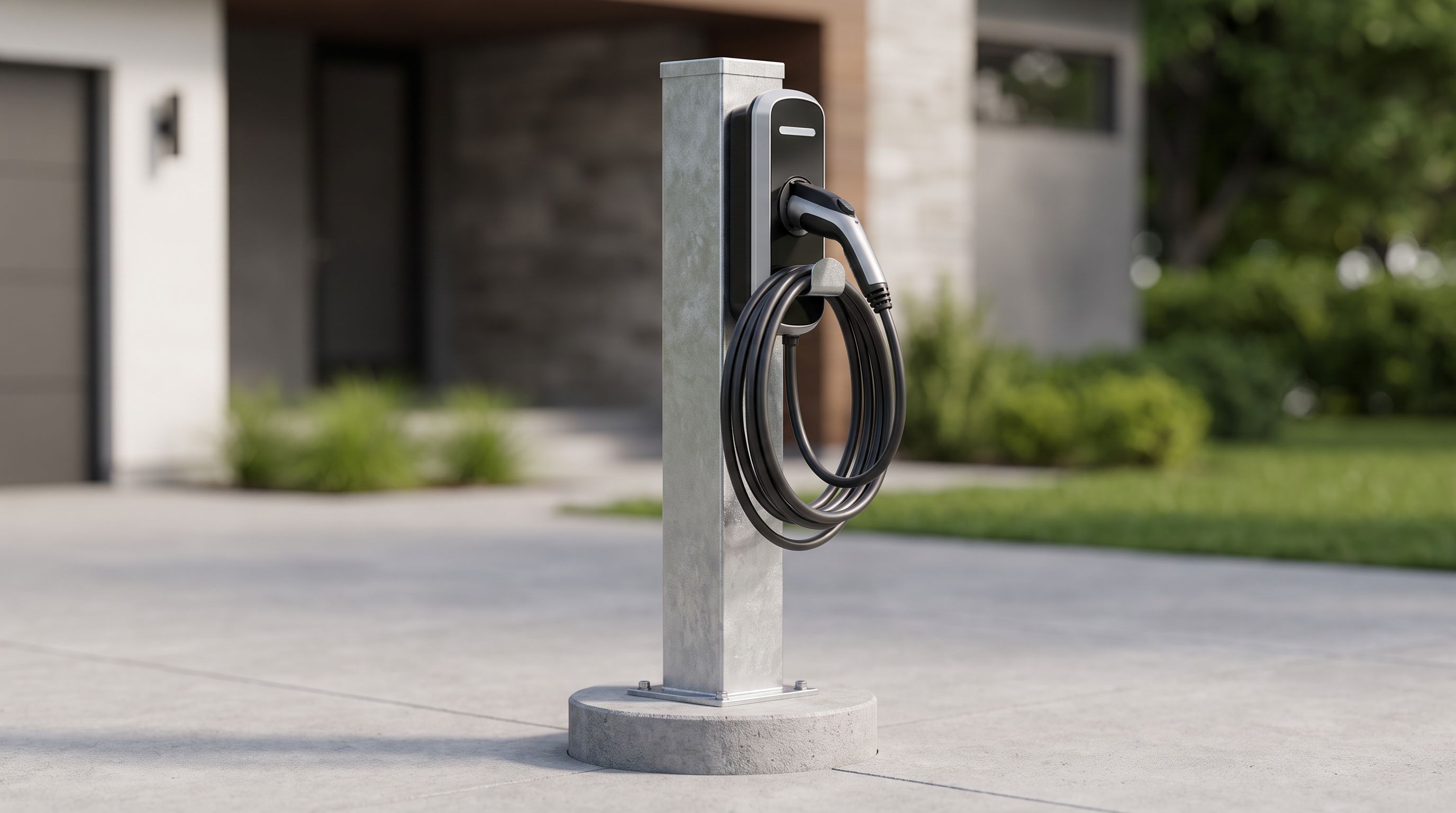
EV Charger Pedestal Mount 2026: Fit It Before You Dig
Compare EV charger pedestal mounts for 2026 by bolt pattern, charger compatibility, cable reach and footing depth — confirm your Level 2 unit fits before you pour concrete.
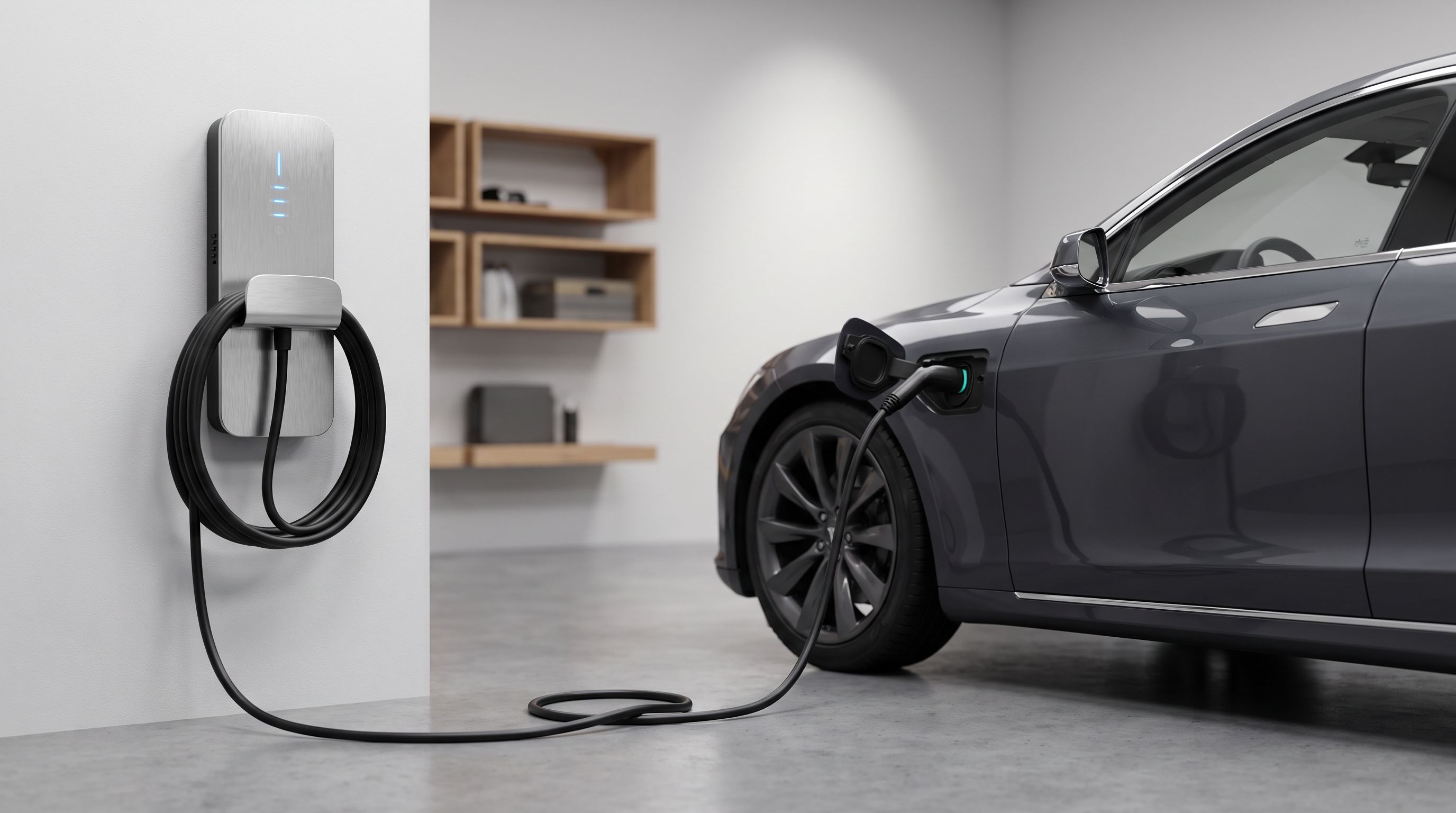
Level 2 EV Charger Cable Length in 2026: 25ft Without Sag
Level 2 EV charger cable length explained for 2026: why 25 ft is the ceiling, what gauge really matters, and how to match reach to your charge port side.
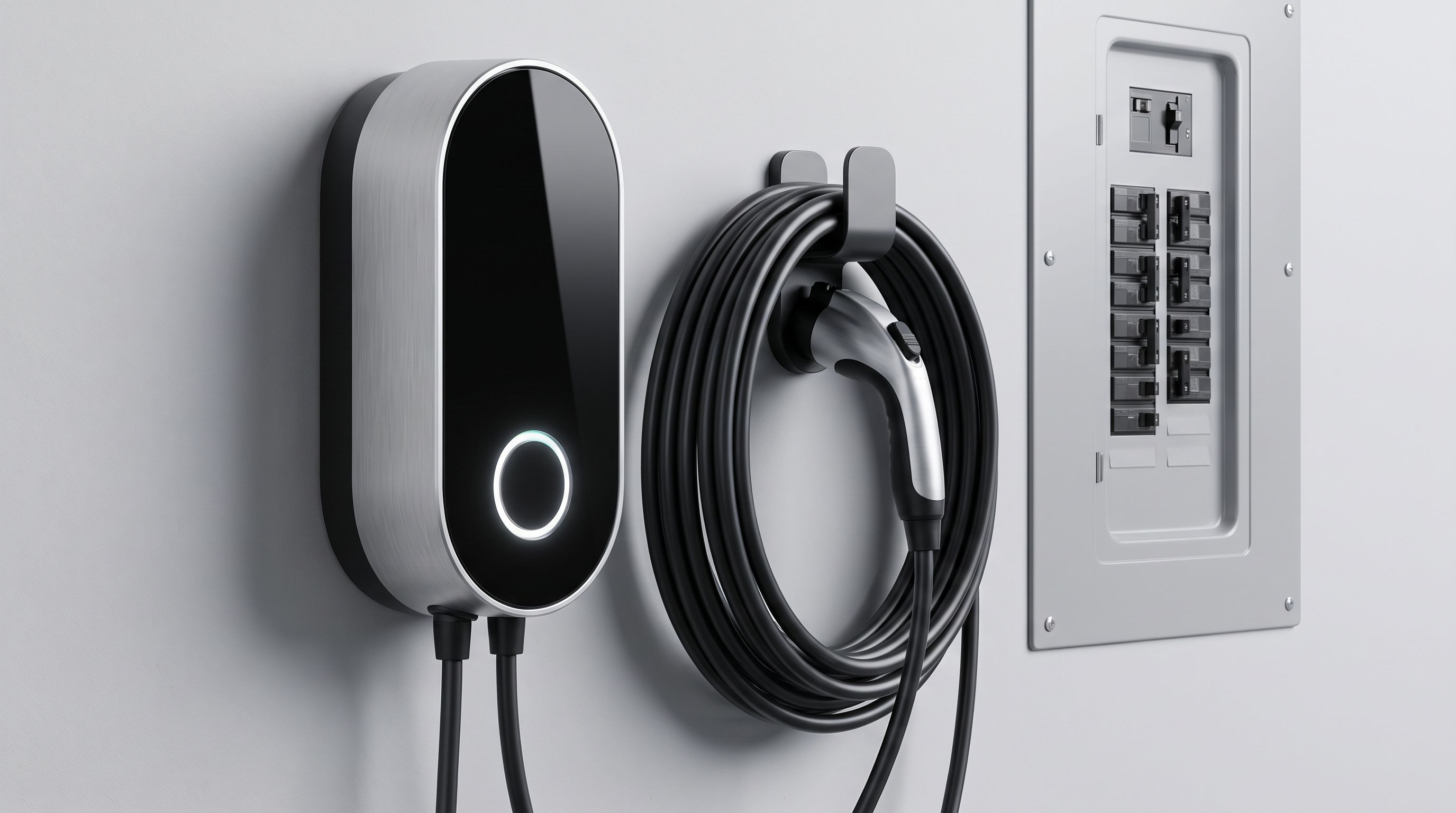
Level 2 EV Chargers in 2026: 40A vs 48A, Explained
Picking the best Level 2 EV charger for home in 2026? Compare 40A vs 48A, NEMA 14-50 vs hardwired, cable length and panel load — plus five solid picks.