Portable EV Charger Adapter Guide 2026: Match Your Outlet
Portable EV charger adapter guide for 2026: which NEMA plugs travel chargers ship with, how to identify your outlet, and the amperage limits that actually matter.
Reader-supported: we may earn a commission from links on this page, at no extra cost to you. It never affects our picks. Learn more.
The short version
- Best overall adapter-equipped travel charger: Lectron Portable Level 1 & Level 2 EV Charger
- Best multi-outlet adapter kit: Lectron NEMA Adapter Set for Level 2 Portable Chargers
- Best for RV parks and 14-50 garages: MUSTART Travelmaster Level 1 and 2 Portable EV Charger
- Best for dryer-outlet charging: Leviton Portable EV Charger with NEMA 14-30/L14-30 plug
- Best Tesla/NACS-to-J1772 solution: Lectron Tesla to J1772 Adapter
A portable EV charger is only as useful as the plug on the end of it. That's the part most buyers skip past — they compare amperage and cable length, then discover on a road trip that the "universal" charger in the trunk has a NEMA 14-50 plug and the campground pedestal is a TT-30. Or that the garage outlet behind the washing machine is a 14-30, not the 14-50 the listing photo showed.
This guide is about matching the adapter to the receptacle. We compared the adapter sets that major portable chargers actually ship with in 2026, explain how to identify the outlet you already have, and flag the safety limits that make some adapter combinations a bad idea even when they physically fit.
First: identify the receptacle you actually have
Before you buy anything, go look at the outlet. Take a photo of the face of it, and if there's a breaker panel label, photograph that too. The pin pattern tells you almost everything.
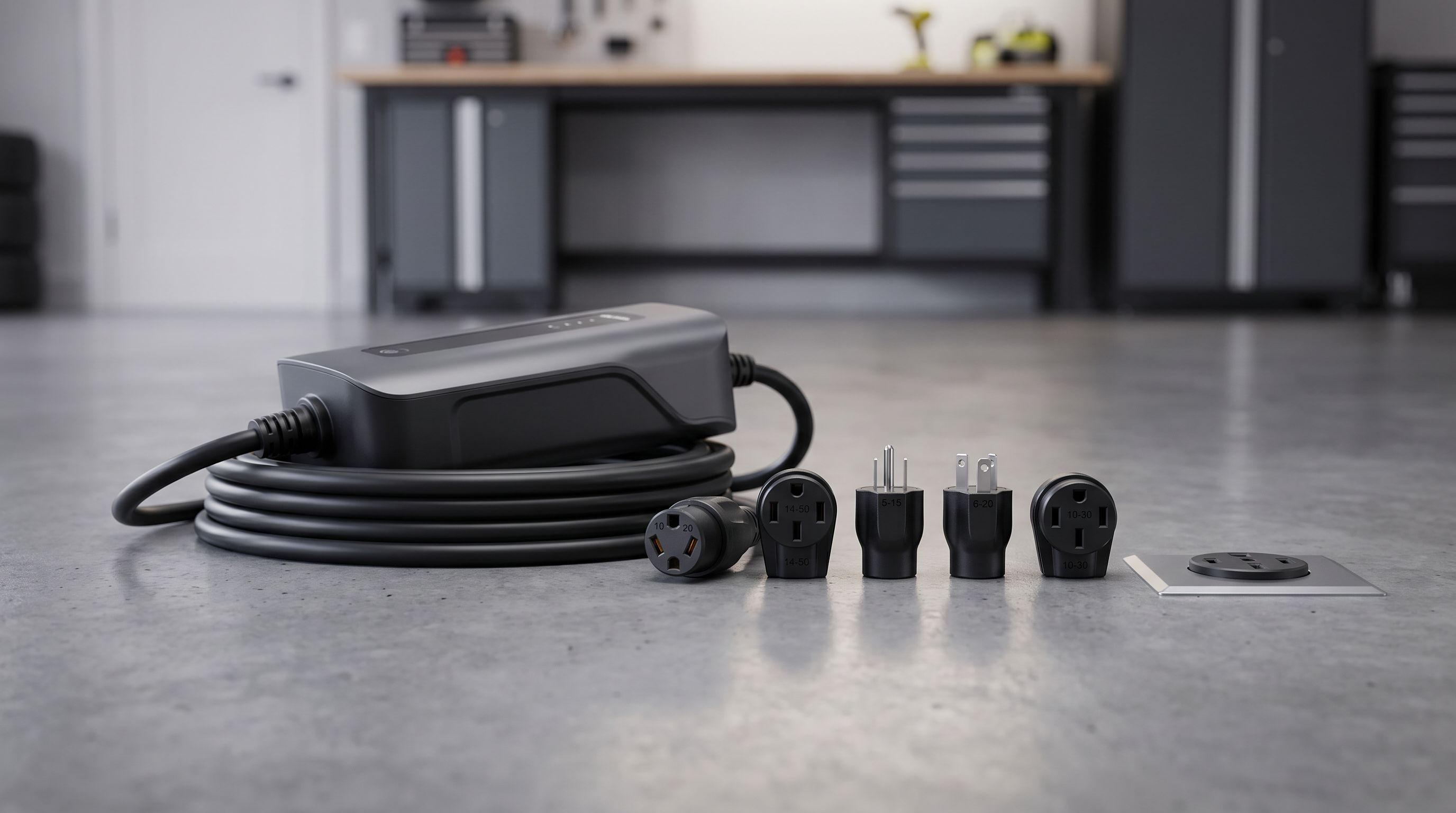
Common receptacles you'll encounter, in rough order of likelihood:
| Receptacle | Voltage | Typical breaker | Realistic continuous EV draw | Where you'll find it |
|---|---|---|---|---|
| NEMA 5-15 | 120 V | 15 A | 12 A (~1.4 kW) | Any standard household outlet |
| NEMA 5-20 | 120 V | 20 A | 16 A (~1.9 kW) | Garages, workshops (T-shaped slot) |
| NEMA TT-30 | 120 V | 30 A | 24 A (~2.9 kW) | RV parks, campgrounds |
| NEMA 14-30 | 240 V | 30 A | 24 A (~5.8 kW) | Modern dryer outlets (4-prong) |
| NEMA 10-30 | 240 V | 30 A | 24 A (~5.8 kW) | Older dryer outlets (3-prong, no ground) |
| NEMA 6-20 | 240 V | 20 A | 16 A (~3.8 kW) | Shops, some window A/C circuits |
| NEMA 6-50 | 240 V | 50 A | 32–40 A | Welder outlets |
| NEMA 14-50 | 240 V | 50 A | 32–40 A (~7.7–9.6 kW) | Ranges, RV pedestals, EV-ready garages |
| NEMA L14-30 | 240 V | 30 A | 24 A | Generator inlets, twist-lock |
Two rules that come out of that table and matter more than anything else:
The 80% rule. Continuous loads — and EV charging is the textbook continuous load — are limited to 80% of the circuit's rating. A 50 A circuit gives you 40 A, a 30 A circuit gives you 24 A, a 15 A circuit gives you 12 A. A good portable charger reads the adapter and automatically derates itself. A cheap one may not, which is how outlets melt.
The breaker is the ceiling, not the adapter. Plugging a 14-50 charger into a 14-30 via an adapter does not create 50 A of capacity. If the charger doesn't detect the adapter and throttle to 24 A, you must set the current limit manually, every time.
The NEMA 10-30 trap
Older homes often have a three-prong 10-30 dryer outlet. It has no separate equipment ground — the neutral does double duty. Most reputable EV charger makers either don't offer a 10-30 adapter or ship it with explicit warnings, because an EVSE's ground-fault protection depends on a real ground. If your only 240 V option is a 10-30, the honest answer is to have an electrician convert it or run a new circuit rather than hunting for an adapter.
How to choose
Match the adapter set to where you'll actually charge
Be realistic about your charging locations. If you have a 14-50 in the garage and never travel, you don't need a six-adapter kit — you need one good charger with a 14-50 plug and a 5-15 adapter for emergencies. If you road-trip, camp, or visit family with unknown garages, the broader kit earns its keep. The most useful four-adapter combination for travelers is 14-50, TT-30, 14-30, and 5-15: that covers almost every campground pedestal and almost every laundry room in North America.
Check whether adapters are auto-detecting
The best portable chargers use keyed or chipped adapters so the unit knows which plug is attached and caps the current automatically. Others rely on a button or app to set the amperage. Auto-detection is a meaningful safety feature, especially if more than one person in the household uses the charger. If you're buying adapters separately from a third party, assume no auto-detection and plan to set the limit by hand.
Mind the cordset, not just the plug
Adapter pigtails should be short, heavy-gauge, and rated for the current they'll carry. Avoid stacking adapters (adapter into adapter) and avoid running the charger through an extension cord — manufacturers almost universally prohibit it, and the resistance in a long, undersized cord becomes heat at the connection point. If you need reach, buy the charger with a longer cable: 25 ft is the common travel length.
Confirm the car-side connector: J1772 or NACS
Adapters come in two flavors and people conflate them. NEMA adapters are the wall end. J1772 and NACS (the Tesla-style connector) are the car end. In 2026 most non-Tesla EVs sold in North America are mid-transition: some ship with NACS ports, many still use J1772, and nearly all come with a factory adapter in the frunk or trunk. Buy the charger with the car-side connector that matches the majority of your charging, then keep the appropriate adapter in the car. Check your owner's manual for the exact port type on your year, make, and model — it changed mid-cycle on several brands.
Plan for weather and abuse
A travel charger lives in a trunk, gets dropped, and gets used in rain. Look for an IP-rated enclosure, strain relief where the cable meets the plug, and a storage bag or case. Adapters are the most frequently lost component of any portable charging kit — a case with molded slots is worth more than it sounds.
The picks
Lectron Portable Level 1 & Level 2 EV Charger — best overall adapter-equipped travel charger
Prices last checked October 29, 2026. Amazon prices change frequently, so treat these as a guide and check the live price before you buy.

Lectron Portable Level 1 & Level 2 EV Charger
Dual-voltage, rugged, available in J1772 or NACS — the default trunk charger for most EV owners.
Lectron's dual-level portable is the one that shows up on nearly every 2026 round-up, and the reason is practical rather than exotic: it ships ready for both a standard household outlet and a 240 V outlet, with adjustable current and a build that reviewers consistently describe as rugged. It's available in both J1772 and NACS versions, so you're not fighting a car-side adapter on top of a wall-side one. What you give up is premium smarts — there's no deep app ecosystem, no energy dashboards, no load-sharing. If you want a charger that mostly lives in the trunk and occasionally becomes a home charger, that's a fair trade. Confirm which plug and connector variant you're ordering before checkout.
Lectron NEMA Adapter Set — best multi-outlet adapter kit

Lectron NEMA Adapter Set for Level 2 Portable Chargers
Covers 14-30, 10-30, 6-50, TT-30 and more so one 14-50 charger reaches nearly any receptacle.
If you already own a Level 2 portable with a 14-50 plug, a matched adapter set is cheaper and smarter than buying a second charger. Lectron sells adapters that cover the common 240 V and 120 V receptacles — 14-30, 10-30, 6-50, TT-30, 5-15 and similar — in short, heavy pigtails designed for EVSE duty rather than generic appliance use. The catch: adapters bought separately generally do not auto-derate your charger. You have to set the amperage on the unit to match the smaller circuit yourself, and you have to remember to change it back. Treat that as a required habit, not an optional one. Check the product listing for your charger's exact plug before ordering.
MUSTART Travelmaster — best for RV parks and 14-50 garages
MUSTART Travelmaster Level 1 and 2 Portable EV Charger
25 ft cable and 16/24/32 A selectable output map neatly onto TT-30, 14-30 and 14-50 circuits.
The Travelmaster is the long-standing enthusiast favorite for campground charging. It's a Level 1/Level 2 unit with a 240 V plug, a 25-foot cable, and selectable current steps typically spanning 16/24/32 A — which maps neatly onto TT-30, 14-30, and 14-50 circuits respectively. The long cable matters at RV pedestals, where the receptacle is often on a post well away from where you can park. It's a fairly basic unit otherwise: no Wi-Fi, no scheduling beyond what your car provides, and a bulkier control box than some rivals. Verify the plug configuration and connector type on the specific listing before buying.
Leviton Portable EV Charger — best for dryer-outlet charging
Leviton is a mainstream electrical brand, which buys you a level of distribution and support that no-name EVSEs don't have. Its portable units are offered in configurations suited to 30 A circuits, including L14-30 and 14-30 style plugs with adjustable output in the 8–16 A range and up. That's the right answer if your only practical 240 V source is the laundry room: you get roughly 5–6 kW instead of the 1.4 kW a wall outlet delivers, without a panel upgrade. The limitation is obvious — a 30 A circuit caps you well below what a 14-50 can deliver, so this isn't the charger to buy if you're planning a dedicated 50 A circuit later. Check the plug variant carefully; Leviton lists several.
Lectron Tesla to J1772 Adapter — best Tesla/NACS-to-J1772 solution
Lectron Tesla to J1772 Adapter
Glovebox-sized adapter that opens up Tesla AC destination chargers for J1772 vehicles.
This is the car-side piece, and it solves a different problem than NEMA adapters. If you drive a J1772-equipped EV and want to use a Tesla Wall Connector or a Tesla Mobile Connector at a friend's house or a hotel destination charger, this adapter bridges the gap for AC charging. It's compact enough to live in a glovebox. Important limits: it is for AC charging only — it does not make a Supercharger work — and compatibility depends on the specific Tesla equipment and the host network's rules. Confirm your vehicle's port type and the adapter's stated compatibility list for your year, make, and model before relying on it for a trip.
A realistic kit for most drivers
If you want a simple shopping list rather than a menu: one dual-voltage portable charger with the car-side connector your EV uses, a 14-50 plug as the default, plus adapters for TT-30 and 14-30, plus the 5-15 pigtail for emergencies. That's four wall options and covers the overwhelming majority of real-world situations. Add the car-side J1772/NACS adapter only if you regularly encounter the other standard.
Store the whole thing in one bag. The single most common portable-charging failure in 2026 isn't a technical one — it's arriving at a campground with the charger and without the adapter that fits.
FAQ
Can I use an extension cord with a portable EV charger? Manufacturers generally prohibit it, and for good reason: undersized or long cords add resistance, which becomes heat at the plug. If you need more reach, buy a charger with a longer cable (25 ft is common) rather than extending it.
Will an adapter let me charge faster? No. An adapter changes the plug shape, not the circuit's capacity. A 30 A circuit delivers 24 A continuous regardless of what's plugged into it. The only way to charge faster is a bigger circuit.
Do portable chargers automatically reduce current for smaller outlets? Some do, via keyed or chipped adapters the charger recognizes. Many do not, especially when you use third-party adapters. Check your charger's manual, and if in doubt, set the current limit manually to 80% of the breaker rating.
My dryer outlet is a three-prong 10-30. Can I charge from it? Technically adapters exist, but 10-30 has no separate ground, which compromises the EVSE's fault protection. The safer path is to have an electrician install a properly grounded 14-30 or a dedicated EV circuit.
J1772 or NACS — which should I buy in 2026? Buy the connector that matches your car's port, then carry the adapter for the other. Port types changed mid-generation for several manufacturers, so check your owner's manual for your exact year, make, and model rather than assuming based on brand.
Is a portable Level 2 charger a substitute for a wall-mounted one? For many drivers, yes — a 32–40 A portable on a 14-50 outlet delivers the same energy as most hardwired units. You give up smart features, cable management, and weather-rated permanent mounting.
Our picks
Leviton Portable EV Charger (NEMA 14-30/L14-30)
Mainstream-brand EVSE built around 30 A circuits — real Level 2 speed without a panel upgrade.
Get the best car care deals in your inbox
Join the GarageProof newsletter for hand-picked car care deals and new buying guides. No spam, unsubscribe anytime.
Related reads
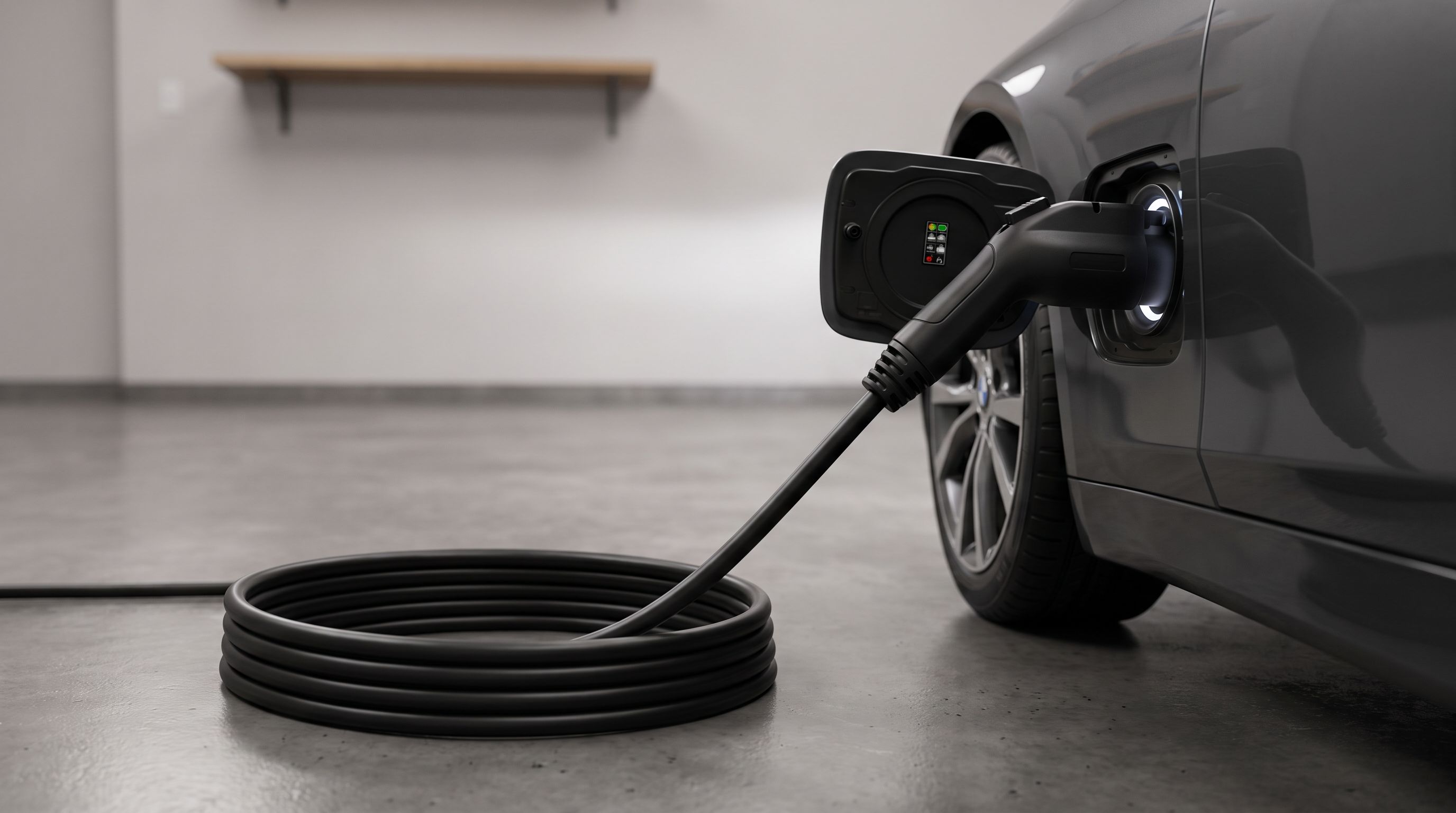
EV Charging Cable Extension 2026: What's Actually Safe
Most EV charging cable extensions aren't code-compliant. Here's what NEC and automakers actually say, plus safer ways to add reach in 2026.
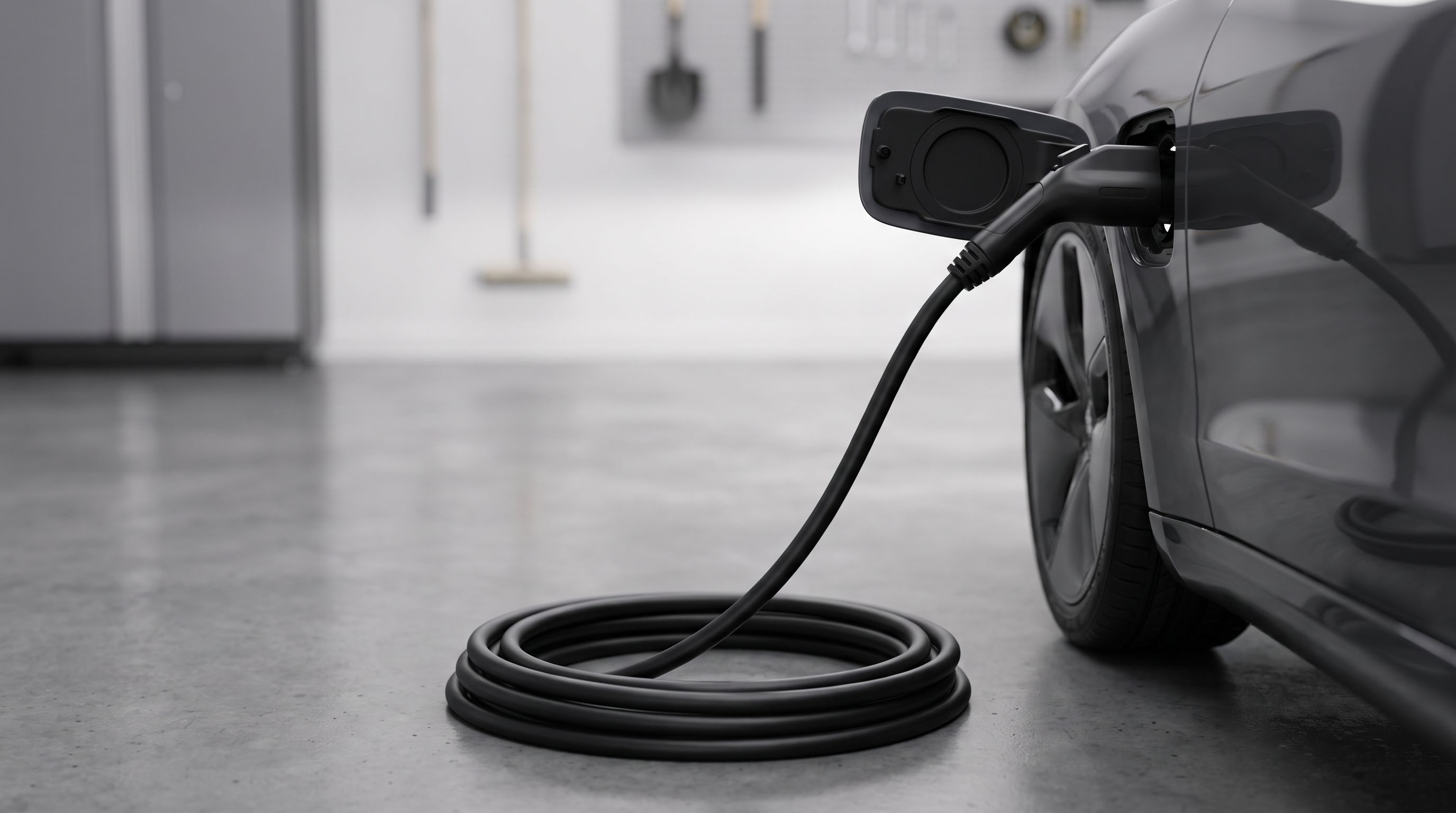
J1772 Charging Cable 40 Amp: Why Cheap Cords Run Hot in 2026
A J1772 charging cable rated 40 amp is only as good as its copper, jacket and contacts. Here's how gauge and connector quality prevent heat soak — plus 2026 picks.

Portable EV Charger NEMA 14-50 vs 6-20: What to Buy in 2026
Portable EV charger NEMA 14-50 vs 6-20 explained for 2026: match plug tails and amperage to your real outlet, plus picks that ship swappable adapters.