Polisher Backing Plate Size 2026: Stop Stalling on Curves
Polisher backing plate size guide for 2026: match plate diameter, thread spec, and pad overhang to your DA polisher so pads stop stalling on curves.
Reader-supported: we may earn a commission from links on this page, at no extra cost to you. It never affects our picks. Learn more.
The short version
- Best overall: Lake Country HDO 5-inch Backing Plate
- Best for 5-inch pads on long-throw machines: Griot's Garage 5-inch Backing Plate
- Best small-pad plate: Rupes 3-inch (75mm) Backing Plate
- Best budget 3-inch option: Chemical Guys TORQ R5 Hyper Flex 3-inch Backing Plate
- Best universal adapter fix: Rotary Hook & Loop Backing Plate with M14 to 5/16"-24 Adapter
 Budget pick · Chemical Guys TORQ R5 Hyper Flex 3-inch Backing Plate — Check price on Amazon →
 Best small-pad plate · Rupes 3-inch (75mm) Backing Plate — Check price on Amazon →
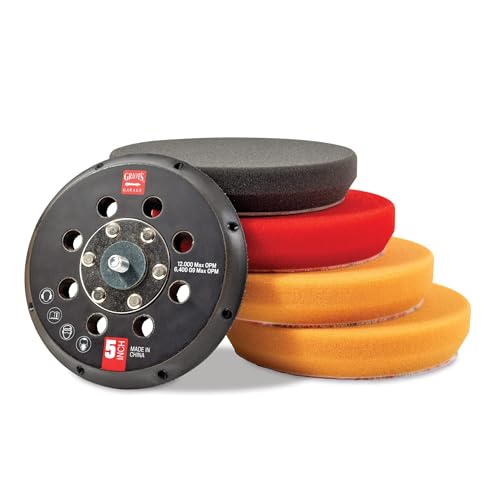 Best for long-throw machines · Griot's Garage 5-inch Backing Plate — Check price on Amazon →
 Best overall · Lake Country HDO 5-inch Backing Plate — Check price on Amazon →
If you only remember one rule from this guide: the pad should be no more than about half an inch larger in diameter than the backing plate, all the way around is too much. A 5-inch plate wants a 5.5-inch pad. A 3-inch plate wants a 3.5-inch pad. Go bigger than that and the unsupported pad edge folds, grabs, heats up, and stalls your dual action polisher the moment it meets a curve.
Why backing plate size is the fitment spec nobody checks
Most people buy a polisher, buy pads, and then wonder why the machine goes dead quiet on a fender flare or the shoulder of a hood. Nine times out of ten the problem isn't the polisher — it's geometry.
A DA polisher's rotation is driven only by friction between the pad face and the paint. There's no gear forcing the pad to spin. So anything that adds drag — too much pressure, too much polish, a pad that's too big for its plate — stops the rotation. The machine still oscillates, so it feels like it's working, but it's barely correcting anything.
Backing plate diameter controls how much of that pad is actually supported. The overhanging ring of foam past the plate edge has nothing behind it. On flat glass-like panels that overhang is harmless. Put it on a convex body line and the overhang contacts first, levers the pad sideways, and kills rotation.
The three numbers you need
- Plate diameter — measured across the hook-and-loop face, not the rubber hub.
- Thread/spindle spec — almost always 5/16"-24 on DA polishers, M14 on rotaries and some big machines, or a proprietary press-fit on certain tools.
- Throw (orbit) of your machine — 8mm, 9mm, 12mm, 15mm or 21mm. Longer throw needs a smaller plate to keep from bogging.
Get all three right and pad choice becomes trivially easy.
The pad overhang rule, in plain numbers
The industry convention is that a pad should be roughly a quarter-inch larger in radius than the plate — which works out to about half an inch larger in diameter. That small lip lets the foam flex over curves without the hard plate edge marring paint.
| Backing plate diameter | Correct pad size | Typical use | Works best on |
|---|---|---|---|
| 3 in (75 mm) | 3–3.5 in | Pillars, mirrors, bumper corners, spot repairs | 8–12 mm throw |
| 3.5 in (90 mm) | 4 in | Mid-size panels on compact cars, door handles area | 8–15 mm throw |
| 5 in (125 mm) | 5.5 in | General correction, doors, hoods, fenders | 8–15 mm throw |
| 6 in (150 mm) | 6.5 in | Large flat panels, trucks, RVs, finishing | 15–21 mm throw |
| 3 in rotary (M14) | 3–4 in | Heavy defect removal in tight areas | Rotary only |
Where people go wrong: running a 6.5-inch pad on a 5-inch plate because "it fits." It physically mounts, yes. But you've now got three-quarters of an inch of unsupported foam all the way around, and the pad will stall under any real pressure.
Undersizing is also a mistake
Running a 5-inch pad on a 5-inch plate seems safer, but it isn't. With zero overhang, the hard plate edge sits flush with the foam edge, and the moment you tilt the machine — which you will, constantly — that rim can scuff or even burn the clear coat. Keep the small lip.
Thread specs: 5/16"-24 is the default, but check
The overwhelming majority of consumer dual action polishers — Porter Cable 7424XP, Griot's Garage G9 and G15, Meguiar's MT300, Chemical Guys TORQ, Adam's, Harbor Freight Bauer — use a 5/16"-24 male spindle on the tool and a female-threaded backing plate. That's why most aftermarket plates list 5/16"-24 as the spec.
Exceptions to watch for:
- Rupes LHR15/21 Mark III and LHR75 Mini use proprietary quick-release or M8/M14 mounts depending on model. Buy Rupes plates for Rupes machines unless you've confirmed the adapter.
- Flex XFE and PE-series often use M14.
- Rotary polishers (Makita 9237C, Flex PE14, DeWalt DWP849X) are M14 almost universally.
- Some cordless compact polishers use a smaller proprietary hub.
If you're crossing systems — say, running a 5/16"-24 DA plate on an M14 rotary — an adapter exists, but adapters add stack height and a bit of wobble. Use them for occasional work, not for your daily setup.
How to check your machine: unscrew the existing plate, measure the exposed spindle with calipers. Roughly 7.9 mm across the threads = 5/16". Roughly 14 mm = M14. If you can't measure, search your exact polisher model plus "spindle thread" — manufacturers publish it.
Throw length changes everything
This is the part most sizing guides skip. A 21mm long-throw machine moves the pad in a much wider orbit than an 8mm short-throw. The wider the orbit, the more leverage the pad edge has, and the more easily a large pad stalls.
- 8–9 mm throw (Griot's G9, Porter Cable 7424XP): happily runs 5-inch and even 6-inch plates. Short throw is forgiving.
- 15 mm throw (Griot's G15, Rupes LHR15): 5-inch plate is the sweet spot. A 6-inch plate works on flat panels but struggles on curves.
- 21 mm throw (Rupes LHR21, long-throw clones): stick to 5-inch or smaller. The orbit already covers huge area; you don't need pad diameter too.
Notably, reviewers consistently point out that the 9mm-throw Griot's G9 ships with a 6-inch plate for 6.5-inch pads, while longer-throw machines in the same lineup drop down. That's not a coincidence — it's the throw-versus-diameter tradeoff in action.
How to choose
Match the plate to your panel reality, not your ambition
A 5-inch plate is the right default for nearly everyone in 2026. It handles doors, fenders, hoods, and bumpers without constant swaps, and 5.5-inch pads are the most widely stocked size in every foam and microfiber line. Buy the 5-inch first. Add a 3-inch as your second plate, not a 6-inch.
Check the max RPM/OPM rating
Backing plates are rated for a maximum speed. A cheap plate spun past its rating on a 21mm machine can delaminate or throw the hook-and-loop face. Match or exceed your polisher's top speed rating — most quality plates list it on the hub or packaging.
Look at hub flexibility and centering
A good plate has a flexible urethane or rubber hub that lets the face conform slightly to curves without transmitting vibration to your hands. Rigid plastic plates chatter. Also check that the hook-and-loop face is concentric — an off-center plate creates a vibration you'll feel for hours.
Think about hook-and-loop quality
The Velcro face is a wear item. Cheap loop material glazes over after a dozen pad changes and pads start flying off mid-pass. Plates with dense, tall hook fields hold pads through heat cycles far better, and this is the single biggest difference between budget and premium plates.
Count your total stack height
Plate thickness plus pad thickness determines how much leverage the machine has over the panel. Thin plates with thin pads give you the most control and the least stall risk; thick plates with thick pads are more forgiving on finish work but bog faster.
The picks
Lake Country HDO 5-inch Backing Plate — best overall
Prices last checked November 4, 2026. Amazon prices change frequently, so treat these as a guide and check the live price before you buy.
Lake Country HDO 5-inch Backing Plate
Flexible hub and dense hook face in the 5-inch, 5/16"-24 size that fits most consumer DA polishers.
Lake Country has been the default supplier for serious detailers for years, and the HDO line is built around a flexible hub with a dense hook face that survives repeated pad swaps. The 5-inch size pairs with 5.5-inch HDO and standard foam pads, and the 5/16"-24 thread fits the vast majority of consumer DAs — Porter Cable, Griot's, Meguiar's, Chemical Guys, Bauer. What it gives up: it's not a quick-change system, so swapping between plate sizes mid-job means unscrewing by hand. And if you own a Rupes with a proprietary mount, this won't fit without an adapter. For everyone else, it's the plate to buy once.
Griot's Garage 5-inch Backing Plate — best for 5-inch pads on long-throw machines
If you run a G15 or another 15mm machine, Griot's own 5-inch plate is the natural match — it's engineered around the tool's throw and balance, and the thread spec is standard 5/16"-24 so it crosses over to other brands fine. The flexible hub soaks up vibration well, which matters on longer sessions. Give-ups: it's priced as an OEM accessory, and the hook face, while good, isn't quite as aggressive as premium aftermarket options. If you already own a Griot's machine and want zero guesswork about balance and speed rating, this removes the question entirely.
Rupes 3-inch (75mm) Backing Plate — best small-pad plate
Rupes 3-inch (75mm) Backing Plate
Precisely centered 75mm plate for mirrors, pillars and bumper corners — check your spindle spec first.
For mirrors, A-pillars, bumper corners, and door handle surrounds, a 3-inch plate is non-negotiable — and Rupes' 75mm plate is the reference. It's designed for the LHR75 Mini and compatible compact machines, with a precisely centered hub that keeps vibration low at the high speeds small pads need. Pair with 3.5-inch pads. What it gives up: fitment is the catch. Rupes uses its own mount on several machines, so confirm your spindle spec before ordering — this is not a blanket "fits all DAs" plate. Check your model's thread, then buy.
Chemical Guys TORQ R5 Hyper Flex 3-inch — best budget 3-inch option
Chemical Guys TORQ R5 Hyper Flex 3-inch Backing Plate
Genuinely flexible 3-inch plate that follows bumper curves instead of fighting them.
The Hyper Flex is exactly what a spot-correction plate should be: genuinely flexible, so it follows the curve of a bumper rather than fighting it, and cheap enough that you won't hesitate to add it as a second plate. Standard 5/16"-24 thread means it drops onto most DAs. Pair it with 3.5-inch or 4-inch pads. Give-ups: that flexibility costs you a little cutting power on flat areas, and the hook face isn't as durable as Lake Country's — expect to replace it sooner if you detail frequently. For occasional spot work on a home machine, it's more than enough.
Rotary Hook & Loop Backing Plate with M14 to 5/16"-24 Adapter — best universal adapter fix

Rotary Hook & Loop Backing Plate with M14 to 5/16"-24 Adapter
Bridges M14 rotaries to your existing 5/16"-24 plate collection without buying a second set.
If you've got an M14 rotary or an M14 cordless polisher and a drawer full of 5/16"-24 plates, an adapter solves the mismatch without a second set of plates. It's the pragmatic option for anyone running mixed tools. What it gives up: adapters add stack height and a small amount of runout, which you'll feel as vibration at higher speeds. They're also one more thing to lose. Treat this as a bridge, not a permanent setup — if you find yourself using the adapter daily, buy the correctly-threaded plate instead.
Quick setup checklist
- Measure or look up your polisher's spindle thread.
- Buy a 5-inch plate (5/16"-24 for most DAs) as your primary.
- Buy 5.5-inch pads for it — nothing larger.
- Add a 3-inch plate and 3.5-inch pads for tight areas.
- Confirm the plate's max speed rating meets or beats your machine's top setting.
- If the pad stalls on a curve, reduce pressure first, then check that your pad isn't oversized.
Get the sizing right and a mid-range DA will out-correct an expensive one that's wearing the wrong plate.
FAQ
What size backing plate should I start with? Five inches. It covers doors, hoods, fenders, and bumpers without constant tool swaps, and 5.5-inch pads are the most widely available size across every major pad brand.
Can I put a 6.5-inch pad on a 5-inch backing plate? It'll mount, but don't. That's 0.75 inches of unsupported foam all the way around, which folds under pressure and stalls the pad on any curved panel. Keep overhang to about a quarter inch of radius.
What thread do most DA polishers use? 5/16"-24. That covers the Porter Cable 7424XP, Griot's G9 and G15, Meguiar's MT300, Chemical Guys TORQ, and most budget DAs. Rotaries and some Flex and Rupes machines use M14 or proprietary mounts — verify before buying.
Does a smaller backing plate correct faster? Per square inch, yes — smaller plates concentrate pressure and spin more reliably, so defect removal is quicker in a given spot. But you cover far less area per pass, so total job time usually goes up.
My pad keeps stopping on curves — is my polisher broken? Almost certainly not. Reduce arm pressure, make sure the pad isn't oversized for the plate, and check the pad isn't saturated with polish. Those three fixes solve the majority of stalling complaints.
Do I need a different plate for microfiber pads? Not usually, but microfiber cutting discs generate more heat and drag, so a slightly smaller plate relative to pad size helps. Also make sure your plate's hook face is in good condition — microfiber discs tend to let go first when the loop is glazed.
Our picks
Griot's Garage 5-inch Backing Plate
OEM-matched balance and speed rating for G15-class 15mm polishers, with standard 5/16"-24 threads.
Get the best car care deals in your inbox
Join the GarageProof newsletter for hand-picked car care deals and new buying guides. No spam, unsubscribe anytime.
Related reads
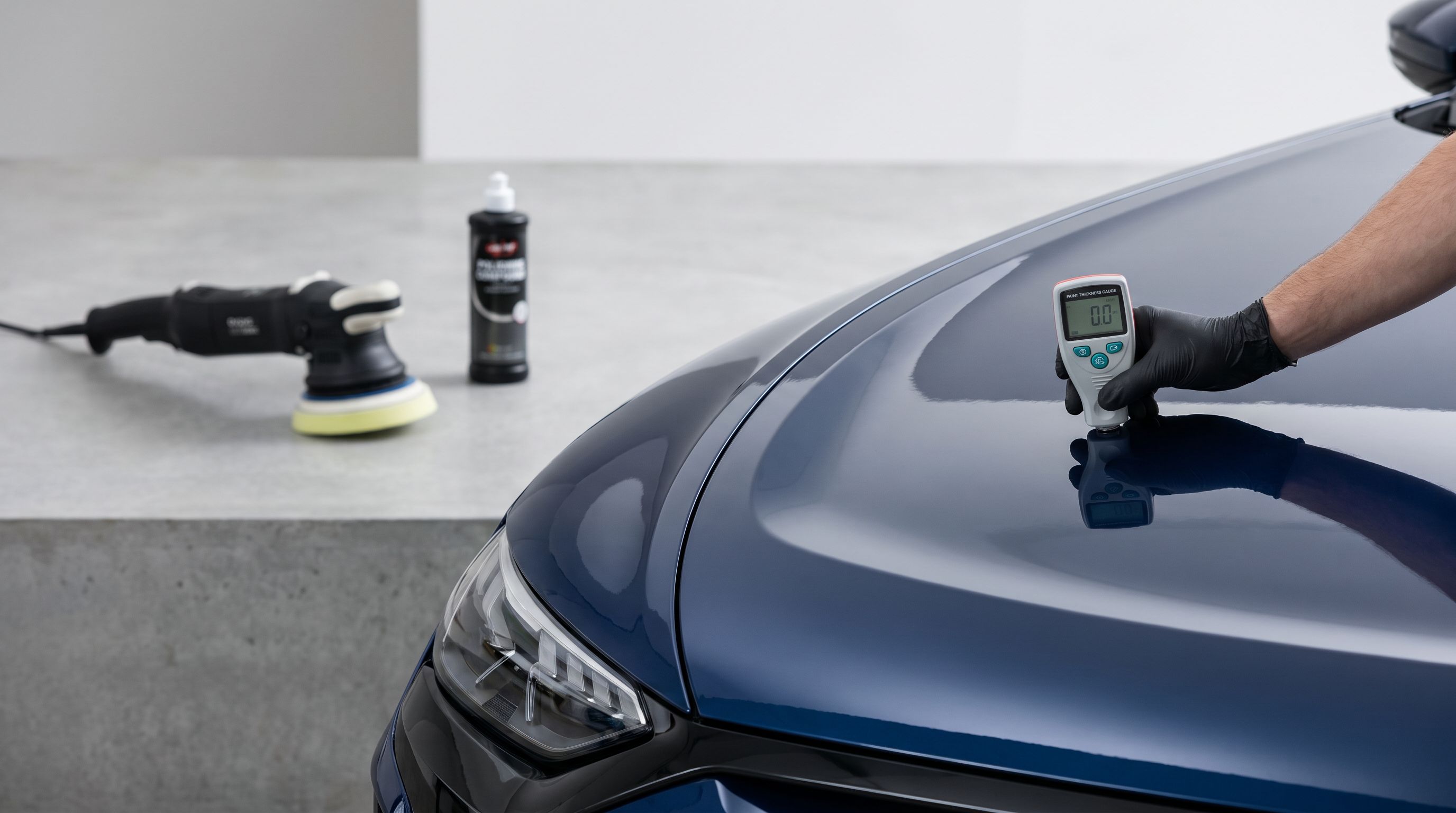
Paint Correction Clear Coat Thickness in 2026: When to Stop
How to read a paint depth gauge, budget clear coat microns, and know when to stop polishing — plus the best paint thickness gauges and compounds for 2026.
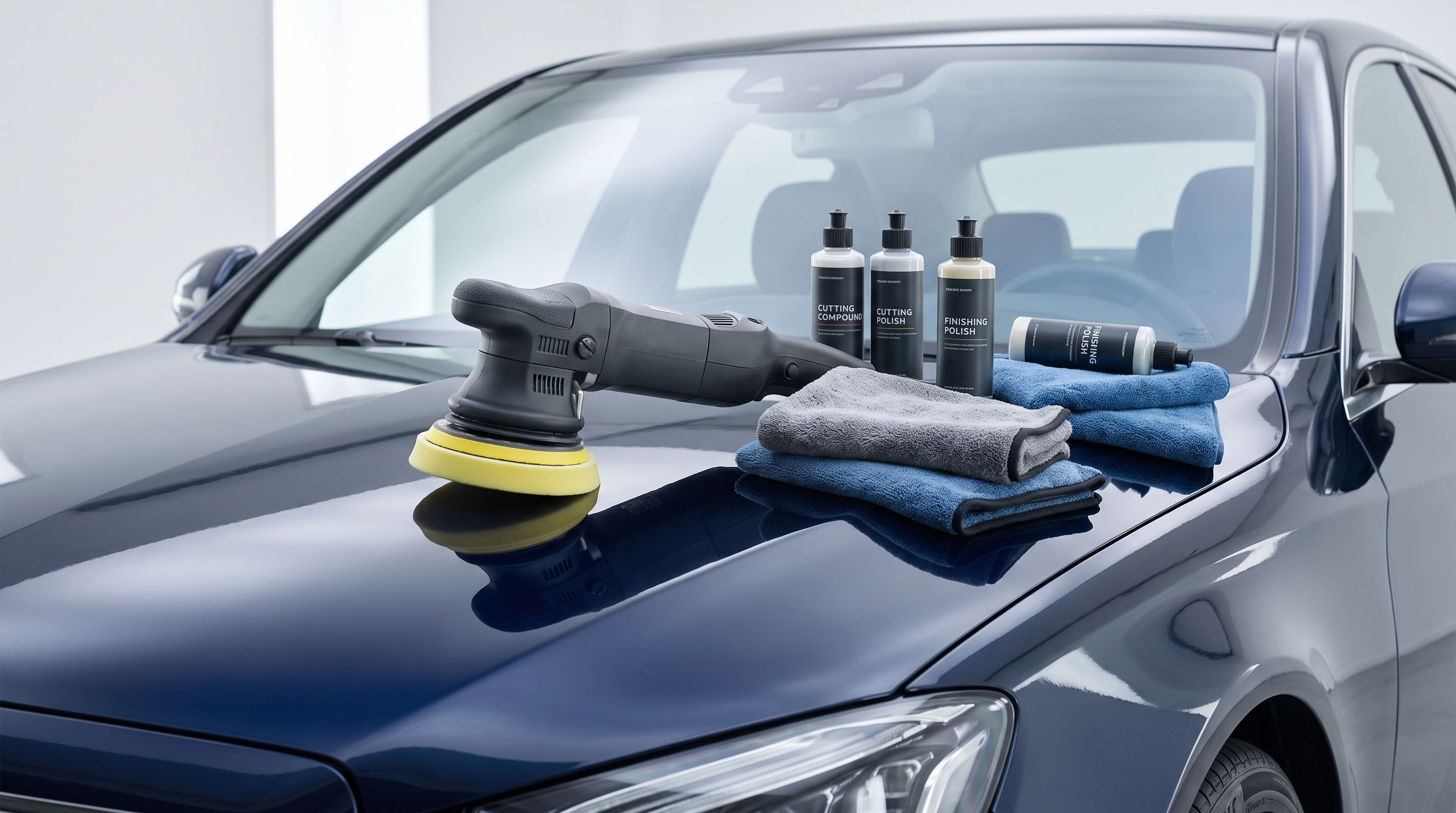
Dual-Action Polishers in 2026: 15mm vs 21mm Throw
Which dual-action polisher should a beginner buy in 2026? We compare 15mm vs 21mm throw, backing plate sizes and power on soft and hard clearcoats.
Ceramic Coating Prep Kit 2026: Why Coatings Fail at Step One
A ceramic coating prep kit decides whether your coating bonds or flakes. We compare iron removers, panel wipes and applicators for 2026, plus cure-time rules.