Mirror Dash Cams in 2026: Will It Clamp Over Your Mirror?
Mirror dash cam fitment explained for 2026: strap vs clip mounts, auto-dimming mirror clearance, screen size and wiring — plus four models worth buying.
Reader-supported: we may earn a commission from links on this page, at no extra cost to you. It never affects our picks. Learn more.
Mirror dash cams promise a tidy install: no windshield clutter, a huge rear view that ignores headrests and cargo, and a screen you already look at. The catch is that they are the only dash cam category where the mount itself can be a dealbreaker. A mirror cam has to clamp over whatever your manufacturer bolted to the glass — and in 2026 that factory mirror is increasingly fat, powered, and wired.
This guide is built around that one question: will it actually fit, and will it still work properly once it does? We compared current mirror models on mounting hardware, clearance behind the housing, screen size and wiring demands, using manufacturer specs, independent reviews and verified owner feedback. GarageProof does not physically test units.
The short version
- Best overall: Wolfbox G900 TriPro
- Best balance of size and price: Wolfbox G930
- Best OEM-look fit: AUTO-VOX T9 PRO
- Best alternative to a mirror cam: Viofo A229 Pro
 Best alternative to a mirror cam · Viofo A229 Pro — Check price on Amazon →
 Best OEM-look fit · AUTO-VOX T9 PRO — Check price on Amazon →
 Best balance of size and price · Wolfbox G930 — Check price on Amazon →
 Best overall · Wolfbox G900 TriPro — Check price on Amazon →
Why fitment is the whole ballgame
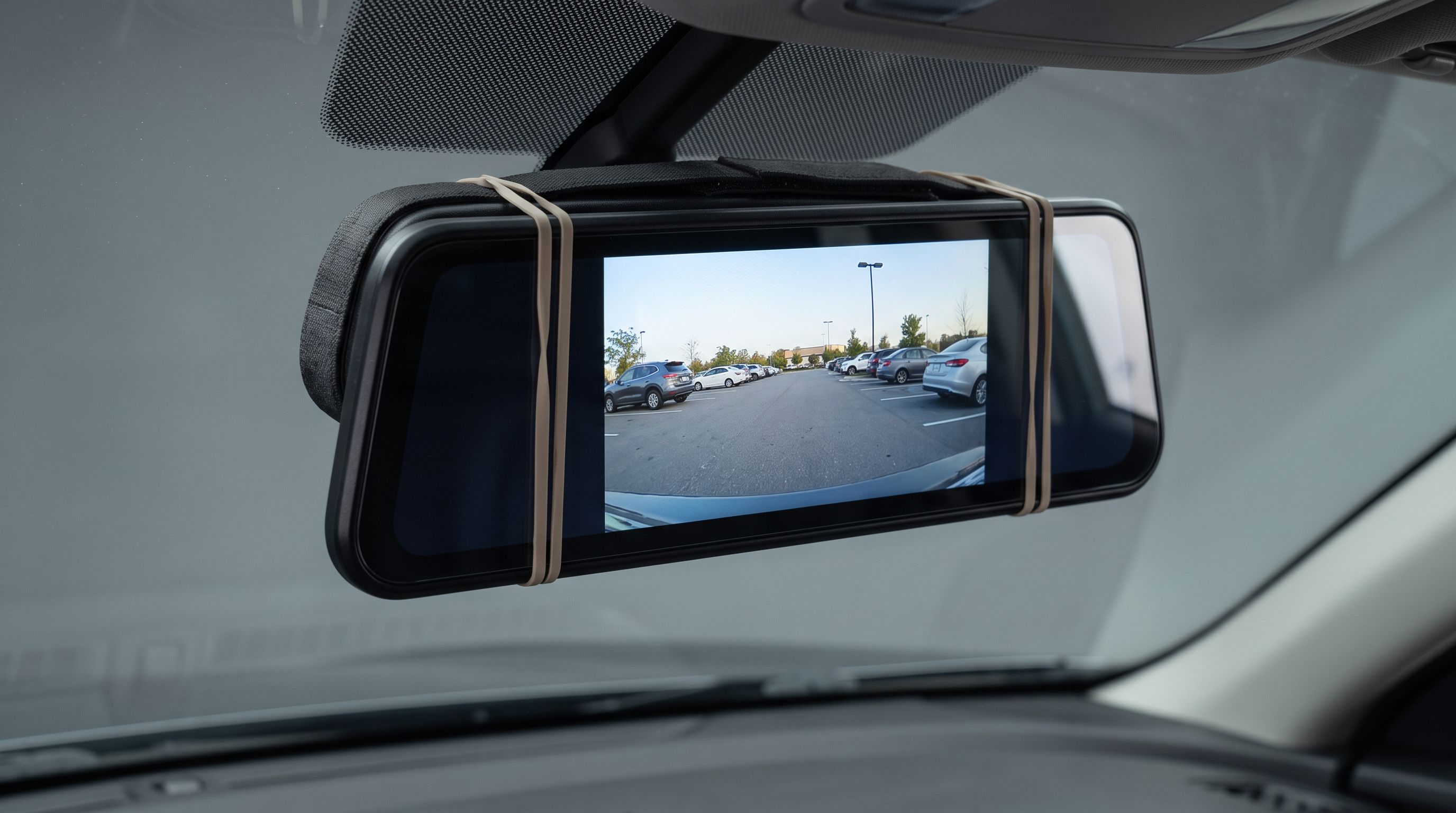
A mirror dash cam is a slab of glass and electronics that hangs off your existing mirror using either rubber straps or a spring clip. Three things go wrong most often:
The mirror housing is too thick. Modern auto-dimming mirrors with HomeLink buttons, compass displays, microphones and rain/light sensor housings are deep. If the mirror cam's strap channel or clip jaws are shallower than that housing, the unit sits crooked, rattles, or won't seat at all.
The factory mirror has a wiring loom. Auto-dimming and camera-based mirrors carry a cable up the windshield into the headliner. Straps have to clear it. On many vehicles this is fine; on some it forces the mirror cam to sit a few millimetres proud, which puts the strap under tension and encourages vibration.
The combined assembly is too heavy or too wide. Stack a 12-inch panel on top of a factory mirror and you add weight to a mount designed for a fraction of it. On a windshield-bonded mirror button this is usually fine. On a mirror attached to a plastic headliner trim pod (common on some European models), owners report sag and vibration.
Before you buy, do this: sit in the driver's seat, measure the depth of your mirror housing front-to-back at its thickest point, measure the mirror's width, and look at whether a cable exits the top of the housing. Then check those numbers against the product listing's mount specification. If the listing doesn't state a mount capacity, treat that as a warning sign.
Strap mounts vs clip mounts
Rubber strap mounts are the default. Two or four elastic bands loop around the back of your factory mirror and hook onto the mirror cam's body. They tolerate a wide range of mirror sizes, including deep auto-dimming units, and they're cheap to replace when they perish. The downsides: they can introduce a little wobble on rough roads, they age and lose tension after a couple of years of heat cycling, and they look less tidy from the passenger seat.
Spring clip mounts grip the top and bottom edges of the factory mirror like a jaw. They feel more solid and look cleaner, but they have a hard dimensional limit. If your mirror is deeper than the clip's maximum jaw opening, you're done — there's no workaround. Clips also concentrate pressure on the mirror housing, which some owners dislike on leased vehicles.
OEM-replacement mirror cams are the third path: you unclip the factory mirror entirely and bolt the camera mirror to the windshield button. This looks best by far, but you lose auto-dimming and any HomeLink/compass functions unless the replacement supports them, and on vehicles with a camera-based or frameless mirror it's often not viable.
Our practical advice: if you have a basic manual mirror, a clip is lovely. If you have auto-dimming, a sensor pod, or any doubt at all, buy a strap-mount unit. Straps are the universal donor.
Auto-dimming, glare and the screen-off problem
Here's a subtlety buyers miss. When you mount a mirror cam over an auto-dimming mirror, the auto-dimming function is now behind an opaque screen. It does nothing. At night, your rear view is whatever the camera and screen produce — so screen quality, brightness control and the rear camera's low-light performance matter more than they would on a windshield cam.
Good mirror cams handle this with an adjustable brightness schedule, a screen-off mode that reverts the top layer to a conventional mirror surface (most are half-silvered, so with the display off you get a usable, if slightly dim, reflective mirror), and a rear camera with a decent sensor rather than the cheapest module available. Cheap units go milky in rain and bloom badly under following headlights.
Also check polarised sunglasses. Some mirror panels wash out completely through polarised lenses at certain head angles. Reviews flag this inconsistently by model, so if you always drive in polarised shades, look for owner feedback on that specific unit.
Screen size: 9.35, 10, 11, 12 inches
Bigger screens give a wider, more useful rear image and easier touch controls. They also block more windshield. A 12-inch panel is roughly the width of a large factory mirror plus several inches, and in cars with a short windshield-to-roof distance or an A-pillar-mounted sun visor, that extra span can intrude on your view of traffic lights or clip the visor's swing.
Rule of thumb: measure your existing mirror. If it's around 10 inches wide, a 12-inch mirror cam adds about an inch per side — usually fine. If your factory mirror is a compact 8-inch unit in a small car, drop to a 10-inch class panel.
Comparison table
| Model | Screen | Mount type | Channels | Best for | Main compromise |
|---|---|---|---|---|---|
| Wolfbox G900 TriPro | 12 in touchscreen | Rubber straps | 3 (front, rear, interior/bumper) | Drivers who want maximum coverage on one screen | Widest panel here; more cable routing work |
| Wolfbox G930 | 12 in touchscreen | Rubber straps | 2 (front + rear) | Most people upgrading from no dash cam | Same width concerns, no third channel |
| AUTO-VOX T9 PRO | 9.35 in | OEM-style, sits close to glass | 2 (front + rear) | Tight mirror clearance, factory look | Smaller screen, less flashy feature set |
| Viofo A229 Pro | None (phone app) | Windshield adhesive | 2 (front + rear) | Best video quality, zero mirror fitment risk | No mirror screen at all |
The picks
Wolfbox G900 TriPro — best overall
Prices last checked October 8, 2026. Amazon prices change frequently, so treat these as a guide and check the live price before you buy.
Wolfbox G900 TriPro
12-inch 4K mirror with a three-channel setup and the most polished screen in the category.
The G900 TriPro is the most complete execution of the mirror format right now. You get a 12-inch touchscreen, 4K front recording and a three-channel configuration that adds an interior or bumper camera alongside the standard rear unit — useful for rideshare drivers or anyone who wants a front-bumper angle for low-speed parking scrapes. The display is bright and responsive enough that touch gestures for angle adjustment don't feel like a chore. It uses rubber straps, so it clears deep auto-dimming housings on most vehicles.
What it gives up: it's physically large, and three cameras means three cable runs plus a hardwire kit if you want parking mode. Budget an afternoon, not twenty minutes.
Wolfbox G930 — best balance of size and price
Wolfbox G930
4K front and 2.5K rear on a 12-inch display without the third camera complexity.
For most drivers, the third channel is a nice-to-have. The G930 keeps the 12-inch mirror screen and 4K front capture but sticks to a conventional front-and-rear pair, which halves the install complexity. Rear footage is sharp enough to read plates at sensible following distances, and the screen's split and swap modes let you flick between camera feeds or run a straightforward full-width rear view.
It gives up the bumper/interior camera and some of the TriPro's newer processing. If you've already decided you want a mirror cam and don't need interior coverage, this is the sensible buy — and the one with fewer things to go wrong.
AUTO-VOX T9 PRO — best OEM-look fit
AUTO-VOX T9 PRO
Slim 9.35-inch panel designed to sit close to the glass for cars with tight mirror clearance.
AUTO-VOX built the T9 PRO around the fitment problem. The panel is slim and designed to sit tight against the factory mirror rather than standing proud of it, and at 9.35 inches it's narrower than the 12-inch crowd — the right answer for compact cars, short windshields, or anyone who finds a huge mirror panel distracting. The look is closer to a factory digital mirror than an aftermarket add-on.
The trade-offs are real: a smaller screen means a smaller rear view, and the feature set is less expansive than Wolfbox's flagships. Check the mount style against your mirror before ordering — the tighter the design, the less tolerance it has for an unusually deep housing.
Viofo A229 Pro — best alternative to a mirror cam
Viofo A229 Pro
If fitment fails, this compact 4K two-channel hides behind the mirror and records better.
Include this one honestly: if your mirror is too deep, too wide, or wired in a way that makes a clamp-on unit a bad idea, the best outcome isn't a compromised mirror cam. It's a compact two-channel that tucks behind the mirror and never touches it. The A229 Pro is widely regarded as a top all-round dash cam, with 4K front capture, strong night performance and a mature app.
What you lose is the point of a mirror cam entirely: there's no live rear view while driving, and no big screen. If the rear-view benefit is the reason you're shopping, this isn't a substitute — it's a fallback worth knowing about.
How to choose
Measure before you add to cart
Three numbers: mirror width, mirror housing depth at its thickest point, and the clearance between the top of your mirror and the headliner. Compare against the product's stated mount range. If you have a sensor pod or a cable exiting the mirror stem, lean strap-mount.
Decide how much you need the third channel
Interior cameras matter for rideshare and for theft evidence; bumper cameras help with parking damage. Both add cable runs. If neither applies to you, a two-channel mirror cam installs faster and fails less.
Plan the rear camera run and the power source
The rear camera cable has to travel the length of the car, usually under trim and through a tailgate grommet. Hatchbacks and SUVs are harder than sedans because of the flexing boot. For parking mode you need a hardwire kit tapped into the fuse box with a voltage cutoff — a cigarette lighter plug won't do it. Factor that in before you buy.
Check the night-time rear view, not just the daytime specs
Because the mirror cam disables auto-dimming, the camera's low-light handling is your night mirror. Look specifically for owner comments about headlight glare and rain performance on the rear channel, not just front-camera resolution headlines.
Confirm memory card support
High-bitrate 4K across multiple channels chews through cards. Check the maximum supported capacity and use a high-endurance microSD rated for continuous surveillance writing. Standard phone cards fail early in this duty cycle.
FAQ
Will a mirror dash cam fit over an auto-dimming mirror? Usually, if it uses rubber straps. Clip mounts and OEM-style units often can't clear the deeper housing. The auto-dimming function stops working once a screen covers it, so you rely on the camera and screen at night.
Does a mirror dash cam block the windshield? It occupies more area than a factory mirror. A 12-inch panel adds roughly an inch per side on a typical mid-size car. Check sun visor swing and your sightline to overhead traffic lights before committing.
Can I still use it as a normal mirror? On most models yes — the display layer is half-silvered, so with the screen off you get a reflective surface. It's dimmer than a true mirror, and you lose auto-dimming.
Are mirror dash cams legal? Laws on windshield obstruction vary by state and country, and some jurisdictions restrict screens visible to the driver. Check your local rules; a mirror cam is generally treated more favourably than a suction-cup unit because it sits in the mirror's footprint.
Do I need to hardwire it? Only for parking surveillance. For drive-time recording, a 12V plug works fine. Parking mode needs a hardwire kit with low-voltage cutoff so it doesn't flatten your battery.
Will it work on a frameless or camera-based digital mirror? Often not. Vehicles with factory digital rear-view mirrors or frameless designs have unusual shapes and integrated electronics. Verify with the manufacturer's fitment list for your year, make and model rather than assuming universal fit.
Get the best car care deals in your inbox
Join the GarageProof newsletter for hand-picked car care deals and new buying guides. No spam, unsubscribe anytime.
Related reads
Dash Cam for a Leased Car in 2026: No-Drill Power Routes
The best no-drill dash cam setups for leased cars in 2026 — OBD and fuse-tap power, adhesive mounts, and how to route cables around A-pillar airbags safely.
Dash Cam Mount for Sloped Windshield: 2026 Wedge Guide
Steeply raked glass ruins dash cam aim. Here's how wedge angle, adhesive vs suction mounts and ball-joint range decide what you should buy in 2026.
Rear Dash Cam Through Tinted Window: Will Yours See in 2026?
Tinted rear glass can gut your dash cam's night footage. Here's how much light you lose, which rear-camera specs compensate, and 5 setups worth buying in 2026.