Lithium Jump Starters for Winter 2026: Don't Buy Undersized
Peak amps are marketing. Compare real cold-cranking capability, engine-size limits and clamp quality to find the best jump starter 2026 for diesels and gas cars.
Reader-supported: we may earn a commission from links on this page, at no extra cost to you. It never affects our picks. Learn more.
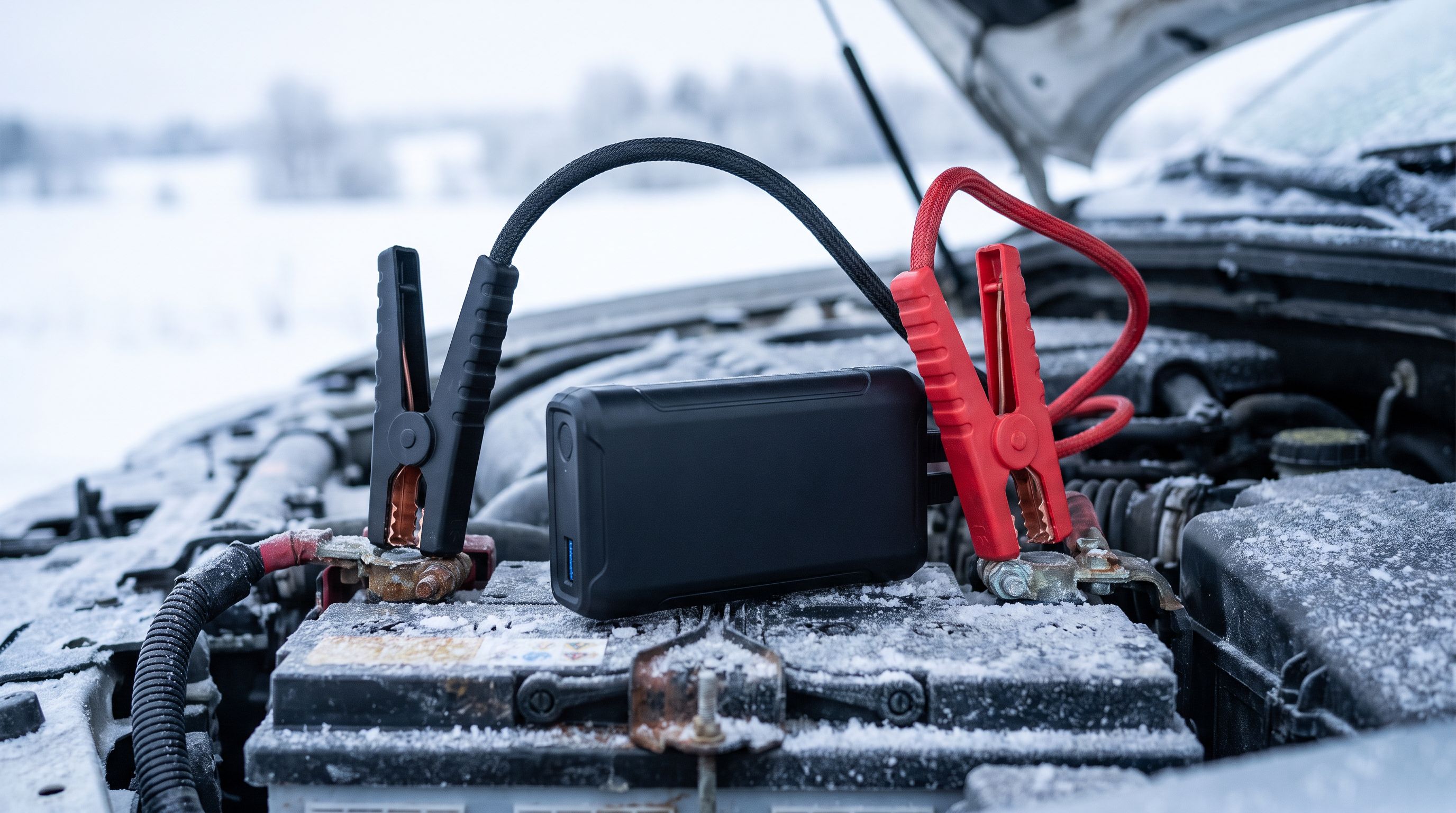
Cold mornings are when jump starters earn their keep — and when the cheap ones quietly fail. A lithium pack that confidently cranked a four-cylinder in September can sit in a -15°C truck bed overnight and refuse to deliver, because lithium cells lose usable output as temperature drops and a cold 6.7L diesel demands far more current than the same engine does warm.
This guide compares the packs worth carrying into winter 2026, and — more importantly — explains how to read the specs so owners of big-displacement diesels don't end up stranded with a pack rated for a Civic. We researched manufacturer specifications, independent test results and verified owner feedback rather than physically testing units ourselves.
The short version
- Best overall for big diesels: NOCO Boost X GBX155
- Best heavy-duty workhorse: NOCO Boost Pro GB150
- Best compact pick: NOCO Boost Plus GB40
- Best value all-rounder: Clore Jump-N-Carry JNC325
- Best with air compressor: WOLFBOX MegaVolt 16 Air
 Best with air compressor · WOLFBOX MegaVolt 16 Air — Check price on Amazon →
 Best value all-rounder · Clore Jump-N-Carry JNC325 — Check price on Amazon →
 Best compact pick · NOCO Boost Plus GB40 — Check price on Amazon →
 Best overall for big diesels · NOCO Boost X GBX155 — Check price on Amazon →
Why "peak amps" is the most misleading number in the category
Walk down the jump starter aisle — or scroll Amazon — and you'll see packs advertising 3000A, 5000A, even "8000A peak". Treat that figure with deep suspicion.
There is no enforced industry standard for how peak amps are measured on consumer lithium jump starters. Reputable brands (NOCO, Clore, CTEK, Schumacher) publish figures tied to defined test conditions. Many no-name sellers simply publish a big number. Independent teardowns have repeatedly found budget packs whose internal cells, wiring gauge and MOSFETs are physically incapable of sustaining anything close to the printed rating.
Three numbers actually matter more:
- Cranking amps sustained over several seconds. Starting an engine isn't an instantaneous spike — a cold diesel may crank for 3–8 seconds. A pack that peaks high but sags immediately won't finish the job.
- Cable gauge and length. Thin, short cables throw away current as heat and resistance. Clore's 24-inch cables on the JNC325 and NOCO's 4AWG cables on the GB150 exist for a reason.
- Stated engine-size limit. This is the manufacturer telling you, in plain language, what they'll stand behind. It's far more useful than peak amps.
The engine-size limit is the spec to shop by
Manufacturers publish limits like "up to 10 litres gasoline, up to 8 litres diesel". That's a real-world design envelope that accounts for cell chemistry, internal resistance and cable losses together.
As a rough mapping for common vehicles:
- Up to ~3.0L gas (most sedans, small crossovers, 4-cyl): a 1000A-class compact pack like the NOCO Boost Plus GB40 is genuinely adequate.
- 3.0–6.0L gas, small diesels up to ~3.0L: step up to a 2000A-class unit.
- 6.2L–7.3L gas V8s, 3.0L Duramax/EcoDiesel, 6.7L Cummins/Power Stroke: you want the top tier — GBX155 or GB150 territory, or a lead-acid boost pack.
- Anything above that, or 24V fleet equipment: lithium consumer packs are out of their depth. Buy a dedicated commercial unit.
Diesels are harder work for a reason: high compression ratios, larger starter motors, often twin batteries, and in cold weather glow plug loads running concurrently. A pack that can jump a 5.7L Hemi may stall out on a 6.7L Power Stroke at -20°C.
How cold actually changes the equation
Lithium-ion cells suffer two separate cold-weather penalties. Internal resistance rises, reducing deliverable current. And self-discharge plus capacity loss means a pack left in the vehicle all winter may hold far less charge than the display suggests.
Meanwhile, the battery you're trying to help is also degraded — a conventional lead-acid battery at -18°C may deliver only around 40% of its rated cranking capability, while the engine's oil is thicker and harder to turn over. The demand goes up exactly as the supply goes down.
Practical consequences:
- Pre-warm the pack if you can. Several manufacturers, including NOCO, note that letting the unit sit in a warm cabin for a few minutes before use improves output in extreme cold. Some models include a manual override or boost mode for very deeply discharged batteries.
- Recharge monthly. Set a calendar reminder. A pack at 40% won't start a cold diesel.
- Don't store it loose in an unheated truck bed. Cabin storage is better for both performance and cell longevity.
- Let the dead battery take a surface charge. Connecting the pack and waiting 60 seconds before cranking helps, particularly on very flat batteries.
The comparison table
| Model | Class | Engine-size guidance (mfr) | Cable notes | Extras | Best for |
|---|---|---|---|---|---|
| NOCO Boost X GBX155 | Top-tier lithium | Up to 10L gas / 8L diesel | Heavy-gauge, long reach | USB-C PD in/out, integrated light | 6.7L diesels, heavy trucks |
| NOCO Boost Pro GB150 | Top-tier lithium | Up to 10L gas / 8L diesel | 4AWG, robust clamps | 12V out, work light | Corroded terminals, fleet/farm use |
| NOCO Boost Plus GB40 | Compact lithium | Up to 6L gas / 3L diesel | Short, light | USB out, light | Sedans, crossovers, glovebox carry |
| Clore Jump-N-Carry JNC325 | Mid lithium | Mid-size gas/light diesel | 24in cables — class-leading reach | Simple, shop-grade design | Everyday value buyers |
| WOLFBOX MegaVolt 16 Air | Large lithium + inflator | Large gas / mid diesel | Substantial | Built-in air compressor | Winter tyre pressure + jumps |
Always confirm the current published engine rating for the exact model and revision you're buying — manufacturers do revise specs, and listings from third-party sellers are frequently out of date.
The picks
NOCO Boost X GBX155 — best overall for big diesels
NOCO Boost X GBX155
NOCO's biggest lithium pack, rated for 10L gas and 8L diesel engines, with USB-C PD in and out.
The GBX155 sits at the top of NOCO's lithium range and is the one to buy if your daily driver has a 6.7L Cummins, Power Stroke or Duramax under the hood. NOCO rates it for gasoline engines up to 10 litres and diesels up to 8 litres, which covers essentially every consumer pickup sold in North America. The X-series adds USB-C Power Delivery for faster recharging and the ability to charge laptops and phones — genuinely useful if you're stuck.
What you give up: size, weight and cost. This isn't a glovebox item, and if you drive a 2.0L hatchback you're paying for headroom you'll never use. Recharge it monthly to keep it winter-ready.
NOCO Boost Pro GB150 — best heavy-duty workhorse
NOCO Boost Pro GB150
Thick 4AWG cables and heavy clamps make it the pick for poorly maintained or corroded terminals.
The GB150 predates the X-series but remains the pick for people who jump other people's vehicles — farm equipment, work trucks, neglected batteries with furred-up terminals. Its 4AWG cables and heavy clamps bite through corrosion better than the slimmer clamps on compact packs, and owner feedback consistently praises it for repeated use in a single session.
It carries the same 10L gas / 8L diesel guidance as the GBX155. What it gives up is modernity: no USB-C PD, slower recharge, and a bulkier form factor. If you want the toughest hardware rather than the newest features, this is the one.
NOCO Boost Plus GB40 — best compact pick
NOCO Boost Plus GB40
Glovebox-sized 1000A unit that covers most 4- and 6-cylinder gas engines without taking up space.
For the majority of drivers — a commuter car, a small SUV, a 4-cylinder — the GB40 is the honest answer. Rated for gas engines up to 6L and diesels up to 3L, it fits in a glovebox, weighs almost nothing, and has been one of the most consistently well-reviewed compact packs on the market for years.
Its limits are real, though. Do not buy this for a 6.7L diesel and expect it to work at -20°C. Cables are short, so you need decent access to the battery. Treat it as excellent insurance for a normal car, not a universal tool.
Clore Jump-N-Carry JNC325 — best value all-rounder
Clore Jump-N-Carry JNC325
Long 24-inch cables and straightforward operation from a brand shops actually use.
Clore is a name professional shops recognise, and the JNC325 earned Best Overall honours in at least one independent 2026 comparison test, largely on the strength of its unusually long 24-inch cables and no-nonsense operation. Cable length matters more than buyers expect: with a remote-mount battery, or when you're reaching across a snowbank, extra reach is the difference between a jump and a tow.
It sits below the top-tier NOCO units in raw capability, so match it to mid-size gas engines and light diesels rather than a loaded one-ton. In exchange, you get a well-built, sensibly specified pack from a brand with real trade credibility.
WOLFBOX MegaVolt 16 Air — best with air compressor
WOLFBOX MegaVolt 16 Air
Combines a large-capacity jump pack with a built-in inflator, handy for winter tyre pressure drops.
Winter drops tyre pressure roughly 1 PSI per 10°F, which means the two most common cold-weather roadside problems are a flat battery and an underinflated tyre. The MegaVolt 16 Air handles both, combining a large-capacity jump pack with a built-in inflator, and it was named a top compressor-equipped pick in 2026 lab-based testing.
Compromises: combination devices are heavier and bulkier than either tool alone, and running the compressor drains charge you may want for a jump. Inflate after you've started the engine, not before. Best suited to people who'd otherwise carry two devices.
How to choose
Match the pack to the largest engine you'll realistically jump
Buy for the worst case, not the average. If you own a diesel pickup, or expect to help friends and family with trucks, buy top-tier. Undersizing is the single most common — and most expensive — mistake in this category.
Look at clamps and cable gauge, not just the headline number
Solid copper clamps with real spring tension, and thick cables in the 2–4AWG range, indicate a pack designed to deliver its rating. Thin, floppy cables and lightweight stamped clamps are a reliable tell of an overstated spec regardless of the number printed on the case.
Insist on reverse-polarity and spark protection
Every pack here has it, but the wider market is full of units that don't, or implement it poorly. Modern vehicles are full of sensitive electronics; a reverse-polarity event can be a very costly lesson. Also look for a manual override or force/boost mode, which lets you jump a battery so flat the pack can't detect it — a common scenario in deep cold.
Decide whether you want extras or a focused tool
Air compressors, USB-C PD, work lights and 12V outlets all add utility. They also add weight, failure points and cost. If your priority is the highest possible chance of starting a cold diesel, a focused pack like the GB150 beats a multi-tool. If you want one device in the trunk for everything, the MegaVolt 16 Air makes sense.
Consider lead-acid if size doesn't matter
Lithium packs won this category on convenience, not raw capability. Traditional lead-acid boost packs such as Clore's larger JNC-series units remain the most capable option for genuinely dead batteries on large engines, and owners of heavy diesels often keep one in the shop alongside a lithium pack in the cab. They're heavy and need regular charging, but they deliver.
FAQ
Can a lithium jump starter damage my car's electronics? A reputable pack with reverse-polarity protection, spark-proof connections and over-voltage protection is safe for modern vehicles. The risk comes from unprotected budget units or from improvising with jumper cables and a running donor car. Always follow the manufacturer's connection order and check the indicator light before cranking.
How often should I recharge my jump starter in winter? Monthly is a good rule, and check it before any long cold-weather trip. Lithium packs self-discharge slowly, but cold storage accelerates apparent capacity loss. Most manufacturers recommend storing between roughly 50% and 80% charge for long-term cell health; top it to full before a trip.
Will a 2000A pack start my 6.7L diesel? Maybe warm, probably not at -20°C with a genuinely dead battery. Ignore the amp figure and read the manufacturer's engine-size rating: for a 6.7L diesel you want a unit rated for 8L diesel engines, such as the GBX155 or GB150.
Do I need one per vehicle? Not necessarily, but it's worth thinking about. A pack sized for your diesel will also jump your spouse's sedan; the reverse isn't true. If you have two vehicles at very different ends of the range, buy for the bigger one.
Is it safe to leave a jump starter in the car all winter? It will work, but repeated deep-cold cycling shortens lithium cell life and reduces available output when you need it. Where practical, store it indoors or in the cabin rather than an unheated bed or trunk, and bring it inside during extended cold snaps.
What about 24V systems? Most consumer lithium packs are 12V only. Class 8 trucks, some agricultural machinery and certain marine setups run 24V and require a purpose-built unit — check your system voltage before buying anything here.
Get the best car care deals in your inbox
Join the GarageProof newsletter for hand-picked car care deals and new buying guides. No spam, unsubscribe anytime.
Related reads
Jump Starter Clamps in 2026: Will They Fit Your Posts?
Jump starter clamps vs battery terminals: compare jaw openings, cable gauge and reach for top-post, side-post and recessed truck batteries before you buy in 2026.
Winter Car Emergency Kit 2026: Build It or Buy It?
Prebuilt winter car emergency kit vs. a component build in 2026: what boxed kits leave out, what a jump starter, inflator and traction boards really cover.

Snow Chains for Tires in 2026: Class S or Bust?
Snow chains for tires in 2026: how to match SAE Class S, S-Class cables, and full chains to your wheel well clearance and tire size — plus five picks.