LED Road Flares for Cars in 2026: Do You Still Need Triangles?
LED road flares for cars vs reflective triangles in 2026: visibility distance, DOT-style rules, cold-weather battery life, and five kits worth keeping in the trunk.
Reader-supported: we may earn a commission from links on this page, at no extra cost to you. It never affects our picks. Learn more.
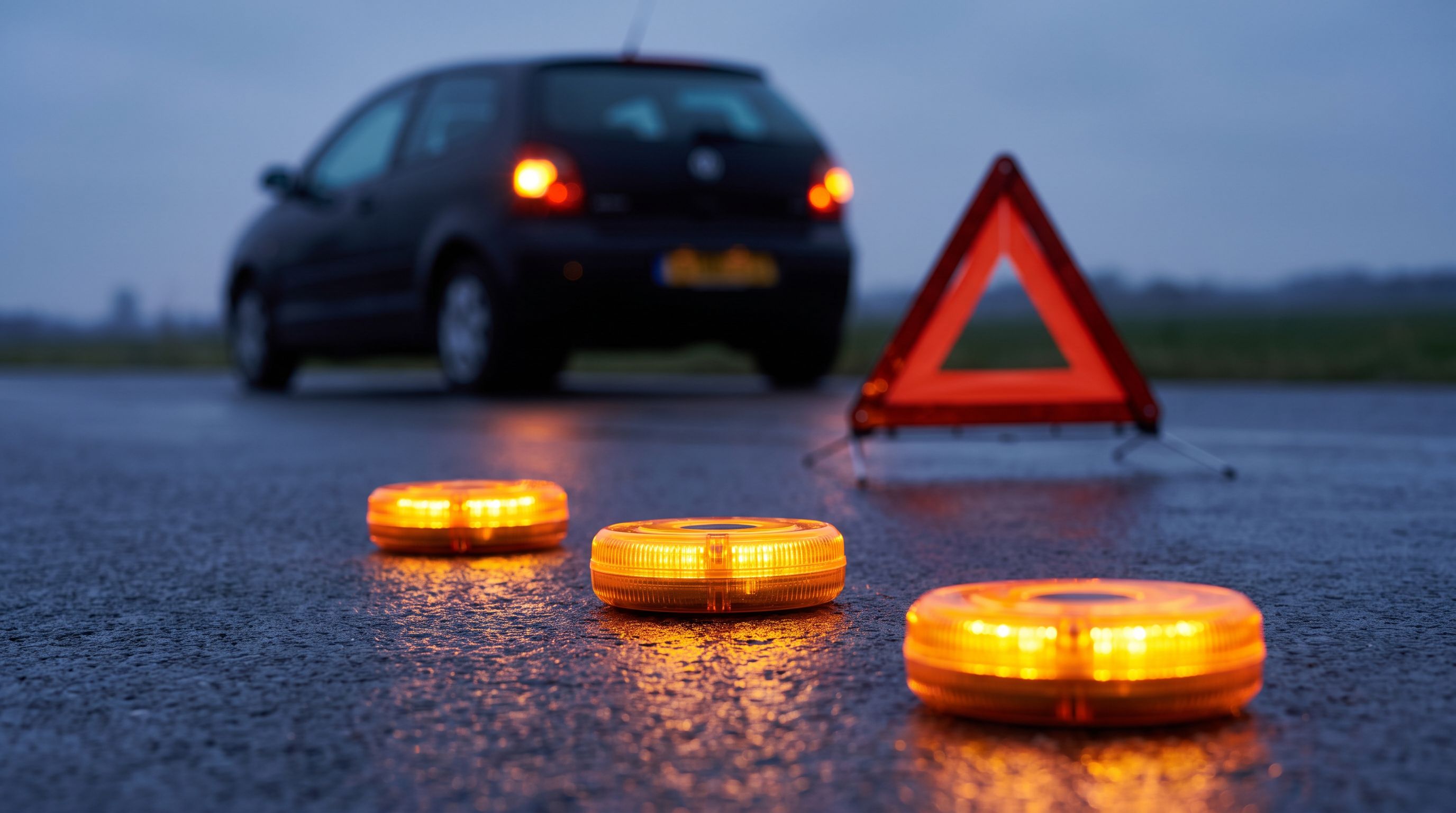
Your car dies in the left lane of a dark interstate. What you pull out of the trunk in the next sixty seconds matters more than almost any other piece of gear you own — and the honest answer in 2026 is that it probably shouldn't be an either/or decision between LED beacons and reflective triangles.
This guide compares the two on the things that actually decide outcomes: how far away a driver first sees you, what the regulations technically require, and how each behaves at 10°F after sitting in a trunk since last spring. We researched manufacturer specs, federal standards, and verified owner feedback rather than physically testing units.
The short version
- Best overall: Wagan EL4340 FRED PRO Flashing Roadside Emergency Disc
- Best multi-flare kit: Tobfit LED Road Flares 6-Pack
- Best value: HOKENA LED Road Flares Emergency Discs 3-Pack
- Best reflective triangles: Cartman Warning Triangle Kit (3-Pack)
- Best battery-free backup: Cyalume SnapLight 6-inch Light Sticks
 Best battery-free backup · Cyalume SnapLight 6-inch Light Sticks — Check price on Amazon →
 Best reflective triangles · Cartman Warning Triangle Kit (3-Pack) — Check price on Amazon →
 Best multi-flare kit · Tobfit LED Road Flares 6-Pack — Check price on Amazon →
 Best overall · Wagan EL4340 FRED PRO Flashing Roadside Emergency Disc — Check price on Amazon →
LED flares vs triangles: the real difference
The two devices solve different halves of the same problem, which is why framing them as competitors leads people to carry the wrong thing.
Reflective triangles are passive retroreflectors. They have no power source and emit nothing. They throw a driver's own headlight beam straight back at them, which is enormously efficient — a compliant triangle is designed to be conspicuous at roughly 600 feet under low-beam illumination. That's the distance baked into the federal standard for the device. The catch is the word retroreflective: a triangle only works when headlights hit it. On a curve, over a crest, in a parking lot with the oncoming vehicle's lights pointed elsewhere, or when the triangle is coated in road salt spray and slush, performance collapses.
LED flares are active emitters. They make their own light, so they work regardless of whether anyone's headlights are aimed at them — around corners, in fog, in daylight, in a dark lot where you're changing a tire. Flashing amber also reads as "hazard" to the human visual system in a way a static triangle doesn't; motion and flicker grab peripheral attention. The trade-off is raw distance. A typical consumer LED disc is bright enough to be clearly visible for several hundred feet at night, but very few match a well-placed retroreflective triangle for sheer early detection on a straight, well-lit approach — and none match a burning magnesium fusee, which is why some fleet and emergency responders still carry pyrotechnic flares.
The compliance question, stated plainly
Here's the part most product listings gloss over. In the United States, FMVSS 125 governs warning devices for vehicles on public roads, and the federal requirement for commercial vehicles (49 CFR 392.22) specifies three bidirectional emergency reflective triangles, six fusees, or three liquid-burning flares. LED beacons are not currently listed as an approved substitute for commercial vehicles. If you drive a CDL vehicle, a box truck, or anything subject to FMCSA rules, LED discs are a supplement — not a replacement. Carry the triangles.
For private passenger cars, there is no federal mandate to carry anything at all, and state rules vary. So "DOT compliant" on an LED flare's packaging is marketing language, not a certification claim you should rely on. If a product page says "DOT approved," treat it as a yellow flag about the seller's precision generally.
Cold weather is where the gap widens
Lithium-ion cells lose usable capacity as temperatures drop; below freezing it's common to see meaningful runtime reduction, and many rechargeable packs will refuse to charge at all below 0°C. A rechargeable LED flare that's been sitting in a Minnesota trunk since October may deliver a fraction of its rated 100-hour figure — or sit dead because it self-discharged over four months and nobody checked it.
Triangles don't care. Neither do chemical light sticks, which work by mixing two liquids and are largely temperature-indifferent (cold slows the reaction and extends duration; heat shortens it and brightens it).
This is the single strongest argument for a layered kit: triangles and a couple of Cyalume SnapLight sticks have no charge state to forget about, while LED flares give you the active, attention-grabbing signal that triangles can't produce.
Comparison table
| Reflective triangles | Rechargeable LED flares | AAA-powered LED flares | Chemical light sticks | |
|---|---|---|---|---|
| Light source | Passive retroreflective | Active LED | Active LED | Chemiluminescent |
| Works without headlights on it | No | Yes | Yes | Yes |
| Typical night conspicuity | ~600 ft design target (straight, lit approach) | Several hundred feet, all angles | Several hundred feet, all angles | Short range — marks a hazard, not a distance warning |
| FMCSA-accepted for commercial vehicles | Yes | No | No | No |
| Cold-weather reliability | Excellent | Reduced; may not charge below freezing | Good (swap in lithium AAAs) | Excellent |
| Needs maintenance | Wipe clean | Recharge every few months | Check cells annually | Check expiry date |
| Reusable | Yes | Yes | Yes | No (single use) |
| Setup time in traffic | Slower — unfold, place, walk back | Fast — magnet to roof/trunk, toss | Fast | Fast |
| Works in rain/snow | Degrades when dirty | Yes (check IP rating) | Yes (check IP rating) | Yes |
How to choose
Decide whether you need legal compliance or practical visibility
If your vehicle is subject to FMCSA rules — commercial plates, CDL, DOT number on the door — the question is settled: you need three compliant bidirectional triangles in the cab, full stop. LEDs ride along as a bonus. If you're a private driver, you're optimizing purely for not getting hit, and a combination kit wins. Most people should own both and store them together in one labeled bag.
Match the power source to your climate
In a mild climate, a rechargeable disc like the Wagan EL4340 FRED PRO is the cleanest choice: top it off twice a year and forget it. In a region with hard winters, AAA-powered flares such as the HOKENA 3-Pack have a real advantage — you can load them with lithium AAA cells, which hold voltage far better in the cold and have shelf lives measured in years. The cost is that you're buying batteries instead of plugging in.
Count how many you actually need
One flare marks a car. Three to six let you build a taper — a line of beacons angling from the shoulder out toward the lane, starting well upstream, which is what actually redirects traffic. The standard guidance for triangles is one about 10 feet behind the vehicle, one at roughly 100 feet, and one at roughly 200 feet (farther on high-speed roads, around curves, or over hills). LED flares follow the same logic. A 6-pack like the Tobfit set exists for exactly this reason.
Check the mounting and the ingress rating
Magnets matter more than brightness specs. A strong magnet lets you slap a beacon on the roof or trunk lid so it's at driver eye level rather than down at pavement height where it disappears behind the car ahead. For weather, look for an explicit IP rating — IP67 means dust-tight and survivable in brief immersion, which is the right bar for something that will sit in slush. Vague "waterproof" claims without a number are worth less.
Think about where it lives in the car
A warning device in the trunk, under the spare, behind the cargo organizer, is a warning device you won't deploy on a shoulder in the rain. Put flares in a door pocket, seat-back pocket, or center console. Triangles can live in the trunk since you'll be walking back anyway.
The picks
Wagan EL4340 FRED PRO — best overall
Prices last checked October 8, 2026. Amazon prices change frequently, so treat these as a guide and check the live price before you buy.
Wagan EL4340 FRED PRO Flashing Roadside Emergency Disc
Crushproof, IP67-rated disc with amber warning modes plus a white work light — the most complete single beacon.
The FRED PRO is the most complete single device in this category. It's a rechargeable disc rated IP67 and built to be crushproof, with amber warning patterns on one side and a white work light for changing a tire or looking under the hood — which means it does double duty and justifies living in the console rather than the trunk. Rated runtime stretches to around 100 hours on lower settings. What it gives up: it's a single unit at a premium price, so building a proper three-point taper means buying multiples, and like any lithium device it needs a recharge on a schedule, especially before winter.
Tobfit LED Road Flares 6-Pack — best multi-flare kit
Tobfit LED Road Flares 6-Pack
Six magnetic discs with nine patterns and a storage case — enough to build a proper taper line.
Six discs is the number that lets you actually do roadside safety properly instead of symbolically. The Tobfit set includes nine selectable flash patterns, 360-degree visibility, magnetic bases, and a carrying case so they don't rattle loose in the trunk. Frequently cited as an editor's pick in roundups of this category. The compromise is that budget multi-packs are rarely as ruggedly built as a single premium unit — the magnets and housings are adequate rather than exceptional — and six rechargeable or battery-powered units means six charge states to keep track of. Label the case with the date you last checked them.
HOKENA LED Road Flares 3-Pack — best value
HOKENA LED Road Flares Emergency Discs 3-Pack
Three bright magnetic beacons on AAA cells, so cold-weather runtime is a battery swap away.
HOKENA's three-disc set is the sensible default for a family car: three units is the right count for a basic taper, the magnetic bases are strong enough for a steel roof or trunk lid, and they run on AAA cells. That last point is the quiet advantage — in cold climates you can load them with lithium AAAs and get dependable winter starts with no charging ritual. They're widely recommended as a value pick. What you give up is runtime per dollar versus a rechargeable, plus the mild hassle of keeping spare cells on hand. Build quality is good, not heirloom.
Cartman Warning Triangle Kit — best reflective triangles
Cartman Warning Triangle Kit (3-Pack)
Foldable weighted triangles that meet the FMVSS 125-style spec LEDs legally can't replace.
This is the part of the kit LEDs can't legally or optically replace. The Cartman three-pack folds flat, sets up with a weighted base that resists wind and highway blast from passing trucks, and uses the bidirectional retroreflective design that FMVSS 125 is written around — meaning it reflects a driver's headlights back at them from several hundred feet out. If you drive commercially, this is mandatory equipment rather than a nice-to-have. The downsides are real: triangles take longer to deploy, require walking back into traffic to place, and lose effectiveness when caked with winter road grime. Wipe them when you check your tire pressures.
Cyalume SnapLight 6-inch — best battery-free backup
Cyalume SnapLight 6-inch Light Sticks
Chemical glow sticks that work at any temperature with zero charge state to forget about.
Glow sticks look unserious next to a rugged LED disc, right up until the night the discs are dead. Cyalume's SnapLight sticks are the military-standard version of the format: crack, shake, and you have hours of light with no electronics, no charge state, and no meaningful temperature sensitivity. They're useful for marking a hazard close to the car, handing to a passenger standing off the shoulder, or dropping into a drainage ditch so a tow operator can find a dropped tool. Limitations are obvious — single use, limited range, and they do expire, so note the date and rotate them every few years.
Building the kit that actually goes in your trunk
The practical answer for most private drivers in 2026 is a three-layer setup, and it costs less than one tow.
- Three reflective triangles in the trunk for distance warning and any compliance obligation.
- Three to six LED flares stored in the cabin where you can reach them without opening the trunk in traffic — a mix of one premium unit and a multi-pack works well.
- A few chemical light sticks tucked in the glovebox as the no-maintenance fallback.
Then add the habit that makes all of it work: twice a year, when you change your clocks or swap your tires, pull the kit out, top up the rechargeables, check the AAA cells, and confirm nothing has expired. A flare kit is only as good as its last inspection.
And remember the hierarchy of roadside safety. Getting the vehicle off the travel lane if it's drivable, hazard lights on, occupants out and behind the guardrail if you're on a high-speed road — those matter more than any device. The flares and triangles buy you the seconds that make the rest of it survivable.
FAQ
Are LED road flares legal to use instead of triangles? For private passenger cars, there's generally nothing stopping you from using LED flares, and no federal requirement to carry any warning device at all. For commercial vehicles under FMCSA rules, LED beacons are not an accepted substitute — 49 CFR 392.22 calls for compliant triangles, fusees, or liquid-burning flares. Treat "DOT compliant" marketing on LED packaging with skepticism and check your state's rules.
How far away can a driver see an LED road flare? It depends heavily on brightness, flash pattern, weather, and ambient light. Quality amber LED discs are clearly conspicuous for several hundred feet on a dark road, and crucially they work at angles where retroreflective triangles get no headlight return. Manufacturer claims of a mile are best-case, flat-terrain, zero-ambient-light figures — don't plan around them.
Do LED road flares survive being stored in a hot or freezing car? Mostly yes — they're designed for it. But lithium-ion cells lose capacity in deep cold and age faster in sustained heat, so expect reduced runtime and plan on recharging before winter. AAA-powered models with lithium cells handle temperature extremes more gracefully.
How many flares do I need? Three is the practical minimum so you can place one near the vehicle, one around 100 feet back, and one around 200 feet back. Six gives you a better taper on high-speed roads or blind curves.
Are magnesium flares still better? Pyrotechnic fusees are brighter than any consumer LED and cut through fog well, which is why some responders still carry them. They're also a fire hazard near fuel or dry grass, burn for a limited time, can't be reused, and are restricted in some areas. For a civilian trunk kit, LEDs plus triangles are the safer, more practical combination.
Should I buy rechargeable or battery-powered? Rechargeable if you'll actually maintain them and you live somewhere mild. AAA-powered with lithium cells if you drive in hard winters or know yourself well enough to admit you won't remember to charge anything.
Get the best car care deals in your inbox
Join the GarageProof newsletter for hand-picked car care deals and new buying guides. No spam, unsubscribe anytime.
Related reads
Winter Car Emergency Kit 2026: Build It or Buy It?
Prebuilt winter car emergency kit vs. a component build in 2026: what boxed kits leave out, what a jump starter, inflator and traction boards really cover.
Cordless Tire Inflator Valve Stem Fitment in 2026: 4 Picks
Match cordless tire inflator chucks and hose lengths to your valve stems — rubber, metal, TPMS or recessed alloys — with 2026 picks, specs and owner feedback.
Car Window Breaker Escape Tool 2026: Spring vs Hammer
Spring-loaded punches fail on laminated side glass. Compare car window breaker escape tools for 2026 and learn which windows in your car can actually be broken.