LED Headlight Bulbs 2026: Will They Fit Your Housing?
A fitment-first guide to LED headlight bulbs for cars in 2026: bulb-size lookup, projector vs reflector housings, CANbus errors and heat-sink clearance.
Reader-supported: we may earn a commission from links on this page, at no extra cost to you. It never affects our picks. Learn more.
Swapping halogens for LEDs looks like a 15-minute job. It usually is — right up until the heat sink hits the dust cap, or the dash throws a bulb-out warning, or the beam scatters into oncoming traffic because your housing was never designed for an LED emitter.
This guide flips the usual order. Before we talk lumens or color temperature, we're going to talk about whether the bulb will physically and electrically fit your car. That's the part most buyers get wrong, and it's the part that turns a cheap upgrade into a return label.
GarageProof researches and compares products using manufacturer specs, independent beam-pattern testing published by specialists, and verified owner feedback. We don't physically test units ourselves.
The short version
- Best overall: Sealight X1 H11 LED Bulbs
- Best for tight dust caps: Fahren F-20 9005 LED Bulbs
- Budget pick: SEALIGHT S1 H11 LED Bulbs
- Best name-brand plug-and-play: Philips Ultinon Access LED H11
- Best CANbus behavior: Auxbeam F-16 Pro H11 LED Bulbs
 Best CANbus behavior · Auxbeam F-16 Pro H11 LED Bulbs — Check price on Amazon →
 Best name-brand plug-and-play · Philips Ultinon Access LED H11 — Check price on Amazon →
 Budget pick · SEALIGHT S1 H11 LED Bulbs — Check price on Amazon →
 Best overall · Sealight X1 H11 LED Bulbs — Check price on Amazon →
All of these are sold in multiple bulb sizes. The model names above reference a common size, but you must confirm the size your vehicle actually uses before ordering — see below.
Step 1: Find your actual bulb size
Bulb size is the single hard requirement. Everything else is preference.
Three ways to check, in order of reliability:
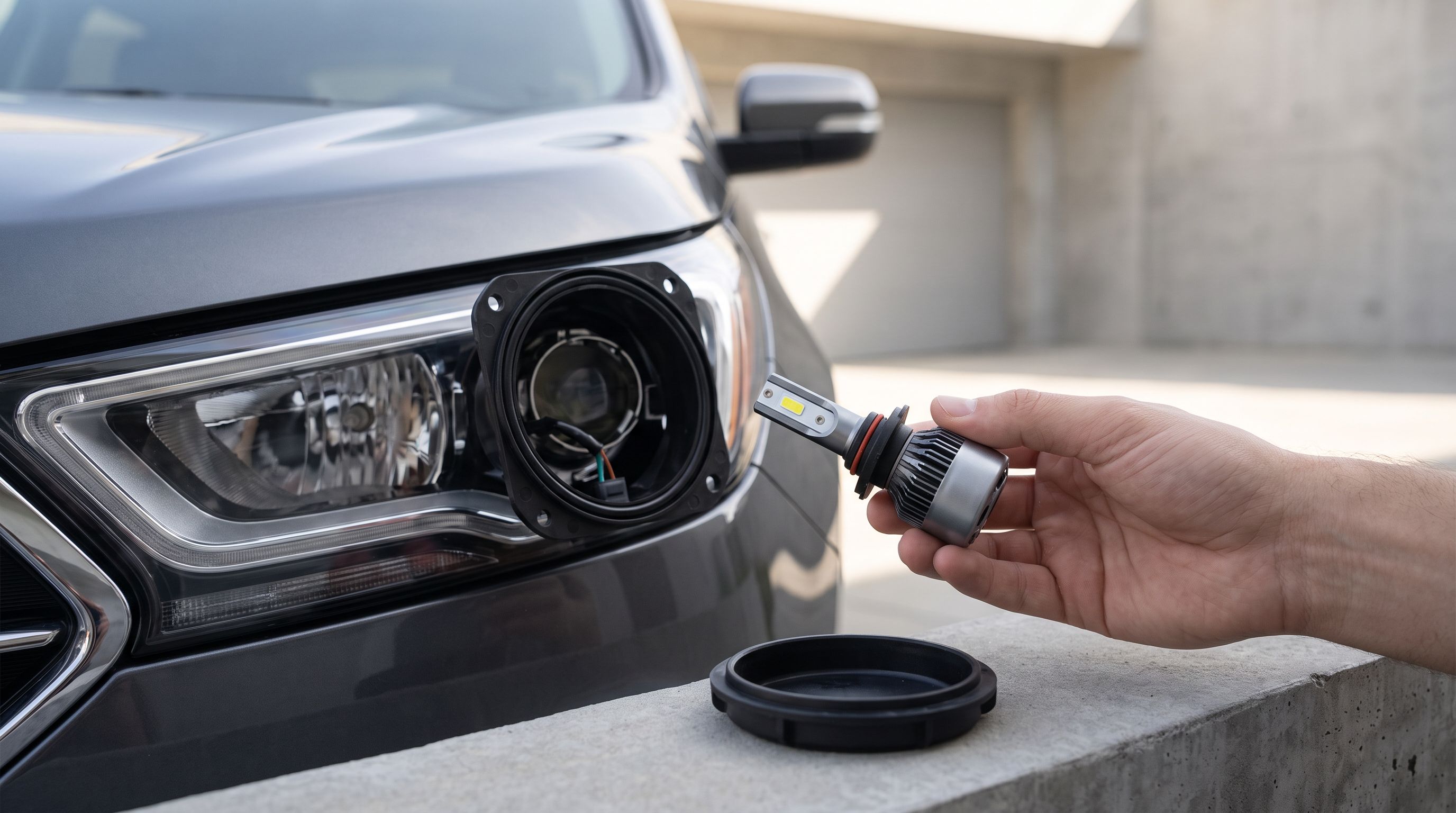
- Pull the bulb. Open the hood, remove the dust cap behind the headlight, twist the bulb out, and read the stamped code on the base — H11, H7, 9005/HB3, 9006/HB4, H4/9003, H13/9008, and so on. This is the only method that can't be wrong.
- Owner's manual. Most manuals list bulb sizes in the maintenance section, though some only give a part number you'll have to cross-reference.
- Retailer fitment lookup. Enter year, make, model, and trim. Treat this as a starting point, not gospel — trim-level differences (halogen vs factory HID vs factory LED) trip these tools up constantly.
Watch for these gotchas:
- Low and high beam often differ. A very common combo is 9005 high / H11 low. Buying a "pair" only covers one function.
- Some cars use one dual-filament bulb (H4/9003, H13/9008) for both beams. LED replacements for these have to switch between two emitter positions, and beam quality is harder to get right.
- H7 bulbs use a retaining clip or locking ring, not a twist-lock. Many H7 LEDs ship with vehicle-specific adapters — you may need the correct adapter type for your car.
- Factory HID or factory LED cars are a different project. If your car came with D1S/D3S HID capsules or a sealed LED module, a halogen-style LED bulb isn't the right part. Don't force it.
Step 2: Projector or reflector? Look into the housing
Shine a light into your headlight with the car off and look at the shape.
Reflector housings have a large mirrored bowl with facets or flutes, and the bulb sits in the middle. The reflector geometry was computed around a halogen filament's exact size and position.
Projector housings have a visible lens — a glass or plastic dome — with a small bulb hidden behind it and a cutoff shield inside.
Why it matters
Projectors are the more forgiving of the two. The lens and internal shield do the work of shaping the beam and creating the cutoff line, so a reasonably well-built LED with correctly placed chips will usually produce a clean, sharp pattern.
Reflectors are unforgiving. The bowl expects light to originate from a specific point in space. LED bulbs emit from flat chips on two sides of a board, not from a glowing cylinder, so the light leaves at different angles than the reflector was designed for. A good LED gets close; a bad one throws glare everywhere and actually reduces your usable distance while blinding oncoming drivers.
Practical rule: if you have reflectors, prioritize bulbs where the emitter chips sit at the same height and depth as a halogen filament, and where the chips are thin and closely spaced. Manufacturers that publish emitter-placement dimensions — or that independent reviewers have measured — are worth the extra money here. If you have projectors, you have more latitude, but the same principle still improves your result.
Clocking the bulb
Most LED bulbs must be rotated so the chips face up and down (12 and 6 o'clock), not left and right. Many include an adjustable collar for this. Getting it wrong produces a smeared, foggy pattern with no cutoff. After installation, park facing a garage door about 25 feet away and check for a flat, level cutoff line on low beam. If it looks like a blob, rotate the bulb.
Step 3: Measure the space behind the dust cap
This is the failure mode nobody anticipates. LED bulbs need to dump heat, so they have either a finned aluminum heat sink or a small fan behind the base — sometimes both, plus a braided copper strap. That hardware adds length and width that a halogen bulb simply doesn't have.
Before you buy, check:
- Depth. Remove the dust cap and measure from the back of the bulb base to the nearest obstruction — strut tower, washer bottle, air box, inner fender. Compare that to the bulb's published length behind the base.
- Diameter. Factory dust caps often have a small center hole or a shallow dome. A wide finned heat sink won't pass through, and a fan-cooled body with a large diameter may not let the cap seat.
- The cap itself. If the cap won't close, water and road grime get into the housing. Some vendors sell extended or vented dust caps for common vehicles — that's a legitimate fix. Cutting a hole in the original cap and leaving it open is not.
Bulbs with a flexible braided heat sink, like the Fahren F-20 design, are the escape hatch for tight engine bays because the braid bends around obstructions. The tradeoff is that braid cooling is generally less effective than an active fan, which can mean the driver throttles output sooner during long night drives.
Step 4: Will it throw a CANbus error?
Modern cars monitor headlight circuits by measuring current draw. An LED pulls far less than a halogen, so the body control module may conclude the bulb has failed. Symptoms include a dash warning, flickering, strobing at startup, or the headlight simply refusing to stay on.
Your options, from best to worst:
- Buy a bulb with built-in CANbus-friendly drivers. Many current bulbs, including the Auxbeam F-16 Pro, handle this internally with no extra hardware. This is the clean solution.
- Add an external decoder or resistor harness. Works, but resistors get genuinely hot and must be mounted to metal away from wiring and plastic. It's a compromise, not a feature.
- Ignore it. Only viable if there's no error at all.
European brands (VW, Audi, BMW, Mercedes, Volvo) and many post-2015 domestic and Japanese vehicles are the most likely to complain. Some vehicles also use PWM dimming on the headlight circuit, which can make LEDs flicker visibly even without a warning light — a bulb with PWM-compatible drivers is the fix there.
Comparison table
| Pick | Best for | Cooling style | Typical housing fit | CANbus |
|---|---|---|---|---|
| Sealight X1 | All-round upgrade | Active fan, compact body | Reflector and projector | Built-in handling on most vehicles |
| Fahren F-20 | Shallow clearance | Flexible braided strap | Reflector and projector | Built-in handling on most vehicles |
| SEALIGHT S1 | First-time budget swap | Compact fan | Best in reflectors on older cars | Varies; check vehicle |
| Philips Ultinon Access | Brand-name reliability | Passive/compact | Reflector and projector | Varies by size and vehicle |
| Auxbeam F-16 Pro | Error-prone vehicles | Active fan | Reflector and projector | Strongest built-in compatibility |
Fitment varies by year, make, model and trim. Always confirm your bulb size and measure dust-cap clearance before ordering.
The picks
Sealight X1 — best overall
Sealight X1 H11 LED Bulbs
Compact fan-cooled design with tight emitter placement — fits most reflector and projector housings without cap surgery.
The X1 is the bulb we'd point most people toward first because it balances the three things that actually matter: compact body, sensible emitter placement, and a fan small enough to clear most factory dust caps. Owner feedback across reflector-housing vehicles consistently reports a usable cutoff rather than a scattered glow, which is the hardest thing for a reflector-compatible LED to get right. It's available in the mainstream sizes — H11, 9005, 9006, H7, H4.
What it gives up: it's not the brightest bulb on paper, and the fan is an active component that can eventually fail. If your priority is maximum raw output, there are hotter bulbs — usually with heat sinks that won't fit your car.
Fahren F-20 — best for tight dust caps
Fahren F-20 9005 LED Bulbs
Short, flexible-braid heat sink squeezes into shallow engine-bay clearance where finned bulbs won't go.
If you've already measured behind the cap and found two inches of space, this is the answer. The F-20 uses a flexible braided heat sink rather than rigid fins, so the cooling hardware can be folded around a strut tower or washer bottle instead of fighting it. That flexibility is why it fits vehicles where finned bulbs simply cannot go, and why it's a common recommendation for compact cars and trucks with crowded engine bays.
What it gives up: braided cooling is less aggressive than an active fan. Owners report it runs warm and may reduce output slightly during extended high-load use. It's also fiddlier to install cleanly — take your time routing the braid.
SEALIGHT S1 — budget pick
SEALIGHT S1 H11 LED Bulbs
Plug-and-play basics with a low-profile body — a sane first LED upgrade for older reflector housings.
The S1 is the low-risk way to find out whether you like LED headlights at all. It's a straightforward plug-and-play bulb with a low-profile body, and on older reflector-housing vehicles with no sophisticated bulb monitoring, it's frequently all you need. It's a sensible choice for a second vehicle, a work truck, or a car you're not sure you're keeping.
What it gives up: less refined beam control than the pricier picks, fewer size options with vehicle-specific adapters, and CANbus behavior that varies by vehicle — on a newer car you may end up buying decoders separately, which erases the savings. Check your vehicle's monitoring behavior first.
Philips Ultinon Access — best name-brand plug-and-play
Philips has been making headlight bulbs for as long as headlights have existed, and the Ultinon Access line brings that engineering discipline to the aftermarket LED segment. The appeal is consistency: known emitter placement, credible build quality, a real warranty, and a compact body that clears factory dust caps on most vehicles without modification. If you've been burned by a no-name bulb that died in a season, this is the reset button.
What it gives up: it's generally not chasing headline lumen numbers, and the range of sizes is narrower than the big aftermarket brands. Some buyers find it less dramatic a jump than marketing elsewhere promises — which is arguably honest engineering rather than a flaw.
Auxbeam F-16 Pro — best CANbus behavior
Auxbeam F-16 Pro H11 LED Bulbs
Built-in driver tuning that avoids flicker and bulb-out warnings on many European and late-model vehicles.
If your car is a VW, Audi, BMW, Volvo, or any late-model vehicle that monitors headlight current, start here. The F-16 Pro's drivers are tuned to avoid the flicker, strobing, and bulb-out warnings that make LED swaps miserable on these platforms, and owner reports on error-prone vehicles are notably better than average. It's also a genuinely bright bulb with an active fan and decent beam discipline in projectors.
What it gives up: the body is chunkier than the Fahren, so measure your clearance carefully before committing. And "CANbus-ready" is never a universal guarantee — a small number of vehicles still need an external decoder.
How to choose
Match the emitter, not the lumen claim
Lumen numbers on LED bulb packaging are close to meaningless — most are theoretical chip ratings, not measured output through your housing. What determines whether you actually see farther is where the chips sit relative to the halogen filament they replace. Look for bulbs that publish emitter dimensions or that independent reviewers have measured. A 6,000-lumen bulb with bad geometry is worse than a 3,000-lumen bulb with good geometry.
Pick a color temperature you can drive in
Around 5000K to 6000K is the sweet spot: white enough to look modern, warm enough to cut through rain and fog reasonably well. Above about 6500K the light goes blue, which scatters more in bad weather and reduces contrast on wet asphalt. Skip the 8000K "ice blue" bulbs entirely unless you only drive on dry summer nights.
Decide on cooling before you decide on brand
Active fan bulbs cool better and sustain output longer, but they're longer, noisier, and have a moving part. Passive finned bulbs are silent and durable but wide. Braided-strap bulbs fit anywhere but run hottest. Your available space behind the dust cap should make this decision for you — measure first, shop second.
Check the legal picture for your use
In the US, LED replacement bulbs in housings designed for halogens generally aren't DOT-compliant for on-road use, and rules vary by state and by country. Inspection stations in some jurisdictions will flag them. This doesn't stop millions of people from fitting them, but you should know where you stand rather than find out at inspection time.
Aim your headlights afterward
An LED swap almost always shifts your beam pattern slightly. Once installed, park 25 feet from a flat wall on level ground and check that the cutoff is level and below eye height of oncoming drivers. Most housings have a vertical adjustment screw. Ten minutes here does more for night visibility than the next $60 of bulb.
FAQ
How do I find my bulb size if the manual doesn't list it? Pull the existing bulb and read the code stamped on its plastic base. That's definitive. Online lookup tools are useful for narrowing it down, but trim-level differences — especially halogen versus factory HID versus factory LED — make them unreliable on their own.
Will LED bulbs work in my reflector headlights? They can, but the result depends heavily on the bulb. Reflector housings are designed around a halogen filament's exact size and position, so only LEDs with closely matched emitter placement produce a clean cutoff. Poorly designed bulbs scatter light and create glare. Projector housings are much more forgiving.
What causes flickering after an LED swap? Usually one of two things: the car's bulb-monitoring circuit seeing too little current draw, or PWM dimming on the headlight circuit. A bulb with built-in CANbus and PWM-compatible drivers solves most cases; otherwise an external decoder harness is needed.
Do I need to remove my dust cap to fit LED bulbs? You shouldn't have to, and you shouldn't leave it off — it keeps moisture and debris out of the housing. If the heat sink won't let the cap seat, either choose a shorter or braided-strap bulb, or fit a proper extended dust cap made for your vehicle.
Can I fit LED bulbs if my car came with factory HID or factory LED headlights? Not with halogen-style LED bulbs. Factory HID cars use D-series capsules with a ballast, and factory LED cars typically use sealed modules. Those are different parts entirely — identify what you actually have before buying anything.
Do LED headlight bulbs need to be aimed after installation? Yes. Any bulb change can shift the beam. Check the cutoff against a wall from about 25 feet and adjust vertically so the line sits below oncoming drivers' eye level. It takes minutes and materially improves how far you can see.
Our picks
Philips Ultinon Access LED H11
Philips-engineered emitter placement and build quality, in a compact body that clears most factory caps.
Get the best car care deals in your inbox
Join the GarageProof newsletter for hand-picked car care deals and new buying guides. No spam, unsubscribe anytime.
Related reads
Mirror Dash Cams in 2026: Will It Clamp Over Your Mirror?
Mirror dash cam fitment explained for 2026: strap vs clip mounts, auto-dimming mirror clearance, screen size and wiring — plus four models worth buying.
Cabin Air Filter Guide 2026: Carbon vs HEPA, by Fitment
Carbon or HEPA-style cabin air filter in 2026? We compare media types, airflow trade-offs and how to match the right part number to your exact year and model.
Mud Flaps for Trucks 2026: Fit the Wheel Well, Not the Badge
Heavy-duty mud flaps for trucks in 2026: how wheel-well lip, lift height and flare type decide whether drill-in or no-drill kits actually fit.