Jump Starter Peak Amps vs. Cranking Amps, Explained
Peak amps are a marketing number. Here's how cranking amps, battery capacity and engine displacement actually determine whether a jump pack starts your car in 2026.
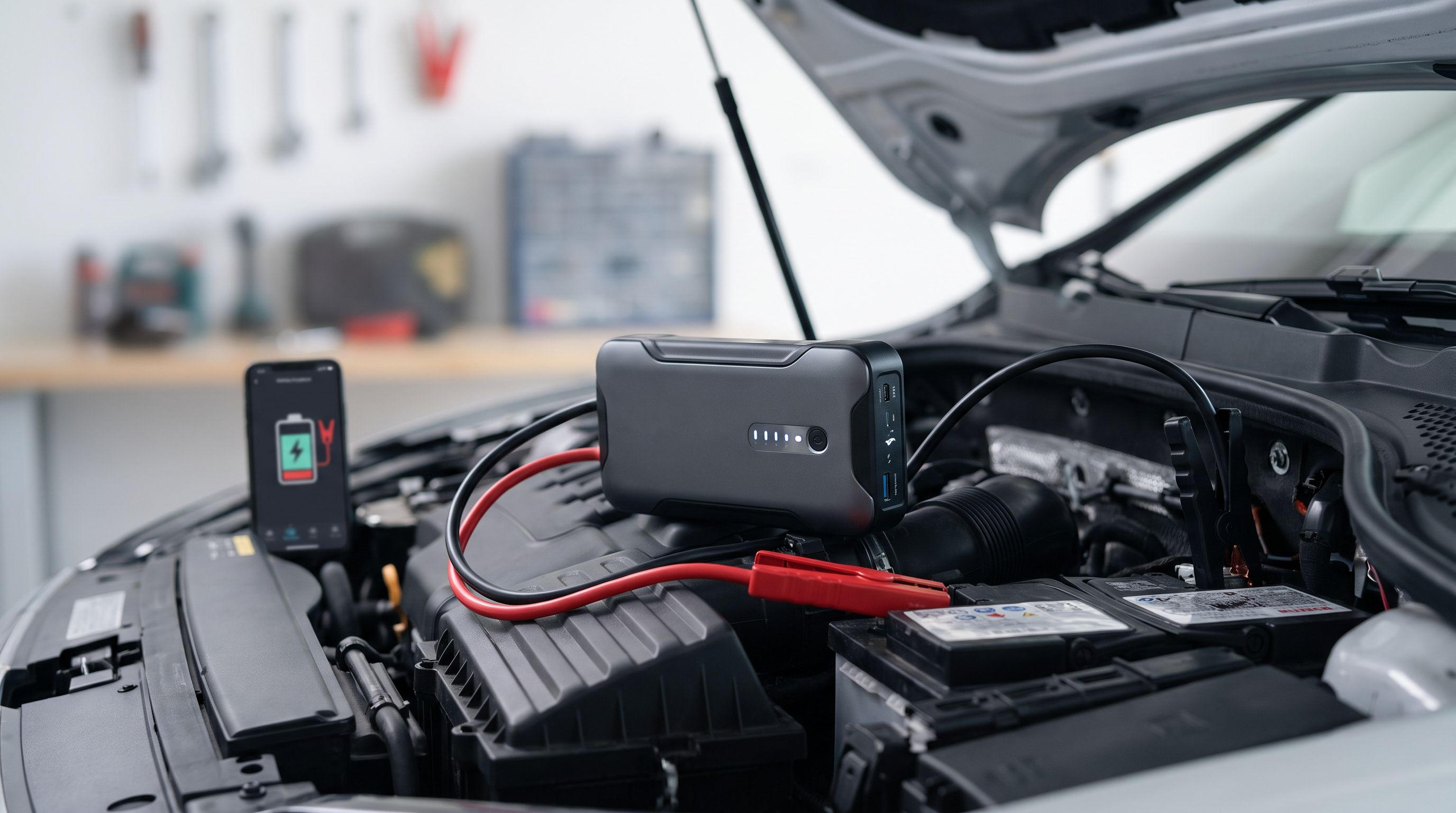
Reader-supported: we may earn a commission from links on this page, at no extra cost to you. It never affects our picks. Learn more.
The number on the box is the one that matters least
Walk down the automotive aisle in 2026 and you'll see jump packs the size of a paperback claiming 2,000, 3,000, even 4,000 "peak amps." Meanwhile, the battery those packs are supposed to rescue — a group 48 AGM in a modern crossover — is rated at something like 760 cold cranking amps. A device a tenth the size claiming four times the current should set off alarm bells.
It isn't fraud, exactly. Peak amps is a real measurement; it's just a measurement of something that doesn't start your engine. The spec that correlates with whether the car fires is sustained current delivery over several seconds — and most brands either bury that number or never publish it at all. That gap between what's advertised and what's engineered is the whole story, and it's why the smarter way to size a pack is to ignore the headline figure and start from your engine's displacement and fuel type.
What's actually happening now
Three definitions are in play, and only two of them are standardized in any meaningful way.
Peak amps (PA) is the maximum instantaneous current a pack can push, typically measured over a span measured in milliseconds, often into a near-dead short rather than a real starter motor. There is no industry-wide test standard forcing brands to measure it the same way, which is precisely why the numbers inflate year over year without the packs getting physically larger.
Cranking amps (CA) is sustained output — the current a source can hold for a meaningful interval. Cold cranking amps (CCA) is the SAE-standardized version: amps delivered for 30 seconds at 0°F while holding at least 7.2 volts across a 12V battery. CCA is the number stamped on your car's battery and the number your engine was engineered around.
The disconnect is structural. Your starter motor doesn't want a millisecond spike. It wants a few hundred amps held steadily for two to five seconds while the engine overcomes compression and oil drag. A lithium pack with modest cell capacity can hit a huge instantaneous peak and still sag under a sustained load — which is why a 2,000-peak-amp pack can fail to turn over a cold 5.7L V8 that a 425-cranking-amp lead-acid shop unit handles without complaint.
There's a second wrinkle people miss: jump starters almost never work alone. Unless your battery is completely dead or internally shorted, the pack is supplementing a weak battery, not replacing it. That's why undersized packs often work fine in September and fail in January — cold thickens oil, slows battery chemistry, and shifts more of the burden onto the pack.
The real players and what they actually publish
NOCO is the dominant name in consumer lithium packs, and to its credit it publishes engine-size guidance rather than leaving you to decode amp claims. The NOCO Boost Plus GB40 is rated 1000A and NOCO positions it for gas engines up to roughly 6.0 liters and diesels up to about 3.0 liters. Step up to the NOCO Boost X GBX55 at 1750A and you get more capacity plus 60W USB-C in and out, which matters more for recharge convenience than for cranking. At the top, the NOCO Boost Pro GB150 is rated 3000A and aimed squarely at large-displacement gas and diesel applications where you may need multiple cranking attempts.
 Middle ground with USB-C · NOCO Boost X GBX55 1750A Lithium Jump Starter — Check price on Amazon →
 For big diesels · NOCO Boost Pro GB150 3000A Lithium Jump Starter — Check price on Amazon →
 The sensible default · NOCO Boost Plus GB40 1000A Lithium Jump Starter — Check price on Amazon →
Clore Automotive takes the opposite approach with its Jump-N-Carry line. The JNC660 is advertised as 1700 peak amps but — unusually — also publishes 425 cranking amps. That transparency is the tell: a lead-acid professional unit that quietly holds 425A for real duration will outperform plenty of lithium packs boasting double the peak figure. Clore's units are heavier and need to be kept charged, but they're what a lot of fleet and shop techs reach for.
Below those, a long tail of marketplace brands competes almost entirely on the peak-amp number, which is exactly the dynamic that made the spec useless. When a figure is unverifiable and bigger always sells better, it inflates until it means nothing.
| Spec | What it measures | Standardized? | Does it predict a successful start? |
|---|---|---|---|
| Peak amps (PA) | Instantaneous current spike, often milliseconds | No common standard | Weakly — marketing-driven |
| Cranking amps (CA) | Sustained current over seconds | Loosely | Yes |
| Cold cranking amps (CCA) | 30 sec at 0°F, ≥7.2V | Yes (SAE) | Yes — the engineering baseline |
| Capacity (Wh / mAh) | Energy stored | Yes | Indirectly — governs repeat attempts |
| Engine displacement guidance | Manufacturer's own sizing | Per brand | Most useful practical proxy |
What it means if you're shopping today
Start with the car, not the box. Pull the CCA rating off your existing battery — it's printed on the label — and treat that as your floor. A four-cylinder commuter might sit around 500–600 CCA; a V8 truck or a diesel can be 800 CCA or well beyond, and many diesels run dual batteries precisely because sustained cranking demand is so high.
Then use displacement and fuel as the sanity check, because that's the framing manufacturers themselves use. Roughly: small gas engines up to about 3 liters are undemanding and a 1000A-class pack like the GB40 is comfortably sized. Gas engines in the 4–6 liter range are where cheap packs start failing in winter. Diesels are a different category entirely — high compression means the starter draws far more for longer, and manufacturer guidance for diesels is always a tier or two above gas engines of the same displacement.
Three practical filters beyond the amp claim:
- Does the brand publish engine-size guidance? If it only shouts a peak number, you have no information at all.
- What's the capacity in watt-hours or mAh? A bigger cell pack means more cranking attempts before you're stranded anyway, and it resists voltage sag better.
- Will it hold charge? Lithium packs self-discharge slowly but not never; glovebox-stored units should be topped up a few times a year. Lead-acid units like the JNC660 need more disciplined maintenance.
If you live somewhere genuinely cold, size up a tier. Cold is the variable that converts a marginal pack into a useless one.
What to watch next
Two shifts are worth tracking. First, USB-C Power Delivery is becoming standard on lithium packs — the GBX55's 60W in/out is representative — which quietly solves the real failure mode of jump starters: the ones that die in a trunk for three years. Easier recharging means a charged pack when you need it.
Second, there's slow pressure toward honest ratings. Independent reviewers and YouTube teardowns have been attacking the peak-amp claim for a couple of years now, and brands that publish cranking amps or displacement guidance are increasingly differentiating on that transparency. Don't expect a regulated standard soon, but do expect "we tell you what engine this starts" to become a selling point.
Third, and more structurally: start-stop systems and larger accessory loads mean modern batteries are bigger and more demanding than their displacement alone suggests. If your car has start-stop with an AGM or EFB battery, lean toward the higher tier regardless of engine size.
FAQ
Is a higher peak amp rating ever meaningful? Within a single brand's lineup, yes — NOCO's 3000A GB150 genuinely is a bigger, higher-capacity device than the 1000A GB40. Across brands, peak amps is close to meaningless because nobody measures it the same way.
What cranking amps do I actually need? Match or exceed your battery's CCA rating as a baseline, then account for the fact that in most jumps your battery contributes some current too. Manufacturer displacement guidance is the easier shortcut.
Can a small pack start a diesel? Sometimes, on a warm day, with a battery that's only slightly weak. Not reliably in cold weather with a genuinely flat battery. Diesel compression demands sustained current, which is exactly what small packs lack.
Lithium or lead-acid? Lithium wins on size, weight and glovebox practicality. Lead-acid units like the Jump-N-Carry JNC660 win on sustained output per dollar and tolerance for repeated hard cranking, which is why shops still buy them.
Our picks
Prices last checked October 11, 2026. Amazon prices change frequently, so treat these as a guide and check the live price before you buy.
NOCO Boost Plus GB40 1000A Lithium Jump Starter
Rated in amps NOCO actually stands behind, with published engine-size guidance up to 6.0L gas / 3.0L diesel.
NOCO Boost Pro GB150 3000A Lithium Jump Starter
NOCO's heavy-duty pack, spec'd for large-displacement gas and diesel engines where repeated cranking is likely.

Clore Automotive Jump-N-Carry JNC660 1700 Peak Amp Jump Starter
Lead-acid pro unit published with 425 cranking amps alongside its peak figure — rare transparency.
NOCO Boost X GBX55 1750A Lithium Jump Starter
Steps up capacity over the GB40 and adds 60W USB-C in/out for faster self-recharge.
Get the best car care deals in your inbox
Join the GarageProof newsletter for hand-picked car care deals and new buying guides. No spam, unsubscribe anytime.
Related reads
Wiper Blade Lifespan, Explained: Why Yours Fail Fast
Wiper blades rarely wear out — they degrade. Here's how rubber compounds, UV, and winter blade design decide whether yours last six months or three years.
Dash Cam Storage, Explained: Bitrate, Cards, and Why They Die
Why dash cam SD cards fail early, how bitrate (not resolution) drives file size, and roughly how many hours you really get from 64GB to 512GB in 2026.
Car Vacuum Suction Ratings, Decoded for 2026
Air watts, kPa and "20,000Pa" claims explained — why the spec on the box rarely predicts how a car vacuum handles pet hair, sand and floor mats.