Hub Centric Wheel Spacers 2026: Get the Bore Right First
Hub centric wheel spacers in 2026: how to match hub bore, bolt pattern and stud engagement to your vehicle — plus four spacer brands worth considering.
Reader-supported: we may earn a commission from links on this page, at no extra cost to you. It never affects our picks. Learn more.
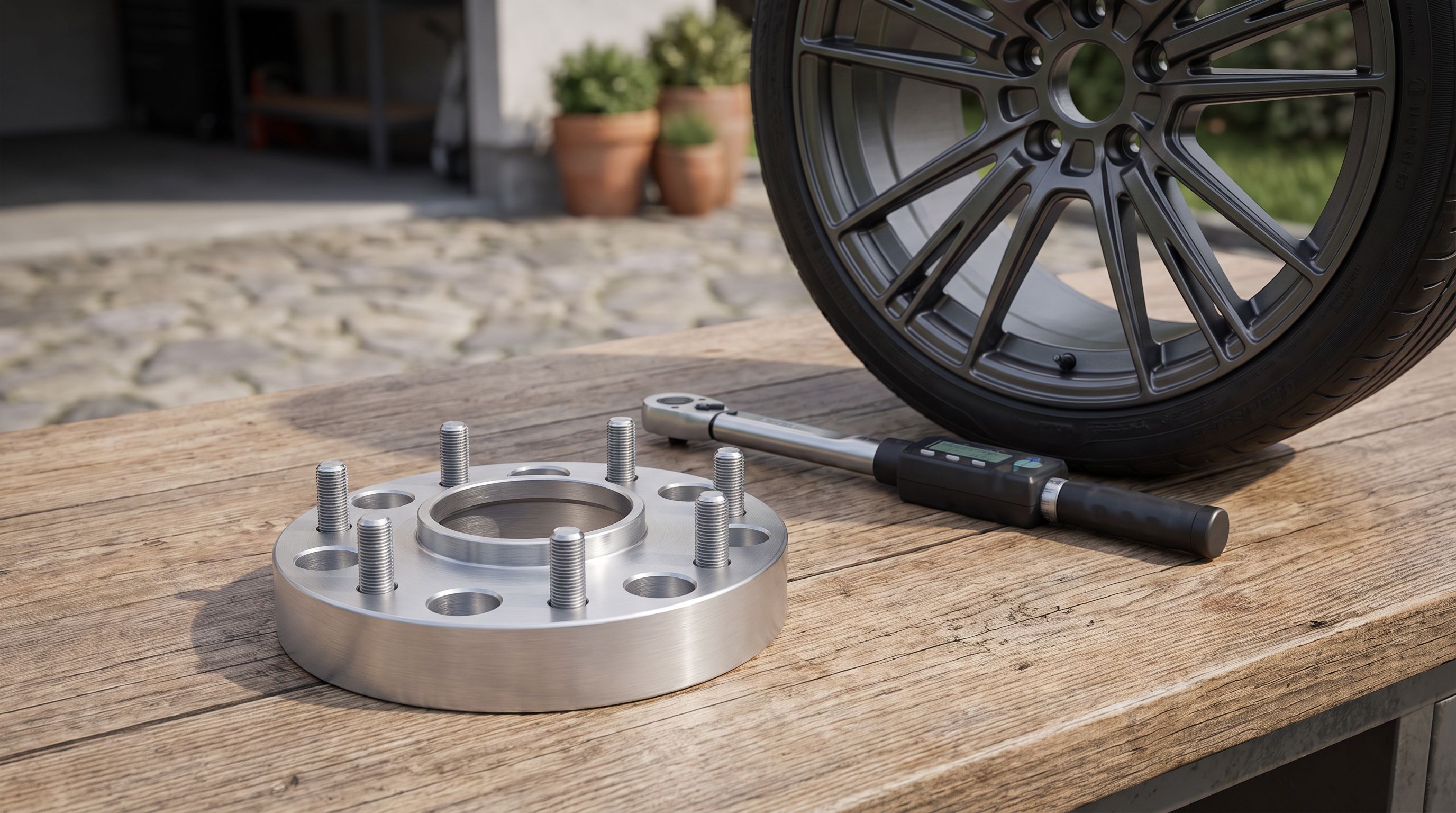
Wheel spacers get a bad reputation almost entirely because of how they're bought. People search a thickness, add a cheap kit to the cart, and never check the two numbers that actually determine whether the thing is safe: the hub bore it centers on, and how much stud thread is left once the wheel goes back on.
Get those right and a quality spacer is a boring, reliable piece of hardware used by OEM-adjacent motorsport programs for decades. Get them wrong and you've built a vibration generator with lug nuts.
This guide is about matching spacers to your vehicle — not about finding the cheapest 2-inch set on page one.
The short version
- Best overall: BONOSS Forged Active Cooling Hubcentric Wheel Spacers
- Best for trucks and SUVs: Supreme Suspensions Hub-Centric Wheel Spacers
- Best bolt-on (adapter-style) option: Motorsport Tech Hub Centric Wheel Spacers
- Premium pick for European cars: H&R DRM Series Wheel Spacers
- Best for UTVs and ATVs: SuperATV Wheel Spacers
 Best for UTVs and ATVs · SuperATV Wheel Spacers — Check price on Amazon →
 Premium pick for European cars · H&R DRM Series Wheel Spacers — Check price on Amazon →
 Best for trucks and SUVs · Supreme Suspensions Hub-Centric Wheel Spacers — Check price on Amazon →
 Best overall · BONOSS Forged Active Cooling Hubcentric Wheel Spacers — Check price on Amazon →
GarageProof researches and compares products using manufacturer specifications, independent testing where it exists, and verified owner feedback. We don't physically test spacers, and you shouldn't trust anyone who claims a universal set fits everything.
What "hub centric" actually means (and why it's non-negotiable)
Your wheel is located one of two ways. Hub centric means a machined hub flange on the axle fits snugly inside the wheel's center bore, carrying the shear load and centering the wheel precisely. Lug centric means the tapered lug nuts do the centering as you tighten them in a star pattern.
Factory wheels on virtually every modern car and truck are hub centric. The moment you insert a spacer, that centering register has to be recreated — twice:
- The back of the spacer must have a bore that matches your vehicle's hub diameter.
- The front of the spacer must have a raised lip that matches your wheel's center bore.
A "universal" spacer with a generic oversized bore and no lip does neither. It turns a hub centric setup into a lug centric one, and the usual symptom is a steering-wheel shimmy between 55 and 75 mph that no amount of balancing fixes. That's the single most common spacer complaint in owner forums, and it's a fitment problem, not a quality problem.
Finding your two bore numbers
- Hub bore (vehicle side): search your year/make/model for "hub bore" or "center bore." Common examples include 78.1 mm on many GM trucks, 87.1 mm on several Ford trucks, 66.5–66.6 mm across VW/Audi/Mercedes, and 72.6 mm on BMW. Verify yours — platforms change.
- Wheel bore (wheel side): OEM wheels usually match the hub exactly. Aftermarket wheels are often bored larger and shipped with plastic hub rings, in which case you want the spacer's front lip to match the wheel's bore, not the hub's.
If those two numbers differ, you need a stepped or two-piece spacer — which is exactly what reputable vehicle-specific listings supply.
Bolt pattern, and the adapter distinction
A spacer keeps your bolt pattern. An adapter changes it (e.g., 5x114.3 to 5x120). Adapters are always the bolt-on type with their own studs, and they're thicker by necessity.
Write your pattern as count x diameter: 5x114.3, 6x139.7 (also written 6x5.5), 6x135, 8x180, 5x112. A 5x114.3 wheel will start onto a 5x120 hub on some studs and feel almost right. It isn't. Measure, don't eyeball.
Stud engagement: the number nobody checks
This is where thin "slip-on" spacers fail people.
A slip-on spacer slides over your existing studs and the wheel bolts on with the original lug nuts. Your factory studs only protrude so far. Add 20 mm of aluminum and you've just removed 20 mm of usable thread.
The widely cited rule of thumb, echoed by wheel and fastener manufacturers, is full thread engagement equal to at least the stud diameter — so roughly 12 mm of engaged thread on a 12 mm stud, 14 mm on a 14 mm stud. In practice that means counting turns: with the wheel off, thread a lug nut onto a bare stud and count full rotations to snug. Common guidance is a minimum of six to eight full turns.
Practical consequences:
- Up to ~5–8 mm: slip-on is usually fine on most vehicles with stock studs.
- ~10–20 mm: borderline. Check engagement, or fit extended studs.
- 20 mm and up: use a bolt-on spacer, which bolts to your hub with its own fasteners and provides a fresh set of full-length studs for the wheel. This is why Motorsport Tech and H&R DRM style products exist.
On European cars with lug bolts rather than studs, the maths is the same but you solve it with longer bolts or a bolt-on spacer — never by reusing the stock bolts on a thick spacer.
Comparison table
| Pick | Type | Typical use | Centering | Thickness range offered | Key trade-off |
|---|---|---|---|---|---|
| BONOSS Forged Active Cooling | Slip-on and bolt-on, vehicle-specific | Trucks, SUVs, performance cars | Hub-centric both sides, model-matched | Thin through thick, model dependent | Must order by exact vehicle; fewer "grab and go" generic sizes |
| Supreme Suspensions Hub-Centric | Billet slip-on, truck patterns | Half-ton and HD trucks, body-on-frame SUVs | Hub-centric with matched lip | Mostly mid to thick truck sizes | Check stud engagement; extended studs sometimes needed |
| Motorsport Tech Hub Centric | Bolt-on adapter style | Thicker setups, wheel clearance builds | Hub-centric, own stud set | Thicker sizes where bolt-on makes sense | Heavier, more install steps, two torque specs |
| H&R DRM Series | Bolt-on, European fitments | VW, Audi, BMW, Mercedes | Hub-centric, tight tolerances | Per-application sizes | Narrow fitment coverage outside European makes |
| SuperATV Wheel Spacers | UTV/ATV specific | Polaris, Can-Am, Honda side-by-sides | Hub-centric for UTV hubs | UTV-typical sizes | Ordered by thread pitch; not for road cars |
The picks
BONOSS Forged Active Cooling Hubcentric Wheel Spacers — best overall
Prices last checked October 25, 2026. Amazon prices change frequently, so treat these as a guide and check the live price before you buy.
BONOSS Forged Active Cooling Hubcentric Wheel Spacers
Forged 6061-T6, vehicle-specific bore and stud spec, with a published fitment lookup for most makes.
BONOSS has become the default recommendation in truck and tuner forums for one reason: the catalogue is organised by vehicle, not by thickness. You select year, make and model, and the spacer arrives with the correct hub-side bore, the correct wheel-side lip, the right stud thread, and matching lug nuts. The forged 6061-T6 construction and the vented "active cooling" face are the marketing headline, but the real value is fitment discipline and clear documentation of stud and torque specs.
What you give up: you can't buy them like a generic part, lead times on less common applications can be longer, and they sit above budget cast spacers. If your vehicle isn't in the fitment list, don't force it.
Supreme Suspensions Hub-Centric Wheel Spacers — best for trucks and SUVs
Supreme Suspensions Hub-Centric Wheel Spacers
Billet aluminum truck spacers in common 6x5.5, 6x135 and 8-lug patterns with matched hub lips.
Supreme Suspensions covers the patterns that dominate American driveways: 6x5.5, 6x135, 5x5, and 8-lug HD fitments, in billet aluminum with a properly machined hub lip rather than a flat generic disc. For a Silverado, F-150, Tacoma, Ram or full-size SUV running wider tires that need a little more clearance from the UCA or fender liner, it's a straightforward, widely used option with broad application coverage.
What you give up: many of the popular sizes are slip-on, so stud engagement is on you to verify. Budget for extended studs if you're going past roughly 1 inch, and confirm whether your wheel bore matches the lip before ordering.
Motorsport Tech Hub Centric Wheel Spacers — best bolt-on (adapter-style) option

Motorsport Tech Hub Centric Wheel Spacers
Bolt-on design with its own studs, letting you run thicker spacers without losing stud engagement.
When you've worked out the engagement math and the answer is "my studs are too short," this is the fix. Bolt-on spacers mount to the hub with their own fasteners and present a brand-new set of full-length studs to the wheel, so thickness stops eating thread. Motorsport Tech offers hub-centric bolt-on spacers and adapters across a wide range of patterns, including setups that change bolt pattern entirely for a wheel swap.
What you give up: weight, cost and complexity. You now have two torque specifications and two sets of fasteners to re-check after your first 50 to 100 miles, and the mounting surface must be clean and rust-free before installation.
H&R DRM Series Wheel Spacers — premium pick for European cars
H&R DRM Series Wheel Spacers
German-made DRM bolt-on spacers with TUV-style tolerances, popular for VW, Audi, BMW and Mercedes.
H&R is a German manufacturer best known for springs, and the DRM series is its bolt-on spacer line. These are made per application with tight bore tolerances and supplied with appropriate hardware, which matters enormously on VW, Audi, BMW and Mercedes platforms where tight 66.5 mm and 72.6 mm bores and lug-bolt mounting leave no room for approximation. Owner feedback consistently points to the absence of vibration complaints, which is the entire point.
What you give up: price, and coverage. If you drive a domestic truck or a Japanese SUV, this isn't your shortcut — look at BONOSS or a truck-focused line instead.
SuperATV Wheel Spacers — best for UTVs and ATVs
SuperATV Wheel Spacers
Purpose-built 4/156 and 4/137 UTV spacers ordered to your hub's stud thread pitch.
Side-by-sides are their own world: 4/156 and 4/137 patterns, varied stud thread pitches, and suspension geometry that genuinely benefits from a wider track. SuperATV builds spacers specifically for Polaris, Can-Am and Honda machines and asks you to order by the thread your hub uses, which is the right way to sell this part. For an RZR or Maverick chasing stability on off-camber trails, it's the established choice.
What you give up: nothing road-relevant — these are not a substitute for automotive spacers, and widening track on a UTV does add stress to bearings and CV joints over time.
How to choose
1. Nail the bore before anything else
Hub bore first, wheel bore second. If they differ, you need a stepped spacer. If a listing doesn't publish both numbers, that's your signal to move on. "Hub centric" in a product title with no bore dimension is a marketing word, not a specification.
2. Do the stud engagement math, then decide slip-on vs bolt-on
Count turns on a bare stud. If adding your intended thickness leaves fewer than roughly six to eight full turns of engagement, buy extended studs or switch to a bolt-on spacer. This single decision separates safe installs from scary ones, and it's independent of brand.
3. Check what the extra width does to the rest of the car
Pushing the wheel outward increases scrub radius and leverage on wheel bearings, and can change steering feel. Modest spacers on a truck running oversized tires are routine; large spacers used to clear wheels that were the wrong offset to begin with are a workaround. Also confirm the tire won't contact the fender liner at full lock and full compression — and check your state or province's rules on tire coverage.
4. Material, finish and hardware quality
Forged 6061-T6 or billet 7075 aluminum is the norm for good spacers. Look for an anodized or coated finish for corrosion resistance, supplied lug nuts that match your wheel's seat type (conical, ball or flat with washer), and a stated torque spec. Mixing seat types is a real failure mode.
5. Buy for your vehicle, not for a number
The best-sounding spacer in the world is useless if it's listed for a different platform. Every listing worth buying names years, makes and models. Cross-check against your own VIN-level details, especially on trucks that changed hub specs mid-generation.
Installation notes that actually matter
- Clean the hub face and the back of the wheel. Rust scale between mating surfaces is a leading cause of lug nuts loosening.
- Never use anti-seize or oil on the studs unless the manufacturer specifies a lubricated torque figure — it changes clamp load significantly.
- Torque in a star pattern to the manufacturer's figure with a calibrated torque wrench, not an impact gun.
- Re-torque after 50 to 100 miles, then again after a few hundred. This is the step most people skip, and it is the one that prevents nearly every horror story.
- On bolt-on spacers, re-check both the hub-side fasteners and the wheel lug nuts.
FAQ
Are hub centric wheel spacers safe? Properly sized, correctly installed and re-torqued spacers from a reputable manufacturer are used routinely on street and track vehicles. The risks come from wrong bore sizes, insufficient stud engagement, mismatched lug seats and skipped re-torques — all avoidable.
How thick can I go with slip-on spacers? It depends entirely on your factory stud length, not on a universal number. Count thread turns with the wheel off. Many vehicles are comfortable with 5–8 mm slip-ons; beyond that, verify engagement or move to bolt-on spacers with their own studs.
Do spacers wear out wheel bearings? Increased track width adds leverage on the bearing. Small spacers on a vehicle with otherwise stock geometry have a modest effect; large spacers combined with heavy wheels and oversized tires accelerate wear. Treat it as a known trade-off rather than a myth or a guarantee.
Can I use hub rings instead of a hub-centric spacer? Hub rings centre a wheel on a hub. They don't fix a spacer that has no centering register. Use a spacer machined for your hub and wheel bores; rings are a complement, not a substitute.
Will spacers affect my alignment? They don't change camber or toe, but they do change scrub radius and can alter steering feel and tramlining slightly. It's worth checking alignment after any significant wheel or tire change regardless.
Do I need a different spacer for front and rear? Often yes. Many vehicles use different hub diameters front to rear, and many builds need more clearance at one end than the other. Buy per axle, and confirm both bores.
Get the best car care deals in your inbox
Join the GarageProof newsletter for hand-picked car care deals and new buying guides. No spam, unsubscribe anytime.
Related reads
Mud Flaps for Trucks 2026: Fit the Wheel Well, Not the Badge
Heavy-duty mud flaps for trucks in 2026: how wheel-well lip, lift height and flare type decide whether drill-in or no-drill kits actually fit.
Ceramic Coating for Wheels in 2026: Heat Rating Matters
Which ceramic coating for wheels survives real brake heat? We compare temperature tolerance, cure time and durability for alloy, painted and powder-coated wheels.
Undercoating Spray for Cars in 2026: Match It to Your Climate
Wax, lanolin-oil or rubberized? Compare undercoating spray for cars on durability, reapplication intervals and salt-belt owner feedback — plus picks for rusty frames.