Hitch Cargo Carriers 2026: Match Tongue Weight First
A hitch cargo carrier guide for 2026: match receiver class, tongue weight rating and shank rise to your truck or SUV before you buy a 2-inch basket.
Reader-supported: we may earn a commission from links on this page, at no extra cost to you. It never affects our picks. Learn more.
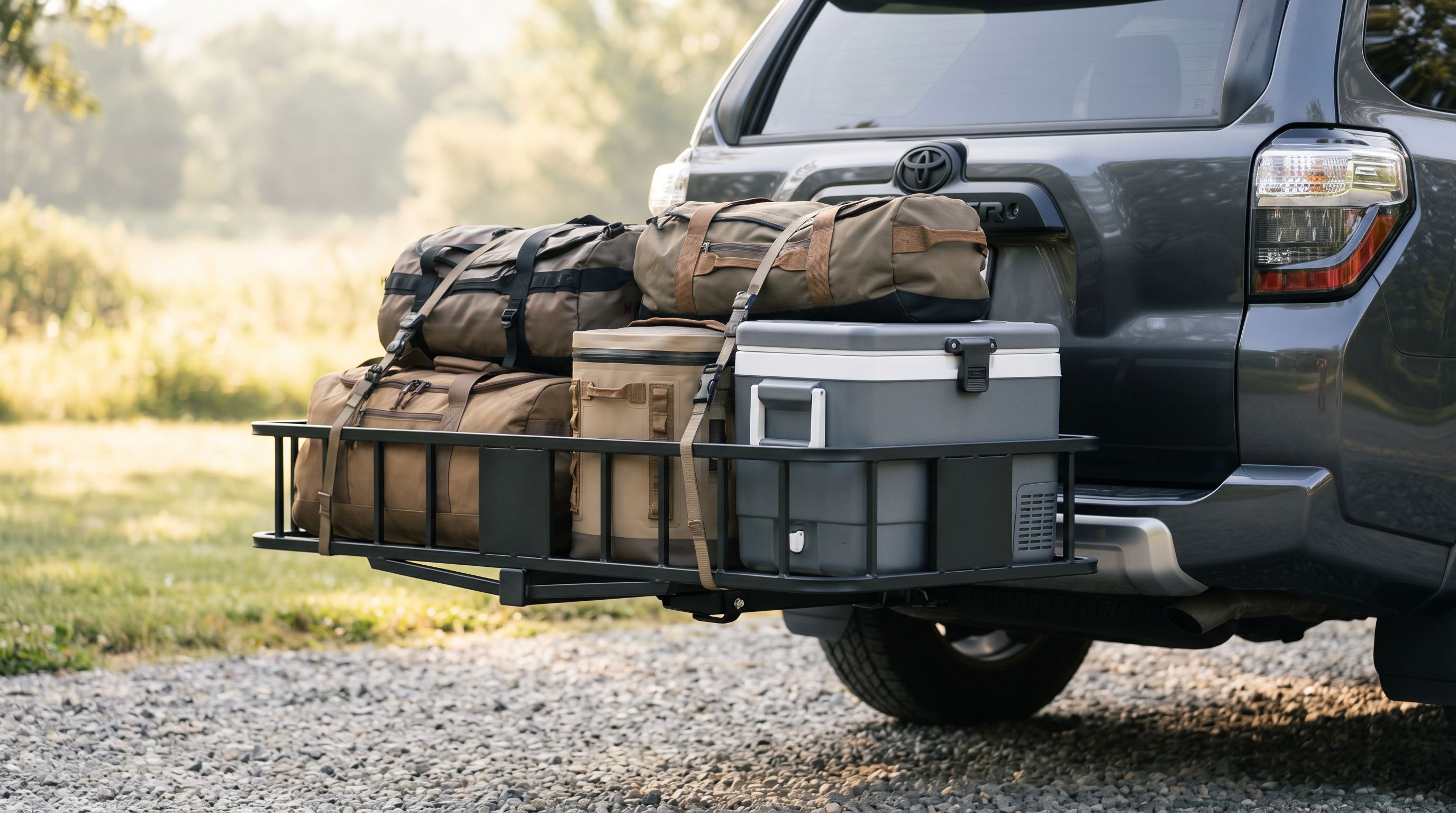
Most people buy a hitch cargo carrier the same way: measure the receiver, see "2-inch," click buy. Then the basket arrives, bolts up, droops two inches below level, drags on the first steep driveway, and the owner's manual turns out to cap tongue weight at a number the loaded basket blows past before the cooler goes in.
A hitch cargo carrier is not a universal accessory. Three numbers decide whether a given carrier works on your truck or SUV: your receiver class, your hitch's tongue weight rating, and the rise or drop built into the carrier's shank. Get those right and a cargo basket is one of the most useful hundred-something-pound additions you can make to a road trip. Get them wrong and you've bought a very heavy driveway scraper.
Below are the carriers we'd recommend for 2026 based on manufacturer specs, independent reviews and verified owner feedback — plus the fitment math that actually matters.
The short version
- Best overall: CURT 18153 Cargo Carrier
- Budget pick: MaxxHaul 70108 Hitch Cargo Carrier
- Best lightweight pick: CURT 18100 Aluminum Cargo Carrier
- Best folding carrier: Reese Explore 1394300 Rambler HD Cargo Carrier
- Best for small vehicles: CURT 18113 Hitch Cargo Carrier
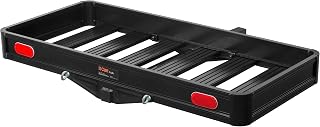 Best for small vehicles · CURT 18113 Hitch Cargo Carrier — Check price on Amazon →
 Best lightweight pick · CURT 18100 Aluminum Cargo Carrier — Check price on Amazon →
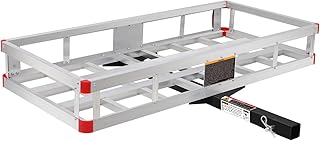 Budget pick · MaxxHaul 70108 Hitch Cargo Carrier — Check price on Amazon →
 Best overall · CURT 18153 Cargo Carrier — Check price on Amazon →
Why "2-inch receiver" isn't fitment
A 2-inch square opening tells you the shank will slide in. It tells you nothing about what the hitch, the vehicle, or the carrier can carry.
Tongue weight is the hard ceiling
Tongue weight (TW) is the downward force a hitch can take at the ball or in the receiver. Your hitch has a rating stamped on its label, and your vehicle has a separate rating in the owner's manual — the lower of the two wins. A Class III hitch is commonly rated around 500–600 lb TW when towing, but many vehicles cap TW well below their hitch's structural rating, and a cargo carrier loads that number differently than a trailer does.
Then subtract the carrier itself. A full-size steel basket can weigh 50–70 lb empty. A heavy-duty platform like the PakMule, which reviewers have highlighted for a 650-pound capacity, is heavier still. That empty weight comes straight out of your tongue weight budget before a single duffel goes on.
Worse, cargo sits behind the receiver, not at it. The further back the load's center of gravity, the more leverage it applies. That's why many hitch and carrier manufacturers instruct you to halve the hitch's tongue weight rating when using a cargo carrier, and why some vehicle manufacturers publish a specific, lower accessory-load limit. Check your manual. If it gives a cargo-carrier number, that number is the law.
Receiver class sets the hardware
- Class I/II (1-1/4-inch): light-duty crossovers and sedans. Carriers for these are smaller, lower-rated, and usually capped around 150–350 lb. Do not adapt a 1-1/4-inch receiver up to 2 inches so you can run a big basket — adapters add leverage and almost always void the rating.
- Class III/IV (2-inch): most trucks, SUVs and larger crossovers. This is where the 500 lb-class carriers live, including the CURT 18153 and MaxxHaul 70108.
- 2-1/2 or 3-inch: heavy-duty pickups. Most carriers need a reducer sleeve; confirm the sleeve is rated for the load, not just the fit.
Rise and drop decide your ground clearance
This is the spec buyers skip. The shank on a cargo carrier is either straight, dropped, or raised — and the cargo deck's final height is set by your receiver height plus that rise or drop.
Measure from the ground to the top inside edge of your receiver tube. Then:
- Under about 16 inches (most crossovers, cars, lowered trucks): you want a carrier with a rise so the tray sits level or above the receiver. Otherwise the tray hangs low, scrapes on driveways and speed bumps, and buries the back-up sensors in metal.
- Roughly 16–20 inches: a straight or lightly raised shank is usually fine.
- Above 20 inches (lifted trucks, body-on-frame 4x4s): a drop shank lowers the deck to a loadable height so you're not hoisting a cooler to chest level.
Also check spare tire clearance. Jeeps, 4Runners and body-on-frame SUVs with rear-mounted spares often need an extended shank — the X-Rack style carriers exist specifically to clear a swing-out spare and still let the tailgate open.
Rear overhang and the tailgate test
Load the carrier only once and you'll find out whether the tailgate or liftgate clears it. Most 60-inch baskets extend roughly 20–24 inches behind the bumper. On a pickup, the tailgate usually clears. On an SUV with a liftgate that swings down and out, it often doesn't — which is where a folding carrier like the Reese Explore Rambler HD earns its keep, or a model with a hinged/tilting shank.
Finally: in several states, cargo that obscures your license plate or taillights requires a relocated plate and auxiliary lighting. Budget for a plate bracket and a light kit if your load blocks either.
Comparison
| Carrier | Material | Typical size | Capacity (mfr.) | Shank | Best for |
|---|---|---|---|---|---|
| CURT 18153 | Steel | 60 x 20 in | 500 lb | Raised | Most 2-inch Class III trucks/SUVs |
| MaxxHaul 70108 | Steel | 60 x 20 in | 500 lb | Straight/raised | Occasional road-trip use on a budget |
| CURT 18100 | Aluminum | ~60 x 20 in | 500 lb | Raised | Vehicles tight on tongue weight |
| Reese Explore Rambler HD | Steel | ~60 x 24 in | ~500 lb class | Folding | Garage clearance, walk-around space |
| CURT 18113 | Steel | ~48 x 20 in class | 500 lb | Raised | Crossovers, shorter overhang |
Capacities are manufacturer ratings for the carrier itself. Your usable load is limited by whichever is lower: the carrier's rating, the hitch's tongue weight rating, or the vehicle's published limit — often halved for cargo carriers. Always confirm fitment for your exact year, make and model.
The picks
CURT 18153 — best overall
Prices last checked October 14, 2026. Amazon prices change frequently, so treat these as a guide and check the live price before you buy.
CURT 18153 Cargo Carrier
Steel 60x20 basket with a 500 lb capacity and raised shank — a strong fit for most 2-inch Class III receivers.
The 18153 is the default answer for a reason: 60 x 20 inches of steel tray, a 500 lb manufacturer rating, and a raised shank that keeps the deck closer to level on a typical SUV or half-ton receiver height. The raised geometry matters more than the capacity number for most buyers, because it's what keeps a loaded basket off steep driveway transitions. The powder-coated steel holds up well to salt in owner reports, and the mesh floor keeps bulk cargo from falling through. What it gives up: it's heavy to install solo, it doesn't fold, and on a liftgate SUV you'll likely need to unload before opening the hatch. Confirm your vehicle's cargo-carrier tongue weight limit first.
MaxxHaul 70108 — budget pick
MaxxHaul 70108 Hitch Cargo Carrier
Basic 60x20 steel basket, 500 lb rated, for occasional road-trip overflow on a Class III hitch.
If the carrier goes on twice a year for a camping trip and lives in the garage the rest of the time, the 70108 covers it. It's a conventional 60 x 20 steel basket with a 500 lb rating and the same basic footprint as pricier baskets, at a fraction of the outlay. Owner feedback is consistent on the trade-offs: the finish is thinner than premium steel carriers and benefits from touch-up if you live where roads get salted, and hardware tolerances mean you should expect a hitch tightener or anti-rattle bolt to eliminate play. For light, intermittent duty it's a lot of basket for the money.
CURT 18100 — best lightweight pick
CURT 18100 Aluminum Cargo Carrier
Aluminum tray keeps carrier weight low so more of your tongue weight budget goes to actual cargo.
Aluminum is the right move when your limiting factor is tongue weight rather than tray space. The 18100 saves meaningful weight versus an equivalent steel basket, and every pound saved is a pound you can actually load. It also doesn't rust, which matters for carriers that live outside year-round or get splashed with brine. The compromises are real: aluminum trays cost more, they're easier to gouge or dent with sharp-cornered gear, and the extruded deck is less forgiving of point loads like a generator foot. Use a sheet of plywood or a mat under heavy items and it'll serve for years.
Reese Explore 1394300 Rambler HD — best folding carrier
Reese Explore 1394300 Rambler HD Cargo Carrier
Folds up against the vehicle when empty so you keep garage clearance and walk-around space.
The Rambler HD exists for the two problems fixed carriers create: you can't get past the back of the vehicle in a tight garage, and the thing lives permanently in the way. Fold the tray up against the vehicle when it's empty and you reclaim both. The wider deck also handles bulkier items like a cooler plus firewood better than a 20-inch tray. Trade-offs: folding hinges are one more thing to keep clean and lubricated, the mechanism adds weight versus a plain basket, and you still need to unload before folding. Check liftgate clearance in the folded position before committing.
CURT 18113 — best for small vehicles
CURT 18113 Hitch Cargo Carrier
Compact steel tray sized for crossovers and smaller receivers where a 60-inch basket overhangs too far.
Not every vehicle wants 60 inches hanging off the back. On a compact crossover, a full-size basket adds enough rear overhang to make parking garages and steep ramps genuinely annoying, and it puts the load's center of gravity further behind the receiver than the hitch rating likes. The shorter 18113 tray keeps the mass closer to the vehicle while still carrying real gear. You give up outright volume — this is a two-duffels-and-a-cooler carrier, not a firewood hauler — and you'll want to confirm your receiver is a true 2-inch Class III, not a 1-1/4-inch opening, before ordering.
Installation and safety habits worth having
- Kill the rattle. A hitch tightener or threaded anti-rattle pin stops the slop that makes a carrier feel (and sound) like it's failing. It also reduces fatigue on the shank.
- Torque the pin and recheck. After the first 25 miles and at every fuel stop, check the hitch pin, the carrier bolts, and your straps.
- Strap, don't bungee. Ratchet straps over the top of the load, routed through the basket frame. Bungees loosen at highway speed.
- Load low and forward. Heavy items against the vehicle side of the tray, light stuff at the rear. This minimizes leverage on the receiver.
- Expect a departure-angle change. Steep driveways, ferry ramps and parking-garage transitions are where loaded carriers get bent. Approach at an angle.
- Recheck your rear camera and sensors. Many carriers sit directly in the parking-sensor field and will trigger false alerts; some vehicles let you disable rear sensors temporarily.
FAQ
How much can I actually put on a hitch cargo carrier? Take the lowest of three numbers: the carrier's rating, your hitch's tongue weight rating, and your vehicle's published limit. Many manufacturers advise halving the tongue weight rating when the load sits on a cargo carrier instead of at the ball, because of the rearward leverage. Then subtract the carrier's own weight. The remainder is your cargo allowance.
Can I use a cargo carrier and tow a trailer at the same time? Generally no, not on a standard receiver — the carrier occupies the receiver and the two loads stack on one rated point. Some purpose-built carriers include a pass-through ball mount, but you must confirm the combined tongue weight stays under both the hitch and the vehicle limits, and towing with a loaded carrier behind the ball is often expressly prohibited. Check your hitch label and manual.
Do I need a raised shank or a dropped shank? Measure ground to the top inside edge of your receiver. Low receivers (roughly under 16 inches) want a rise so the tray clears driveways. Lifted trucks (above about 20 inches) benefit from a drop so the deck is loadable. Mid-height vehicles are usually fine with a straight or lightly raised shank.
Will the carrier block my license plate? Often, yes, once it's loaded. Many states require the plate to be visible and illuminated. A relocation bracket plus an LED light kit solves it; some carriers include mounting provisions.
Is a 1-1/4-inch receiver enough? For a small, low-rated carrier and modest loads, yes. For a 60-inch basket, no — and adapting up to 2 inches to force the fit adds leverage and voids the rating. Match the carrier to the receiver class you actually have.
Do these fit any vehicle with a 2-inch hitch? Mechanically they'll slide in, but fitment is about clearance and ratings: spare tire position, liftgate swing, bumper shape, and your vehicle's specific cargo-carrier weight limit. Check your year, make and model against the hitch label and owner's manual before ordering.
Get the best car care deals in your inbox
Join the GarageProof newsletter for hand-picked car care deals and new buying guides. No spam, unsubscribe anytime.
Related reads
Hitch Bike Rack 2 Inch Receiver vs Bed Mount in 2026
Bed-mounted or hitch bike rack? Compare 2-inch receiver classes, tongue weight limits and real 2026 racks so you confirm fitment before you buy.
Towing Mirrors for Trucks in 2026: Clamp-On vs Bolt-On
Clamp-on or vehicle-specific towing mirrors for trucks in 2026? We compare stability, vibration, DOT-legal width and fitment for real tow setups.
Mud Flaps for Trucks 2026: Fit the Wheel Well, Not the Badge
Heavy-duty mud flaps for trucks in 2026: how wheel-well lip, lift height and flare type decide whether drill-in or no-drill kits actually fit.