Hitch Bike Rack 2 Inch Receiver vs Bed Mount in 2026
Bed-mounted or hitch bike rack? Compare 2-inch receiver classes, tongue weight limits and real 2026 racks so you confirm fitment before you buy.
Reader-supported: we may earn a commission from links on this page, at no extra cost to you. It never affects our picks. Learn more.
If you drive a pickup, you have a choice most SUV owners don't: put the bikes in the bed, or hang them off the hitch. The answer depends less on brand loyalty than on arithmetic — receiver class, tongue weight, rack weight, bike weight, and whether you also plan to tow. Get that math wrong and a $300–$1,000 rack either doesn't fit, overloads your receiver, or blocks the trailer you bought the truck for.
This guide compares bed-mounted and hitch-mounted approaches, explains how 2-inch receiver ratings actually work, and ranks the racks we'd shortlist in 2026 based on manufacturer specs, independent reviews and verified owner feedback. GarageProof does not physically test products — we research, compare and rank.
The short version
- Best overall: Thule T2 Pro XTR 2-Bike (2-inch)
- Premium pick: Kuat Piston Pro X 2-Bike
- Best value platform: RockyMounts MonoRail 2-Bike
- Best for big tires and long wheelbases: Yakima StageTwo
- Best bed-mounted option: Thule Insta-Gater Pro Truck Bed Bike Rack
 Best bed-mounted option · Thule Insta-Gater Pro Truck Bed Bike Rack — Check price on Amazon →
 Best for big tires and long wheelbases · Yakima StageTwo — Check price on Amazon →
 Premium pick · Kuat Piston Pro X 2-Bike — Check price on Amazon →
 Best overall · Thule T2 Pro XTR 2-Bike (2-inch) — Check price on Amazon →
Bed-mounted vs hitch: the real trade-off
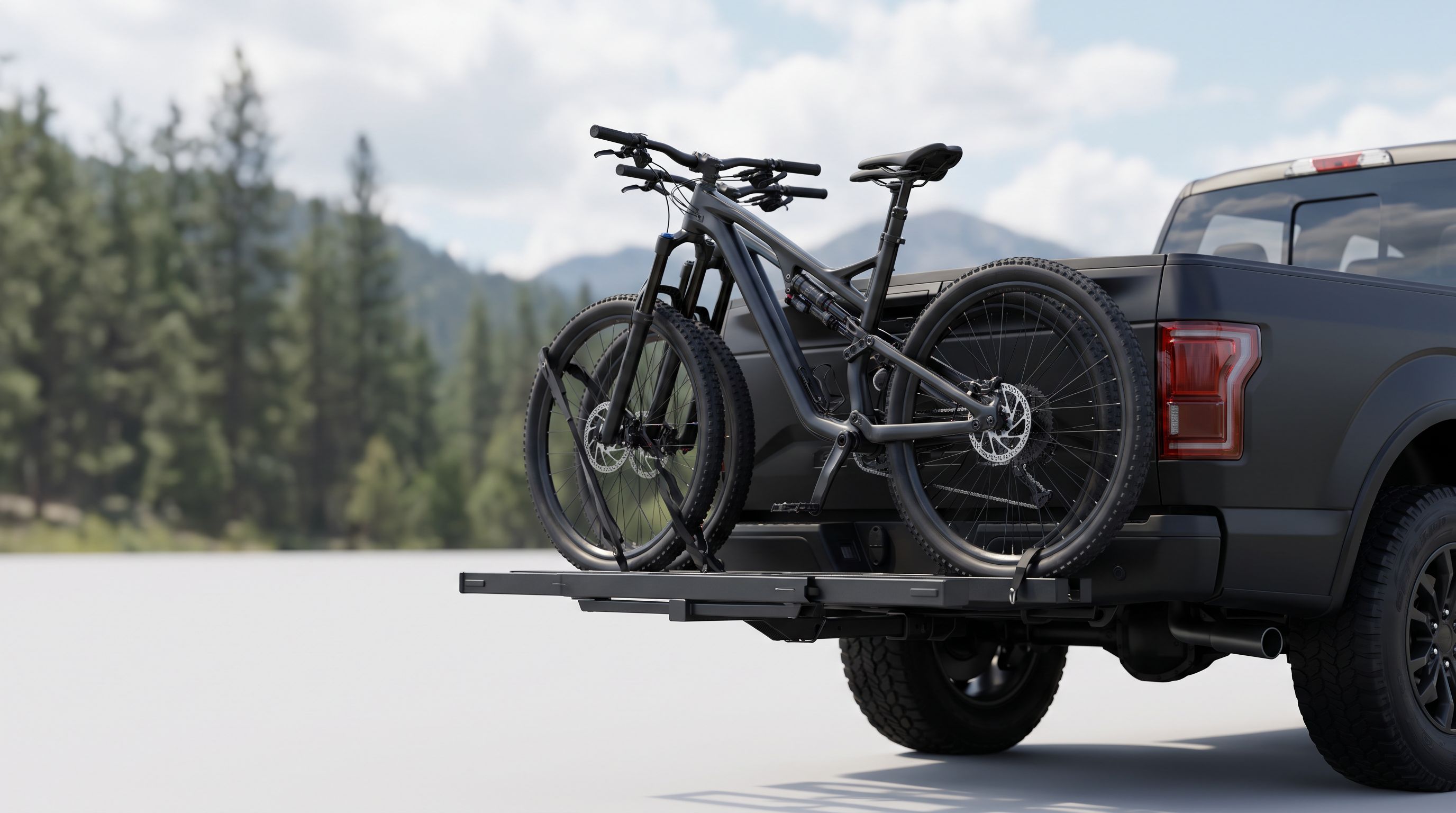
A bed rack lives in the cargo box and clamps either the front wheel or the fork. It uses zero receiver capacity, adds nothing to your rear overhang, and keeps your hitch open for a boat, camper or utility trailer. The cost is bed space — once two bikes are standing in the box, you've lost most of a 5.5-foot bed — plus bikes sitting high enough that garage and drive-through clearance becomes a real consideration.
A hitch rack puts the bikes behind the truck, keeps the bed free for gear, and is far easier to load since bikes sit at roughly knee height. The costs: it consumes tongue-weight capacity, it blocks the trailer ball, it extends the vehicle by two to three feet, and on a tilt-away model you still need clearance to drop the rack and open the tailgate.
For most people who own one truck and rarely tow on bike days, a 2-inch platform hitch rack is the better daily answer. For anyone who tows a trailer to the trailhead — dirt bikes, a camper, a side-by-side — a bed rack is the only workable choice short of a hitch extension (which we don't recommend; extensions multiply leverage on the receiver).
Receiver class and the numbers that actually matter
"2-inch receiver" describes the opening size, not the strength. A Class III receiver and a Class V receiver can both have a 2-inch square opening with wildly different ratings. What you need off the sticker on your own hitch:
- Tongue weight (TW): the downward load the receiver can carry. Class III is commonly rated around 500–600 lb TW in towing mode, Class IV higher. Your rack plus bikes must stay well under this.
- Weight-carrying vs weight-distributing: those are two different numbers on the hitch label. For a bike rack you care about the weight-carrying figure.
- Vehicle payload: everything behind the rear axle also eats into the payload printed on your door-jamb sticker. Passengers, tools and a cooler count.
- Rack self-weight: premium platform racks for two bikes often land in the 50–65 lb range before any bike goes on. That's real tongue weight.
- Per-bike limit: most 2-inch platform racks are rated around 60 lb per bike, with some e-bike-specific models going higher. A 55 lb e-MTB is close to that ceiling.
Do the quick sum: rack weight + (bikes × per-bike weight). Two 35 lb trail bikes on a 55 lb rack is roughly 125 lb at the receiver. Two 60 lb e-bikes on the same rack is roughly 175 lb, and it's acting at a long lever arm behind the axle. Both are fine for a healthy Class III hitch; neither is fine on a 1.25-inch Class I or II receiver, which is exactly why 2-inch receivers dominate this category.
One more check people skip: the hitch pin and anti-wobble system. A threaded expander or cam-lock (standard on the Thule T2 Pro XTR, Kuat Piston Pro X and Yakima StageTwo) dramatically reduces the rack sway that otherwise loosens bolts and wears the receiver.
Comparison table
| Rack | Mount type | Receiver | Typical bikes | Key strength | Main compromise |
|---|---|---|---|---|---|
| Thule T2 Pro XTR 2-Bike | Hitch platform | 2 in. (1.25 in. version exists) | 2, add-on available | Tool-free wheel clamps, tilts loaded, no frame contact | Heavy to install and store solo |
| Kuat Piston Pro X 2-Bike | Hitch platform | 2 in. | 2, add-on available | Pneumatic arms, premium finish, lighting option | Highest cost in the group |
| RockyMounts MonoRail 2-Bike | Hitch platform | 2 in. and 1.25 in. versions | 2, add-on available | Value-to-feature ratio | Fewer luxury touches, lighter duty hardware |
| Yakima StageTwo | Hitch platform | 2 in. | 2, add-on available | Wide spacing for plus tires and long bikes | Long rear overhang when loaded |
| Thule Insta-Gater Pro | Truck bed | None — bed mount | 1 per unit, add more | Leaves hitch free for towing | Consumes bed space, tall load height |
The picks
Thule T2 Pro XTR — best overall
Prices last checked October 5, 2026. Amazon prices change frequently, so treat these as a guide and check the live price before you buy.
Thule T2 Pro XTR 2-Bike (2-inch)
Tool-free wheel clamps, no frame contact, and a proven 2-inch platform that tilts with bikes loaded.
The T2 Pro XTR is the default recommendation for a 2-inch receiver because it does the boring things right. Bikes are held by the wheels, not the frame, so carbon frames, odd tube shapes and full-suspension layouts are all fine. The ratcheting arms adjust without tools, the rack tilts down with bikes mounted so you can reach the tailgate, and the integrated hitch tightening system keeps wobble out of the equation. It's a two-bike rack with an add-on available if your receiver and tongue weight can absorb it.
What it gives up: it's genuinely heavy, so lifting it in and out of the receiver by yourself is a chore, and storage eats garage floor. It's also priced above value platforms that carry bikes nearly as well.
Kuat Piston Pro X — premium pick
Kuat Piston Pro X 2-Bike
Pneumatic arms, heated lighting option and the slickest load/unload of any 2-inch platform rack.
If your bikes come off and on several times a week, the Piston Pro X earns its money. The pneumatic arms do most of the clamping work for you, the trays are generously spaced, and build quality — anodized finish, machined hardware — is a step above everything else here. An accessory lighting kit and remote tilt elevate it further for people who tow at night or use a rack year-round.
The compromises are predictable: it's the most expensive option, it's heavy, and the extra mechanical complexity means more parts that can eventually need service. If you load bikes twice a year, you're paying for convenience you won't use.
RockyMounts MonoRail — best value platform
RockyMounts MonoRail 2-Bike
Most of the premium-platform experience — wheel-only clamping, tilt access — for noticeably less money.
The MonoRail has been a value benchmark for several seasons and remains so in 2026. You get the core platform experience — wheel-only contact, tilt access, locking hardware, a 2-inch receiver version plus a 1.25-inch option — without the premium-brand surcharge. For two mountain bikes or a pair of hybrids, it's hard to justify spending double.
What you trade: hardware feels a notch less refined than Thule or Kuat, the tilt and clamping mechanisms take a bit more muscle, and resale value isn't as strong. Check the 1.25-inch version's lower per-bike rating carefully if that's your receiver — it's a different capacity, not just a different shank.
Yakima StageTwo — best for big tires and long wheelbases
Yakima StageTwo
Wide bike spacing and deep trays swallow plus-size and long-travel bikes without handlebar clash.
The StageTwo was designed around the reality that modern bikes got longer, slacker and fatter. Trays are deep and widely staggered, so a 29er with 2.6-inch tires doesn't fight the handlebars of the bike next to it. That vertical offset also makes two-bike loading less of a puzzle than on tightly packed racks. Yakima's hitch tightening and tilt systems are straightforward and well documented.
The downside is footprint. With two long bikes mounted, your rear overhang is substantial — parallel parking and steep driveway entries demand attention, and reversing with a backup camera partially blocked takes practice.
Thule Insta-Gater Pro — best bed-mounted option
Thule Insta-Gater Pro Truck Bed Bike Rack
Clamps the front tire in the bed with no fork removal, leaving your hitch free for a trailer.
If the hitch has to stay free, the Insta-Gater Pro is the cleanest answer. It clamps the front tire in a cradle inside the bed — no fork removal, no through-axle adapters, no contact with the frame. It mounts to the bed rail or floor depending on configuration, holds one bike per unit, and multiple units can sit side by side across a full-size bed.
The trade-offs are real: bikes stand tall, so check garage, carport and parking-structure clearance before buying. Each unit occupies bed width you'd otherwise use for gear, and loading requires lifting the bike into the box. Fitment is vehicle-specific — confirm your truck's year, make, model and bed configuration against Thule's fit guide, especially if your bed has a liner, tonneau cover or factory cargo management rails.
How to choose
Start with the hitch label, not the rack
Walk to the back of your vehicle and read the sticker on the receiver. Note the weight-carrying tongue weight rating and the class. If it isn't legible, your owner's manual lists it. Anything with a 2-inch opening on a half-ton truck or mid-size SUV is usually Class III or higher and comfortably handles a two-bike platform rack; small crossovers with 1.25-inch receivers often cap out around 150–200 lb tongue weight and need the 1.25-inch rack variant with its lower rating.
Weigh your actual bikes
Per-bike limits around 60 lb sound generous until you weigh a modern e-bike. If either bike has a battery, check the rack's e-bike rating specifically and look at ramp accessories — lifting a 60 lb bike to tray height is a two-person job otherwise. Also confirm the rack's wheelbase and tire-width range against your longest bike.
Decide whether you'll tow on the same trip
This is the single question that settles bed vs hitch. If a trailer and bikes ever need to travel together, buy the bed rack. If not, the hitch rack wins on ease of loading and preserved cargo space.
Check tailgate and tilt clearance
Every platform rack here tilts, but tilt needs space behind the vehicle and the tailgate still needs room to drop. If you park nose-in in a tight garage, measure before you order — total vehicle-plus-rack length is the number that matters, loaded and unloaded.
Plan for security and storage
Locking hitch pins and integrated cable locks are standard on most of these racks, but no cable stops a determined thief. Equally, think about where a 55 lb rack lives when it's off the truck. Wall-mount storage hooks are cheap insurance against a dented rack and a sore back.
FAQ
Can I put a 2-inch bike rack in a 1.25-inch receiver with an adapter? Technically adapters exist, but we'd avoid them. They add leverage and slop at the weakest point in the system, and many rack manufacturers void warranty coverage when an adapter is used. Buy the shank size that matches your receiver.
How much tongue weight does a two-bike hitch rack use? Rack self-weight plus bike weight. For a typical premium platform rack around 55 lb carrying two 35 lb bikes, you're near 125 lb at the receiver. Compare that against your hitch's weight-carrying tongue weight rating and your remaining payload.
Will a hitch rack block my backup camera or license plate? Often, partially. Most jurisdictions require a visible, illuminated plate; accessory light-and-plate kits (Kuat offers one for the Piston Pro X) solve it. Backup cameras will see the rack — drive accordingly and rely on mirrors in tight reverse maneuvers.
Do bed racks damage the truck bed or liner? Properly installed, no. Clamp-style mounts like the Thule Insta-Gater Pro distribute load across bed rails, but a spray-in or drop-in liner can change the mounting geometry. Check the manufacturer fit guide for your specific year, make, model and bed length before ordering.
Is a platform rack always better than a hanging rack? For anything with a non-traditional frame — full suspension, step-through, carbon — yes, because platform racks touch only the wheels. Hanging racks are lighter and cheaper and still make sense for a couple of classic-geometry road bikes, but they're a shrinking use case.
Get the best car care deals in your inbox
Join the GarageProof newsletter for hand-picked car care deals and new buying guides. No spam, unsubscribe anytime.
Related reads
Hitch Cargo Carriers 2026: Match Tongue Weight First
A hitch cargo carrier guide for 2026: match receiver class, tongue weight rating and shank rise to your truck or SUV before you buy a 2-inch basket.
Towing Mirrors for Trucks in 2026: Clamp-On vs Bolt-On
Clamp-on or vehicle-specific towing mirrors for trucks in 2026? We compare stability, vibration, DOT-legal width and fitment for real tow setups.
Mud Flaps for Trucks 2026: Fit the Wheel Well, Not the Badge
Heavy-duty mud flaps for trucks in 2026: how wheel-well lip, lift height and flare type decide whether drill-in or no-drill kits actually fit.