Heat Resistant Dash Cam 2026: Picks for 115°F Summers
A heat resistant dash cam has to survive a dashboard that hits 160°F. We compared supercapacitor models from Viofo, Thinkware, BlackVue and Vantrue for Sunbelt drivers.
Reader-supported: we may earn a commission from links on this page, at no extra cost to you. It never affects our picks. Learn more.
The short version
- Best overall: Viofo A229 Pro
- Best for extreme heat: Thinkware U3000
- Best hidden install: BlackVue DR770X Box
- Best three-channel: Vantrue N4 Pro
- Budget pick: Viofo A119 Mini 2
 Budget pick · Viofo A119 Mini 2 — Check price on Amazon →
 Best three-channel · Vantrue N4 Pro — Check price on Amazon →
 Best hidden install · BlackVue DR770X Box — Check price on Amazon →
 Best for extreme heat · Thinkware U3000 — Check price on Amazon →
 Best overall · Viofo A229 Pro — Check price on Amazon →
If you park outside in Phoenix, Houston, Orlando or anywhere else where a July dashboard reads like a pizza stone, the single most important dash cam spec isn't resolution. It's whether the thing still boots in August.
Why heat kills dash cams
A car parked in direct sun in Arizona routinely sees cabin air temperatures above 140°F, and the windshield glass and dash surface — exactly where your camera lives — can run hotter still. Independent measurements and vehicle-safety research have repeatedly put dashboard surface temperatures north of 160°F on 95°F days. Your dash cam is bolted to the hottest real estate in the car.
Two components fail first.
The battery. Older and cheaper dash cams use a small lithium-ion cell to finish writing the last file after you kill the ignition. Lithium cells degrade fast above roughly 140°F and can swell, leak or vent. A swollen battery is what cracks a dash cam housing and pops the lens out of alignment. This is the number one reason heat-climate buyers are told to avoid battery cams entirely.
The capacitor. Supercapacitors replace that battery. They store just enough energy to close the file and shut down cleanly, and they tolerate far wider temperature ranges. Most dash cam supercapacitors are rated to around 185°F (85°C) operating, with storage ratings higher still. That is the number that matters for Sunbelt buyers — and it's why practically every serious hot-climate recommendation is a supercapacitor model.
But a capacitor alone doesn't save you. The image sensor, the SoC, the Wi-Fi module and the microSD card all have their own thermal limits. A well-designed hot-weather cam adds thermal management on top of the capacitor: an aluminum chassis that acts as a heat sink, a thermal cut-off that shuts down parking recording before damage occurs, and low-power parking modes that generate less heat in the first place.
What manufacturers actually publish
Most brands list an operating range (commonly around -4°F to 158°F / -20°C to 70°C) and a separate, higher storage range. Read both. Operating range is what applies while the camera is recording in parking mode with the car off in a parking lot. Storage range applies when it's powered down. A camera with a 158°F operating ceiling will trip its thermal protection on a bad day in Tucson — that's the system working correctly, not a defect, but it means you lose parking coverage in the hours you may want it most.
Also note that published figures are ambient air temperatures, not surface temperatures. A camera clipped to the glass in full sun is hotter than the air around it.
How to choose
Supercapacitor, not battery — no exceptions
If the spec sheet says "built-in battery" or "Li-ion," skip it for a hot climate. Every pick below uses a supercapacitor. If you're evaluating a model we haven't listed, search the manual for "supercapacitor" before you search for anything else. Note that some cams still include a tiny backup cell for the GPS clock — that's generally fine; a full lithium power cell is not.
Match parking mode to how hot your parking spot gets
Parking mode is where heat problems show up, because the camera is running with no airflow and no A/C. Options, roughly from coolest to hottest running:
- Impact/buffered parking only: camera sits in low-power standby and only wakes on a G-sensor hit. Coolest, but can miss the first second of an event.
- Time-lapse / low-bitrate parking: records at 1–5 fps. Much less heat and much less card wear than full recording.
- Radar or motion-triggered: Thinkware's radar approach keeps the camera idle until something actually moves nearby, which is both cooler and kinder to your 12V system.
- Continuous full-resolution parking: maximum coverage, maximum heat. Reserve this for garaged or shaded parking.
If you park outdoors all day in Texas, pick a cam with a genuine low-power or radar parking mode rather than one that just keeps recording at 4K.
Thermal protection and mounting position
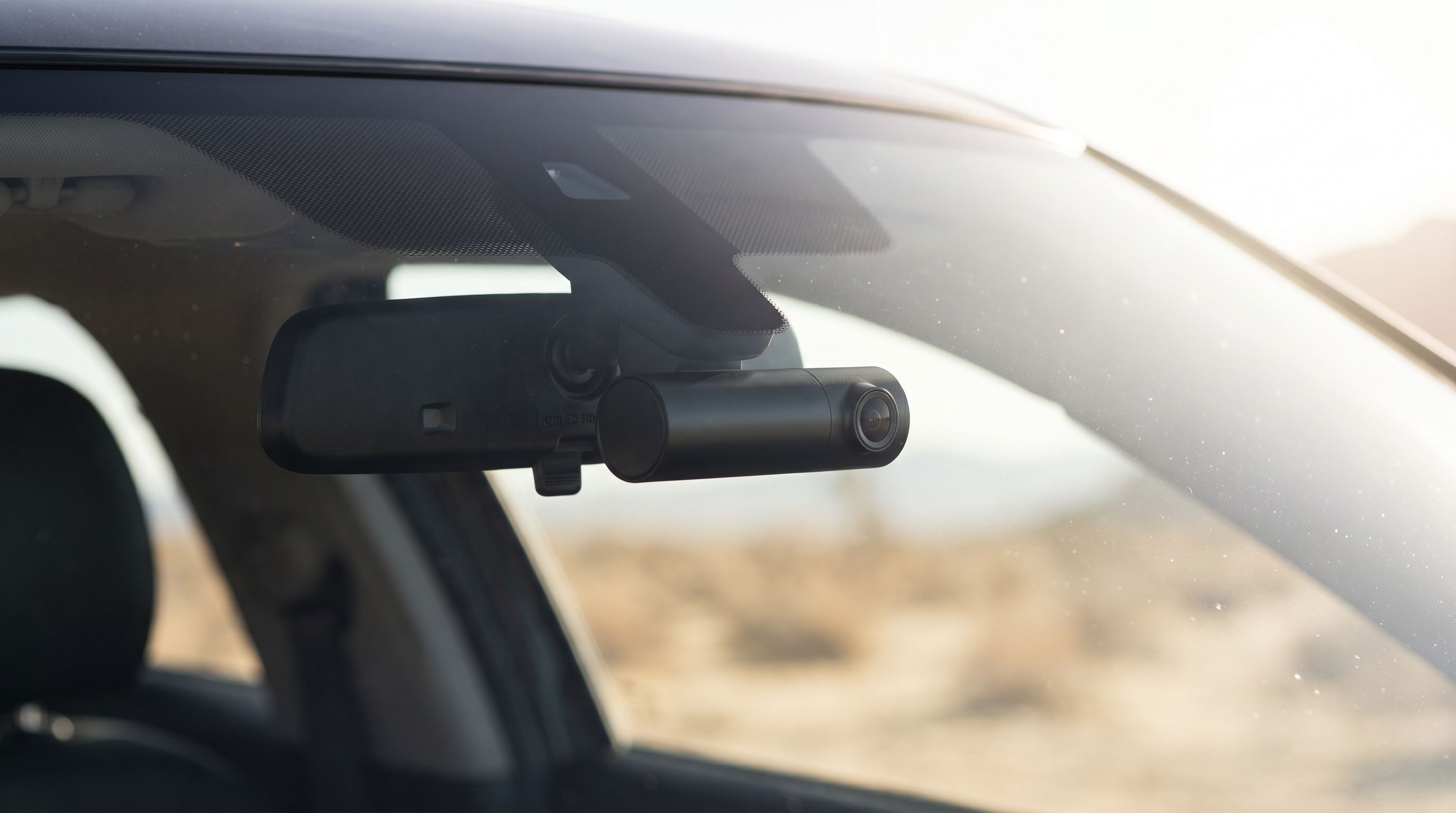
Look for an explicit thermal shutdown feature. Thinkware has advertised thermal protection on its parking modes for years, and it's one of the reasons installers in hot states keep recommending the brand. Second, think about placement: tucking the camera high and directly behind the rearview mirror puts it in the mirror's shadow for most of the day, which measurably reduces what the housing sees. A camera stuck low on the glass or on the dash itself is asking for trouble.
Hardwire kit voltage cutoff
Parking mode needs a hardwire kit or an OBD-II power cable, and that kit needs a low-voltage cutoff. In hot weather, lead-acid and AGM batteries are already under stress — heat accelerates grid corrosion and water loss far more than cold does. Set the cutoff conservatively (12.0–12.2V for most vehicles) so a hot night of parking recording doesn't leave you calling for a jump at 7 a.m. Some owners in the Sunbelt use a small LiFePO4 auxiliary battery instead, which also keeps the vehicle battery out of it entirely.
Card choice matters more than you think
Standard consumer microSD cards are not designed for continuous write cycles at high temperature. Use a high-endurance or industrial card from a reputable brand, format it in-camera every month or two, and treat cards as consumables. Most "my dash cam died in summer" reports turn out to be card failures, not camera failures.
Comparison
| Model | Power storage | Channels | Standout heat feature | Best for |
|---|---|---|---|---|
| Viofo A229 Pro | Supercapacitor | 1–3 (front, +rear, +interior options) | Low-bitrate and buffered parking modes; aluminum-backed body | All-round Sunbelt daily driver |
| Thinkware U3000 | Supercapacitor | Front + optional rear | Thermal protection with radar-based parking mode | Cars parked outdoors in extreme heat |
| BlackVue DR770X Box | Supercapacitor | Front + rear | Separate processing box mounts out of direct sun | Clean, hidden, heat-aware installs |
| Vantrue N4 Pro | Supercapacitor | 3 (front, cabin, rear) | Full three-channel coverage without a lithium cell | Rideshare and fleet drivers |
| Viofo A119 Mini 2 | Supercapacitor | 1 (front) | Very small housing, hides fully behind the mirror | Budget buyers and second vehicles |
The picks
Viofo A229 Pro — best overall
Prices last checked October 18, 2026. Amazon prices change frequently, so treat these as a guide and check the live price before you buy.
Viofo A229 Pro
Supercapacitor 4K HDR front cam with low-bitrate parking modes and a strong Sunbelt reliability record.
The A229 Pro is the model most often recommended as the default good dash cam right now, including by Wirecutter, and it happens to suit hot climates well. It's a supercapacitor design with 4K HDR front capture, modular rear and interior channels, and parking modes that include buffered impact detection and a low-bitrate option that keeps heat and card wear down. Owner reports from Texas and Arizona generally describe it as a survivor across multiple summers, provided it's mounted behind the mirror and fed by a hardwire kit with a sensible cutoff. What it gives up: there's no radar parking sensor, and continuous 4K parking recording in full sun is more than any camera should be asked to do. Use the low-bitrate mode.
Thinkware U3000 — best for extreme heat
Thinkware U3000
Thermal-protection shutdown, radar parking mode and the best long-term reputation in hot climates.
Thinkware has the strongest reputation among installers for surviving Gulf Coast and desert summers, and the U3000 is its flagship. The key differentiator is the optional radar module: instead of keeping the sensor live and processing motion, the camera sits in a true low-power state and only wakes when radar detects movement. That means dramatically less self-generated heat during an eight-hour shift in an uncovered lot, plus far less battery drain. Thinkware also builds in thermal protection that will suspend parking recording rather than cook the unit. What it gives up: it's a pricier ecosystem, the app and firmware are more fiddly than Viofo's, and the best setup really wants professional installation.
BlackVue DR770X Box — best hidden install
BlackVue DR770X Box
Splits the camera from the processing box so the hot part lives out of direct sun under the dash.
The DR770X Box takes a genuinely clever approach to the heat problem: it splits the system in two. The camera head on the windshield is small and passive, while the processing box — the part generating the heat and housing the supercapacitor and card slot — mounts under the dash, in the glovebox area, or anywhere out of direct sun. That's a structural advantage no single-body camera can match, and it also makes the install nearly invisible from outside the car. BlackVue's cloud features, parking modes and build quality are well established. What it gives up: a two-piece install is more work, routing the cable neatly takes patience, and BlackVue's full feature set leans on a subscription for cloud connectivity.
Vantrue N4 Pro — best three-channel
Vantrue N4 Pro
Supercapacitor triple-channel coverage for rideshare and truck drivers who need cabin and rear video.
If you drive rideshare, delivery or any job where you need the cabin on video, the N4 Pro is the sensible supercapacitor choice. Three channels — forward, interior with IR illumination, and rear — on a single unit, with parking mode support and no lithium cell to swell in July. Owners in Florida and Texas report it holding up across summers when hardwired properly and left in a low-power parking mode. What it gives up: three channels means three streams of heat and data, so it runs warmer than a single-channel cam and chews through cards faster. Plan on a high-endurance 256GB card and expect to replace it more often than you would in a milder climate.
Viofo A119 Mini 2 — budget pick
Viofo A119 Mini 2
Tiny supercapacitor 2K cam that hides behind the mirror and survives heat better than its price suggests.
Not everyone needs 4K. The A119 Mini 2 is a 2K supercapacitor camera in a very small, low-profile housing that disappears behind a rearview mirror — which is exactly the shaded spot you want in Phoenix. It's frequently recommended as the budget option for people who want reliable, legible footage of plates and lane positions without a big install. Parking mode works with the appropriate hardwire kit. What it gives up: single channel only (you'll want a separate rear solution if you need one), no radar, and lower resolution means less cropping room when you're trying to read a plate three cars ahead. For a second car or a commuter, it's plenty.
Installation tips for hot-climate drivers
- Mount high and behind the mirror. Shade is free thermal management.
- Use a windshield sunshade. It cuts cabin peak temperatures substantially and the camera benefits even if its lens is above the shade line.
- Route cables along the headliner and A-pillar, and keep clear of airbag deployment paths.
- Set the hardwire cutoff conservatively and check your 12V battery's health before summer — heat is harder on batteries than cold.
- Reformat the card monthly and keep a spare in the glovebox.
- Pull footage you care about immediately. Loop recording overwrites, and a heat-stressed card can fail without warning.
FAQ
Is a supercapacitor dash cam really necessary in a hot climate? Yes. Lithium cells degrade quickly above about 140°F and can swell or vent, which is a fire risk in a sealed car. Every pick on this list uses a supercapacitor for exactly that reason.
What temperature can a dash cam actually handle? Most quality models publish an operating range topping out around 158°F (70°C) with a higher storage ceiling. Those are ambient air figures, not the surface temperature of a sun-baked windshield, so real-world margin is thinner than it looks. Shade and low-power parking modes are what preserve that margin.
Should I run parking mode if I park outside all day in Arizona? Run it, but run a low-power version — buffered impact detection, time-lapse, or radar-triggered rather than continuous 4K. Continuous full-resolution parking recording in direct sun is the single hardest thing you can ask of a dash cam.
Will heat damage my microSD card? It's the most common failure point. Use high-endurance or industrial-grade cards, format in-camera regularly, and replace them proactively — annually is reasonable in a hot climate, sooner for three-channel setups.
Are these cameras vehicle-specific? The cameras themselves are universal, but hardwire kits and OBD-II power cables are not. Fuse box layouts, fuse tap sizes (mini, micro2, low-profile mini) and OBD port pinouts vary by year, make and model. Check your owner's manual fuse diagram and confirm the kit matches before ordering, or have a shop handle the power connection.
Does a sunshade actually help the dash cam? Yes, meaningfully. Reducing peak cabin temperature lowers the ambient air the camera sits in, and a reflective shade also keeps direct sun off the lower part of the glass. It's the cheapest reliability upgrade available.
Get the best car care deals in your inbox
Join the GarageProof newsletter for hand-picked car care deals and new buying guides. No spam, unsubscribe anytime.
Related reads
Cold Weather Dash Cam Picks for 2026 That Boot at −20°C
Supercapacitor dash cams that survive sub-zero mornings. We compare BlackVue, Viofo, Thinkware and Vantrue models on cold-rated specs and winter owner feedback.
LTE Cloud Dash Cam in 2026: Is the Subscription Worth It?
We compared LTE cloud dash cams in 2026 on hardware cost, monthly plan fees, live-view limits and parking alerts — and when a plain SD card cam is smarter.
Supercapacitor Dash Cam vs Battery in 2026: Heat Survival
Supercapacitor dash cams vs lithium-battery models in 2026: how each survives hot parked cars, what parking mode really needs, and which cameras owners trust.