Hardwired vs Plug In Level 2 Charger: 2026 Install Reality
Hardwired vs plug in Level 2 charger in 2026: how continuous-load rules, GFCI breaker costs and outdoor durability should decide your install before you get quoted.
Reader-supported: we may earn a commission from links on this page, at no extra cost to you. It never affects our picks. Learn more.
The short version
- Best overall (plug-in or hardwired): Emporia Level 2 EV Charger
- Best hardwired for high power: ChargePoint Home Flex
- Best rugged outdoor plug-in: Grizzl-E Classic
- Best smart hardwired with load management: Wallbox Pulsar Plus
- Best budget NEMA 14-50 unit: Lectron V-Box 48A
 Budget pick · Lectron V-Box 48A — Check price on Amazon →
 Best smart hardwired with load management · Wallbox Pulsar Plus — Check price on Amazon →
 Best rugged outdoor plug-in · Grizzl-E Classic — Check price on Amazon →
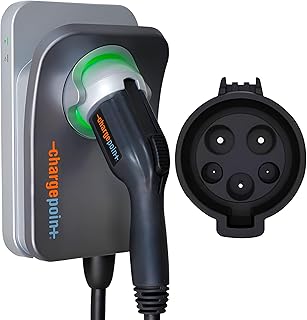 Best hardwired for high power · ChargePoint Home Flex — Check price on Amazon →
 Best overall · Emporia Level 2 EV Charger — Check price on Amazon →
The question that stalls more home EV charger projects than any other isn't "which brand?" — it's "do I need an outlet or not?" Get that decision wrong and you either pay an electrician twice, or you buy a 48-amp charger you legally can't plug in.
This guide breaks down hardwired vs plug in Level 2 charger installs for 2026: what the continuous-load rule actually means for your amperage, why the GFCI breaker requirement adds real cost to a NEMA 14-50 install, and how outdoor exposure quietly tips the scales. GarageProof researches and compares products using manufacturer specs, electrical code documentation, independent testing and verified owner feedback — we don't physically install these units ourselves.
The core difference in 60 seconds
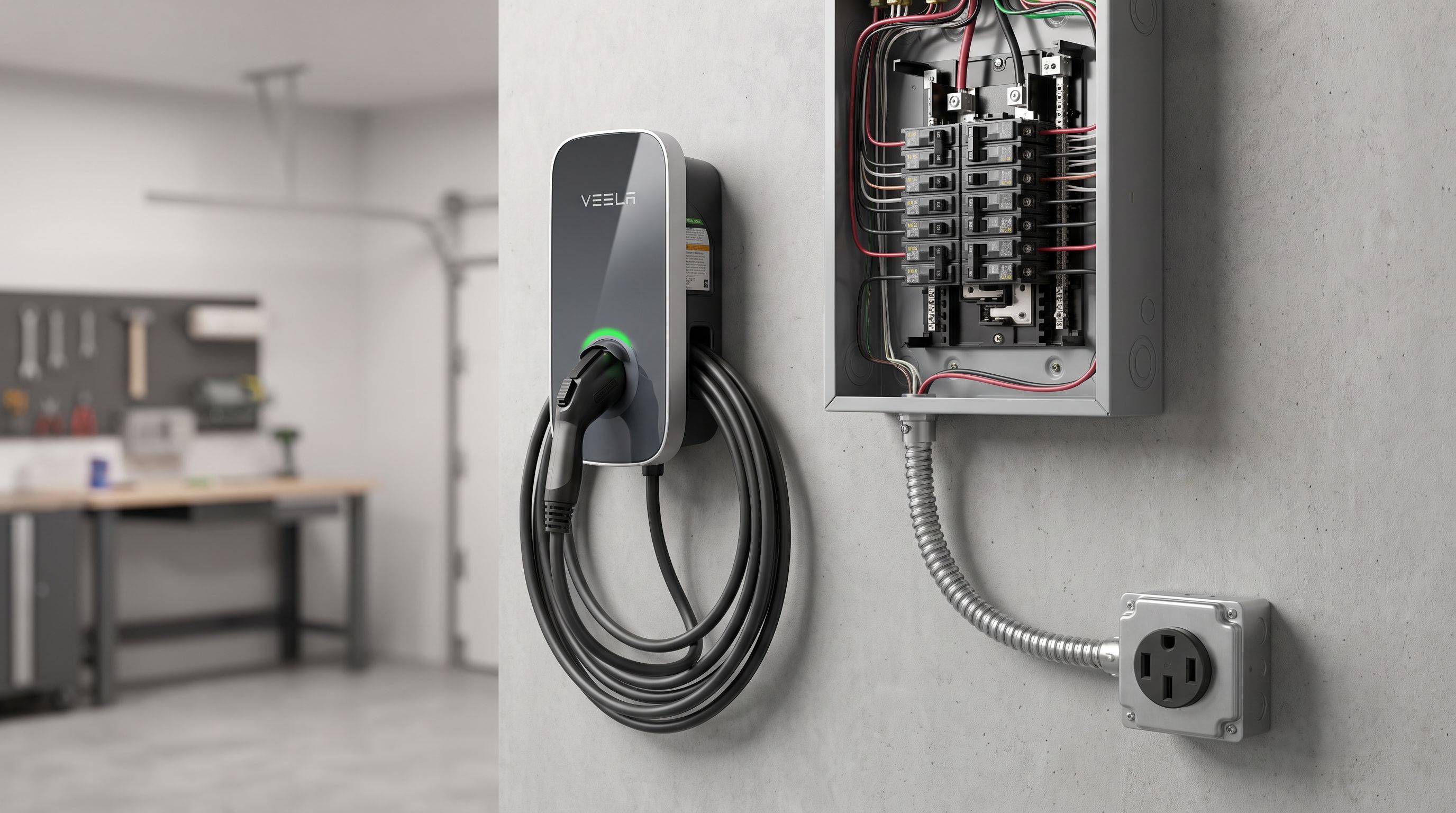
A plug-in Level 2 charger terminates in a NEMA plug — almost always a 14-50 (the four-prong "range outlet") or sometimes a 6-50. Your electrician installs a receptacle; you plug the unit in yourself. It's removable, replaceable and portable.
A hardwired charger is wired directly into a junction box or the unit's own wiring compartment. No plug, no receptacle, no removal without tools.
Both deliver identical Level 2 charging — roughly 6–9× faster than a standard 120V wall outlet. The differences are about maximum current, breaker type, weatherproofing and what happens in year seven.
The continuous-load rule: why 50 amps means 40 amps
This is the single most misunderstood part of EV charging, and it dictates everything downstream.
EV charging is a continuous load — current draw at or near maximum for three hours or more. Electrical code requires continuous loads to be limited to 80% of the circuit's rating. So:
- 40A circuit → 32A charging
- 50A circuit → 40A charging (not 50)
- 60A circuit → 48A charging
- 100A circuit → 80A charging
Here's the catch for plug-in users: a NEMA 14-50 receptacle is rated for 50 amps, which caps you at 40 amps of continuous charging — about 9.6 kW on a 240V supply. That's the hard ceiling for any plug-in unit. There is no residential 60-amp plug standard in common use.
Hardwiring removes that ceiling. A hardwired charger on a 60A circuit delivers 48A (~11.5 kW), and some commercial-grade units on larger feeders go higher still. In practice, 48A is the sweet spot for home use and the main reason people hardwire.
Does the extra 8 amps matter? For most people, barely. 40A adds roughly 30 miles of range per hour; 48A adds roughly 36. Over an overnight charge both fully replenish a typical daily commute several times over. It matters if you have a large battery (think 100+ kWh), a short charging window, or two EVs sharing one charger.
Also worth knowing: many vehicles cap their own onboard AC charger below 48A anyway. Check your car's maximum AC acceptance rate before paying for a 60A circuit — plenty of EVs top out at 7.7 kW or 11 kW regardless of what you feed them.
The GFCI breaker question — and why it costs you
Here's where plug-in installs get expensive in 2026.
Current code requires GFCI protection on 240V receptacles in dwelling units, including the NEMA 14-50 outlets used for EV charging. That means your electrician must install a two-pole GFCI breaker, which costs substantially more than a standard breaker — often several times more — and in some panels requires a specific, limited-availability part.
Hardwired installations do not require a GFCI breaker. Why? Because every UL-listed Level 2 EVSE already has ground-fault protection built in (CCID20 — charging circuit interrupting device). The receptacle is what triggers the GFCI rule, not the charger.
This creates two real-world headaches for plug-in owners:
- Nuisance tripping. Two layers of ground-fault detection — the breaker's and the charger's — can interact badly. Owner reports of mid-charge trips with 14-50 setups are common enough that electricians routinely warn about it.
- Breaker availability and cost. Some older or off-brand panels have expensive or hard-to-source 50A two-pole GFCI breakers.
So the usual assumption that "plug-in is cheaper" often doesn't survive contact with a quote. You save the labor of a hardwire termination but pay for a receptacle, a heavy-duty one at that, plus a GFCI breaker. Hardwired skips both.
That said — if a properly rated 14-50 outlet already exists (an old range or welder circuit, correctly sized and on a dedicated breaker), plug-in is dramatically cheaper. Have an electrician verify the wire gauge and breaker before you assume it's usable; many legacy range circuits are aluminum or undersized.
Outdoor durability: the underrated tiebreaker
If your charger lives outside — on a driveway post, exterior wall, or in a carport — this factor should probably decide it for you.
A NEMA 14-50 receptacle is a weak point outdoors. Moisture, insects, thermal cycling and corrosion all attack the contact surfaces. Worse, a plug left in an outlet 24/7 under 40A continuous load creates heat at the contacts. There's a documented pattern of melted and charred 14-50 plugs and receptacles, usually traced to cheap residential-grade outlets rather than industrial-grade ones. If you go plug-in, insist on an industrial-spec receptacle (Hubbell, Bryant, Leviton industrial grade) — not the $12 hardware-store version — and a proper in-use weatherproof cover.
Hardwired connections have no contact interface to degrade. For outdoor and coastal installs, that's a genuine reliability advantage.
Separately, check the charger's own IP or NEMA enclosure rating and its rated operating temperature range. A unit rated to NEMA 4 with a wide low-temperature spec will fare far better through winters than one designed with garages in mind.
Comparison: hardwired vs NEMA 14-50 plug-in
| Factor | NEMA 14-50 plug-in | Hardwired |
|---|---|---|
| Max continuous current | 40A (~9.6 kW) | 48A typical home, higher on larger feeders |
| GFCI breaker required | Yes — adds meaningful cost | No (EVSE has built-in CCID20) |
| Nuisance trip risk | Higher (double GFCI layers) | Lower |
| Install labor | Receptacle install; you plug in | Direct termination by electrician |
| Can you take it when you move? | Yes, easily | Only with an electrician |
| Swap/replace a failed unit | Unplug and swap | Requires de-energizing and rewiring |
| Outdoor longevity | Receptacle is a wear/corrosion point | No exposed contacts |
| Works with an existing range circuit | Yes, if verified correct | Requires rework |
| Best for | Renters, movers, indoor garages, existing 14-50 | Outdoor installs, big batteries, long-term homes |
How to choose
1. Start with your car's actual AC charge rate
Look up your vehicle's maximum onboard AC charging power, in kW. If it's 7.2 or 7.7 kW, a 40A plug-in unit on a 50A circuit already exceeds what the car can take, and paying for a 60A hardwired circuit buys you nothing today. If it's 11 kW or higher — or you expect your next EV to be — the 48A hardwired path is worth it.
2. Decide how long you'll live in this house
Plug-in's killer feature is portability. Moving in two years? A plug-in unit comes off the wall in ten seconds and the 14-50 outlet stays behind as a selling point. Staying put for a decade? Hardwire it, skip the GFCI breaker, and gain the extra headroom.
3. Look at where the unit will physically live
Indoors, on a dry garage wall, with an existing correct 14-50? Plug-in is an easy call. Outdoors, exposed to weather, salt air or sub-zero winters? Hardwire, and prioritize enclosure rating and cable cold-flex behavior over smart features.
4. Check your panel's spare capacity before you shop
Many homes can't simply add a 60A circuit. If your panel is tight, look at chargers with dynamic load management or support for an energy monitor — these throttle charging when household demand spikes, often avoiding a panel upgrade entirely. This is where Wallbox Pulsar Plus and Emporia earn their keep.
5. Confirm the connector type for your vehicle
The transition to NACS/J3400 is well underway in 2026. Some new EVs ship with NACS ports, others still use J1772. Most home chargers still ship with J1772 and work fine with an adapter, but check your specific year, make and model before buying, and confirm the manufacturer's adapter guidance rather than assuming.
The picks
Emporia Level 2 EV Charger — best overall
Prices last checked October 30, 2026. Amazon prices change frequently, so treat these as a guide and check the live price before you buy.
Emporia Level 2 EV Charger
Ships with a removable NEMA 14-50 plug so you can start plug-in and hardwire to 48A later.
Emporia's unit is the most sensible default because it ships with both options: a NEMA 14-50 plug you can remove to hardwire. That flexibility is genuinely useful — start plug-in, hardwire later if you move or upgrade cars. It's UL listed, Energy Star certified, supports up to 48A hardwired, and integrates with Emporia's Vue energy monitor for load management, which is a real advantage on a tight panel. What it gives up: the app ecosystem is more utilitarian than premium rivals, and the cable isn't the most cold-tolerant on the market. For most garages, it's the right balance.
ChargePoint Home Flex — best hardwired for high power
ChargePoint Home Flex
Amperage-selectable up to 50A with the most mature charging app and scheduling in the category.
Home Flex is the long-running benchmark for a reason. It's amperage-selectable during install — from 16A up to 50A depending on configuration — so one unit covers everything from a modest circuit to a full 60A hardwired run. The ChargePoint app is the most mature in the category, with scheduling, utility rate integration and access to the public ChargePoint network. It's also available in plug-in form. What it gives up: it sits at the premium end, and some of the smart features depend on a stable Wi-Fi connection reaching your garage. Best for owners committed to a hardwired install who want polished software.
Grizzl-E Classic — best rugged outdoor plug-in
Grizzl-E Classic
Cast-aluminum, app-free and built for brutal winters — DIP-switch amperage, NEMA 14-50 or hardwired.
Grizzl-E takes the opposite approach to smart chargers: a cast-aluminum enclosure, no app, no cloud account, and a reputation for surviving harsh Canadian winters. It's offered in multiple plug configurations including NEMA 14-50, and can be hardwired. Amperage is set via internal DIP switches. For an outdoor install where you simply want the car charged without a firmware update ever being involved, it's a strong choice. What it gives up: no scheduling, no energy reporting, no load management — you'll rely on your car's in-vehicle charge timer instead, which most EVs handle well anyway.
Wallbox Pulsar Plus — best smart hardwired with load management
Wallbox Pulsar Plus
Compact 48A hardwired unit whose dynamic load management can save you a panel upgrade.
The Pulsar Plus is notably compact — among the smallest Level 2 units you can mount — which matters in a cramped garage. It's primarily a hardwired unit, supports up to 48A in the higher-amperage version, and its Power Boost / dynamic load management capability lets it throttle automatically based on whole-home demand. That can be the difference between charging at 48A and needing a service upgrade. What it gives up: setup via Bluetooth/app is more involved than plug-and-play rivals, and some owners report a learning curve with the app. Best for homes with limited panel headroom.
Lectron V-Box 48A — best budget NEMA 14-50 unit
Lectron V-Box 48A
UL-listed, weather-resistant basics in NEMA 14-50 or hardwired form at a lower price point.
Lectron's V-Box covers the fundamentals at a lower price point: UL listed, 48A capable when hardwired, available in NEMA 14-50 plug-in form (which caps it at 40A, per the continuous-load rule), with a weather-resistant enclosure for outdoor mounting. If you already have a verified, correctly wired 14-50 outlet and just want a reliable unit on the wall, this is the pragmatic buy. What it gives up: smart features and app polish are basic compared to ChargePoint or Wallbox, and brand support history is shorter. For a straightforward indoor or sheltered install, that's an acceptable trade.
FAQ
Is hardwired actually safer than plug-in? Both are safe when installed correctly to code by a licensed electrician. Hardwired removes one potential failure point — the plug/receptacle contact interface — which matters most outdoors and under sustained 40A loads. The documented melting incidents almost always involve residential-grade receptacles rather than industrial-grade ones.
Can I plug a 48A charger into a NEMA 14-50? No. A 50A receptacle limits you to 40A continuous. Chargers rated at 48A achieve that figure only when hardwired to a 60A circuit. Any product marketed as "48A" with a 14-50 plug will operate at 40A in that configuration.
Do I need a GFCI breaker if I hardwire? Generally no, because UL-listed EVSEs include built-in ground-fault protection. The GFCI requirement attaches to the 240V receptacle. Local amendments vary, so confirm with your electrician and permitting authority.
I already have a 14-50 outlet from an old stove. Can I use it? Possibly — but have it inspected first. Check the wire gauge, breaker size, whether it's a dedicated circuit, whether the conductors are aluminum, and whether the receptacle is industrial grade. Legacy range circuits frequently fail one of those tests.
Which connector should I buy in 2026 — J1772 or NACS? Check your vehicle's port. Most home chargers still ship J1772, and adapters are widely available and well-proven. If your car has a native NACS port, confirm the manufacturer's recommended adapter rather than assuming any adapter works.
Will a plug-in charger let me take it on road trips? Technically yes, and some people do — but a wall-mount unit isn't designed for it. If portability is the goal, look at dedicated portable Level 2 units with interchangeable plug heads instead.
Bottom line: if the charger lives outdoors, you're staying put, or you want 48A headroom, hardwire it — you'll skip the GFCI breaker cost and remove the most common failure point. If you rent, plan to move, or already have a verified, correctly specified 14-50 in a dry garage, plug-in is the smarter spend. Decide which camp you're in before the electrician quotes, because the answer changes which charger you should be shopping for.
Get the best car care deals in your inbox
Join the GarageProof newsletter for hand-picked car care deals and new buying guides. No spam, unsubscribe anytime.
Related reads
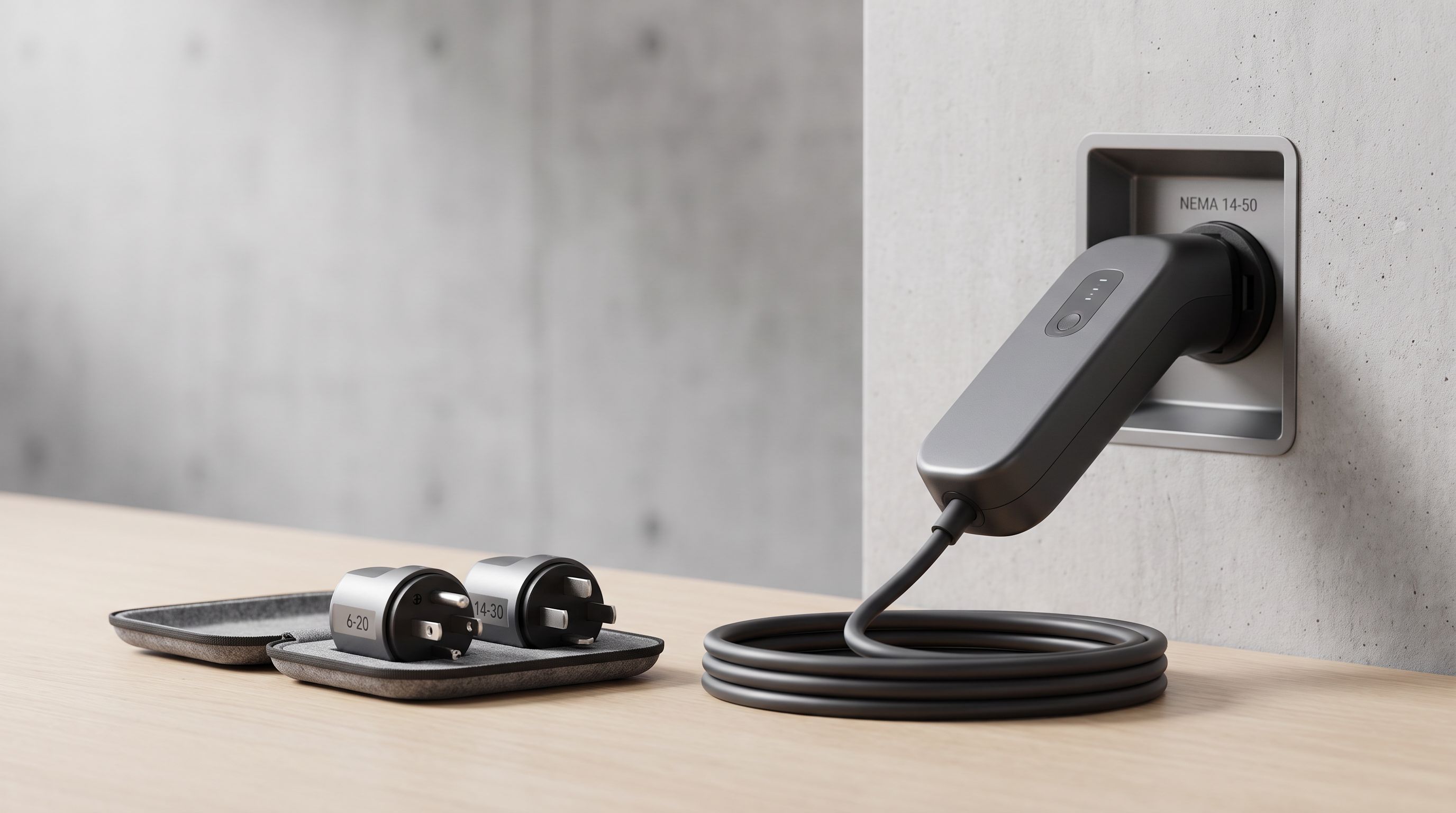
Portable EV Charger NEMA 14-50 vs 6-20: What to Buy in 2026
Portable EV charger NEMA 14-50 vs 6-20 explained for 2026: match plug tails and amperage to your real outlet, plus picks that ship swappable adapters.
Level 2 EV Chargers in 2026: 40A vs 48A, Explained
Picking the best Level 2 EV charger for home in 2026? Compare 40A vs 48A, NEMA 14-50 vs hardwired, cable length and panel load — plus five solid picks.
Level 2 EV Charger Garage Install: Amps, Outlet or Hardwire?
Outlet vs hardwire, 40A vs 48A, and the 80% continuous rule — how to pick a Level 2 EV charger that actually fits your 2026 garage panel and wiring.