Foam Cannon Buying Guide 2026: Match Orifice to Your Washer
The best foam cannon for your pressure washer depends on orifice size, GPM and quick-connect fit. Here's how to match them — plus four picks for 2026.
Reader-supported: we may earn a commission from links on this page, at no extra cost to you. It never affects our picks. Learn more.
Most disappointing foam cannons aren't bad products — they're mismatched ones. The cannon arrives, you bolt it onto a 1.2 GPM electric washer, and out comes thin, runny suds that slide off the paint in ten seconds. The fix almost never involves buying more soap. It involves matching the cannon's orifice size to your washer's flow rate, and making sure the quick-connect fitting physically fits your wand.
This guide explains how that matching works, then recommends four cannons that suit different washer classes. GarageProof researches and compares products using manufacturer spec sheets, independent reviews, and verified owner feedback — we don't physically test units, and we'll tell you where owner reports and published specs disagree.
The short version
- Best overall: MJJC Foam Cannon S V3.0
- Best for low-GPM electric washers: Chemical Guys TORQ Foam Blaster 6
- Premium pick: Griot's Garage The Boss Foam Cannon
- Budget pick: Tool Daily Foam Cannon
- Best for thick clinging foam: Chemical Guys Big Mouth Max Release Foam Cannon
 Budget pick · Tool Daily Foam Cannon — Check price on Amazon →
 Premium pick · Griot's Garage The Boss Foam Cannon — Check price on Amazon →
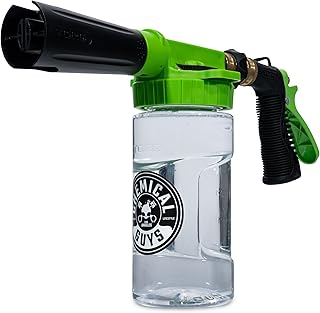 Best for low-GPM electric washers · Chemical Guys TORQ Foam Blaster 6 — Check price on Amazon →
 Best overall · MJJC Foam Cannon S V3.0 — Check price on Amazon →
Why orifice size is the whole ballgame
Inside every foam cannon is a small brass insert with a precise hole in it. Water forced through that hole accelerates, creating a low-pressure zone that siphons soap from the bottle. The mixture then gets rammed through a mesh screen, which is where the air gets whipped in and foam is actually born.
The hole size determines how much water the cannon will pass at a given pressure. That's the conflict:
- Too small an orifice for your washer and you choke flow. A powerful gas washer bogs down, the pump may cycle in bypass, and foam output drops.
- Too large an orifice for your washer and there isn't enough pressure drop across the hole to create decent siphon. A small electric washer produces a weak, wet spray with barely any soap draw.
Common orifice sizes sold with consumer cannons run roughly 1.1 mm, 1.25 mm, and occasionally 1.0 mm or larger. The widely repeated rule of thumb among detailers and cannon manufacturers:
- Electric washers under about 1.6 GPM: go smaller — 1.1 mm, sometimes 1.0 mm
- Electric/gas washers around 1.6–2.4 GPM: 1.1 mm is the safe default
- Gas washers 2.4 GPM and up: 1.25 mm or larger
That's guidance, not gospel. Two washers with identical claimed GPM can behave differently depending on pump condition, hose length, and inlet water supply. The practical takeaway is to buy a cannon that includes more than one orifice, or one whose spare orifices are cheap and easy to source. Being able to swap a $6 brass insert is worth more than any marketing claim about "thickest foam ever."
PSI matters less than you'd think
Buyers fixate on PSI because it's the number printed biggest on the washer's box. For foam production, GPM is the more important spec. Pressure creates the siphon; volume creates the visible blanket of foam. A 2.5 GPM / 2200 PSI gas unit will out-foam a 1.3 GPM / 2300 PSI electric every time. If your washer's GPM is under about 1.2, accept that you're going to get respectable suds rather than shaving cream, no matter which cannon you buy.
How to choose
Check your quick-connect before anything else
Nearly all cannons sold for consumer washers use a 1/4" male quick-connect plug, which fits the standard female socket on most gas washers and many electrics. But several popular electric brands use proprietary bayonet-style wand connections:
- Karcher K-series uses its own twist-lock — you need a Karcher adapter
- Ryobi, some Greenworks, and some Sun Joe models use bayonet or push-lock fittings
- Many newer electrics ship with a 1/4" adapter in the box, or one is sold separately
Before you buy, look at the end of your spray wand. If it's a square-shouldered socket with a sliding collar, you're on standard 1/4" and any cannon will fit. If it's round and twists, buy the brand-specific adapter at the same time. Check your washer's manual or manufacturer accessories page for the correct adapter part — don't assume.
Match the orifice to your measured flow
Manufacturers overstate GPM routinely. If you want a real number, run your washer into a bucket for 30 seconds and double the result. A washer claiming 1.8 GPM that actually delivers 1.3 needs a smaller orifice than the box implies. This five-minute check saves more foam frustration than any product upgrade.
Bottle size, thread, and refill practicality
Most cannons use a 1 litre bottle, some go larger. Bigger bottles mean fewer refills on a full-size SUV, but they also make the assembly nose-heavy on the end of a wand. Check that the bottle neck is a common thread — generic replacement bottles and lids are widely available for the popular designs, and cracked bottles are the most frequent failure point owners report.
Adjustability: soap dial and fan knob
Two controls matter. The top dial adjusts soap draw (usually a needle valve or a simple restrictor). The nozzle collar adjusts spray pattern from a narrow jet to a wide fan. Cheaper cannons have coarse, vague soap dials that go from "nothing" to "everything" in a quarter turn. Better ones give you fine control, which matters when you're stretching an expensive snow foam concentrate across two cars.
Build material and serviceability
Brass bodies resist corrosion and thread wear better than plated zinc. More important for longevity: whether the mesh screen is removable and replaceable. Screens clog with hard-water scale and soap residue, and a clogged screen is the single most common cause of "my cannon stopped foaming after six months." Rinse it with clean water after every use and store it dry.
Comparison table
| Model | Best suited to | Orifice approach | Typical fitment | Notable trade-off |
|---|---|---|---|---|
| MJJC Foam Cannon S V3.0 | 1.4–3.0 GPM electric or gas | Multiple orifice sizes available; easy swap | 1/4" QC standard; brand adapters sold separately | Plastic bottle is the weak point |
| Chemical Guys TORQ Foam Blaster 6 | Low-GPM electrics, ~1.2–1.8 GPM | Fixed, tuned for lower flow | 1/4" QC standard | Won't exploit a big gas washer's full output |
| Griot's Garage The Boss | Gas washers, 2.2 GPM and up | Larger-bore design | 1/4" QC standard | Overkill and underwhelming on weak electrics |
| Tool Daily Foam Cannon | Anyone experimenting or on a budget | Usually ships with 1.1 mm and 1.25 mm | 1/4" QC standard | Coarser adjustment, less refined build |
| Chemical Guys Big Mouth Max Release | Mid-to-high GPM, thick-foam chasers | Wide-mouth outlet design | 1/4" QC standard | Uses soap faster; bulky on the wand |
The picks
MJJC Foam Cannon S V3.0 — best overall
Prices last checked September 26, 2026. Amazon prices change frequently, so treat these as a guide and check the live price before you buy.
MJJC Foam Cannon S V3.0
Swappable orifice options and a fine mesh make it the easiest cannon to dial in to any washer.
The MJJC S V3.0 earns the top spot for the same reason it keeps appearing in independent roundups: it's the most tunable mainstream cannon. Orifice inserts are available in multiple sizes and are straightforward to swap, so one purchase covers you if you upgrade from a 1.6 GPM electric to a 2.8 GPM gas unit later. The soap dial has usable resolution rather than on/off behavior, and owner reports consistently praise the density of foam relative to soap used. What it gives up: the bottle is plastic and is the part most likely to crack if dropped on concrete, and you'll want to confirm the correct adapter separately if you run a Karcher or Ryobi wand.
Chemical Guys TORQ Foam Blaster 6 — best for low-GPM electric washers
Chemical Guys TORQ Foam Blaster 6
Foams reliably at modest flow rates and includes a wide adjustment range for weak electrics.
If your washer is a 1.2–1.8 GPM electric — the category most home users actually own — the Foam Blaster 6 is the sensible choice. It's designed and tuned around modest flow, so it draws soap properly instead of producing the wet, watery spray that big-bore cannons give on small pumps. It's also one of the more commonly reviewed cannons, which makes fitment and behavior easy to verify before buying. The compromise is at the other end of the scale: pair it with a 3 GPM gas washer and you're leaving output on the table. It's a specialist for the low-flow crowd, and it's good at that job.
Griot's Garage The Boss Foam Cannon — premium pick
The Boss gets recommended repeatedly by detailers running gas washers, and the reasoning is consistent: a substantial brass body, a large-bore design, and a soap valve with genuinely fine control. Feed it 2.2 GPM or more and it produces the thick, clinging, slow-sliding foam that makes touchless pre-washes actually effective. It's also built to be serviced rather than replaced. The honest caveat is that it's the wrong tool for a small electric — several owner reports from low-GPM users describe mediocre results, which is exactly what the physics predicts. Buy it if your washer can feed it; skip it if you're under about 2 GPM.
Tool Daily Foam Cannon — budget pick
Tool Daily Foam Cannon
Cheap, widely available, and ships with 1.1mm and 1.25mm orifices so you can tune the flow.
The Tool Daily cannon is the low-risk way to find out whether your washer and water supply can produce good foam at all. Listings typically include both 1.1 mm and 1.25 mm orifices, which means you can experiment with matching on day one instead of ordering parts later. Foam quality on a decent washer is genuinely respectable for the money. You give up refinement: the soap dial is coarser, the plated finish isn't as durable as brass, and long-term reports on thread wear are mixed. Treat it as a well-priced entry point or a second cannon dedicated to wheel cleaner.
Chemical Guys Big Mouth Max Release Foam Cannon — best for thick clinging foam
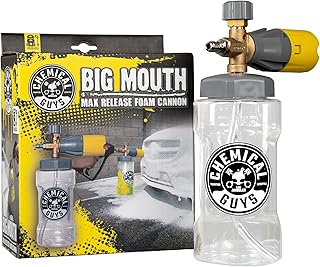
Chemical Guys Big Mouth Max Release Foam Cannon
Wide-mouth nozzle and big bottle deliver heavy shaving-cream foam on capable washers.
The Big Mouth is built around a wider outlet and larger bottle, aimed squarely at people who want the full car-covered-in-shaving-cream result. On a mid-to-high GPM washer it delivers exactly that, and the larger bottle means you can do a full-size truck without a mid-wash refill. It appears at the top of multiple independent 2026 roundups for good reason. Trade-offs are predictable: it consumes soap faster than a conservative cannon, it's physically bulky hanging off the end of a wand, and like every big-bore design, it underperforms on a low-flow electric.
Getting thick foam once the cannon arrives
Buying right is most of the job. The rest:
- Use hot-ish water if your washer allows it. Check the manual — many electrics cap inlet temperature around 40 °C. Warmer water within spec dissolves soap concentrate faster and foams better.
- Add soap to the bottle first, then water, and swirl rather than shake. Shaking creates foam inside the bottle, which reduces the liquid the siphon can draw.
- Start at roughly 1–3 oz of concentrate per litre and adjust. More soap isn't always more foam; past a point you just waste product.
- Hard water kills foam. If you're on well water or heavily mineralized supply, expect thinner results and consider a dedicated snow foam formulated for hard water.
- Rinse the cannon after every use. Run a bottle of clean water through it for 20 seconds. This alone doubles the practical lifespan of the mesh screen.
FAQ
Will a foam cannon work with my garden hose? No — not properly. Hose-end foam guns exist and are a separate product category. A pressure washer foam cannon needs the pressure drop across its orifice to siphon soap, and a garden hose at 40–60 PSI can't provide it. If you don't own a pressure washer, buy a foam gun designed for hose pressure and set your expectations accordingly.
What orifice size should I use for a 1.6 GPM electric washer? Start with 1.1 mm. It's the default for most consumer electrics and the size most cannons ship with. If foam is thin and the washer seems unstrained, that's usually a soap or water-hardness issue rather than an orifice issue.
Does my Karcher or Ryobi need a special adapter? Usually yes. Both use proprietary wand connections rather than standard 1/4" quick-connect. Check the end of your wand and buy the matching adapter from the washer manufacturer's accessory line, then any 1/4" cannon will fit.
Why did my cannon stop foaming after a few months? Almost always a clogged mesh screen or a blocked soap pickup tube. Remove the screen, soak it in white vinegar to dissolve scale, rinse thoroughly, and check that the pickup tube and its filter are clear.
Is foam cannon washing actually safer for paint? The pre-soak stage is — it lifts and lubricates grit before any contact. But foam alone doesn't remove bonded dirt. Treat it as step one, then follow with a proper two-bucket contact wash using a clean microfiber mitt.
Our picks
Griot's Garage The Boss Foam Cannon
Heavy brass body and a large-bore design that turns a strong gas washer into a foam machine.
Get the best car care deals in your inbox
Join the GarageProof newsletter for hand-picked car care deals and new buying guides. No spam, unsubscribe anytime.
Related reads
Battery Powered Pressure Washer 2026: PSI That Still Cleans
Cordless vs corded for car washing in 2026: real PSI and GPM at the nozzle, runtime per battery, tank-draw limits, and five picks that actually rinse a car clean.
Car Wash Bucket Kit 2026: Grit Guards, Sized Right
Our 2026 guide to the car wash bucket kit: grit guard inserts, 3.5 vs 5 gallon buckets, wash mitts and dollies — picks for sedans, trucks and tight garages.
Pressure Washers for Car Washing in 2026: 4 Safe Picks
The best pressure washer for car washing in 2026 isn't the most powerful one. We compare PSI/GPM sweet spots, hose length, motor type and foam cannon fit.