Engine Oil Analysis Kit Guide 2026: Reading Wear Metals
How engine oil analysis kits work in 2026: what wear metals, TBN, and viscosity numbers mean, plus the best mail-in lab kits and sampling pumps for DIY oil changes.
Reader-supported: we may earn a commission from links on this page, at no extra cost to you. It never affects our picks. Learn more.
Oil analysis is the cheapest real diagnostic you can run on an engine. For roughly the cost of a quart of synthetic, a lab tells you how much iron your camshaft is shedding, whether coolant is leaking into the sump, how badly fuel is diluting the oil, and whether your 10,000-mile interval is conservative or reckless. The catch is that the report comes back as a wall of parts-per-million numbers that mean nothing without context.
This guide covers how mail-in kits actually work, what each number on the report is telling you, how to pull a sample that isn't garbage, and which kit-and-pump combination makes sense for the way you change oil.
The short version
- Best overall: AMSOIL Oil Analyzers Used Oil Analysis Kit
- Budget pick: WIX 24077 Oil Analysis Kit
- Best for performance and race engines: SPEEDiagnostix Standard Oil Analysis Kit
- Best sampling pump: Mityvac MV7201 Fluid Evacuator Plus
- Budget sampling pump: OEMTOOLS 24397 Fluid Extractor Pump
 Budget sampling pump · OEMTOOLS 24397 Fluid Extractor Pump — Check price on Amazon →
How a mail-in oil analysis kit actually works
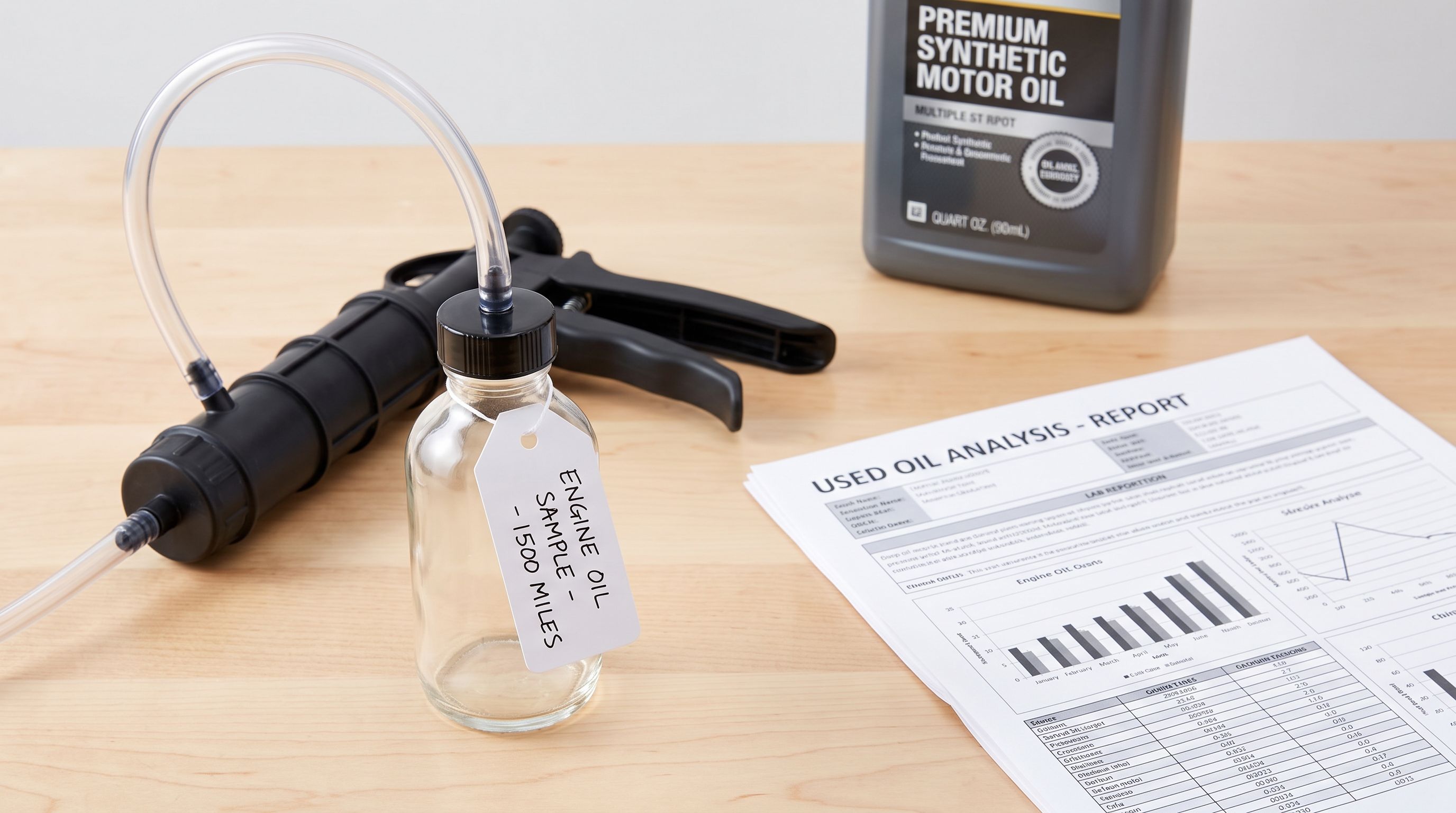
Every consumer kit follows the same shape. You get a sample bottle (usually 3–4 oz), a mailer or shipping container that meets carrier rules for used oil, and a paperwork slip asking for the make, model, engine, total vehicle mileage, miles on this oil, oil brand and grade, and whether you topped off.
You pull a sample of hot, well-mixed oil, fill the bottle, seal it, fill out the slip, and mail it. The lab runs the sample through a spectrometer — typically ICP (inductively coupled plasma) or rotating-disc emission spectroscopy — which reports metals in parts per million. Separate benchtop tests cover viscosity at 100°C, flash point, insolubles, and depending on the lab, TBN, fuel dilution by gas chromatography, oxidation/nitration by infrared, and water by Karl Fischer. Results usually land by email in a few business days.
Two things determine the value of the report. First, the lab's universal averages: your 24 ppm of iron is meaningless until it's compared against what the lab sees from hundreds of other samples of the same engine family at a similar interval. Second, the trend. A single sample is a snapshot with no baseline. Three samples on the same engine is a diagnostic tool. Budget for a series, not a one-off.
Sampling technique matters more than lab choice
A bad sample ruins an expensive test. Two approaches work:
Drain-stream sampling. Pull the plug, let the first slug of oil dump out (it carries sediment that settled on the pan floor), catch your bottle mid-stream, then let the rest drain. Free, simple, and acceptable — but messy, and hard to hit the same point in the drain every time, which hurts trend consistency.
Vacuum sampling through the dipstick tube. Feed clean tubing down to roughly mid-sump depth, pull vacuum, and draw oil directly into the bottle. This is the repeatable method, it's what the labs prefer, and it lets you sample mid-interval without dropping the oil at all. That's the real unlock: you can test at 5,000 miles to decide whether to run to 10,000.
Two rules either way: sample the oil hot and immediately after running, so wear particles are suspended rather than settled, and use fresh tubing every time. Reused tubing carries over contamination from the last sample and will show up as phantom wear metals.
What the numbers on the report mean
Wear metals (parts per million)
Spectrometers detect particles up to roughly 5–8 microns reliably. That's a genuine limitation — large chunks from a catastrophic failure can be partly invisible to ICP, which is why labs also report visual sediment and some offer particle counts.
- Iron (Fe): cylinder liners, camshafts, crankshaft, valvetrain, gears, oil pump. The headline wear number. Rising iron is the most common early warning.
- Aluminum (Al): pistons, some bearings, timing components, and on many engines the block itself.
- Chromium (Cr): piston rings on many engines; sometimes liners. Chromium trending with iron suggests ring and bore wear.
- Copper (Cu) and lead (Pb): bearings and bushings. Copper alone, especially on a fresh engine or after a radiator/oil-cooler change, is often leaching from a cooler core rather than bearing wear. Copper plus lead together is the combination that should get your attention.
- Tin (Sn): bearing overlay, some piston coatings.
- Nickel (Ni), molybdenum (Mo): can be wear, but moly is also a common anti-wear additive — context matters.
- Silicon (Si): usually dirt — abrasive silica getting past the air filter or intake tract. Also shows up from silicone sealant on a fresh build. High silicon alongside rising iron and aluminum means your intake is ingesting dust, and that's a fix-the-cause situation, not a change-the-oil situation.
Additive and contaminant elements
Calcium, magnesium, boron, zinc, and phosphorus are additive package elements — detergents, dispersants, and ZDDP anti-wear chemistry. They tell the lab which oil you're really running and whether the additive package is depleting. Sodium and potassium are coolant markers; both climbing together, especially with visible water, points at a head gasket or cooler leak.
Viscosity, fuel dilution, and oxidation
Viscosity is reported at 100°C in centistokes. Compare against the fresh-oil spec for your grade. Thinning usually means fuel dilution or shear; thickening usually means oxidation, soot, or heat. Direct-injection and turbo engines — and anything doing short cold trips — are notorious for fuel dilution, and a few percent of gasoline in the sump wrecks the oil's film strength regardless of how clean the wear metals look.
TBN and TAN — the numbers people misread
TBN (total base number) measures remaining alkaline reserve: the oil's ability to neutralize acids from combustion. Fresh engine oils typically start somewhere in the mid-single digits to low teens depending on formulation. As the oil runs, TBN falls. Conventional guidance treats a TBN approaching ~1 as the practical end of useful life, though modern low-SAPS formulations behave differently and some labs weight TAN more heavily.
TAN (total acid number) measures acidic byproducts building up. Rising TAN with falling TBN is the clearest signal that the oil is chemically done, independent of how many miles are on it.
Here's the part people miss: TBN is the number that actually justifies extended drain intervals, and not every lab includes it by default. If extending intervals is your goal, confirm TBN is in the base report before you buy a stack of kits.
Comparison: the kits and pumps at a glance
| Product | Type | Best for | Typically includes | Watch out for |
|---|---|---|---|---|
| AMSOIL Oil Analyzers Kit | Mail-in lab kit | Extended-drain decisions, diesels, daily drivers | Wear metals, viscosity, insolubles, fuel dilution, base number | Kit price is higher than entry-level mailers |
| WIX 24077 Oil Analysis Kit | Mail-in lab kit | First-time samplers, cheap trend building | Wear metals, viscosity, contamination basics | Thinner report; confirm whether TBN is included |
| SPEEDiagnostix Standard Kit | Mail-in lab kit | Race, built, and high-output engines | ICP wear metals with tight detection limits, builder-oriented interpretation | Overkill for a stock commuter |
| Mityvac MV7201 | Hand vacuum evacuator | Repeatable sampling + full oil extraction | ~7.3 L reservoir, multiple tube sizes | Bulky to store; needs fresh tubing per sample |
| OEMTOOLS 24397 | Hand vacuum pump | Occasional sampling on a budget | Pump body, tubing, small reservoir | Slow on thick cold oil; smaller capacity |
The picks
AMSOIL Oil Analyzers Used Oil Analysis Kit — best overall
Prices last checked October 19, 2026. Amazon prices change frequently, so treat these as a guide and check the live price before you buy.
AMSOIL Oil Analyzers Used Oil Analysis Kit
Comprehensive report with TBN/TAN and fuel dilution included, not billed as an extra.
This is the kit we'd put in most garages. The reason is scope: fuel dilution and base number are part of the standard report rather than paid add-ons, which is exactly the data you need if the question is "can I safely run this oil longer?" Forum consensus among diesel owners and extended-drain users consistently points here for that reason, and the turnaround is reported as quick. The report format is denser than Blackstone's famously plain-English writeup, so if you want a friendly paragraph telling you what to do, there's a learning curve. You give up some hand-holding in exchange for more numbers. Note that the service is lab-processed regardless of where you buy the kit.
WIX 24077 Oil Analysis Kit — budget pick
WIX 24077 Oil Analysis Kit
Cheapest credible mail-in lab kit; covers wear metals, viscosity and contamination basics.
The cheapest way to start building a trend line. Sold through NAPA and other parts channels, the WIX kit covers the core spectrometric wear metals, viscosity, and contamination screening — enough to catch coolant intrusion, dirt ingestion, and a wear metal that's climbing. What it gives up is depth: the report is leaner, and the interpretation is more "here are the numbers" than "here's what's happening in your engine." That's an acceptable trade when you're sampling three vehicles twice a year and mainly want trend continuity. If a number spikes, send the next sample to a deeper lab.
SPEEDiagnostix Standard Oil Analysis Kit — best for performance and race engines
SPEEDiagnostix Standard Oil Analysis Kit
Tight ICP detection limits and engine-builder-focused interpretation for high-output motors.
SPEEDiagnostix built its reputation around engine builders and motorsport, and the standard kit reflects that: ICP analysis with tight detection limits and interpretation from people who think in terms of break-in curves, ring seal, and bearing material rather than commuter mileage. If you've just finished a build, run a boosted or high-RPM engine, or want to catch a bearing going away before it takes the crank, this is the lab that speaks your language. A premium tier adds further testing. For a stock sedan on 5W-30, it's more analysis than the engine's behavior warrants — and it costs accordingly.
Mityvac MV7201 Fluid Evacuator Plus — best sampling pump
Mityvac MV7201 Fluid Evacuator Plus
7.3-liter hand-pumped evacuator pulls clean mid-sump samples and doubles as an oil extractor.
If you're committed to trend analysis, buy a vacuum evacuator and stop sampling the drain stream. The MV7201 is a hand-pumped unit with a large reservoir and an assortment of tubing diameters, so it fits everything from a motorcycle dipstick tube to a truck sump. Pump it down, feed the tube to a consistent depth, and you get a clean mid-sump sample at the same point every interval — which is what makes trending valid. It doubles as a full oil extractor for boats, bikes, and top-drain engines. Downsides: it's physically bulky, and you still need to keep fresh tubing on hand for every sample.
OEMTOOLS 24397 Fluid Extractor Pump — budget sampling pump
OEMTOOLS 24397 Fluid Extractor Pump
Simple hand vacuum pump and tubing for pulling dipstick-tube samples without a drain-stream mess.
For someone sampling one or two vehicles a couple of times a year, a small hand vacuum pump does the job for a fraction of the outlay. Thread on clean tubing, drop it down the dipstick tube, draw the sample straight into the bottle, done — no catch pan, no drain-stream timing, no mess. The compromises are real: it's slow going on cold or heavy-grade oil, and the small capacity rules it out as a full oil-extraction tool. Warm the engine first and it works fine. Think of it as a sampling accessory, not a shop tool.
How to choose
Decide whether you need TBN before you need anything else
If your goal is extending drain intervals on a modern synthetic, TBN (and ideally TAN) is non-negotiable — without it you're guessing at the oil's remaining life from wear metals that may look perfectly healthy. If your goal is monitoring a known problem (coolant leak, suspected bearing wear, dirt ingestion), wear metals and viscosity alone are sufficient, and a cheaper kit is the right call. Check the base report contents, not just the headline price.
Match the lab's interpretation style to your experience level
Labs differ as much in how they explain results as in what they measure. Some write a conversational summary that tells you what to do next; others hand you a dense data sheet and expect you to read it. Blackstone's free kits are widely recommended precisely because the writeup is plain English and the kit itself costs nothing upfront. If you're new to this, readability is worth more than an extra test you won't understand.
Buy the pump that matches your sampling frequency
One sample a year? Drain-stream sampling or a cheap hand pump is fine. Four or more samples a year across multiple vehicles, with extended intervals on the line? A proper evacuator pays for itself in sample quality and repeatability — and it's genuinely useful for extracting oil from engines that are a nuisance to drain from below.
Commit to a series and a single lab
Different labs use different equipment, detection limits, and universal averages. Switching labs mid-trend introduces a step change that looks like a mechanical event but isn't. Pick one, sample at consistent intervals and consistent oil temperature, and record the same supporting data every time. Three samples from one lab beat six samples scattered across three.
FAQ
How often should I sample? At every oil change is the thorough approach. A practical minimum is once a year on a daily driver, or at every interval for the first three intervals on a new-to-you vehicle or fresh build, to establish a baseline.
Will oil analysis tell me my engine is about to fail? It can flag developing problems — rising bearing metals, coolant intrusion, dirt ingestion — often well before symptoms appear. It can't predict sudden mechanical failures, and spectrometers under-report large particles, so a catastrophic event may not show up proportionally in the metals.
Can I use any bottle instead of the kit's? No. Use the lab's supplied bottle and labels. Household containers introduce contamination and the mailer must comply with carrier rules for shipping used oil.
Does one bad sample mean I should panic? No. Investigate, then re-sample at a shorter interval. Contaminated tubing, a top-off you forgot to report, a recent oil-cooler replacement, or sampling cold oil all produce misleading numbers. Trends diagnose; single samples suggest.
Is the free kit from Blackstone good enough? For many owners, yes — the kits are free and the explanations are unusually readable. If you specifically need base number and fuel dilution as standard, compare the report scope against the AMSOIL Oil Analyzers or SPEEDiagnostix options before committing to a lab for the long haul.
Get the best car care deals in your inbox
Join the GarageProof newsletter for hand-picked car care deals and new buying guides. No spam, unsubscribe anytime.
Related reads
ECU Coding Scan Tool in 2026: Do You Actually Need One?
ECU coding scan tool vs mid-tier bidirectional in 2026: which tier you actually need, what coding really unlocks, and 5 tools ranked by module coverage.
Scan Tools That Read Transmission Fluid Temp in 2026
Most modern automatics have no dipstick. We compare scan tools by whether they read live transmission fluid temperature PIDs for your make in 2026.
Brake Fluid Tester 2026: Pens vs Strips, Honestly
Brake fluid tester guide for 2026: how electronic moisture pens and chemical test strips differ on DOT 3/4/5.1 fluid, plus five picks and how to read results.