Engine Hoist Buying Guide 2026: Will It Fit Your Bay?
Engine hoist buying guide 2026: compare 1–2 ton folding cranes on boom reach, leg span, lift height and folded storage footprint so your crane fits your garage.
Reader-supported: we may earn a commission from links on this page, at no extra cost to you. It never affects our picks. Learn more.
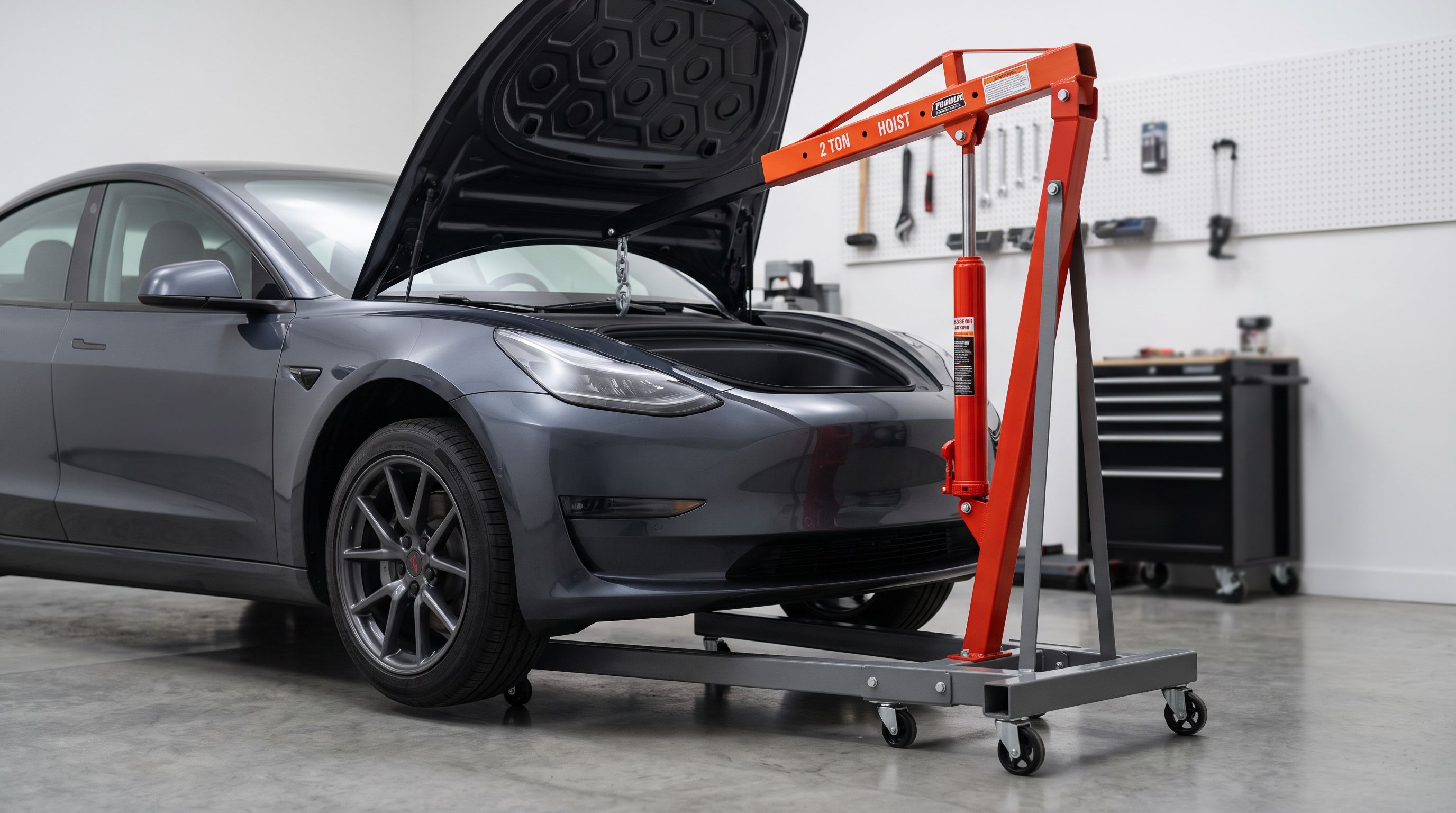
Most people shop for an engine hoist by looking at one number: tons. That number is almost never the thing that bites you. The thing that bites you is a 48-inch leg span trying to straddle a car on jack stands, a boom that won't reach past the radiator support, or a folded crane that needs 30 inches of floor your single-car garage doesn't have.
We compared the current crop of folding hydraulic engine cranes — manufacturer specs, independent reviews and verified owner feedback — with one question in mind: which one actually works in a normal home garage, on a normal car, without a forklift to move it?
The short version
- Best overall: Torin Big Red 2 Ton Folding Engine Hoist (T32002X)
- Best value: VEVOR 2 Ton Folding Engine Hoist (4400 lb)
- Heavy-duty pick: Strongway Hydraulic Engine Hoist 2-Ton
- Best for tight garages: Goplus 2 Ton Folding Engine Hoist
- Best accessory: Torin Big Red 1/2 Ton Engine Leveler
 Best accessory · Torin Big Red 1/2 Ton Engine Leveler — Check price on Amazon →
 Best for tight garages · Goplus 2 Ton Folding Engine Hoist — Check price on Amazon →
 Heavy-duty pick · Strongway Hydraulic Engine Hoist 2-Ton — Check price on Amazon →
Hoist vs. floor crane: is there actually a difference?
Short answer for 2026: not much, and the terms are used interchangeably by most retailers. "Engine hoist," "shop crane," "floor crane" and "cherry picker" all describe the same thing — a rolling A-frame with a telescoping boom and a hydraulic ram.
Where the distinction still matters:
- Folding engine hoists are built around home use. The legs and mast fold flat for storage, capacities typically run 1–2 tons, and the boom has multiple pinned extension positions.
- Fixed-frame shop cranes (often called floor cranes) don't fold. They're heavier, often 3–5 tons, with wider legs and bigger casters. They live in commercial shops that have the floor space to park them.
Unless you're pulling truck diesels or machinery, the folding type is the right answer. The only real cost of folding is a bit of flex in the mast under load and a slightly fussier setup, neither of which matters at the weights a DIYer actually lifts.
The numbers that actually decide the purchase
Capacity is rated at the boom's shortest position
This is the single most misunderstood spec in the category. A "2-ton" hoist is 2 tons only with the boom fully retracted. Every notch you extend the boom outward cuts capacity — typically down to around a quarter of the rating at full extension. A 4,400 lb crane might be a 1,100 lb crane at the last pin hole.
That's not a defect; it's leverage, and it's printed on a decal on the boom of every legitimate hoist. The practical consequence: buy more capacity than your engine weighs, because you will need boom reach.
Rough dry weights to plan around:
- Four-cylinder, aluminum block: roughly 250–350 lb
- Small-block V8, iron: roughly 500–600 lb
- V8 with transmission attached: roughly 750–900 lb
- Big-block or diesel V8 with accessories: 900 lb and up
A 2-ton hoist extended two or three notches still has comfortable margin over an iron V8 and trans. A 1-ton hoist extended to the same reach does not. That's why we recommend 2 ton for nearly everyone — it's not about the weight, it's about buying back the reach you lose.
Leg span and leg height
The legs have to pass under the vehicle or around it. Two measurements matter:
- Inside leg width — must clear the car's track width if you're straddling it, or at minimum clear the front tires.
- Leg height — most folding hoists have legs around 4 to 5 inches tall. If your car is on jack stands, the legs can roll underneath. If it's sitting on the ground with a low air dam, they may not clear.
Measure the gap between your front tires and the distance from the nose of the car to the engine's lift points before you buy. If the boom needs to reach 40 inches past the bumper to center over the engine, you're going to be at a long boom setting, which loops back to the capacity point above.
Lift height and your garage ceiling
Max lift heights on 2-ton folding cranes commonly land in the 75–90 inch range at the hook. That sounds like plenty until you add a load leveler (4–8 inches), chain, and a hoist plate. In an 8-foot garage with a sectional door track overhead, you can genuinely run out of room mid-pull.
Check the clearance at the point where the crane will stand, not at the center of the garage — door tracks, lights and storage racks are what you'll hit.
Folded footprint and whether you can move it alone
A folded 2-ton crane is still 180–250 lb of steel. The useful questions are:
- Does it fold flat enough to stand against a wall, or does it just get shorter?
- Can you tilt and roll it on its own casters when folded?
- Are the front casters swivel and the rears fixed (easier to steer loaded), and how big are they?
Caster size is the sleeper spec. Small 2-inch wheels stop dead at an expansion joint or a cracked slab when there's 600 lb hanging off the boom. Bigger casters are worth real money here.
Comparison
| Model | Rated capacity | Boom | Fold-flat storage | Best suited to |
|---|---|---|---|---|
| Torin Big Red 2 Ton (T32002X) | 2 ton / 4,000 lb | Multi-position telescoping, 8-ton ram | Yes — legs and mast fold | The default home-garage choice; V8 and trans pulls |
| VEVOR 2 Ton Folding Hoist | 2 ton / 4,400 lb | Six-position telescoping boom | Yes | Budget-conscious buyers doing occasional swaps |
| Strongway 2-Ton Hydraulic | 2 ton | Telescoping, long-reach | Folds, but heavier frame | Rough concrete, gravel-floor shops, frequent use |
| Goplus 2 Ton Folding Hoist | 2 ton / 4,000 lb | Multi-position telescoping | Yes — compact folded profile | Single-car bays where storage space is the constraint |
| Torin 1/2 Ton Engine Leveler | 1,000 lb | N/A (hangs from hook) | Hangs on a hook | Anyone pulling an engine with the trans attached |
Capacities above are manufacturer ratings at the shortest boom position. Always confirm the derating decal on the unit you receive.
The picks
Torin Big Red 2 Ton Folding Engine Hoist (T32002X) — best overall
Prices last checked October 16, 2026. Amazon prices change frequently, so treat these as a guide and check the live price before you buy.
Torin Big Red 2 Ton Folding Engine Hoist (T32002X)
Classic 2-ton folding crane with an 8-ton ram and a proven parts supply — the safe default for most home bays.
This is the crane most home garages should buy, and the reasoning is unglamorous: it's the most widely sold pattern of folding 2-ton hoist on the market, which means replacement rams, pins, casters and seal kits are trivially easy to find years after purchase. The 8-ton ram is comfortably oversized for the frame, the boom offers multiple pinned positions, and the whole thing folds flat for wall storage. Owner feedback consistently flags two things: assembly takes longer than the box suggests, and the hardware benefits from a re-torque after the first lift. Neither is a dealbreaker. What you give up versus heavier shop cranes is caster size and some mast rigidity at full extension.
VEVOR 2 Ton Folding Engine Hoist (4400 lb) — best value
VEVOR 2 Ton Folding Engine Hoist (4400 lb)
Full 2-ton capacity, six boom positions and a fold-flat frame at a price that undercuts most name brands.
VEVOR has become the default budget answer in this category, and for an occasional-use crane the value is hard to argue with. You get the full 4,400 lb rating at the short position, a six-position boom that gives usable reach, and a frame that folds for storage. Reviews and owner reports are generally positive on the steel and ram, with the recurring complaints being instructions, paint finish and the occasional misaligned bolt hole during assembly. If you're pulling one engine, or one every few years, this is a sensible place to spend less. If it'll live in a working shop and get rolled daily, step up.
Strongway Hydraulic Engine Hoist 2-Ton — heavy-duty pick
Strongway Hydraulic Engine Hoist 2-Ton
Beefier tubing, wide-stance legs and large casters for rolling a loaded crane across rough concrete.
Strongway's 2-ton crane is aimed at people who will actually use it. The tubing is heavier, the leg stance is wide, and the casters are sized to roll a loaded boom across imperfect concrete rather than skating to a halt at every crack. That matters enormously if your "shop" is a sloped driveway or a garage with a patched slab. The trade-off is honest: it's heavier to fold, heavier to move, and it takes more floor to store than the lightest folding units. Choose it if you're doing multiple builds, lifting truck engines, or you've already been frustrated by a lightweight crane stalling on a floor seam.
Goplus 2 Ton Folding Engine Hoist — best for tight garages
Goplus 2 Ton Folding Engine Hoist
Folds compactly against a wall and rolls easily on smooth floors — good for single-car bays with no corner to spare.
If your constraint is storage rather than lifting, the Goplus is the one to look at. It carries the same 2-ton class rating and a multi-position telescoping boom, but the appeal is how compactly it collapses — flat enough to stand against a wall in a single-car bay and roll out when needed. It's a lighter-duty build than the Strongway, so it rewards being used on smooth, level concrete; small casters and uneven floors are a bad combination. Treat the capacity decal seriously at long boom settings. For a DIYer swapping a four-cylinder or a small V8 in a cramped garage, it's well matched.
Torin Big Red 1/2 Ton Engine Leveler — best accessory
Torin Big Red 1/2 Ton Engine Leveler
Chain leveler that tilts the engine in place so you can clear the core support without re-rigging.
Not a crane, but the accessory that turns a frustrating pull into a straightforward one. A leveler hangs between the hoist hook and your lift chains and lets you tilt the engine fore-and-aft with a hand crank while it's suspended — essential when you're angling a V8 and transmission up past the firewall and out over the core support. Rated at 1,000 lb, it covers the vast majority of car engines. Two caveats: it adds several inches of height between hook and engine, which eats into your ceiling clearance, and cheap levelers can have stiff screws under load. Budget for one before you budget for a nicer crane.
Setup and safety basics worth repeating
- Lift from factory lift points or a proper hoist plate. Intake manifold bolts and accessory brackets are not rigging points.
- Keep the boom as short as the job allows. Move the car, not the boom setting.
- Never leave a load hanging. Lower onto an engine stand or cradle before you walk away; hydraulic rams weep.
- Bleed the ram and check oil level before the first lift. Most "my new hoist won't lift" complaints are air in the system.
- Lower slowly. The release valve on these cranes is sensitive — a quarter turn is usually enough.
- Check the pins. Boom extension pins and leg pins should have retainers installed every single time.
How to choose
Start with the engine, then add reach
Weigh — or look up — the heaviest thing you plan to lift, including the transmission if it's coming out as a unit. Then assume you'll need the boom at a middle or long setting, and check the derating chart. If that leaves less than roughly 50% headroom, size up. In practice this pushes nearly everyone to 2 ton.
Measure three things in your garage before you order
Inside leg clearance needed to straddle your car, the distance from the front of the vehicle to the engine's lift points (that's your required boom reach), and ceiling height at the spot where the crane will stand. Write them down. Then compare against the manufacturer's spec sheet, not the marketing copy.
Decide where it lives when it's not working
A folded crane in a two-car garage is a minor inconvenience. In a single-car bay it's a daily one. If storage is your binding constraint, prioritize fold-flat designs like the Goplus and plan a wall spot with a strap or hook to keep it from tipping.
Match casters to your floor
Smooth, level, sealed concrete: almost anything works. Cracked slab, expansion joints, gravel, or any slope: buy the bigger casters, which in this lineup means Strongway. Replacement casters are also a cheap upgrade on any crane you already own.
Buy the leveler and chain at the same time
A hoist with no rigging is a paperweight. Grade-rated chain, correct-size bolts for the engine's lift points or a hoist plate, and a leveler should be part of the same purchase decision — not an afterthought at midnight with an engine half out.
FAQ
Is a 1-ton engine hoist enough for a V8? On paper, yes — but only with the boom retracted. Once you extend the boom far enough to reach over the front of a car, a 1-ton hoist can drop below the weight of an iron V8 with a transmission attached. A 2-ton crane costs modestly more and removes the math.
Can I use an engine hoist to lift the whole car? No. Engine cranes are designed for a vertical load hanging from the hook, not for supporting a vehicle. Use a proper jack and stands or a lift.
How much ceiling height do I need? Plan for 8 feet as a workable minimum, and measure where the crane will actually stand — garage door tracks and light fixtures are the usual obstacles. Remember a load leveler adds several inches between the hook and the engine.
Do I need an engine stand too? If the engine is coming apart or staying out for more than a few hours, yes. Leaving a block hanging from a hydraulic ram is both unsafe and a good way to find out your seals leak.
Are the budget folding cranes safe? The mainstream ones from established sellers carry the same basic ratings and construction as the name brands, and owner feedback is broadly positive. The risks are assembly quality and long-term wear, not catastrophic failure at normal loads. Assemble carefully, re-torque after the first lift, respect the boom derating decal, and never work under a suspended load.
What's the difference between a hoist, a crane and a cherry picker? In the automotive aftermarket, nothing meaningful — they all describe the same rolling A-frame hydraulic lifter. "Floor crane" sometimes implies a heavier non-folding shop unit, but retailers use the terms interchangeably.
Get the best car care deals in your inbox
Join the GarageProof newsletter for hand-picked car care deals and new buying guides. No spam, unsubscribe anytime.
Related reads
Ratcheting Wrench Sets 2026: Flex-Head vs Fixed Clearance
Pick a ratcheting wrench set by swing arc, head profile and SAE/metric spread — not piece count. Flex-head vs fixed compared, with 4 picks for 2026.
Cordless Impact Ratchet Kit 2026: 3/8" or 1/2" Anvil?
Cordless impact ratchet kit guide for 2026: how 3/8" vs 1/2" anvils match fastener torque, plus battery platform lock-in advice for home mechanics.

The Median Floor Jack Costs $112.90 in 2026 (99 Listings)
The median floor jack listed on Amazon costs $112.90, but prices run from $31.99 to $892.94 — a 28x spread across 99 listings analyzed on 2026-10-25.