Dual Battery Isolator vs DC-DC Charger: 2026 Fit Guide
Isolator or DC-DC charger for your dual battery setup? We compare Redarc, Victron, Renogy and more by alternator type, battery chemistry and cable run for 2026.
Reader-supported: we may earn a commission from links on this page, at no extra cost to you. It never affects our picks. Learn more.
Dual battery systems fail for boring reasons. The auxiliary battery never reaches full charge, the fridge dies on day three, and the owner blames the battery when the real culprit is a charging path that was never matched to the vehicle. In 2026, the single biggest decision in any 12V build is still this: a voltage-sensitive relay (a "smart isolator") or a DC-DC charger?
The honest answer is that neither is universally correct. The right choice falls out of three vehicle-specific facts — what your alternator actually does, what chemistry your house battery is, and how far the cable has to run. Get those three straight and the hardware choice makes itself.
The short version
- Best overall: Redarc BCDC1225D 25A DC-DC Charger
- Best for big lithium banks: Victron Energy Orion XS 12/12-50A DC-DC Charger
- Best value DC-DC: Renogy 12V 40A DC-DC Battery Charger with MPPT
- Best isolator/relay: Blue Sea Systems ML-ACR 7622 Automatic Charging Relay
- Best budget combiner: Victron Energy Cyrix-ct 12/24V 120A Battery Combiner
 Best value DC-DC · Renogy 12V 40A DC-DC Battery Charger with MPPT — Check price on Amazon →
 Best overall · Redarc BCDC1225D 25A DC-DC Charger — Check price on Amazon →
Isolator vs DC-DC charger: what actually differs
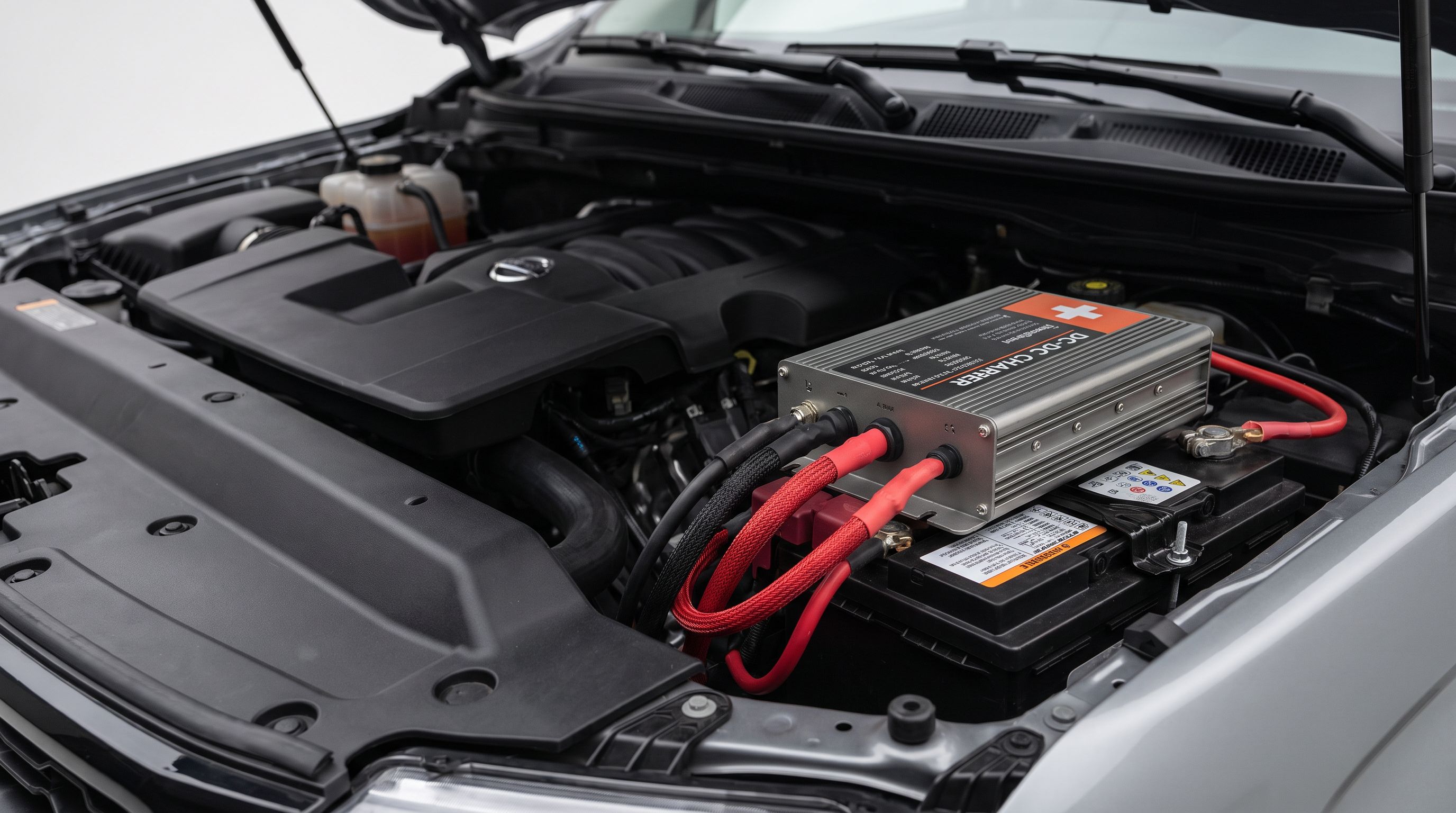
A battery isolator or automatic charging relay does exactly one thing: it connects and disconnects the power path between your starter battery and your house battery. When the engine runs and start-battery voltage rises above a threshold (typically around 13.2–13.7V depending on the unit), the relay closes and both banks are paralleled. When voltage drops, it opens so your house loads can't flatten the cranking battery. That's it. The relay does not regulate, boost, or stage the charge — whatever your alternator puts out, minus losses in the cable, is what the auxiliary battery sees.
A DC-DC charger is a different animal. It takes the messy input from the alternator or starter battery and actively converts it into a proper multi-stage charge profile — bulk, absorption, float, and often a lithium-specific curve — at a regulated output voltage and a capped current. That capped current matters more than most people realize: it protects the alternator from being hammered by a deeply discharged lithium bank that will happily swallow 150A+ if you let it.
The forum consensus is right at the elemental level — both separate the house bank from the starter bank. The difference is everything that happens after the connection is made.
The three facts that decide it for you
1. What your alternator really does
Most vehicles built roughly from 2015 onward use a "smart" or variable-voltage alternator managed by the ECU, often with regenerative braking logic and battery-current sensors on the negative terminal. These systems deliberately drop charging voltage to as low as 12.3–12.8V once the start battery is topped up, to save fuel. With a plain relay, your auxiliary battery simply never gets enough voltage to finish a charge — and in some cases current flows backward out of the house bank.
If your vehicle has a smart alternator, a DC-DC charger isn't a luxury. It's the only thing that will reliably fill the second battery. Check your owner's manual, look for a current sensor clamped on the start battery's negative cable, or watch voltage at the alternator with a multimeter during a 20-minute drive. If it wanders between 12.4V and 14.8V instead of holding steady near 14.2V, you have a smart alternator.
Older, fixed-voltage alternators that sit at a steady 13.8–14.4V can charge an AGM auxiliary battery through a relay perfectly well — that's why isolators are still widely sold and still work fine in plenty of trucks.
2. Your house battery chemistry
Lead-acid and AGM will tolerate a slightly-wrong voltage and just charge slowly. LiFePO4 will not. Lithium wants a tight voltage window, a controlled charge current, and a charger that stops rather than floats indefinitely. Paralleling a lithium bank directly to a lead starter battery through a relay also creates an ugly situation: the lithium's low internal resistance means it draws enormous inrush current, which can cook relay contacts, melt undersized cable, and overload the alternator diode pack.
If your house battery is LiFePO4 — and in 2026 most new builds are — plan on a DC-DC charger. Make sure the unit has an explicit lithium profile, not just a generic "AGM/Gel/Flooded" selector.
3. Cable run length and voltage drop
A relay passes everything through raw copper, so voltage drop is your enemy. A 20-foot run from the engine bay to a rear-mounted house battery can easily drop half a volt or more at meaningful current, which on a 13.8V alternator means the battery never sees a full absorption voltage. That's why rear-battery and trailer installs are classic DC-DC territory: the charger boosts the input back up to a correct output regardless of what it lost along the way.
If your auxiliary battery lives in the engine bay 18 inches from the main battery with fat 2 AWG cable, voltage drop is trivial and a relay is viable. If it's under the rear seat, in the bed, or in a trailer, boost is the point.
One thing to avoid: stacking a DC-DC charger behind an old diode-type isolator. The diode drop (roughly 0.5–0.7V) starves the charger's input, which can push it out of its operating window or force it to derate. Pick one approach and wire it cleanly.
Comparison table
| Redarc BCDC1225D | Victron Orion XS 12/12-50 | Renogy 40A DC-DC w/ MPPT | Blue Sea ML-ACR 7622 | Victron Cyrix-ct 120A | |
|---|---|---|---|---|---|
| Type | DC-DC charger | DC-DC charger | DC-DC charger | Magnetic latching ACR | Voltage-sensing combiner |
| Output / rating | 25A | 50A | 40A | 500A continuous | 120A continuous |
| Smart alternator safe | Yes | Yes | Yes | No (needs ignition trigger workaround) | No |
| Lithium suitable | Yes, selectable profiles | Yes, programmable | Yes, LiFePO4 profile | Only with caveats | Not recommended |
| Solar input | Yes, dual input MPPT | No (separate MPPT) | Yes, MPPT | No | No |
| App / monitoring | Via optional display | Bluetooth, VictronConnect | Optional module | Manual override switch | No |
| Best for | Overland trucks, tough environments | Large LiFePO4 van banks | Budget-conscious builds | AGM boats and fixed-voltage trucks | Small AGM aux battery, short run |
The picks
Redarc BCDC1225D — best overall
Prices last checked November 9, 2026. Amazon prices change frequently, so treat these as a guide and check the live price before you buy.
Redarc BCDC1225D 25A DC-DC Charger
Rugged 25A dual-input charger with solar MPPT and selectable chemistry profiles, built for engine-bay heat.
This is the unit that most serious overland builders default to, and for good reason: it's engineered for engine-bay installation where heat and vibration kill cheaper electronics. The 25A output handles typical 100–200Ah house banks, the dual-input design accepts both alternator and solar with integrated MPPT, and chemistry selection covers AGM, flooded, gel and lithium. It's explicitly designed to work with variable-voltage alternators.
What you give up: 25A is modest if you're running a 300Ah lithium bank and want it filled on a two-hour drive. It also costs noticeably more than commodity units, and there's no built-in Bluetooth — monitoring requires an add-on display. For a mid-size build that has to survive corrugated roads, that premium buys peace of mind.
Victron Energy Orion XS 12/12-50A — best for big lithium banks
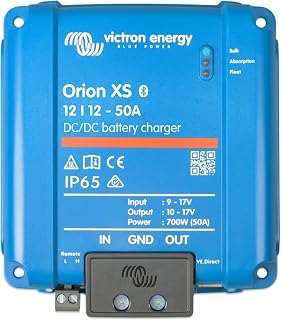
Victron Energy Orion XS 12/12-50A DC-DC Charger
50A output, near-96% efficiency and full Bluetooth control via VictronConnect for serious house banks.
The Orion XS is the current benchmark for high-output 12V-to-12V charging. Fifty amps means a 200Ah LiFePO4 bank gains real capacity on a short drive rather than trickling. Efficiency is quoted near 96%, which matters because waste heat is what forces lesser units to derate on hot days. Full Bluetooth configuration through VictronConnect lets you set output current, voltage limits and engine-detection behaviour without dip switches, and it integrates with the wider Victron ecosystem if you already run their MPPT or shunt.
Give-ups: 50A demands serious cable and fusing — plan on heavy gauge and correct ANL/MEGA protection at both ends. It also assumes your alternator can spare the current; small-displacement vans may need you to dial the output down.
Renogy 12V 40A DC-DC Charger with MPPT — best value DC-DC
Renogy 12V 40A DC-DC Battery Charger with MPPT
40A charging plus built-in solar MPPT at a far lower price than premium units, with lithium profiles.
If budget is the constraint but your build still needs lithium-correct charging, this is the sensible middle path. You get 40A of alternator charging plus an integrated solar MPPT input in one box, with selectable battery profiles including LiFePO4 and smart-alternator compatibility. For a weekend camper van or a truck topper with a fridge and a few hundred watts of panel, it covers both charging sources without buying two devices.
The trade-offs are build quality and support depth rather than function: it's less tolerant of extreme engine-bay heat than the Redarc, so mount it somewhere cooler and ventilated, and monitoring requires an optional accessory. Check current firmware and profile settings against your battery manufacturer's spec sheet before first use.
Blue Sea Systems ML-ACR 7622 — best isolator/relay
Blue Sea Systems ML-ACR 7622 Automatic Charging Relay
500A continuous magnetic latching relay with manual override — the gold standard VSR for AGM builds.
When a relay is genuinely the right answer — older fixed-voltage alternator, AGM house bank, short heavy cable run — this is the one to buy. The magnetic latching design draws almost no current while closed, which avoids the heat and parasitic drain of continuous-duty solenoids, and the 500A continuous rating is far beyond what most builds will ever ask of it. The manual control switch is the underrated feature: you can force a combine to jump-start off the house bank, or force isolation during maintenance.
What it doesn't do: regulate anything. On a smart alternator vehicle it will cycle annoyingly or undercharge, and it is not the correct device for a lithium house bank without additional current limiting.
Victron Energy Cyrix-ct 120A — best budget combiner

Victron Energy Cyrix-ct 12/24V 120A Battery Combiner
Simple, reliable 120A voltage-sensing combiner for modest AGM auxiliary batteries and short runs.
The Cyrix-ct is the simple, cheap, reliable answer for a modest second AGM battery mounted close to the first — think a utility truck running a work light and a radio, or a small camper with a single group-24 AGM. It senses voltage on either side, combines when charging is present, and disconnects below threshold. Installation is about as simple as 12V gets: two heavy posts and a ground.
It gives up everything a DC-DC charger offers — no boost, no profiles, no lithium support, no solar. Treat it as a correctly-engineered version of the basic job, not as a stepping stone to a bigger system. If you expect to go lithium later, skip it and buy the DC-DC now.
How to choose
Match output to drive time, not battery size
The common error is buying the biggest charger available. Work backward instead: a 30A charger replaces roughly 30Ah per hour of driving (slightly less after losses). If you typically drive two hours between camps and use 60–80Ah a day, 30–40A is right. If you move camp every few days with short hops, go bigger. If you have solar covering most of the daily deficit, a 20–25A unit is plenty.
Respect your alternator's headroom
Your alternator also runs headlights, blowers, ignition and infotainment. A 25A draw on a 150A alternator is nothing; a 50A draw on a tired 90A unit in stop-start traffic with the AC on is a real thermal load. Chargers with adjustable output — like the Orion XS — let you tune this rather than guess. If you're unsure, start conservative.
Size cable and fuses before you buy the charger
Voltage drop and fusing are not afterthoughts. Calculate round-trip run length (positive plus negative path), target under 3% drop at rated current, and fuse both ends of the run near each battery. Many "DC-DC charger doesn't work" complaints trace to undersized cable or a weak chassis ground, not the charger.
Decide now whether lithium is in your future
Retrofitting a charging system because you upgraded the house battery is the most common wasted spend in this category. If there's any chance you'll move to LiFePO4 within a couple of years, buy a DC-DC charger with a lithium profile today and skip the relay entirely.
Check vehicle-specific fitment
Mounting location, cable routing through the firewall, and whether your vehicle requires an ignition-signal trigger wire all vary by year, make and model. Consult your vehicle's service documentation or a brand-specific forum thread for your exact platform before ordering, and confirm the charger's engine-detection method suits your alternator type.
FAQ
Can I use a DC-DC charger and an isolator together? Usually you shouldn't. A DC-DC charger already performs the isolation function. Running one behind a diode-style isolator drops the input voltage and can push the charger out of its working range. The exception is a manually-controlled relay used purely for emergency jump-starting, wired in parallel with the charging path.
Will a DC-DC charger drain my starter battery? Properly installed, no. These units detect engine running — either by sensing a voltage rise or via an ignition trigger wire — and shut off when the engine stops. If you see drain, check that engine detection is configured correctly for your alternator type.
Do I need a DC-DC charger if I only have solar? No. If solar alone covers your daily consumption, an MPPT controller is all you need. A DC-DC charger earns its keep when you need alternator charging on cloudy days, in forests, or in winter.
Is a dual battery system still worth it versus a portable power station? It depends on usage. Portable power stations win on simplicity and portability. A hard-wired dual battery system wins on cost per usable watt-hour at larger capacities, continuous charging while driving, and integration with fridges, winches and inverters. Heavy users and long-trip travelers still come out ahead with a built-in system.
What size fuse do I need? Fuse to protect the cable, at both ends, rated above the charger's maximum input current but below the cable's ampacity. Follow the manufacturer's installation manual for the specific unit — recommendations vary with cable gauge and run length.
Get the best car care deals in your inbox
Join the GarageProof newsletter for hand-picked car care deals and new buying guides. No spam, unsubscribe anytime.
Related reads
Dash Cam Hardwire Voltage Cutoff 2026: Match It to Your Battery
How to set dash cam hardwire voltage cutoff for AGM, flooded, and stop-start batteries in 2026 — plus four hardwire kits with user-adjustable cutoff points.
Parking Mode Drain, Explained: Why Dash Cams Kill Batteries
Parking mode is the number one cause of dash cam battery drain. Here's how hardwire kits, voltage cutoffs and battery packs actually compare in 2026.
Electric Winch for Truck 2026: Sizing It by Vehicle Weight
How to size an electric winch for a truck or SUV in 2026: the 1.5x GVWR rule, synthetic vs steel line, mount plate fitment, plus four picks compared.