Dash Cam Hardwire Kit 2026: Match the Tap to Your Fuse Box
Pick the right dash cam hardwire kit in 2026: mini vs micro2 vs low-profile fuse taps, voltage cutoff settings, ACC vs constant circuits, and fitment checks before you order.
Reader-supported: we may earn a commission from links on this page, at no extra cost to you. It never affects our picks. Learn more.
Hardwiring is the difference between a dash cam that records while you drive and one that watches the car while you're asleep. But the single most common reason a hardwire install stalls halfway through is boring and preventable: the fuse tap in the box doesn't fit the fuses in the car.
Modern vehicles use at least four blade fuse formats, and many use two or three of them in the same panel. This guide explains how to identify yours, which hardwire kit to buy, and what voltage cutoff settings actually protect your battery.
The short version
- Best overall: Viofo HK5 ACC Hardwire Kit
- Best for Viofo A229/A139 owners: Viofo HK3 Hardwire Kit
- Best universal battery protector: BlackVue Power Magic Pro
- Best plug-and-play for Nextbase cams: Nextbase Hardwire Kit
- Best fuse tap assortment: Nilight Add-a-Circuit Fuse Tap Assortment Kit
 Best fuse tap assortment · Nilight Add-a-Circuit Fuse Tap Assortment Kit — Check price on Amazon →
 Best plug-and-play for Nextbase cams · Nextbase Hardwire Kit — Check price on Amazon →
 Best for Viofo A229/A139 owners · Viofo HK3 Hardwire Kit — Check price on Amazon →
What a hardwire kit actually does
A hardwire kit replaces the cigarette-lighter adapter with three wires: constant 12V (usually yellow or red), switched/accessory 12V (red or yellow — check your kit's labelling, it varies), and ground. The kit's control box monitors battery voltage and cuts power before the battery drops too low to crank the engine.
That's the whole job. The kit doesn't add features to the camera — your dash cam still needs to support parking mode. A hardwire kit on a camera without parking mode just gives you a tidier cable.
Two things the kit buys you:
- Parking surveillance. Motion, impact, or time-lapse recording while parked, depending on the camera.
- Low-voltage protection. The cutoff is the safety net. Without it, a dash cam left recording overnight can leave you with a no-start in a cold car park.
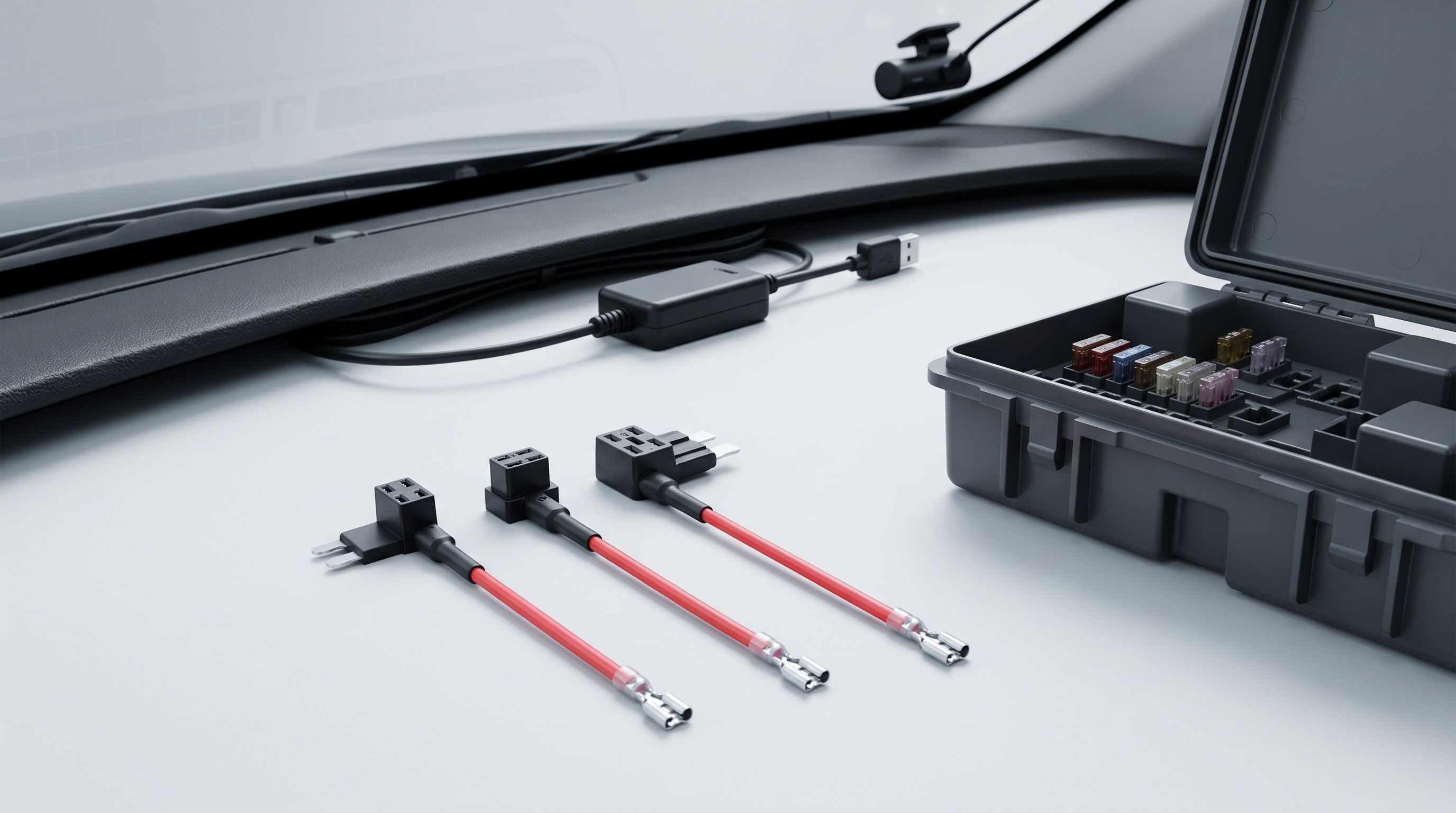
The fuse tap problem: mini vs micro2 vs low-profile
Almost every hardwire kit ships with an add-a-circuit (fuse tap) or two. Vendors typically include the mini (APM/ATM) size because it's the most common. Plenty of 2020s and 2026-model vehicles use something else.
Here's how the formats differ:
| Fuse format | Also called | Rough size | Typical vehicles | Notes |
|---|---|---|---|---|
| Mini | ATM, APM | ~10.9 mm wide, standard height | Very widely used across most brands, interior panels | The default tap in most kits |
| Micro2 | APT | ~9.1 mm wide, tall and narrow blades | Many recent Toyota, Honda, Ford, Stellantis interior panels | Frequently NOT included in kits |
| Low-profile mini | LP-mini, APS | Mini width, short body | Common in newer Toyota, Honda, Kia/Hyundai panels | Looks like a mini but won't seat a mini tap |
| Micro3 | ATL | Three legs, blocky | Some Honda/Acura, Nissan panels | Rarely available as a tap; use an alternative circuit |
| Standard/regular | ATO, ATC | ~19 mm wide | Older vehicles, some under-hood boxes | Rare in modern cabin panels |
The practical consequence: if you own a recent Toyota, Honda, Kia, Hyundai, Ford or a Stellantis product, assume you'll need micro2 or low-profile taps and verify before you order. Threads about installing a dash cam in a 2026 Camry or a current-generation Honda almost always end up in the same place — someone discovers the interior panel is micro2 or low-profile and the included mini tap is useless.
How to check in five minutes
- Open the driver-side interior fuse panel (usually below the steering column, behind a kick panel, or in the end of the dash revealed when you open the driver's door).
- Pull one fuse with the puller clipped inside the lid. Compare it to the table above, or measure blade spacing with a ruler.
- Photograph the lid diagram. You'll need it to pick circuits.
- Check your owner's manual fuse chart to identify an accessory circuit (ACC) and a constant circuit (often the interior lights, clock, or a spare).
- Buy a fuse tap assortment if there's any doubt. An assortment like the Nilight Add-a-Circuit Fuse Tap Assortment Kit covers mini, micro2, low-profile and standard sizes for less than the cost of a wasted evening.
Circuit selection rules
- Never tap airbag, ABS, ECU, or any safety-system circuit. Ever.
- Use a circuit with spare headroom — a dash cam draws very little, but the tap adds its own fuse (typically 5A–7.5A on the accessory leg).
- The tap has two fuse slots: the original circuit's fuse goes in one, the new low-amp fuse in the other. Orientation matters on some taps; the original fuse should sit on the side that's fed from the panel bus. If the original circuit stops working after install, flip the tap.
- Ground to a factory bolt on the metal chassis behind the kick panel, not to a plastic bracket. Scrape paint if needed.
- On many hybrids and EVs, the 12V accessory bus behaves differently. Confirm which fuses stay live with the vehicle off before choosing your "constant."
How to choose
1. Match the kit to the camera first
Dash cam power connectors are not standardised. Mini-USB, micro-USB, USB-C and proprietary barrel/coaxial plugs all exist across current models, and voltage supplied can be 5V or 12V depending on the camera. Buying a kit from the same brand as the camera removes the guesswork. Viofo cams, for instance, are widely recommended to run Viofo's own kits — HK3 for the A229/A139 family and HK5 for newer models with the matching connector. A generic 12V-out kit into a 5V camera is a good way to kill a camera.
If your camera brand doesn't sell a kit, a brand-agnostic cutoff box like the BlackVue Power Magic Pro sits between the fuse box and the camera's original 12V adapter — you keep the correct power supply and just add the cutoff logic.
2. Decide how you want the cutoff configured
There are three approaches:
- Fixed voltage. Simple, cheap, non-adjustable. Fine on a healthy battery in a mild climate.
- Hardware-selectable. A switch or jumper offering a few voltage steps (commonly around 11.8V, 12.0V, 12.2V for 12V systems) plus timer options. The HK3 works this way.
- App-adjustable. Bluetooth configuration from your phone, so you can dial the cutoff in without pulling trim. The HK5 does this, and it's genuinely useful when you're tuning a setting over weeks.
Rules of thumb: a healthy flooded lead-acid battery is best protected around 12.0–12.2V cutoff. AGM batteries tolerate slightly deeper discharge but cost more to replace, so don't get greedy. Cold climates warrant a higher cutoff — cranking current demand rises as temperature falls. If your car sits for days at a time, use a timer limit too (many owners run 6–12 hours).
3. Check whether your car actually has a usable ACC circuit
Some vehicles with keyless start and aggressive power management drop accessory power in stages, or leave circuits live for minutes after lock. Others put nearly everything on a body control module that de-energises fully. Before wiring, use a test light or multimeter on candidate fuses in three states: off/locked, key-on accessory, and running. You want one fuse that's live only with the key on (ACC) and one that's always live (constant).
If you can't find a true ACC circuit, some kits allow a single-wire install where the control box handles everything from constant power — check the kit's manual rather than improvising.
4. Think about the install you're willing to do
An OBD-II power adapter is an alternative to fuse tapping — plug in and go. It's faster, but it keeps a port occupied, may keep modules awake on some vehicles, and rarely offers the same cutoff granularity. For long-term parking mode, a proper fuse-tap hardwire kit is still the better answer. Budget an hour for a first install: trim tools, a fuse puller, a multimeter, and adhesive cable clips or the kit's included clips.
The picks
Viofo HK5 ACC Hardwire Kit — best overall
Prices last checked September 29, 2026. Amazon prices change frequently, so treat these as a guide and check the live price before you buy.
Viofo HK5 ACC Hardwire Kit
Bluetooth app control, adjustable cutoff and timer, and the cleanest match for current Viofo cams.
The HK5 is the kit to get if you want to set the cutoff voltage and parking-mode timer from your phone instead of guessing with a jumper. Bluetooth configuration means you can adjust after the trim is back together — which matters, because the right cutoff depends on your battery's age and your climate, and you'll probably want to change it once. It's designed for Viofo cameras using the matching connector, so confirm your specific model's power port before ordering. What it gives up: it's brand-tied, and the app adds a small layer of setup complexity that some installers simply don't want. Fuse taps included may not match your panel — check sizes.
Viofo HK3 Hardwire Kit — best for Viofo A229/A139 owners
Viofo HK3 Hardwire Kit
The kit Viofo itself recommends for its two-and three-channel cams; simple hardware cutoff selection.
If you own an A229 Pro, A229 Plus, A139 or similar, this is the kit Viofo points you to, and the community consensus in dash cam forums is to stick with the manufacturer's own kit rather than a generic cable. Cutoff voltage and parking timer are selected in hardware — no app, no pairing, nothing to forget. It's the set-and-leave option. What it gives up: changing the cutoff later means getting back under the dash, and there's no diagnostic readout. It's also model-specific, so verify your camera's connector rather than assuming compatibility across the Viofo range.
BlackVue Power Magic Pro — best universal battery protector
BlackVue Power Magic Pro
Brand-agnostic 12V/24V cutoff box with selectable voltage and timer for almost any 12V dash cam.
The Power Magic Pro is the answer when your camera brand doesn't make a hardwire kit, or you want one device you can move between cars. It's a standalone cutoff box for 12V and 24V systems with selectable voltage thresholds and a timer, wired to constant power, ACC and ground, with an output that feeds your camera's existing supply. Long recommended in enthusiast circles as the sensible baseline. What it gives up: it's a box with a manual switch, not an app, and it takes up a little more space behind the trim than a slim inline module. Confirm your camera's input voltage before connecting.
Nextbase Hardwire Kit — best plug-and-play for Nextbase cams
Nextbase Hardwire Kit
Keeps the magnetic Click&Go mount workflow intact while enabling parking mode on Nextbase models.
Nextbase owners are usually buying into the ecosystem for simplicity, and the matching hardwire kit preserves that: it powers the camera through the mount so the Click&Go magnetic attachment keeps working, which generic kits can't always do. If you want parking mode on a Nextbase camera with minimum fuss, this is the path of least resistance. What it gives up: fewer configuration options than the enthusiast kits, and it's tied to Nextbase models — check the kit listing against your exact camera generation, since mount and connector designs have changed between series.
Nilight Add-a-Circuit Fuse Tap Assortment Kit — best fuse tap assortment
Nilight Add-a-Circuit Fuse Tap Assortment Kit
Mini, micro2, low-profile and ATO taps in one box so you can match whatever your fuse panel uses.
Buy this alongside whichever hardwire kit you choose. It bundles add-a-circuit taps in the common blade formats — mini, micro2, low-profile and standard — so a surprise fuse size doesn't end the install. It's also handy if the tap in your hardwire kit is a low-quality crimped unit; a better tap with a solid crimp or a soldered joint is a real reliability upgrade on a circuit that lives behind the dash for years. What it gives up: nothing much, other than that you may only use one tap from the set. The included fuses' amperage ratings vary by bundle, so read the listing.
Install checklist before you order
- Confirm the camera's power connector type and input voltage.
- Open the fuse panel and identify the blade format (mini, micro2, low-profile, micro3).
- Use the lid diagram plus a multimeter to find one ACC and one constant circuit, avoiding all safety systems.
- Decide your cutoff voltage based on battery type, age and climate.
- Have trim tools, a fuse puller, a multimeter and a ground bolt location ready.
Get those five right and the actual wiring is the easy part.
FAQ
Will a hardwire kit drain my battery?
A correctly configured kit shouldn't. The cutoff box stops drawing power once battery voltage falls to your chosen threshold. The risks come from setting the cutoff too low, running an old or weak battery, or wiring to constant power without a cutoff at all. If your car sits unused for more than a few days regularly, set a timer limit as well as a voltage limit.
Can I use an OBD-II power cable instead?
Yes, and it's a faster install. The trade-offs are that it occupies the diagnostic port, some vehicles keep modules awake with something plugged in, and the low-voltage protection is usually cruder than a dedicated kit. For occasional parking mode it's fine; for permanent parking surveillance, a fuse tap install is cleaner and more controllable.
My fuse box uses micro3 fuses and I can't find a tap. Now what?
Micro3 add-a-circuits are uncommon. Look elsewhere in the panel — most vehicles mix formats, so there's often a mini or micro2 circuit you can use instead. Failing that, a fused piggyback connection at an accessory feed or a professional install using a factory connector is the safer route. Don't improvise with spliced fuse legs.
Does hardwiring void my vehicle warranty?
Adding a properly fused, correctly grounded accessory circuit shouldn't void a warranty on its own, but a dealer can decline a claim for a fault they can show your install caused. Use the correct tap size, don't tap safety circuits, and keep the install reversible. If you lease, or the car is new enough to matter, a professional install with a receipt is cheap insurance.
Do I need both constant and accessory wires?
Most kits use three wires for a reason: the constant feed powers parking mode, the ACC feed tells the box whether the vehicle is running. Some kits support a simplified install, but wiring only to constant power on a three-wire kit usually means the camera never knows you've parked. Follow your kit's manual.
Get the best car care deals in your inbox
Join the GarageProof newsletter for hand-picked car care deals and new buying guides. No spam, unsubscribe anytime.
Related reads
Dash Cam for a Leased Car in 2026: No-Drill Power Routes
The best no-drill dash cam setups for leased cars in 2026 — OBD and fuse-tap power, adhesive mounts, and how to route cables around A-pillar airbags safely.
Dash Cam Hardwire Voltage Cutoff 2026: Match It to Your Battery
How to set dash cam hardwire voltage cutoff for AGM, flooded, and stop-start batteries in 2026 — plus four hardwire kits with user-adjustable cutoff points.
3 Channel Dash Cam 2026: Will the Cabin Cam Actually Fit?
A 2026 guide to 3 channel dash cams focused on rear cable length, interior IR quality and hardwire kit fitment — so the cameras physically fit your cabin and glass.