Cordless Dual Action Polisher in 2026: Can It Finish a Car?
Can a cordless dual action polisher correct a whole car? We compare throw, torque under pad load and battery runtime per panel against corded DAs for 2026.
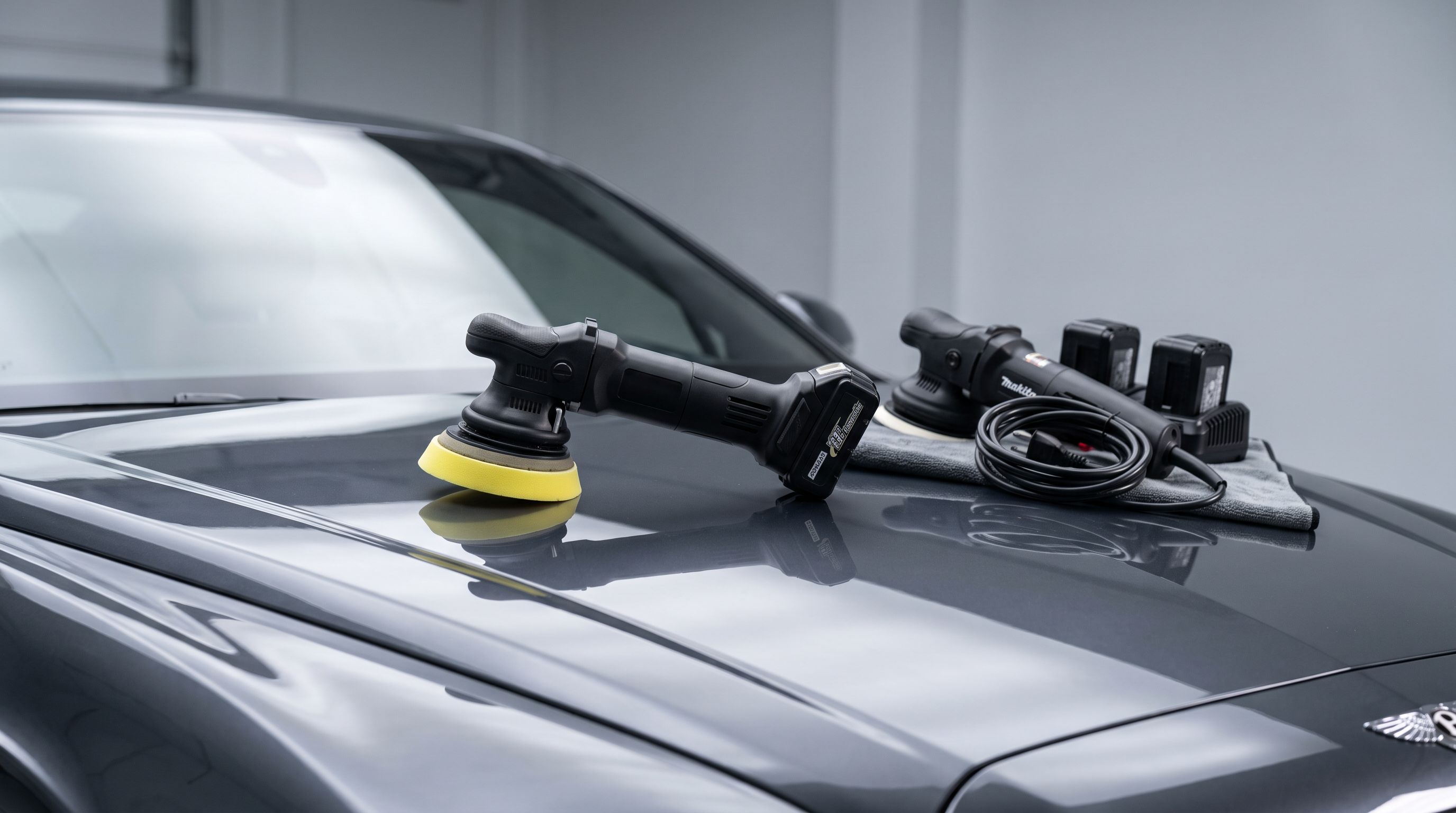
Reader-supported: we may earn a commission from links on this page, at no extra cost to you. It never affects our picks. Learn more.
The short version
- Best overall cordless: Milwaukee M18 FUEL 15mm Random Orbital Polisher (2684-20)
- Best corded DA for the money: Griot's Garage G9 Random Orbital Polisher
- Premium corded pick: RUPES LHR15 Mark V
- Best for tight panels: Adam's Swirl Killer 15mm Mini Polisher
- Budget cordless pick: SPTA 12V Cordless Mini Polisher
 Budget cordless pick · SPTA 12V Cordless Mini Polisher — Check price on Amazon →
 Best for tight panels · Adam's Swirl Killer 15mm Mini Polisher — Check price on Amazon →
 Premium corded pick · RUPES LHR15 Mark V — Check price on Amazon →
 Best corded DA for the money · Griot's Garage G9 Random Orbital Polisher — Check price on Amazon →
The question that brings most people to a cordless dual action polisher isn't "which one is smoothest." It's blunter than that: will the battery die halfway through my hood?
The honest answer in 2026 is that a good cordless DA can absolutely finish a full car — but only if you buy the right class of machine and own enough batteries. A cheap cordless buffer will frustrate you into buying a corded one. A high-end brushless cordless will do everything a corded DA does, with a cord-free workflow that genuinely changes how you move around a vehicle.
We compared published specs, independent reviews and a large volume of owner feedback from detailing forums and retailer reviews to sort out where cordless has caught up and where it hasn't.
Where cordless actually wins — and where it still loses
Throw is throw, regardless of power source
Orbit throw (sometimes called stroke) is the diameter of the random orbital movement: 8mm, 15mm, 21mm. It determines how much paint you cut per pass and how aggressive the machine feels.
Cordless has fully caught up here. The Milwaukee M18 FUEL polisher runs a 15mm throw — the same stroke as the RUPES LHR15 Mark V, which is arguably the reference machine for enthusiast paint correction. You are not trading away cut just by going cordless.
What is still rare in cordless is the 21mm long-throw class. If you want the big-panel speed of a Griot's G9 (21mm) or a RUPES LHR21, corded remains the default. Long throw plus battery weight plus a motor that can hold that stroke under load is a hard combination to package.
Torque under pad load is the real differentiator
This is where cheap cordless machines fall apart, and it's rarely visible on a spec sheet.
A DA polisher has two motions: the orbit (driven) and the pad's free spin (driven by friction against the paint). When you lean on the machine, or hit a curved panel, or use a thick cutting pad, the pad rotation slows or stops. A machine that stalls out isn't cutting — it's just vibrating.
Brushless motors with electronic feedback are what solve this. Reviewers and owners consistently single out the Milwaukee M18 FUEL for not stalling under load, which is the single highest-value attribute in a cordless polisher. Budget cordless buffers — the generic 20V units that flood marketplaces — typically use smaller motors with no load compensation, and owner feedback repeatedly reports pad rotation dying as soon as pressure is applied.
Rule of thumb: if a cordless DA doesn't advertise a brushless motor and constant-speed electronics, assume it's a wax-spreader, not a correction tool.
Runtime per panel: the number nobody publishes
No manufacturer publishes "panels per charge," because it depends on pad size, compound, pressure and how aggressively you work. But you can reason about it sensibly.
Based on owner reports, a high-capacity battery (think 5.0Ah and up on an 18V/20V platform) running a 5-inch pad on a medium polish typically gets you through roughly one to two full panels per charge — a hood, or a door and fender, with some margin. Heavy cutting with a thick wool or microfiber pad drains it faster. Light finishing or applying a sealant stretches it considerably further.
That means the practical minimum for a full-car correction is two large batteries plus a fast charger, run in rotation. With three, you'll never think about it again. One battery is a recipe for standing around.
Factor the battery cost into your comparison honestly. If you already own an M18, DeWalt or Makita platform, cordless becomes dramatically more attractive. If you don't, the cost of entry often exceeds a very good corded DA.
Weight, balance and vibration
Batteries add mass, and that mass sits behind the head. Cordless DAs are generally heavier and more rear-biased than corded equivalents. On a hood that's fine — gravity helps. On vertical door skins and overhead work, you feel it by the third panel.
Corded machines like the RUPES LHR15 Mark V are tuned specifically for low vibration and neutral balance over long sessions, and this is still their quiet advantage. Reviews of the Milwaukee note impressively low vibration for a large-throw cordless, which is praise with a qualifier attached.
Workflow: the underrated cordless argument
Anyone who has wrapped a cord around a mirror, dragged it across a freshly compounded fender, or run an extension lead out to a driveway understands why cordless sells. No cord means no cord management, no snagging, no accidental marring from the cable, and the ability to work in a driveway, car park or at a client's house with zero setup.
For mobile detailers and anyone correcting a car outside a garage, this alone outweighs the runtime math.
Comparison table
| Model | Type | Throw | Pad size | Best for | Main trade-off |
|---|---|---|---|---|---|
| Milwaukee M18 FUEL 2684-20 | Cordless (18V brushless) | 15mm | 5–6 in | Full-car correction without a cord | Needs multiple high-capacity batteries; tool-only pricing |
| Griot's Garage G9 | Corded | 21mm | 5–6 in | Fast coverage on large panels | Cord management; long throw is clumsy on tight areas |
| RUPES LHR15 Mark V | Corded | 15mm | 5 in | Long sessions, complex bodywork | Premium cost; still tethered |
| Adam's Swirl Killer 15mm Mini | Corded mini | 15mm | 3 in | Pillars, bumpers, mirrors, spot repair | Too small to correct a whole car |
| SPTA 12V Cordless Mini | Cordless mini | Short | 3 in | Wheels, spot fixes, touch-ups | Not a correction machine for full panels |
The picks
Milwaukee M18 FUEL 2684-20 — best overall cordless
Prices last checked November 10, 2026. Amazon prices change frequently, so treat these as a guide and check the live price before you buy.

Milwaukee M18 FUEL 15mm Random Orbital Polisher (2684-20)
Brushless 15mm free-spin DA that holds pad speed under load — the cordless unit pros actually trust.
This is the machine that made "cordless dual action polisher" a serious phrase rather than a compromise. The 15mm free-spin throw matches respected corded machines, and the brushless motor with electronic load compensation is why reviewers and detailers repeatedly note it doesn't stall when you lean into a cutting pad. It's a genuine paint-correction tool, not a battery buffer.
Best for: anyone already on the M18 platform, mobile detailers, and garage owners tired of cord wrangling.
What it gives up: it's heavier and more rear-biased than a corded DA, it's typically sold tool-only, and you realistically need two or three high-capacity packs plus a rapid charger to do a whole car without pausing. On vertical panels, the weight is noticeable.
Griot's Garage G9 — best corded DA for the money
Griot's Garage G9 Random Orbital Polisher
21mm throw, long warranty and smooth power delivery — the benchmark a cordless has to beat.
The G9 remains the sensible default recommendation for a first serious polisher, and it's the benchmark any cordless has to justify itself against. The 21mm throw covers large panels quickly, the power delivery is smooth and predictable, and Griot's backs its machines with a famously generous warranty. Reviewers routinely list it as the best starting point for beginners because it's hard to burn paint with and easy to control.
Best for: first-time correctors, home garages with power nearby, anyone wanting maximum capability per dollar.
What it gives up: the cord, obviously. The long 21mm throw is also less graceful on bumpers, pillars and tight curves, where a 15mm or mini machine is easier to keep flat.
RUPES LHR15 Mark V — premium corded pick
RUPES LHR15 Mark V
15mm throw, superb balance and low vibration for long correction sessions on complex panels.
If you spend hours at a time behind a polisher, balance and vibration stop being nice-to-haves. The LHR15 Mark V is the current iteration of a machine that built its reputation on exactly that: a 15mm throw that's aggressive enough to correct, in a chassis tuned to stay comfortable through a full day. Expert roundups continue to rank it as the most balanced choice for pros and serious enthusiasts.
Best for: professionals, enthusiasts doing multi-day corrections, anyone with wrist or shoulder fatigue issues.
What it gives up: it's a premium purchase, and you're still tethered. It also doesn't cut as fast as a 21mm machine on big flat hoods — you trade outright speed for control.
Adam's Swirl Killer 15mm Mini — best for tight panels
Adam's Swirl Killer 15mm Mini Polisher
3-inch pad mini DA that reaches pillars, bumpers and mirror caps a 5-inch machine can't touch.
No 5-inch machine corrects an A-pillar, a mirror cap, or the tight radius around a door handle. A 3-inch mini DA does, and the Swirl Killer 15mm Mini pairs a usable 15mm throw with a small head so it actually cuts in those areas rather than just polishing lightly. Adam's polishers show up consistently in 2026 roundups, and the mini is the one that fills a gap nothing else can.
Best for: owners of cars with complex bodywork, spot repairs, and anyone finishing the 10% of a car their main polisher can't reach.
What it gives up: it's a supplement, not a primary machine. Correcting a whole car with a 3-inch pad is possible but miserable.
SPTA 12V Cordless Mini — budget cordless pick
SPTA 12V Cordless Mini Polisher
Cheap, light cordless mini for spot corrections and wheels when you don't need full-car power.
If your goal is wheels, trim, small scratch removal and the occasional panel touch-up, a cheap 12V cordless mini does the job for a fraction of a flagship's cost. It's light, it goes anywhere, and it's the kind of tool you leave in the boot.
Best for: budget-conscious owners, wheel faces and barrels, spot work, applying sealants and glazes.
What it gives up: almost everything that matters for serious correction. Owner feedback across this class of tool consistently flags limited torque and short runtime — expect pad rotation to slow under pressure, and don't plan a full-car compound session around it.
How to choose
Decide between 15mm and 21mm throw first
21mm (Griot's G9, RUPES LHR21) covers large flat panels faster but is harder to control on curves. 15mm (Milwaukee M18 FUEL, RUPES LHR15 Mark V) is the better all-rounder and the sweet spot for most home users with a 5-inch pad. 8mm short-throw machines are for finishing and coatings, not correction.
Count your batteries before you count your panels
If you go cordless, budget for at least two high-capacity packs plus a fast charger. Check the voltage platform you already own — buying into a new battery ecosystem for one tool is usually worse value than buying a very good corded DA.
Look for brushless plus load compensation
This is the only reliable proxy for "won't stall under pad pressure." If the listing doesn't say brushless and doesn't mention constant speed under load, treat it as a light-duty buffer.
Match pad size to your car
5-inch pads suit most sedans and hatchbacks. 6-inch is faster on large SUVs and trucks but drags more on curves. Either way, plan on adding a 3-inch mini for pillars and bumpers — almost every full correction needs one.
Think about where you'll actually work
Garage with outlets and no time pressure: corded wins on value and comfort. Driveway, car park, client's home, or a shop where cords are a hazard: cordless pays for itself in workflow alone.
FAQ
Can a cordless dual action polisher really correct an entire car? Yes, with a brushless 15mm machine like the Milwaukee M18 FUEL and two to three high-capacity batteries. Expect to swap packs every one to two panels depending on pad and compound aggressiveness.
How long does a battery last per panel? Manufacturers don't publish this because it varies hugely. Owner reports suggest roughly one to two panels per high-capacity pack during medium correction work, more for light polishing or sealant application, less for heavy cutting.
Is cordless less powerful than corded? Not inherently — top-tier brushless cordless machines hold pad rotation under load as well as comparable corded DAs. Budget cordless machines are a different story and commonly stall under pressure.
Do I need both a full-size and a mini polisher? For a complete correction, effectively yes. A 5-inch machine can't follow the tight contours of pillars, mirrors and bumper corners. A 3-inch mini like the Adam's Swirl Killer 15mm Mini covers that gap.
Will any of these polishers fit my car? Polishers aren't vehicle-specific, so there's no fitment list to check. What does matter is panel size and paint hardness — larger vehicles favour 6-inch pads and long throw, while compact cars with lots of curves favour 15mm and a mini. Pad and compound choice should be matched to your paint, not your badge.
Is 2026 the year to finally go cordless? If you're already on a major battery platform, yes. If you're starting from zero and working in a garage with power, a corded G9 or LHR15 Mark V still delivers more capability per dollar.
Get the best car care deals in your inbox
Join the GarageProof newsletter for hand-picked car care deals and new buying guides. No spam, unsubscribe anytime.
Related reads
Paint Depth Gauge Buying Guide 2026: Ferrous + Aluminum
Which paint depth gauge is safe to buy in 2026? How probe type, aluminum panel coverage and calibration accuracy separate useful gauges from junk.
Polisher Backing Plate Size 2026: Stop Stalling on Curves
Polisher backing plate size guide for 2026: match plate diameter, thread spec, and pad overhang to your DA polisher so pads stop stalling on curves.
Paint Correction Clear Coat Thickness in 2026: When to Stop
How to read a paint depth gauge, budget clear coat microns, and know when to stop polishing — plus the best paint thickness gauges and compounds for 2026.