Cooling Car Seat Cushion 12V in 2026: Will It Fit Your Bucket?
A fitment-first guide to 12V cooling car seat cushions in 2026 — cushion dimensions, bolster clearance, fan noise and power draw compared for sedans, trucks and SUVs.
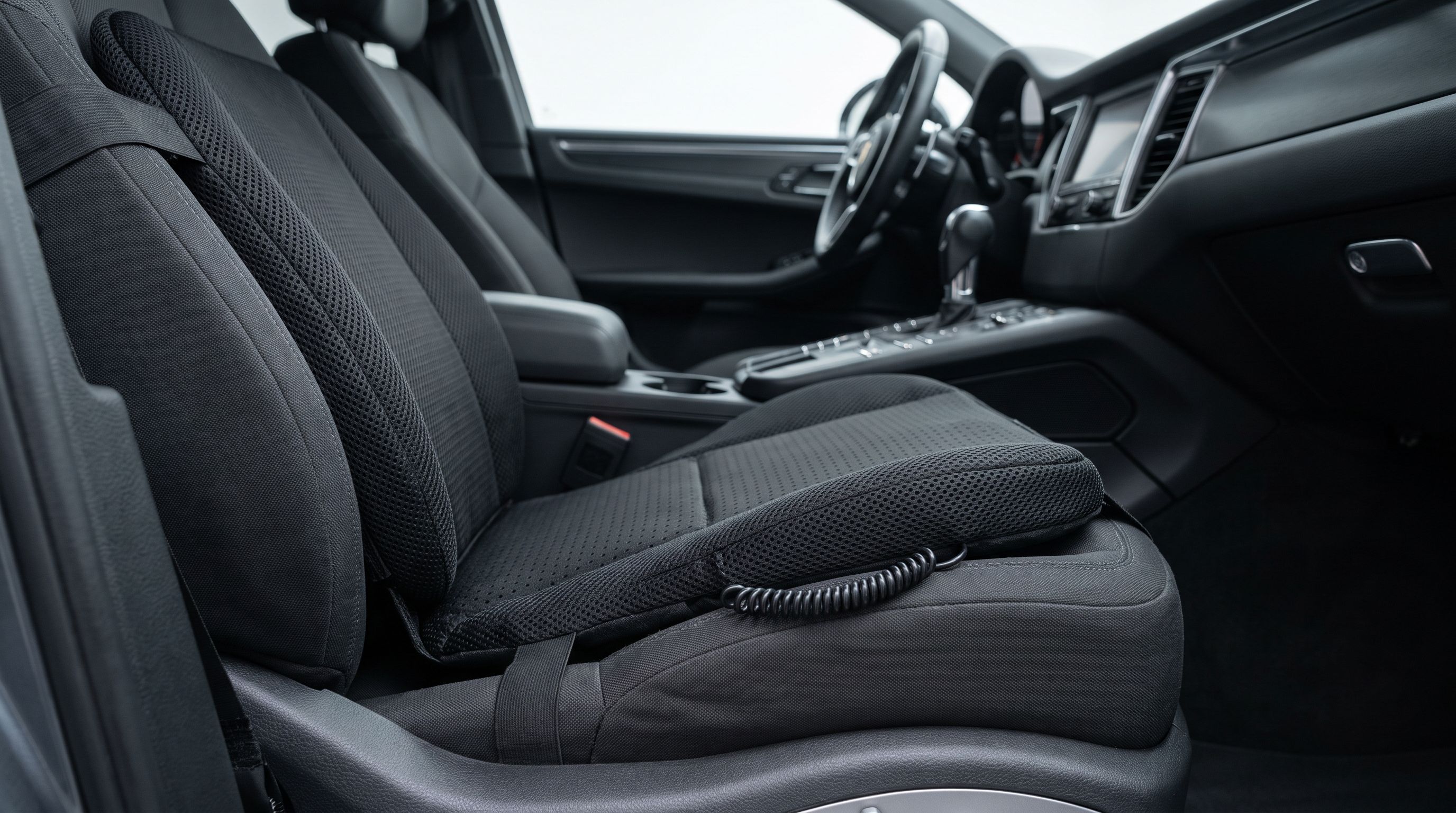
Reader-supported: we may earn a commission from links on this page, at no extra cost to you. It never affects our picks. Learn more.
Most complaints about 12V cooling seat cushions have nothing to do with airflow. They're fitment complaints in disguise: the cushion rides up the bolsters, the backrest panel bows forward and pushes your spine out of position, or the cable won't reach the socket without crossing the gear selector. Airflow is the easy part. Geometry is where these things fail.
So this guide starts with your seat, not the spec sheet. We compared current 12V ventilated cushions on dimensions, backrest construction, mounting hardware and power draw, using manufacturer specs, retail listings and verified owner feedback — GarageProof does not physically test units.
The short version
- Best overall: FLORICH Cooling Car Seat Cover (2026 Upgrade)
- Best for trucks and 24V rigs: Coverado Ventilated Seat Cushion (12V–24V)
- Budget pick: Zone Tech Cooling Car Seat Cushion 12V
- Best heat-and-cool combo: Paffenery Heated and Cooling Seat Cover
- Best minimalist seat-only pad: SriGM Car Seat Cooling Pad
 Best minimalist seat-only pad · SriGM Car Seat Cooling Pad — Check price on Amazon →
 Best heat-and-cool combo · Paffenery Heated and Cooling Seat Cover — Check price on Amazon →
 Budget pick · Zone Tech Cooling Car Seat Cushion 12V — Check price on Amazon →
 Best for trucks and 24V rigs · Coverado Ventilated Seat Cushion (12V–24V) — Check price on Amazon →
 Best overall · FLORICH Cooling Car Seat Cover (2026 Upgrade) — Check price on Amazon →
Measure your seat before you shop
Take five minutes with a tape measure. It will save you a return.
Seat pan width. Measure across the flat part of the bottom cushion you actually sit on, between the inner edges of the side bolsters. Compact sedans and sport seats often give you 15–17 inches of usable flat area. Mid-size SUVs and full-size trucks are usually 18–21 inches. If a cushion's stated width exceeds your flat area by more than about an inch and a half, the fan housings end up climbing the bolsters — which is where the lumpy, uneven feeling comes from.
Bolster height. Run the tape from the flat pan up to the top of the side bolster. Anything over roughly two inches (Recaro-style sport seats, many German sedans, performance trims) means a rigid-base cushion will bridge the bolsters instead of sitting down in the seat. Flexible mesh pads cope; stiff panels don't.
Backrest obstructions. Look for seat-mounted side airbags (usually a "SRS AIRBAG" tag on the outboard seam), seat-back controls, massage bladders and integrated belt anchors. A full-back cushion strap crossing a side airbag seam is a real concern — manufacturers generally advise against covering those areas. If your seat has one, a bottom-only pad like the SriGM Car Seat Cooling Pad sidesteps the question entirely.
Headroom and seat height. Even a one-inch cushion changes your eye line and your relationship with the steering wheel. Drivers over about six feet in a low-roof coupe should favor the slimmest option available.
Socket location and cable run. Measure from your seat's outboard edge to the 12V socket with the seat in its normal position, then add slack for fore-aft travel. Most cushions ship with roughly 5–7 feet of cable. Center-console sockets in trucks are fine; rear-of-console sockets in some SUVs are not.
Comparison at a glance
| Model | Coverage | Power input | Best-fit seat shape | Notable trade-off |
|---|---|---|---|---|
| FLORICH Cooling Car Seat Cover | Full back + base | 12V, dual plug ports + USB-A/C | Sedans and crossovers with moderate bolsters | Full-back design needs airbag-seam check |
| Coverado Ventilated Seat Cushion | Full back + base | 12V–24V | Wide, flat truck and van seats | Oversized on compact-car seat pans |
| Zone Tech Cooling Seat Cushion | Full back + base, slim profile | 12V | Tight headroom, deep bucket seats | Gentler airflow than multi-fan panels |
| Paffenery Heated and Cooling Seat Cover | Full back + base | 12V | Four-season daily drivers | Heating draws far more current than fans |
| SriGM Car Seat Cooling Pad | Base only | 12V | Seats with side airbags or seat-back controls | No back ventilation at all |
The picks
FLORICH Cooling Car Seat Cover — best overall
This is the pick for the most common situation: a sedan or crossover driver who wants real airflow at the back and thighs without engineering a project. The 2026 version's headline feature is dual 12V plug ports, so one accessory socket can feed two front cushions — useful if you and a passenger both want one, or if your car only has a single usable socket. Built-in USB-A and USB-C ports claw back the charging port the cushion would otherwise steal.
What it gives up: it's a full-back cover, so you need to confirm your seat doesn't have a side airbag seam where the straps land. It's also a mid-thickness design, not an ultra-slim pad, so very tall drivers in low-roof cars should measure headroom first.
Coverado Ventilated Seat Cushion (12V–24V) — best for trucks and 24V rigs
Prices last checked October 31, 2026. Amazon prices change frequently, so treat these as a guide and check the live price before you buy.
Coverado Ventilated Seat Cushion (12V–24V)
12V–24V input covers heavy-duty pickups and semis; wide base suits flat bench-style truck seats.
Half-ton and heavy-duty pickups, work vans and Class 8 trucks are where most cooling cushions quietly fail — either the base is too narrow for a wide, flat seat pan, or the vehicle runs a 24V electrical system the cushion can't take. Coverado's 12V–24V input range solves the second problem outright, which matters for commercial drivers and anyone with a 24V upfit. The broad base suits flat bench-style and heavy-duty bucket seats, where cushions designed for compact cars tend to float.
The trade-off is the mirror image: on a small sedan seat with tall bolsters, the same width becomes a liability, riding up the sides and creating pressure points. Match it to a genuinely wide seat.
Zone Tech Cooling Car Seat Cushion 12V — budget pick
Zone Tech Cooling Car Seat Cushion 12V
Simple, slim mesh-and-microfiber pad that adds minimal height — good for drivers tight on headroom.
Zone Tech's cushion is the straightforward option: microfiber and mesh construction that circulates air through the fabric rather than blasting it through a handful of big outlets. Two things make it worth considering beyond price. First, the slim profile — it raises you less than thicker multi-fan panels, which matters in coupes, lowered cars, and anywhere you're already brushing the headliner. Second, the flexible build settles into deep bucket seats instead of bridging them.
You give up intensity. Multi-fan cushions move more air, and in genuinely brutal heat the difference is noticeable. Think of this as a sweat-management pad for daily commuting rather than a cold-air machine.
Paffenery Heated and Cooling Seat Cover — best heat-and-cool combo
Paffenery Heated and Cooling Seat Cover
Year-round pick with both heating elements and ventilation fans in one cushion.
If you live somewhere with four real seasons, buying two seasonal cushions is wasteful and storing the off-season one is annoying. The Paffenery combines heating elements and ventilation fans in a single cover, so one install covers July and January. It's a particularly sensible retrofit for base-trim vehicles that never got factory heated seats — a common gap in work trucks and entry-level sedans.
The compromise is electrical. Heating elements draw substantially more current than fans do, so check your accessory socket's fuse rating before running heat at maximum on a long drive, and avoid daisy-chaining it through a multi-socket splitter alongside other high-draw gear.
SriGM Car Seat Cooling Pad — best minimalist seat-only pad
SriGM Car Seat Cooling Pad
Bottom-cushion-only design avoids backrest interference with side airbags and seat-mounted controls.
Some seats simply shouldn't wear a full-back cover. Seat-mounted side airbags, seat-back entertainment mounts, integrated lumbar controls and aggressive sport backrests all argue for a bottom-only pad. The SriGM targets exactly that: a ventilated cushion for the driver's seat pan with a built-in fan, sized for cars, trucks and SUVs.
What you lose is obvious — no airflow across your back, which is where most of the sweat shows up on a hot day. For drivers who mainly get thigh and seat-bottom heat buildup, or who need an airbag-safe option, that's an acceptable trade. It also stores easily and moves between vehicles in seconds.
How to choose
Cushion dimensions versus your usable flat area
The single most predictive number is the width of your seat's flat pan, not the seat's overall width. Compare that to the cushion's stated base width. A cushion up to about an inch wider than your flat area will still settle acceptably; beyond that, it climbs the bolsters. For backrests, compare the cushion's back height to the distance from your seat pan to your shoulder — a back panel that extends past the seat's shoulder line will flop forward.
Bolster clearance and base rigidity
Rigid or semi-rigid 3D-mesh bases hold their shape and move more air, but they need a flat pan to sit on. Soft mesh-and-microfiber pads conform to deep buckets and tall bolsters. If you drive something with pronounced sport bolsters, prioritize flexibility over fan count — a cushion that doesn't sit flat won't deliver its rated airflow anyway, because the channels get pinched closed.
Power draw and socket sharing
Fan-only cushions are modest loads, which is why dual-output designs like the FLORICH exist. Heating is a different story: resistive elements pull far more current, and that's the realistic limit on what a single accessory socket can support. Before you plug in, check your owner's manual for the socket's amperage rating (commonly 10A or 15A on a 12V outlet), and treat cheap triple-socket splitters with suspicion when heat is involved. If your vehicle cuts accessory power with the ignition, confirm that matches how you want to use the cushion.
Mounting hardware and how it interacts with your seat
Elastic straps with hooks are the norm. The questions to ask: do the hooks reach through your seat's bight (the gap between back and base), and will the lower straps foul a sliding seat rail or a power-seat motor? Vehicles with fixed rear seat backs or full-length seat-back pockets sometimes don't offer a clean route. Also check whether the straps cross child-seat ISOFIX/LATCH anchors or a side airbag seam — both are reasons to choose a bottom-only pad instead.
Noise you'll actually hear
Fan noise sits in a frequency range that's easy to ignore at highway speed and hard to ignore in traffic with the windows up. Multi-fan cushions on their highest setting are audible; most owners end up running them a step or two down. If you take a lot of hands-free calls, look for models with at least three speed settings so you have a usable quiet mode rather than on/off.
Installation notes worth two minutes
Route the power cable along the outboard side of the seat where your leg won't drag it, not across the transmission tunnel. Leave enough slack for the full range of seat travel — a cable pulled tight when you slide back is a cable that will eventually fail at the plug. Check that the cushion doesn't interfere with seat belt buckle access, and that the back panel doesn't push your head forward into a slouched posture; if it does, loosen the upper straps or move to a bottom-only pad.
For leather and vinyl seats, cushions help in a second way: they stop direct skin contact with a surface that's been baking in the sun. Even modest airflow makes a hot leather seat tolerable within a minute or two.
FAQ
Will a 12V cooling cushion actually blow cold air? No. These are ventilation devices, not air conditioners. Fans pull or push cabin air through the cushion to evaporate sweat and break the insulating layer between you and the seat. If your cabin air is 95°F, so is the air moving through the cushion. Run your A/C and the cushion together — that's when they work best.
Can I use one on a seat with a side airbag? Be careful. Seats with seat-mounted side airbags deploy through a specific seam on the outboard edge of the backrest. Covering or restraining that area can affect deployment. If your seat has an airbag tag on the side of the backrest, the safe choice is a bottom-only pad like the SriGM Car Seat Cooling Pad, or a design whose straps clearly avoid the seam.
Will it work in my 24V truck? Only if the cushion lists a 12V–24V input range. The Coverado Ventilated Seat Cushion does; most consumer cushions are 12V-only, and plugging a 12V unit into a 24V source will damage it. Check the label, not the listing title.
How much current do these draw? Fan-only models are light loads easily handled by a standard accessory socket. Heated models are much heavier and are the realistic reason to check your socket's fuse rating. When a combo unit like the Paffenery is running heat, don't share that socket with another high-draw accessory.
Can I run it on a seat that already has factory ventilation? You can, but it's usually redundant and may block the factory perforations. If your factory system has failed, a cushion is a reasonable workaround — just expect it to sit on top of the seat rather than restore the original function.
Do these fit third-row or rear bench seats? Sometimes. Rear benches often have fixed backs with no bight to pass straps through, and rear 12V sockets aren't universal. Measure the flat pan width and confirm you have a powered socket within cable reach before buying for a second or third row.
Our picks
FLORICH Cooling Car Seat Cover (2026 Upgrade)
Dual 12V ports power two front seats, and the flat-panel back fits aggressive sport bolsters better than most.
Get the best car care deals in your inbox
Join the GarageProof newsletter for hand-picked car care deals and new buying guides. No spam, unsubscribe anytime.
Related reads
Car Seat Covers in 2026: Universal or Custom-Fit?
The best car seat covers 2026 guide: how side-airbag seams, seat controls and headrest shapes decide universal vs custom-fit, plus five picks and a fitment checklist.
Heated Car Seat Cover Fitment Guide 2026: Airbag-Safe Picks
Which heated car seat cover actually fits your seats in 2026? We compare side-airbag-safe designs, bucket vs bench fit, 12V amp draw, and mounting hardware.
Mud Flaps for Trucks 2026: Fit the Wheel Well, Not the Badge
Heavy-duty mud flaps for trucks in 2026: how wheel-well lip, lift height and flare type decide whether drill-in or no-drill kits actually fit.