Car Window Breaker Escape Tool 2026: Spring vs Hammer
Spring-loaded punches fail on laminated side glass. Compare car window breaker escape tools for 2026 and learn which windows in your car can actually be broken.
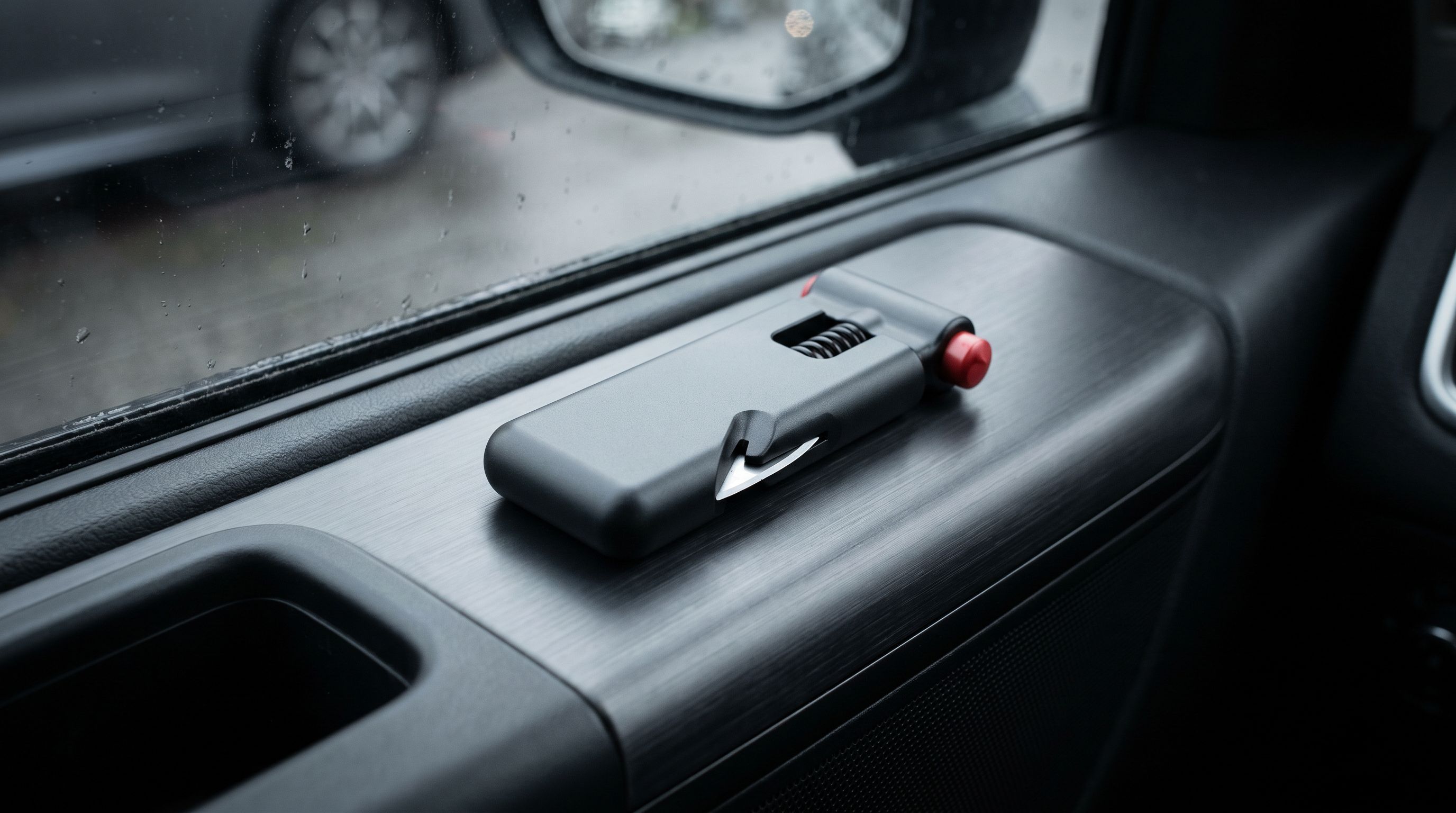
Reader-supported: we may earn a commission from links on this page, at no extra cost to you. It never affects our picks. Learn more.
Most people buy a car window breaker escape tool, drop it in the glovebox, and assume the problem is solved. Two things usually go wrong with that plan. First, the tool ends up somewhere you can't reach when the car is on its side or filling with water. Second — and this is the one almost nobody checks — a growing share of modern vehicles use laminated side glass, which no handheld escape tool will reliably break.
This guide compares spring-loaded punches against hammer-style tools, explains which windows in your specific car are actually breakable, and recommends the models worth keeping within arm's reach in 2026. GarageProof researches and compares products using manufacturer documentation, independent testing from organizations like AAA, and verified owner feedback; we don't smash windows ourselves.
The short version
- Best overall: resqme Car Escape Tool
- Best hammer-style pick: Lifehammer Safety Hammer Evolution
- Budget pick: Amazon Basics Emergency Escape Tool
- Best for keeping it in reach: Ztylus Stinger Car Emergency Escape Tool
- Premium pick: LifeHammer Safety Hammer Plus
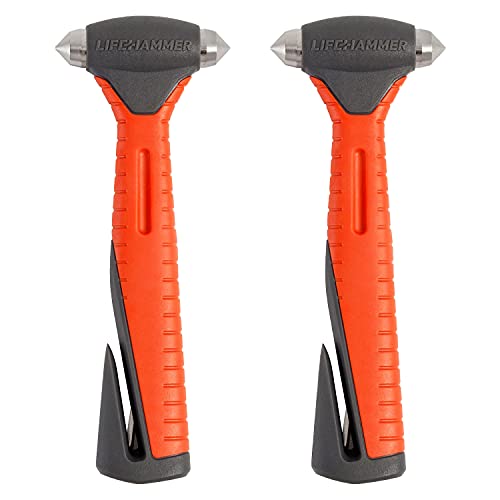 Premium pick · LifeHammer Safety Hammer Plus — Check price on Amazon →
 Best for keeping it in reach · Ztylus Stinger Car Emergency Escape Tool — Check price on Amazon →
 Budget pick · Amazon Basics Emergency Escape Tool — Check price on Amazon →
 Best hammer-style pick · Lifehammer Safety Hammer Evolution — Check price on Amazon →
 Best overall · resqme Car Escape Tool — Check price on Amazon →
First: find out which of your windows can be broken
This is the step that makes or breaks everything else.
Tempered glass is heat-treated so it shatters into small, relatively dull pebbles under a sharp point load. That's what escape tools are designed for. It's used in most rear side windows, most older front side windows, and many rear windshields.
Laminated glass is two layers of glass bonded to a plastic (PVB) interlayer. It's what every windshield is made of, and since roughly the mid-2010s automakers have increasingly used it for front side windows too — for cabin quietness, for UV reduction, and to reduce the risk of occupant ejection in a rollover. A punch or hammer may crack laminated glass, but the plastic layer holds the pieces together. AAA's research on vehicle escape tools found exactly this: the tools worked on tempered glass and failed to create an opening in laminated side windows.
How to check your own car in two minutes
- Look at the bottom corner of each side window. There's a small etched or printed legend on the glass. It will say "Tempered" (sometimes "Temp" or "Toughened") or "Laminated" (sometimes "Lamin-" or "Lamisafe" or similar). Check every door, not just one — many cars use laminated fronts and tempered rears.
- Check both front and rear doors, and the rear quarter glass. On a lot of 2018+ sedans and SUVs, the front doors are laminated and the rears are tempered. That means your escape plan is the back windows.
- If the marking is worn off, look it up in your owner's manual glazing section, or ask a glass shop — they quote by glass type and will know instantly.
- Tell everyone who drives the car. A tool nobody knows how to use, on a window that won't break, is decoration.
If your front windows are laminated and your rears are tempered, you still want a tool — you just need to know you're aiming for a rear window. If every side window is laminated (rare but increasingly possible on premium models), your realistic exits are the doors and the rear hatch, and your escape tool becomes primarily a seatbelt cutter. That's not a wasted purchase; jammed belt latches after a crash are a genuine, common problem.
Spring-loaded vs hammer: how they actually differ
Spring-loaded punches
A spring-loaded center punch stores energy in an internal spring. You press the hardened tip against the glass and push until the mechanism releases, delivering a concentrated impact to a tiny point. Think of it as a controlled, repeatable strike that doesn't depend on your arm.
Strengths: works in confined spaces, works one-handed, works if you're injured, upside down, or underwater. No swing room needed. Small enough to live on a keyring, which solves the "where is it" problem better than anything else.
Weaknesses: needs firm contact with the glass to trigger — you can't do it at arm's length. Cheap units have inconsistent springs and soft tips. Totally ineffective on laminated glass.
Hammer-style tools
A safety hammer uses a hardened steel or tungsten-carbide point on a handle. You swing it. Energy comes from your arm, so a solid hit can deliver more total force than a small punch — but only if you have room to swing and the strength to do it.
Strengths: more forceful hits, longer reach to a far window, usually paired with a bigger seatbelt blade, easier for a bystander to use from outside the vehicle. Some have double-ended tips.
Weaknesses: needs swing clearance, which is exactly what you don't have when you're belted in with a deployed airbag, or submerged (water resistance kills a swing). Bulkier, so it tends to migrate to the trunk. And still useless on laminated glass.
Hybrid tools
Several of the best modern options split the difference: a hammer-shaped body with a spring-loaded tip, so you get reach and mass plus the press-to-fire mechanism. The Lifehammer Safety Hammer Evolution is the best-known example.
Comparison table
| Tool | Type | Breaking mechanism | Seatbelt cutter | Where it lives | Best for |
|---|---|---|---|---|---|
| resqme Car Escape Tool | Keychain punch | Spring-loaded | Recessed blade | Keyring, visor clip | Always-on-you access, tight spaces |
| Lifehammer Safety Hammer Evolution | Hybrid hammer | Spring-loaded tip | Recessed blade | Door pocket, mounted bracket | Balanced reach and reliability |
| Amazon Basics Emergency Escape Tool | Hammer | Swing impact, steel point | Fixed blade | Door pocket, console | Equipping several vehicles cheaply |
| Ztylus Stinger | Socket-mounted punch | Spring-loaded | Recessed blade | 12V socket (doubles as USB charger) | Guaranteed reachability from the seat |
| LifeHammer Safety Hammer Plus | Hammer | Dual hardened tips | Recessed blade | Mounted bracket | Awkward angles, longer reach |
The picks
resqme Car Escape Tool — best overall
Prices last checked October 21, 2026. Amazon prices change frequently, so treat these as a guide and check the live price before you buy.
resqme Car Escape Tool
Keychain-sized spring-loaded punch and recessed seatbelt cutter that lives on your keys, not in the glovebox.
The resqme is a spring-loaded punch and recessed seatbelt blade in a body roughly the size of a car remote. It's been in production for over 25 years and is used widely by first responders and fleet buyers, which is the kind of track record you want in a product you may use exactly once. The key advantage is placement: because it clips to a keyring or a visor, it's with you no matter which seat you're in or whether the car is upright. Trade-offs are real — the blade is small and takes a deliberate pull through a belt, there's no reach at all (you must press it against the glass), and the plastic housing isn't something you'd pry with. Buy one per driver, not one per car.
Lifehammer Safety Hammer Evolution — best hammer-style pick
Lifehammer Safety Hammer Evolution
Classic swing hammer with a spring-loaded tip and a bracket that keeps it within reach of the driver's seat.
The Evolution is the sensible modernization of the classic orange safety hammer: instead of relying purely on a swing, it uses a spring-loaded tip you press against the glass, while keeping a hammer's handle for reach and grip. That combination matters if you're belted in and can only get to the far side of the window, or if your hands are shaking. It ships with a mounting bracket, and using it is non-negotiable — a hammer rolling around a footwell is a hammer you won't find. What you give up is pocketability; this is a vehicle-resident tool, not a keychain one, so passengers in a second car need their own.
Amazon Basics Emergency Escape Tool — budget pick
Amazon Basics Emergency Escape Tool
Simple steel-tipped hammer and blade combo for stocking multiple vehicles without overthinking it.
If you need to put something in a teenager's first car, a work truck, and a spare vehicle without a lot of deliberation, this is the straightforward answer. It's a conventional two-ended design: hardened point for tempered glass, shielded blade for belts. Owner feedback is generally positive on the blade's bite and the grip's size. The compromises are what you'd expect — it's a swing-dependent hammer with no spring mechanism, so it's less effective in cramped positions, and the materials don't feel like the premium Dutch-made options. Still, a basic tool that's actually present beats a great tool you never bought.
Ztylus Stinger — best for keeping it in reach
Ztylus Stinger Car Emergency Escape Tool
Lives in the 12V socket as a USB charger, so the tool is always in the console instead of buried in a bag.
The Stinger's whole premise is placement. It sits in the 12V socket working as a dual-port USB charger, so it's permanently in the center console within reach of the driver's seat — no bracket to install, nothing to slide under a seat. Pull it out and you have a spring-loaded punch on one end and a recessed belt cutter under the cap. It's compact and genuinely well-made for what it is. The downsides: you lose a 12V socket, the body is small so there's no reach to a far window, and if your car's socket is awkwardly placed low in the console, retrieval under stress isn't as instant as the marketing suggests. Test the grab from your normal driving position.
LifeHammer Safety Hammer Plus — premium pick
LifeHammer Safety Hammer Plus
Longer handle and dual tungsten tips for more leverage when you can only reach the glass awkwardly.
The Plus is the longer, more substantial member of the family, with hardened tips on both ends and a shape that gives you more leverage when you can only reach the glass at an angle — the scenario where a short tool simply can't generate useful force. It's the one to pick for a van, a large SUV, or any vehicle where a rear window is some distance from the driver. It also makes sense for a bystander-rescue mindset: it's easy for someone outside the car to use effectively. You're paying for build quality and reach rather than any extra capability, and like all hammers it still needs swing room and is still stopped cold by laminated glass.
How to choose
1. Match the tool to your glass, not the marketing
Before anything else, confirm which windows are tempered. If your rear side windows are tempered and the fronts are laminated, your plan is "break a rear window," and you should keep a tool reachable from the rear of the cabin as well. If everything's laminated, prioritize the seatbelt cutter and door/hatch egress — and don't let a product listing's "breaks any window" claim convince you otherwise.
2. Reachability beats raw power
Statistically, the most common failure isn't the tool breaking — it's the tool being in the trunk, the glovebox, or under a seat. Pick based on where it will genuinely live: keyring (resqme), 12V socket (Ztylus Stinger), or a mounted bracket within seated arm's reach (either Lifehammer). If you can't reach it while belted, it's the wrong tool for you.
3. Spring mechanism if space or strength is limited
Elderly drivers, smaller-framed drivers, anyone who might be injured, and anyone worried about submersion should favor a spring-loaded design. A swing hammer requires clearance and arm strength that a crash or water can take away instantly.
4. Take the seatbelt cutter seriously
Jammed buckles and belts under tension are a more frequent problem than unbreakable windows. Look for a recessed, shielded blade — it protects the edge, prevents injury during fumbling, and lets you saw across the webbing rather than needing a precise slice. Replace any tool with a visibly corroded or dulled blade.
5. Buy more than one
Tools are inexpensive relative to the scenario. A realistic setup is one on the driver's keys, one mounted within reach of the front seats, and one accessible from the second row.
Technique: how to actually use one
- Aim for a corner, not the center. Tempered glass fails most easily near the edges, a few inches in from the frame.
- Brace against the glass with a spring punch — it fires on pressure, not impact.
- Shield your face with a forearm or jacket as the pane collapses.
- Clear the sill of remaining pebbles before climbing through.
- In water: unbuckle first, then window, then children, then out. Act in the first seconds while the door frame is still relatively unloaded. If a window won't break, go for a door before the pressure differential makes it impossible.
- Practice the retrieval motion — not the breaking — once, while parked. Knowing exactly where your hand goes is the entire value of the purchase.
FAQ
Can any escape tool break a windshield? No. Every windshield sold in modern passenger vehicles is laminated. A tool may crack it, but the plastic interlayer prevents a clean opening. Don't plan an escape through the windshield.
How do I tell if my side windows are laminated? Read the small etched legend in a bottom corner of each pane. It will state "Tempered" or "Laminated." Check every door separately, since many vehicles mix the two.
Are spring-loaded punches better than hammers? For most in-car emergencies, yes — they work one-handed, in confined space, and don't require strength. Hammers win when you need reach to a distant window or you're helping someone from outside the vehicle. Hybrid tools like the Lifehammer Safety Hammer Evolution cover both.
Do these tools expire? Not formally, but check them annually. Spring mechanisms can seize with corrosion, blades dull, and plastic housings degrade under years of windshield heat. Inspect any tool that's lived on a sun-baked dash.
Will a spring punch still work underwater? Yes — the mechanism is mechanical and doesn't depend on a swing, which is precisely why it's the preferred design for submersion scenarios. The glass still has to be tempered.
Is one tool enough for a family car? No. Keep one on the driver's keyring and at least one mounted where a rear-seat passenger could reach it. In a crash, the person who can move isn't always the one sitting next to the tool.
Get the best car care deals in your inbox
Join the GarageProof newsletter for hand-picked car care deals and new buying guides. No spam, unsubscribe anytime.
Related reads
Battery Terminal Replacement 2026: Top Post vs Side Post
Battery terminal replacement in 2026: how to match top-post, side-post and GM stud fitments, size cable gauge correctly, and which clamp kits are worth buying.
Car Fire Extinguisher 2026: Which Rating Fits a Vehicle
ABC vs BC vs clean agent, UL ratings explained, EV considerations and bracket fitment — plus car fire extinguisher picks for every budget in 2026.

LED Road Flares for Cars in 2026: Do You Still Need Triangles?
LED road flares for cars vs reflective triangles in 2026: visibility distance, DOT-style rules, cold-weather battery life, and five kits worth keeping in the trunk.