Car Fire Extinguisher 2026: Which Rating Fits a Vehicle
ABC vs BC vs clean agent, UL ratings explained, EV considerations and bracket fitment — plus car fire extinguisher picks for every budget in 2026.
Reader-supported: we may earn a commission from links on this page, at no extra cost to you. It never affects our picks. Learn more.
The short version
- Best overall: Element E50 Fire Extinguisher — tiny, pressure-free, 50 seconds of discharge, no corrosive mess.
- Budget pick: Kidde Auto Fire Extinguisher 2 lb (Auto 5 BC) — UL-listed, bracket included, no excuses not to carry one.
- Premium clean-agent pick: H3R Performance HalGuard HG100R — Halotron clean agent for electronics, EVs and nice interiors.
- Best for trucks, trailers and shops: Amerex B417 2.5 lb ABC — serviceable all-metal ABC unit with a gauge.
- Best compact dry chemical: H3R Performance MaxOut MX100B — ABC-rated punch in a vehicle-friendly size.
 Best for trucks, trailers and shops · Amerex B417 2.5 lb ABC — Check price on Amazon →
 Budget pick · Kidde Auto Fire Extinguisher 2 lb (Auto 5 BC) — Check price on Amazon →
 Best overall · Element E50 Fire Extinguisher — Check price on Amazon →
A fire extinguisher is the single cheapest piece of safety gear most drivers never buy. It's also the one where the wrong choice — wrong rating, wrong size, wrong mounting — turns a two-minute inconvenience into a total loss. This guide explains what the letters and numbers on the label actually mean, where clean agents earn their premium, what's realistic for EVs, and how to mount a bottle under a seat without it becoming a projectile.
GarageProof researches and compares products using manufacturer specifications, UL listings, independent reviews and verified owner feedback. We don't set cars on fire to test extinguishers.
What the ratings actually mean
Every UL-listed extinguisher carries a letter class and, for A and B, a number.
- Class A — ordinary combustibles: upholstery, carpet, plastics, paper, cardboard in the trunk.
- Class B — flammable liquids: gasoline, diesel, oil, transmission fluid, brake fluid.
- Class C — energized electrical equipment. The C rating isn't a capability measure; it means the agent is non-conductive and safe to use on live circuits.
- Class D and K — combustible metals and cooking oils. Not relevant to a car kit.
The numbers matter more than people realize. A "5-B:C" unit will knock down roughly a 5 square-foot flammable liquid fire in the hands of a trained user; "10-B:C" is twice that. A "1A:10B:C" rating adds meaningful Class A capability. For a car, B and C are non-negotiable; A is a strong bonus because most vehicle fires that start small involve a mix — a fuel or fluid leak igniting, then carpet, sound deadening and plastic trim joining in.
ABC vs BC vs clean agent
| ABC dry chemical | BC dry chemical | Clean agent (Halotron/HFC) | Aerosol/condensed (e.g. Element) | |
|---|---|---|---|---|
| Typical rating | 1A:10B:C | 5-B:C to 10-B:C | 1B:C to 5B:C depending on size | Not UL letter-rated; rated by discharge time/coverage |
| Handles upholstery & trim fires | Yes | Poorly | Limited | Yes |
| Residue | Yellow monoammonium phosphate powder; corrosive, hygroscopic | Sodium bicarbonate; messy but less corrosive | None | Minimal, non-corrosive |
| Damage to electronics/wiring | High | Moderate | Very low | Very low |
| Size for the capability | Bulky | Bulky | Bulky for the rating | Extremely compact |
| Gauge / pressure vessel | Yes | Yes | Yes | No pressure vessel, no gauge |
| Best for | Trucks, trailers, shops, general use | Low-cost basic coverage | Classics, EVs, show cars, engine bays with electronics | Daily drivers, tight cabins, glovebox carry |
The honest summary: ABC is the most capable agent per pound, and the most destructive. Monoammonium phosphate powder is mildly acidic, attracts moisture and attacks aluminum and circuit boards if it isn't cleaned out thoroughly and quickly. On a 15-year-old pickup, who cares — put the fire out. On a car with a wiring harness, a hundred connectors and a cabin you have to live in, a clean agent or a condensed-aerosol stick may save you a post-fire bill that exceeds the damage the fire did.
Do EVs change the answer?
Partly — but not in the way most marketing suggests. No portable extinguisher sold for consumer use puts out a lithium-ion battery pack fire in thermal runaway. That's a firefighting problem requiring thousands of gallons of water and professional cooling, or simply letting the pack burn out from a safe distance. If a traction pack vents, the correct move is to get everyone 100+ feet away and call emergency services — do not approach with a 2 lb bottle.
What an extinguisher is good for in an EV or hybrid is everything else: a 12V accessory short, a charging cable or wall connector fault, a carpet or cargo fire, a bag of groceries that met a hot thermos, an engine bay fire on a hybrid. For those, you're on live electrical equipment and sensitive electronics, which is a textbook argument for a C-rated clean agent like the H3R Performance HalGuard HG100R, or a non-corrosive option like the Element E50. The same logic applies to anyone running a home EVSE in an attached garage: a clean agent near the charger beats dusting the panel and your car with ABC powder.
How to choose
1. Match the rating to what's actually in your vehicle
If your car carries fuel, oil and a lot of plastic — almost all of them — you want B:C at minimum. Add Class A capability if you regularly carry cargo, camp, tow, or haul anything combustible. A 1A:10B:C unit like the Amerex B417 or H3R MaxOut MX100B is the all-rounder. A 5-B:C like the Kidde Auto is the budget floor, and it's still vastly better than nothing. Ignore unrated novelty "fire balls" and no-name canisters with no UL listing or published discharge data.
2. Decide what you're willing to clean up
This is the real decision for most people. Dry chemical gets the fire out fastest per dollar and makes an expensive, corrosive mess. Clean agents cost more per rating point and leave nothing behind. Condensed aerosol units like the Element split the difference: no pressure vessel, no powder, long discharge, but no UL A:B:C number to compare against conventional bottles. Think about where a fire is most likely in your car — a track-day fuel line versus a dash wiring short — and buy for that.
3. Size it to the mount, not to the spec sheet
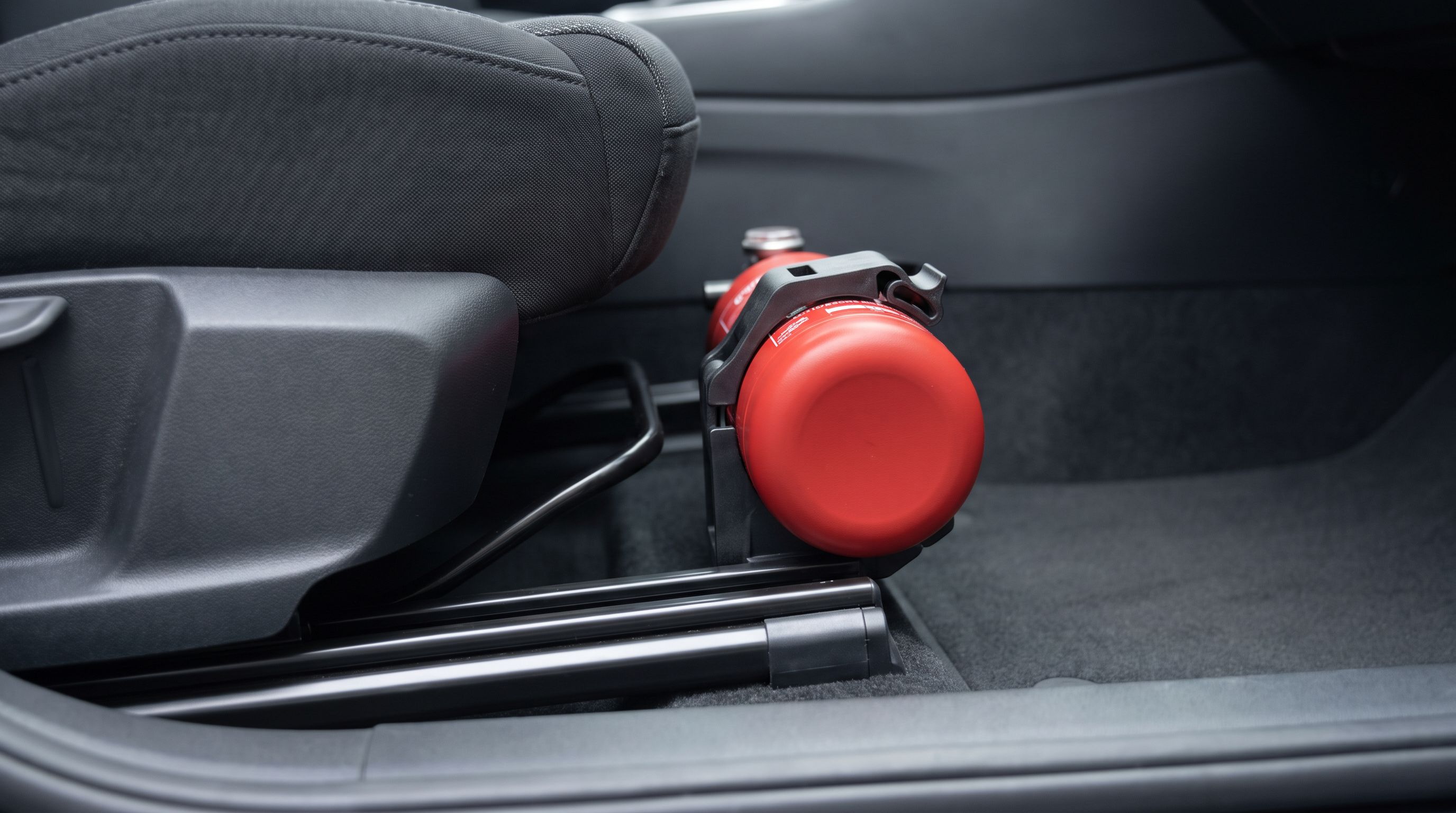
The best extinguisher is the one within arm's reach while you're still belted in. A 5 lb ABC bottle in the trunk of a sedan is nearly useless in the first 30 seconds, which is the window that decides the outcome. Measure your actual mounting location — the seat rail channel, the passenger footwell kick panel, the transmission tunnel, the roll bar, the cargo area wall — before ordering. Under-seat clearance in most modern cars runs tight, especially with power seats and under-seat subwoofers or battery boxes.
4. Insist on a real bracket, and bolt it properly
A loose extinguisher is a 2–5 lb unrestrained mass. In a 30 mph impact it hits with hundreds of pounds of force. Use the manufacturer's metal bracket or a quick-release clamp, bolt it through structure or seat-rail hardware with fender washers, and never trust velcro, bungee cords or a cupholder. Element and H3R both sell vehicle-specific and universal billet mounts; Kidde and Amerex ship serviceable strap brackets. If you're drilling, check underneath first for fuel lines, wiring looms and, in EVs, high-voltage cabling — a sheet-metal screw into an orange cable is a very bad day.
5. Plan for maintenance
Stored-pressure dry chemical and clean-agent extinguishers have a gauge: check it monthly, and invert and tap the bottle a couple of times a year so the powder doesn't compact from road vibration. Most disposable units are replaced rather than recharged; Amerex-style aluminum cylinders can be professionally recharged. Element units have a printed shelf life and no gauge to check — note the date and set a reminder. Vehicle extinguishers live hard lives: heat cycling, vibration, humidity. Replace anything with a dented shell, a corroded head or a gauge outside the green.
The picks
Element E50 — best overall
Prices last checked October 13, 2026. Amazon prices change frequently, so treat these as a guide and check the live price before you buy.
Element E50 Fire Extinguisher
Tiny, no-pressure, 50-second discharge that leaves no corrosive residue — fits almost any cabin.
The Element E50 is the pick we'd put in most daily drivers, because it's the one people actually keep accessible. It's roughly the size of a road flare, has no pressure vessel or gauge to fail, and discharges for about 50 seconds — far longer than a comparable handheld bottle. It works by interrupting the combustion chain chemically rather than smothering with powder, so there's no corrosive residue to scrub out of your dash or engine bay. What it gives up: no UL A:B:C rating to compare directly against conventional units, a finite shelf life rather than a rechargeable cylinder, and a learning curve — you strike it like a flare and must hold it near the base of the flame. Pair it with the quick-release mount.
Kidde Auto Fire Extinguisher 2 lb — budget pick
Kidde Auto Fire Extinguisher 2 lb (Auto 5 BC)
UL-listed 5-B:C dry chemical with a steel head and vehicle bracket — the easy, cheap baseline.
The 2 lb Kidde Auto (the 5-B:C "Auto 5" class of unit) is the sensible default for anyone who currently carries nothing. It's UL listed, has a metal valve assembly rather than all-plastic, includes a vehicle bracket, and offers around 8–12 seconds of discharge on flammable liquid and electrical fires. That's enough to stop a small under-hood fuel leak fire or a wiring fire if you're quick. The compromises are real: dry chemical means a corrosive cleanup, the BC-rated versions lack meaningful Class A capability for upholstery and cargo, and it isn't rechargeable. For the money, it's still the highest-value safety upgrade in your car.
H3R Performance HalGuard HG100R — premium clean-agent pick
H3R Performance HalGuard HG100R
UL-listed Halotron clean agent that won't wreck electronics, wiring or interior trim.
HalGuard is the one to buy if the car is worth protecting from the extinguisher as much as from the fire. It's UL listed, uses Halotron clean agent, discharges as a non-conductive vapor that leaves zero residue, and is a longtime favorite in classic, show and track car circles for exactly that reason. The red powder-coated cylinder and billet bracket options also look at home in a nice interior, which matters more than it should for whether people mount it. Downsides: it's the most expensive route per rating point, the B rating per pound is lower than dry chemical, and Halotron works best on liquid and electrical fires rather than deep-seated Class A material. Consider the larger models if you have room.
Amerex B417 2.5 lb ABC — best for trucks, trailers and shops
Amerex B417 2.5 lb ABC
All-metal 1A:10B:C dry chemical with a real gauge and a rebuildable aluminum cylinder.
If you drive a pickup, tow, overland or want one extinguisher that covers the truck and the garage, the Amerex B417 is the grown-up choice. It's a 1A:10B:C unit in an aluminum cylinder with an all-metal valve, a gauge, and — crucially — it's rechargeable by a licensed service shop rather than disposable. Amerex builds to commercial standards, and the B417 is the size most fleet and marine users land on. The trade-offs are size and agent: at 2.5 lb plus bracket it needs a real mounting location, and the monoammonium phosphate powder will make a corrosive mess of anything it coats. In a work truck, that's an acceptable trade.
H3R Performance MaxOut MX100B — best compact dry chemical
H3R Performance MaxOut MX100B
Compact 1A:10B:C dry chem built for vehicle mounting, with a billet bracket option.
MaxOut is H3R's dry chemical line, built for the same vehicle-mount audience as HalGuard but at a lower price and with higher Class A/B knockdown per bottle. The MX100B is UL listed, carries an ABC rating, and uses the same quality metal valve and bracket ecosystem as the clean-agent models, including billet quick-release mounts that suit roll bars and seat rails. It's the right call if you want maximum firefighting capability in a compact package and you've accepted that a discharge means a thorough cleanup. Choose it over HalGuard when the vehicle is a work car, a trailer, or a build where residue matters less than stopping a fuel fire fast.
When not to fight the fire
Buy the extinguisher, mount it, and then internalize the limits. Get everyone out of the vehicle first. If flames are coming from under the hood, don't open the hood fully — pop the latch and discharge through the gap, because a face full of oxygen turns a smolder into a fireball. If the fire has reached the cabin, the tires, the fuel tank, or an EV's traction pack, or if you can't knock it down within a few seconds of discharge, walk away and call 911. A $50 extinguisher buys you a chance at saving a car. It doesn't buy you a reason to stand near one that's already lost.
FAQ
Is ABC or BC better for a car? ABC is more capable because it adds Class A coverage for upholstery, carpet and cargo, and most car fires involve those materials once they spread. BC units are cheaper and more compact for the same B rating. Both are corrosive dry chemical; neither is kind to your interior or electronics.
Will a fire extinguisher put out an EV battery fire? No. A lithium-ion pack in thermal runaway cannot be extinguished with a portable unit — it reignites because the cells generate their own oxygen and heat. Evacuate and call emergency services. A C-rated extinguisher is still worth carrying in an EV for 12V, charging-equipment, cargo and interior fires.
Where should I mount it? Within reach from the driver's seat: the passenger footwell kick panel, the front of the seat rail, the transmission tunnel, or a roll bar. Trunk mounting is better than nothing but costs you the critical first seconds. Always bolt the bracket to structure — never leave the bottle loose.
Do car fire extinguishers expire? Effectively, yes. Disposable dry chemical units are generally replaced every 5–12 years depending on the manufacturer; condensed-aerosol units like Element have a printed service life; rechargeable units like the Amerex can be serviced and refilled. Check gauges monthly and inspect for corrosion after every winter.
Does one small extinguisher need backup? Many people carry two: a compact unit in the cabin for instant reach, and a larger ABC bottle in the trunk or bed for a fire that needs more agent. It's a cheap redundancy and solves the size-versus-access conflict without compromise.
Get the best car care deals in your inbox
Join the GarageProof newsletter for hand-picked car care deals and new buying guides. No spam, unsubscribe anytime.
Related reads
Car Window Breaker Escape Tool 2026: Spring vs Hammer
Spring-loaded punches fail on laminated side glass. Compare car window breaker escape tools for 2026 and learn which windows in your car can actually be broken.
Battery Terminal Replacement 2026: Top Post vs Side Post
Battery terminal replacement in 2026: how to match top-post, side-post and GM stud fitments, size cable gauge correctly, and which clamp kits are worth buying.
Scissor vs Bottle vs Floor Jack in 2026: What to Carry
Scissor, bottle, or low-profile floor jack? Compare capacity, lift range, and trunk space to pick the best emergency car jack for your vehicle in 2026.