Car Covers in 2026: 4 Picks That Survive Real Weather
The best car cover for outdoor storage balances breathability, fit and tie-downs. We compare semi-custom vs universal covers, fabrics and paint-safe linings for 2026.
Reader-supported: we may earn a commission from links on this page, at no extra cost to you. It never affects our picks. Learn more.
Leaving a car outdoors for months is a slow-motion paint test. UV fades clear coat, acid rain etches it, tree sap bonds to it, and wind-driven grit works like fine sandpaper. A good cover stops most of that. A bad one — wrong size, wrong fabric, no tie-downs — does the sandpaper part itself.
This guide explains how to match a cover to your body style and length, when semi-custom beats universal, and why "waterproof" is often the wrong thing to ask for. GarageProof researches and compares products using manufacturer specifications, independent reviews and verified owner feedback; we don't physically test units.
The short version
- Best overall: Covercraft WeatherShield HP Custom Car Cover
- Best for harsh weather: Seal Skin Supreme Car Cover
- Budget pick: Budge Lite Car Cover
- Best semi-custom value: Kayme 6-Layer Car Cover
 Best semi-custom value · Kayme 6-Layer Car Cover — Check price on Amazon →
 Budget pick · Budge Lite Car Cover — Check price on Amazon →
 Best for harsh weather · Seal Skin Supreme Car Cover — Check price on Amazon →
 Best overall · Covercraft WeatherShield HP Custom Car Cover — Check price on Amazon →
How to choose
Fit: custom, semi-custom or universal
Fit is the single biggest predictor of whether a cover protects paint or damages it. Three tiers exist:
Custom covers are patterned to a specific year, make, model and trim, with mirror pockets, antenna provisions and a hem that follows the rocker line. They're the most expensive and the most likely to stay put in wind.
Semi-custom covers come in a handful of sizes with shaping for a body style — sedan, SUV, hatchback, pickup — plus elasticized front and rear hems. Good ones list a bumper-to-bumper length range. Match your car's actual length, not its "class."
Universal covers are flat-cut rectangles with elastic at each end. They're cheap and fine for a week of pollen, but the excess fabric flaps, and flapping fabric is what polishes dull spots into clear coat.
Before you buy anything, look up your vehicle's overall length in the owner's manual or on the manufacturer's spec page, and measure width at the mirrors and height with any roof rack or shark-fin antenna installed. Roof boxes, lifted suspension, aftermarket wings and tow mirrors all change what fits. If a cover brand offers a year/make/model selector, use it — that's the difference between a cover that hugs the body and one that acts like a sail.
Breathable vs waterproof — pick the right trade-off
"100% waterproof" sounds like the premium option. For long-term outdoor storage it usually isn't.
A fully sealed, non-breathable cover keeps rain out, but it also traps whatever moisture is already under it: dew on the paint, damp carpet, humidity that migrates up from the ground. Warm days drive that vapor out of the car and it condenses on the cover's inner surface, where it sits against the paint. Owners of cheap PVC-backed covers routinely report water spotting, mildew smell and, on older cars, surface rust at panel edges.
What you actually want for outdoor storage is a highly water-resistant, breathable fabric: a coated or laminated nonwoven that sheds liquid water while letting vapor escape. Covercraft's WeatherShield line is the archetype here — marketed as water-resistant and quick-drying rather than hermetically sealed. Multi-layer covers like the Seal Skin Supreme and Kayme 6-Layer stack a waterproof-ish outer film over foam and felt, which is a compromise: more rain resistance, less vapor transfer, so they want a dry car underneath and occasional removal to air out.
Genuinely waterproof covers earn their place in two cases: short-term storm protection, and hail-rated padded covers where impact absorption matters more than airflow. For a car parked outside for a season, breathability wins.
The lining is what touches your paint
Every cover has an inner face, and that's the surface dragging across your clear coat every time wind moves it. Look for a soft nonwoven fleece, brushed cotton or microfiber-style lining. Avoid bare woven polyester or anything that feels slick and hard on the inside.
Two rules matter more than the lining itself:
- Never cover a dirty car. Grit trapped under the lining becomes an abrasive. Wash and dry before covering, and shake the cover out before refitting.
- Never cover a wet car if the cover is multi-layer or low-breathability. Water plus no airflow is how you get mineral spotting.
A coat of wax or a sealant before a long storage stint adds a sacrificial layer and makes the eventual wash far easier.
Wind management: straps, grommets and hems
This is where budget covers fail. A cover that lifts in a gust will either fly off or slap the car repeatedly for hours.
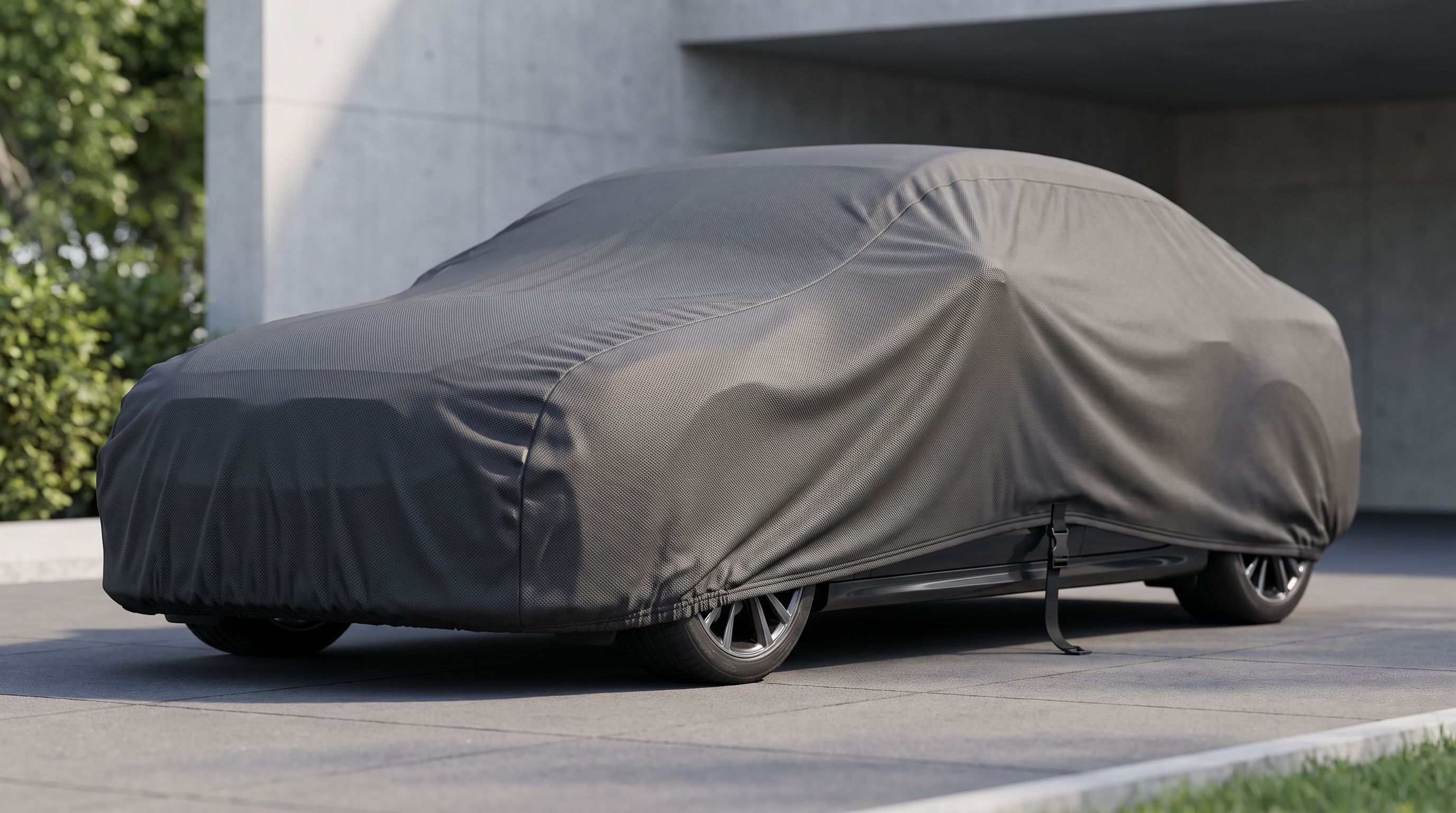
Look for a combination of: elasticized front and rear hems, underbody straps with buckles (usually two or three, routed under the rockers), and reinforced grommets near the wheel arches so you can run a cable or bungee under the car. A driver-door zipper is a genuine convenience if you access the car often — but it's also a wear point and a potential leak path, so it matters less for true long-term storage.
If you park in a genuinely windy or coastal spot, prioritize a snug custom or size-matched semi-custom fit plus straps over any single fabric claim. Fit does more for wind resistance than layer count.
UV and heat: layers vs reflectivity
Sun is the relentless enemy for cars stored outdoors in the South and Southwest. Two approaches: UV-inhibited fabric (the pigment and coating resist breakdown, so the cover itself doesn't chalk and disintegrate) and reflective outer layers (silver or aluminized films that bounce heat). The Kayme 6-Layer uses the reflective approach; Covercraft's WeatherShield HP leans on UV-stable fabric chemistry and comes in colors.
Reflective covers keep cabin temperatures lower, which helps dashboards and leather. But cheap metallized coatings flake after a couple of seasons. Check the manufacturer's warranty length — it's a reasonable proxy for expected outdoor lifespan.
Comparison
| Cover | Fit type | Fabric approach | Wind hardware | Best for |
|---|---|---|---|---|
| Covercraft WeatherShield HP | Custom-patterned by vehicle | Coated, highly breathable, quick-drying | Elastic hems, grommets, optional tie-downs | Year-round outdoor storage where paint condition matters most |
| Seal Skin Supreme | Size-matched semi-custom | Heavy multi-layer, high water resistance | Elastic hems plus straps and buckles | Rain, snow and sustained harsh weather |
| Budge Lite | Universal by size band | Single-layer, light, breathable | Elastic hem | Dust, pollen, short-term parking, garage use |
| Kayme 6-Layer | Semi-custom size bands | Multi-layer with reflective aluminum outer | Straps, buckles, elastic hems | Hot, sunny climates and windy driveways |
The picks
Covercraft WeatherShield HP Custom Car Cover — best overall
Covercraft WeatherShield HP Custom Car Cover
Custom-patterned, highly breathable coated fabric that sheds water without trapping condensation against paint.
Covercraft has been patterning covers to specific vehicles for decades, and that's the main argument here: you order by year, make and model, and the cover arrives with mirror pockets and a hemline that follows your car instead of bunching at the rockers. The WeatherShield HP fabric is built around water resistance plus breathability rather than sealed waterproofing, which is the right priority for a car sitting outside for weeks at a time. It dries fast, resists UV and stays reasonably supple in cold weather.
What it gives up: it's the most expensive option here by a wide margin, it isn't a hail-rated padded cover, and it's only as good as the fitment data you enter — roof racks and aftermarket spoilers need to be declared.
Seal Skin Supreme Car Cover — best for harsh weather
Seal Skin Supreme Car Cover
Heavy multi-layer construction aimed at sustained rain, snow and UV in year-round outdoor storage.
Seal Skin sells size-matched covers with a heavy multi-layer build and is frequently ranked at the top of outdoor-focused roundups for its resistance to sustained rain and snow. The extra layers add mass, which helps the cover sit still in wind, and the included straps and buckles let you cinch it down under the car. If you're in the Northeast or Pacific Northwest and the car sits through a winter, this is a sensible target.
The trade-off is breathability and handling. A thick multi-layer cover is heavier to fit single-handed, slower to dry after a soaking, and wants a clean, dry car underneath. Plan on pulling it off on a dry day occasionally to let everything air out.
Budge Lite Car Cover — budget pick
Budge Lite Car Cover
Light, breathable universal cover for dust, pollen and short-term outdoor parking rather than storm duty.
The Budge Lite is honest about what it is: a light, breathable single-layer universal cover sized by length band. For a car under a pollen-heavy tree, a second vehicle that mostly sits, or covered/carport parking, it does the job cheaply and packs down small. Its breathability is genuinely a strength — there's very little risk of trapping moisture against paint.
What it gives up is everything storm-related. It offers minimal water resistance, no underbody straps in the base configuration, and a loose universal cut that will move in serious wind. Treat it as dust-and-sun insurance rather than weather protection, and don't expect multiple seasons of hard outdoor duty.
Kayme 6-Layer Car Cover — best semi-custom value
Kayme 6-Layer Car Cover
Size-matched universal cover with reflective aluminum outer layer, straps and buckles for windy spots.
Kayme's multi-layer covers are the popular middle ground: pick a size band that matches your car's length and body style, and you get a reflective aluminized outer layer over foam and a soft inner lining, plus straps, buckles and a driver-side zipper on most versions. In hot, sunny climates the reflective face measurably reduces heat soak, and the included wind hardware is better than most covers at this level.
The compromises are real: layered construction breathes less than a single-layer technical fabric, size bands mean the fit is approximate rather than tailored, and reflective coatings on budget covers degrade with years of intense UV. Check the size chart against your actual bumper-to-bumper length before ordering.
Fitment: how to check before you buy
- Find your vehicle's overall length (owner's manual or manufacturer spec sheet) — not the trim level's marketing category.
- Measure width at the mirrors and height including any roof rack, shark-fin antenna or roof box.
- Note anything that protrudes: tow mirrors, a rear wing, a bike rack, a bull bar, a lift kit.
- Match those numbers to the seller's size chart, or use the brand's year/make/model selector if one exists.
- If you're between sizes, size up slightly and rely on straps — an undersized cover stretches, tears at seams and exposes bumpers.
FAQ
Will a car cover scratch my paint? Only if grit gets trapped underneath or the cover flaps against the body. Wash the car first, shake the cover out before each fit, choose a soft lining, and make sure the cover is snug and strapped down. A correctly fitted cover on a clean car is far gentler than months of UV, sap and bird droppings.
Waterproof or breathable — which should I buy for outdoor storage? Breathable and highly water-resistant, in almost all long-term cases. Fully sealed covers trap condensation, which causes water spotting and mildew. Reserve true waterproof covers for short-term storm protection.
Do I need a cover if the car is parked under a carport? A light breathable cover like the Budge Lite still helps with dust, pollen and bird droppings, and it's cheap insurance. You don't need multi-layer weather protection in that situation, and heavy covers are more hassle to fit repeatedly.
How often should I take the cover off? For long-term outdoor storage, pull it off on a dry day roughly monthly. It lets moisture escape, gives you a chance to check for standing water or debris, and stops the cover from bonding to trim in extreme heat.
Can I use a car cover on a wet car? Avoid it with multi-layer covers. If you must, use a highly breathable single-layer cover and remove it as soon as conditions allow. Trapped water is the most common cause of storage paint damage.
Do covers stop hail damage? Standard covers don't. Only thick padded, hail-specific covers offer meaningful impact protection, and even those have limits against large stones. If hail is your main concern, shop specifically for a padded hail cover rather than a general all-weather one.
Get the best car care deals in your inbox
Join the GarageProof newsletter for hand-picked car care deals and new buying guides. No spam, unsubscribe anytime.
Related reads
Spray Wax vs Paint Sealant in 2026: What Lasts a Season?
Spray wax vs paint sealant in 2026: realistic durability windows by climate and wash frequency, plus four protection products that actually survive a full season.
Ceramic vs Graphene Coating for Cars in 2026: Which Wins?
Ceramic coating vs graphene coating for cars in 2026: real durability, prep effort and reapplication intervals compared, plus five DIY picks worth your weekend.
Ceramic Coating for Wheels in 2026: Heat Rating Matters
Which ceramic coating for wheels survives real brake heat? We compare temperature tolerance, cure time and durability for alloy, painted and powder-coated wheels.