Brake Fluid Tester 2026: Pens vs Strips, Honestly
Brake fluid tester guide for 2026: how electronic moisture pens and chemical test strips differ on DOT 3/4/5.1 fluid, plus five picks and how to read results.
Reader-supported: we may earn a commission from links on this page, at no extra cost to you. It never affects our picks. Learn more.
Brake fluid is the one fluid in your car that goes bad by doing its job. It's hygroscopic — it pulls moisture out of the air through reservoir vents, hose walls and seals — and that absorbed water drops the boiling point, rusts bores and lines from the inside, and eventually gives you a pedal that goes soft after a long descent. A brake fluid tester is the cheap way to stop guessing about it.
The catch: there are two completely different technologies sold under the same name, and they measure two different things. Electronic pens measure water. Chemical strips measure chemistry. Knowing which answer you actually need is most of this decision.
The short version
- Best overall: Performance Tool W181 Brake Fluid Moisture Tester
- Best test strips: Phoenix Systems BrakeStrip Brake Fluid Test Strips
- Best for workshop use: AUTOOL AS502 Brake Fluid Tester
- Best budget pen: TESMEN TBF-300 Brake Fluid Tester
- Best for mixed fleets: OTC 3892 Brake Fluid Tester
 Best test strips · Phoenix Systems BrakeStrip Brake Fluid Test Strips — Check price on Amazon →
 Best overall · Performance Tool W181 Brake Fluid Moisture Tester — Check price on Amazon →
Pens vs strips: what each one actually measures
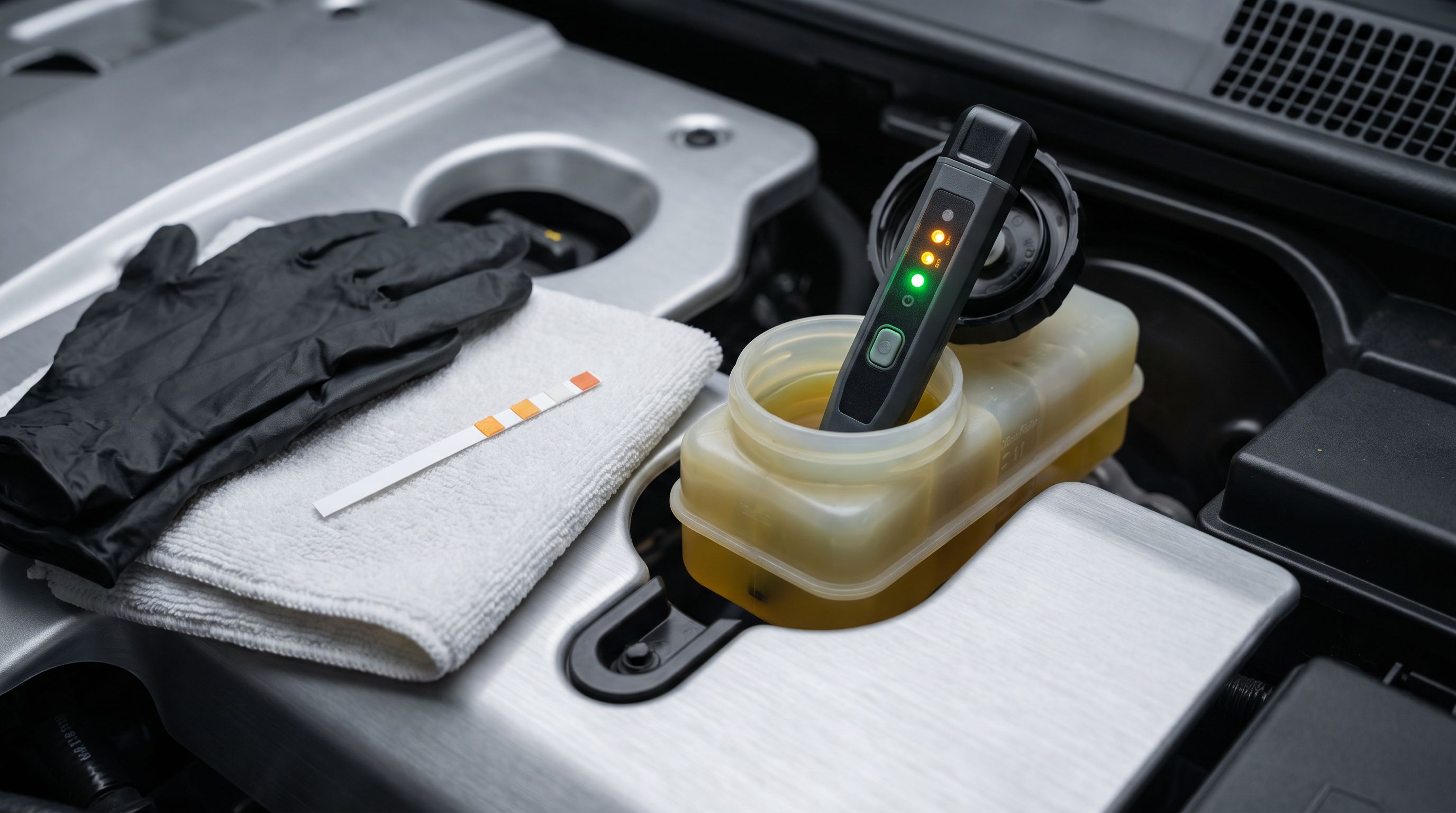
An electronic tester is a probe with two small electrodes on the tip. You dip it in the master cylinder reservoir, it passes a small current through the fluid, and it infers water content from the fluid's electrical behaviour. The result is shown as LEDs (typically green / yellow / red bands roughly corresponding to under 1%, 2%, 3%, 4%+ water) or as a number on a small screen. It takes about five seconds and costs very little.
A chemical test strip is a paper or plastic strip with a reagent pad. You dip it, wait the specified time, and compare the colour against a chart on the package. The better strips — Phoenix Systems BrakeStrip is the reference product here — are not looking for water at all. They detect copper in solution, which leaches out of brazed steel brake line joints as the fluid's corrosion inhibitor package wears out. Rising copper is an indirect but well-regarded indicator that the additive package is spent.
That distinction matters more than most buyers realise. Fluid can read low on moisture and still be chemically exhausted, particularly in a car driven hard, or one where fluid has sat for six or seven years in a dry climate. Conversely, fluid can show measurable water while its inhibitors still have life left. Pens and strips are not competing answers to one question; they're two questions.
Where each one is weak
Electronic pens are sensitive to the fluid type. DOT 3, DOT 4 and DOT 5.1 are all glycol-ether based and conduct similarly enough that one calibration can cover them — which is why most pens list all three. DOT 5 is silicone and does not play by those rules at all; it's not hygroscopic, water separates rather than dissolving, and a conductivity pen reading on DOT 5 is meaningless. If your vehicle runs DOT 5 (some classic restorations and specific military-spec applications), neither a pen nor a copper strip is the right tool — you're looking for free water pooling at the low points, and a fluid change on a schedule.
Pens also only read what's in the reservoir. Reservoir fluid is the newest, coolest fluid in the system. The water concentrates down at the calipers, where the heat is and where it does the damage. Real-world moisture at the caliper bleeders is routinely higher than at the reservoir, which is why a "yellow" reservoir reading is best treated as a red flag rather than a pass.
Strips have their own gripes. They're consumables, the colour comparison is subjective in bad lighting, and timing matters — read too early or too late and you get a different answer. Owner reviews consistently note that results are easier to call on a clean white background in daylight than squinting under a bonnet at dusk.
Comparison table
| Tester | Type | What it measures | DOT compatibility | Readout | Best for |
|---|---|---|---|---|---|
| Performance Tool W181 | Electronic pen | Water content | DOT 3, 4, 5.1 | 5 LEDs | Home mechanics wanting one reliable tool |
| Phoenix BrakeStrip | Chemical strip | Copper / inhibitor depletion | DOT 3, 4, 5.1 (glycol) | Colour chart | Deciding whether fluid is chemically spent |
| AUTOOL AS502 | Electronic, digital | Water content | DOT 3, 4, 5.1 | Numeric % + LEDs | Shops testing many vehicles |
| TESMEN TBF-300 | Electronic pen | Water content | DOT 3, 4, 5.1 | LEDs | Cheapest credible go/no-go check |
| OTC 3892 | Electronic pen | Water content | DOT 3, 4, 5.1 (selectable) | LED scale | Mixed fleets, varied fluid specs |
Always confirm the specific fluid type your vehicle calls for before testing. It's printed on the master cylinder reservoir cap and in the owner's manual — and on some European cars the requirement is a specific low-viscosity DOT 4 (often labelled DOT 4 LV or an OEM part number) for ESP and ABS pump operation, not just "any DOT 4."
How to choose
Match the tool to the fluid, not the car
Glycol fluids (DOT 3, DOT 4, DOT 4 LV, DOT 5.1) are what electronic testers are calibrated for, and essentially every pen on this list covers all three. If a listing doesn't explicitly name the DOT grades it's calibrated for, treat that as a reason to skip it. If your vehicle uses DOT 5 silicone, skip moisture pens entirely. Also worth noting: a brake fluid pen is the wrong tool for hydraulic clutch fluid only if your clutch uses something else — most cars share the brake reservoir or specify the same DOT fluid, in which case the same tester works fine.
Decide whether you need a number or a traffic light
LED pens give you bands. Digital testers like the AUTOOL AS502 give a percentage. For a home mechanic deciding "flush or don't flush," bands are plenty — the industry rule of thumb is that 3% water content is the action point, and many manufacturers simply specify a time-based interval (commonly two years) regardless. For a shop that has to justify a flush to a customer, a number on a screen is a better conversation than "the yellow one lit up."
Accept that cheap conductivity testers scatter
This is the single most common complaint in owner feedback across every brand in this category, including well-known ones: dip the same fluid three times and you may get two different LEDs. Contaminated probe tips, temperature differences and fluid additives all move the needle. The practical workaround, repeated by experienced users, is to test three or four times, wipe the probe with a clean lint-free cloth between dips, and act on the worst reading. Treat these tools as a screening device, not a laboratory instrument. If a result is borderline and the fluid's age is unknown, flush it — brake fluid is one of the cheapest insurance policies on the car.
Consider buying both
The pens and the strips cost very little individually. A pen plus a pack of BrakeStrip gives you both halves of the picture: water content and inhibitor life. That combination is what professional advice generally points toward, and it removes the main failure mode of either tool used alone — passing fluid that's chemically dead because the moisture number looked fine.
The picks
Performance Tool W181 — best overall
Prices last checked October 30, 2026. Amazon prices change frequently, so treat these as a guide and check the live price before you buy.
Performance Tool W181 Brake Fluid Moisture Tester
Simple 5-LED pen calibrated for DOT 3, 4 and 5.1 with a wide, widely-reported-consistent readout.
The W181 is the default recommendation for a reason: it's a plain five-LED pen explicitly calibrated for DOT 3, DOT 4 and DOT 5.1, with a scale that's easy to read at a glance and no menus to navigate. Battery-powered, pocket-sized, and simple enough that you'll actually use it at every oil change instead of leaving it in a drawer. What it gives up is resolution — you get a band, not a percentage, so a reading sitting between two LEDs needs the repeat-and-take-the-worst approach. It also tells you nothing about inhibitor depletion. For a home garage running one to four cars, it's the right amount of tool.
Phoenix Systems BrakeStrip — best test strips
Phoenix Systems BrakeStrip Brake Fluid Test Strips
Copper-content strips flag corrosion inhibitor depletion, not just water — the thing pens can't see.
BrakeStrip answers the question pens can't: is the corrosion inhibitor package still alive? By reading copper in solution, it flags fluid that has chemically aged out even when moisture content looks acceptable. For older vehicles, long-interval fluid, or any car where you genuinely don't know when the brakes were last serviced, this is the more meaningful test. The trade-offs are real: it's a consumable, you need decent lighting to judge the colour, and timing the read matters. It also won't give you a moisture figure, so pairing it with a pen is the sensible move rather than treating it as a replacement.
AUTOOL AS502 — best for workshop use
AUTOOL AS502 Brake Fluid Tester
Digital percentage readout with DOT selection, aimed at shops checking many cars a day.
The AS502 sits a step above the basic pens, with a digital moisture percentage and DOT type selection, and it's commonly positioned as a reasonably priced professional option for daily workshop use. The numeric output is the real advantage: it documents better, it supports a service recommendation, and it removes the between-two-LEDs ambiguity of cheaper pens. Downsides are that you're paying more for data a home user may not need, and no electronic tester escapes the fundamental limitation of only sampling reservoir fluid. If you're testing one car every couple of years, this is more instrument than the job requires.
TESMEN TBF-300 — best budget pen
TESMEN TBF-300 Brake Fluid Tester
Cheap, pocketable LED pen that's good enough for a go/no-go decision on your own cars.
The TBF-300 is the entry point: an inexpensive LED pen covering the glycol DOT grades, light enough to live in a glovebox or toolbox tray. It regularly appears in roundups of digital brake fluid testers, and for a straight go/no-go screening it does the job. Expect the usual budget-tier caveats — some reading scatter between dips, no percentage readout, and build quality that's functional rather than confidence-inspiring. Buy it if you want to start checking fluid at all and have been putting it off because of cost; upgrade later if you find yourself testing frequently.
OTC 3892 — best for mixed fleets
OTC 3892 Brake Fluid Tester
Tool-brand pen with DOT fluid selection and a clear LED scale for garages running varied fluid specs.
OTC is a known professional tool brand, and the 3892 brings fluid-type selection to a simple LED pen format. That selectability is the differentiator when you're moving between a DOT 3 domestic truck, a DOT 4 European sedan and a DOT 5.1 performance car in the same afternoon — you're not relying on one blanket calibration. It's a pen, so you still get bands rather than numbers, and you still only read the reservoir. For an independent shop, a club garage or anyone maintaining several vehicles with different fluid specs, the extra certainty about calibration is worth the step up from the cheapest options.
How to test properly (and not ruin your paint)
- Park level, engine off, cool system. Clean the reservoir cap and surrounding area before opening — grit falling into the reservoir is worse than mild moisture.
- Open the cap. Dip the probe to the depth marked on the tool, not deeper. Avoid touching the reservoir walls or the strainer.
- Read, wipe with a clean lint-free cloth, repeat two or three times. Act on the worst result.
- For a true picture, crack a caliper bleeder on the furthest wheel and test that fluid too. It's the oldest, hottest fluid in the system and tells the real story.
- Cap it promptly. Brake fluid strips paint fast — wipe spills immediately with water.
If you're flushing based on the result, remember that a proper flush pushes fresh fluid all the way to each caliper in the manufacturer's sequence, and many ABS-equipped vehicles need a scan tool to cycle the modulator pump for a complete change.
FAQ
At what moisture level should I change brake fluid? Three percent water content is the widely used action threshold, and many testers put their red zone there. Plenty of manufacturers sidestep the measurement entirely and specify a time interval — commonly every two years — which remains good practice even if your tester reads green.
Do these testers work on DOT 5 silicone fluid? No. Electronic conductivity pens are calibrated for glycol-based DOT 3, DOT 4 and DOT 5.1. DOT 5 silicone doesn't absorb water the same way, so a reading from it is not meaningful. Service DOT 5 systems on a time schedule instead.
Can I use a brake fluid tester on clutch fluid? Yes, if the clutch uses the same glycol DOT fluid — which is typical. Many hydraulic clutches share the brake master cylinder reservoir, and clutch fluid is often in worse shape than brake fluid because it's rarely changed.
Why do I get different readings each time? Conductivity testing is sensitive to probe cleanliness, fluid temperature and additive variation. This is normal across the category, cheap and expensive alike. Wipe the probe, test three or four times, and treat the worst reading as the real one.
Are test strips more accurate than electronic testers? They're not more accurate at measuring water — they don't measure water. Copper strips measure inhibitor depletion, which is a different and arguably more decision-relevant signal. The strongest approach is using both: a pen for moisture, strips for chemistry.
Is a brake fluid tester worth it at all? For the cost of a few coffees, yes — mostly as a prompt. It turns "I think the brakes were done a while ago" into a dated, documented check, and it catches neglected used-car purchases before the first hard stop does.
Get the best car care deals in your inbox
Join the GarageProof newsletter for hand-picked car care deals and new buying guides. No spam, unsubscribe anytime.
Related reads
ABS SRS Code Reader 2026: Check Coverage Before You Buy
An ABS SRS code reader is only as good as its vehicle list. Here are the mid-tier scan tools worth buying in 2026 — and how to verify coverage for your car first.
Car Battery Load Tester 2026: AGM and Mild-Hybrid Traps
A car battery load tester has to match your chemistry. Compare conductance analyzers for AGM, EFB, lithium and 48V mild-hybrid systems in 2026.
TPMS Relearn Tools in 2026: Check Coverage Before You Buy
A 2026 buying guide to TPMS relearn and programming tools, focused on vehicle coverage lists, sensor cloning and OBD relearns — verify your make before you buy.