Bluetooth Car Battery Monitors 2026: Shunt or Terminal Clamp?
Compare Bluetooth car battery monitors for 2026: terminal clamps vs shunts, AGM and lithium profiles, parasitic drain logging, and terminal fitment checks.
Reader-supported: we may earn a commission from links on this page, at no extra cost to you. It never affects our picks. Learn more.
The short version
- Best overall: Victron SmartShunt 500A — true coulomb counting with AGM/lithium/gel profiles and proper state-of-charge math.
- Best simple terminal clamp: Ancel BM200 — bolts to the posts, logs cranking voltage and charging voltage, no wiring loom surgery.
- Budget pick: Quicklynks BM2 (Battery Monitor BM2) — the cheap, widely used 12V Bluetooth monitor that quietly catches a dying battery.
- Best for powersports and lithium starters: Antigravity Battery Tracker — built around Antigravity's lithium/lead-acid ecosystem with voltage history and cranking analysis.
- Best for DIY drain hunting: Victron SmartShunt 300A — same shunt intelligence, smaller current ceiling, easier to tuck into a tight engine bay or trunk.
 Best simple terminal clamp · Ancel BM200 Bluetooth Battery Monitor — Check price on Amazon →
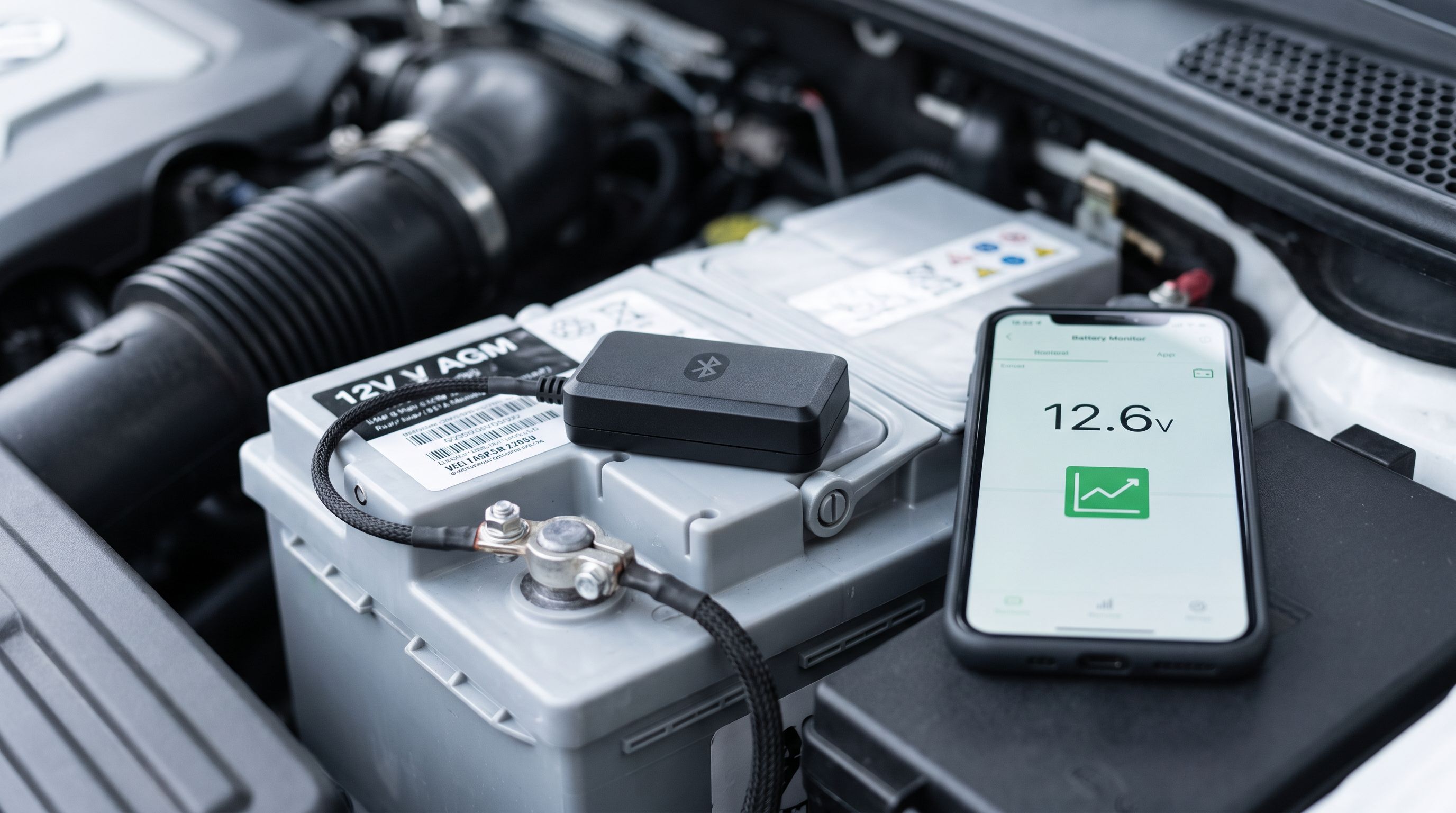
A no-start almost never arrives without warning. Batteries telegraph their decline for weeks: resting voltage sags a tenth at a time, cranking voltage dips lower each cold morning, the alternator works harder on the drive home. The problem is that nobody is watching. A bluetooth car battery monitor fixes that for less than the cost of a tow, and in 2026 the category has split into two genuinely different tools that get lumped together on retail pages.
The first is a terminal-mounted voltage logger — a small puck that clamps or bolts onto the battery posts, samples voltage continuously, and streams it to your phone over Bluetooth Low Energy. The second is a shunt-based monitor, which measures current flowing in and out of the negative terminal and actually counts amp-hours. Both talk to an app. They do not answer the same questions.
This guide compares the options on the three things that matter most for a daily-driven vehicle: whether the hardware physically fits your battery terminals, whether the app understands AGM and lithium chemistry instead of assuming flooded lead-acid, and whether it can log parasitic drain overnight so you can find the module that's killing your battery.
Terminal clamp vs. shunt: which problem are you solving?
A voltage-only monitor tells you the battery's state. A shunt tells you the battery's state plus everything moving through it.
For most people, voltage is enough. Resting voltage at 12.4V instead of 12.7V means you're partially discharged. Cranking voltage dropping below roughly 10V on a warm start suggests failing cells. Charging voltage stuck at 13.0V points at the alternator or a smart-charging strategy, not the battery. All of that comes from a $20–$40 terminal device.
But voltage cannot tell you how many milliamps are leaking out while the car sleeps. If you're chasing a parasitic drain — an aftermarket alarm, a telematics dongle, an infotainment head unit that won't go to sleep — you want current measurement. That's the shunt's job, and it's why the Victron SmartShunt 500A keeps showing up in overland, van-build and tuner forums despite being sold primarily as a marine and solar product.
There's a third consideration specific to 2026: more vehicles now use AGM or EFB batteries from the factory, and a growing number of enthusiasts run lithium (LiFePO4) starter batteries. These chemistries have completely different voltage curves. An AGM at 12.8V resting is healthy; a LiFePO4 at 12.8V is roughly half discharged. A monitor that assumes flooded lead-acid will give you confidently wrong state-of-charge numbers.
Comparison table
| Model | Type | Chemistry profiles | Parasitic drain logging | Mounting | Best for |
|---|---|---|---|---|---|
| Victron SmartShunt 500A | Negative-lead shunt, amp-hour counting | Configurable: flooded, AGM, gel, LiFePO4 (Peukert, charge efficiency, tail current) | Yes — reads live current draw in mA/A, historical deep-discharge log | Inline on negative cable; needs cable work and a fuse on the sense wire | Owners who want real SOC and drain hunting |
| Ancel BM200 | Terminal-mounted voltage logger | Lead-acid, AGM, gel selectable in app | Indirect — voltage decay trend only | Ring terminals / clamps onto both posts | Daily drivers, easy install, cranking analysis |
| Quicklynks BM2 | Terminal-mounted voltage logger | Primarily lead-acid/AGM voltage thresholds | Indirect — overnight voltage curve | Ring terminals onto both posts | Lowest-cost early warning |
| Antigravity Battery Tracker | Terminal-mounted voltage logger | Lead/acid version and lithium-aware ecosystem | Indirect — voltage history | Terminal leads, compact for bikes/powersports | Motorcycles, track cars, lithium starters |
| Victron SmartShunt 300A | Negative-lead shunt | Same as 500A | Yes | Inline on negative cable, smaller footprint | Tight engine bays, smaller 12V systems |
 Best for DIY drain hunting · Victron Energy SmartShunt 300A/50mV — Check price on Amazon →
The picks
Victron SmartShunt 500A — best overall
Prices last checked October 19, 2026. Amazon prices change frequently, so treat these as a guide and check the live price before you buy.
Victron Energy SmartShunt 500A/50mV
True amp-hour counting with configurable AGM, gel and LiFePO4 profiles plus live parasitic-drain readout.
This is the only device here that actually knows how much energy is in your battery, because it counts every amp-hour in and out rather than inferring from voltage. In the VictronConnect app you set battery capacity, chemistry, charged-voltage threshold, tail current and Peukert exponent — which means an AGM or LiFePO4 bank gets modelled correctly instead of being judged against a flooded lead-acid curve. Live current readout makes parasitic drain hunting straightforward: lock the car, wait for modules to sleep, watch the milliamps.
What it gives up: installation. The shunt must sit inline on the negative battery cable, so you're cutting or re-terminating a cable and fusing the positive sense wire. There's no cranking-specific analysis screen like the clamp-on monitors offer. It's overkill if you just want a heads-up before winter.
Ancel BM200 — best simple terminal clamp
Ancel BM200 Bluetooth Battery Monitor
Bolts to the posts and logs resting, cranking and charging voltage with a battery-type selector.
The BM200 is the sweet spot for someone who wants useful data without touching the negative cable. It bolts to both terminals, then reports resting voltage, cranking voltage during start, and charging voltage once the engine is running — the three numbers that diagnose most 12V complaints. The app plots history, so you can see whether last Tuesday's cold start pulled the battery down further than the week before, and it lets you pick a battery type so thresholds suit AGM rather than only flooded cells.
What it gives up: no current measurement. It can suggest a drain by showing overnight voltage decay but it can't tell you the drain is 140 mA versus 35 mA. Fitment also depends on your terminal style — top-post is easy, side-post and some European clamp designs need adapters.
Quicklynks BM2 — budget pick
Quicklynks BM2 Bluetooth Battery Monitor
The cheap, widely used 12V monitor that quietly catches a dying battery before a no-start.
The BM2 is the device that shows up constantly in owner forums, including EV threads where the 12V accessory battery is the weak link. It's inexpensive, it's small, and the free Battery Monitor BM2 app on iOS and Android gives you live voltage, a cranking-voltage reading and a charging-voltage reading. For a second car, a seasonal convertible or a vehicle that sits for weeks, it's the cheapest meaningful insurance you can buy.
What it gives up: polish and depth. The app is functional rather than elegant, chemistry handling is basic, and there is no current measurement. Build quality is adequate rather than rugged. Treat it as a smoke detector, not a diagnostic lab — but a smoke detector that works is worth a great deal.
Antigravity Battery Tracker — best for powersports and lithium starters
Antigravity built this around its own battery ecosystem, which matters if you run a lithium starter battery in a motorcycle, track car or UTV. The unit is physically small — important when you're mounting under a seat rather than in a wide engine bay — and the app tracks voltage, charging performance and starting performance over time. There's a dedicated lead/acid version, so match the variant to what's actually in your vehicle rather than assuming one SKU covers both.
What it gives up: it's a voltage logger, not a shunt, so parasitic drain is inferred rather than measured. It also makes most sense within Antigravity's own world; if you're running a generic AGM in a daily driver, the Ancel BM200 covers similar ground.
Victron SmartShunt 300A — best for DIY drain hunting
Victron Energy SmartShunt 300A/50mV
Same shunt intelligence in a smaller package that fits tight engine bays and single-battery cars.
Mechanically and functionally this is the 500A's smaller sibling, and for a typical passenger car it's often the more sensible choice. Starter current spikes are brief and the shunt's continuous rating is what matters for the loads you'll actually monitor, so the 300A handles accessory circuits, auxiliary batteries and drain diagnostics without the larger unit's footprint. The same VictronConnect configuration applies: set chemistry, capacity and tail current, then read genuine state of charge.
What it gives up: headroom. If you're building a dual-battery overland rig with a big inverter, step up to the 500A. And like its sibling, it demands a proper inline installation on the negative cable — this is a weekend job with a crimper, not a two-minute clip-on.
How to choose
Check your terminal type before you order
This is the number one cause of returns. Top-post batteries with standard SAE posts accept nearly every clamp-on monitor. Side-post batteries (common on some GM products) and JIS posts (smaller, found on many Japanese vehicles) often need adapters or different ring terminals. European vehicles with battery sensors already bolted to the negative terminal can leave you short on stud length for a second ring terminal.
Before buying: open the hood, photograph both terminals, and note whether the negative post already has an intelligent battery sensor (IBS) module attached. If it does, do not stack a monitor ring under that sensor's clamp — it can corrupt the vehicle's own charge-management readings. Route to a different grounding point or choose a shunt placed downstream of the factory sensor.
Match the chemistry profile to what's in the car
Flooded lead-acid, EFB, AGM and LiFePO4 all rest and charge at different voltages. If your monitor only offers one voltage table, its "state of charge" percentage is a guess. Shunt-based units like the Victron SmartShunt let you enter chemistry-specific parameters. Among terminal monitors, look for an explicit battery-type selector — the Ancel BM200 has one; the cheapest units often don't.
If you've installed a lithium starter battery, this is non-negotiable. A LiFePO4's voltage curve is nearly flat across most of its usable range, so voltage-only monitoring is close to useless for SOC and only useful for spotting hard faults.
Decide whether you need actual current measurement
Ask yourself what triggered the purchase. "My battery died twice last winter and I want warning" → terminal monitor. "Something is draining my battery over four days and I need to find it" → shunt. Voltage decay can hint at a drain, but you'll waste a weekend pulling fuses blind. A shunt's live milliamp readout lets you pull one fuse at a time and watch the number drop.
Consider Bluetooth range, battery drain and app health
These devices are themselves a small parasitic load — typically tiny, but meaningful on a car that sits for months. Some offer a sleep mode; check before storing a vehicle long-term. Also check that the app is actively maintained. Several well-reviewed monitors from a few years ago now have app compatibility complaints on current phone OS versions. In an independent comparison round-up of 12V Bluetooth monitors, app reliability — not sensor accuracy — was the deciding factor between units, which matches the pattern in owner feedback across forums.
Know what a monitor can't do
A Bluetooth monitor measures voltage and, with a shunt, current. It does not perform a load test or measure internal resistance the way a proper conductance tester does. It will strongly suggest a failing battery through sagging cranking voltage, but confirm with a load test before replacing anything expensive.
Installation notes worth two minutes
Disconnect the negative terminal first, reconnect it last. Expect to reset clock and radio presets on older vehicles; on newer ones, consider a memory saver, and be aware some vehicles require a battery registration (BMS reset) procedure after a disconnect — look up whether yours does before you start.
Torque terminal clamps properly. Over-tightening a lead post deforms it; under-tightening causes exactly the voltage drops you're trying to diagnose. For shunt installs, use adhesive-lined heat shrink on crimped lugs and fuse the positive sense lead close to the battery.
FAQ
Will a Bluetooth battery monitor drain my battery? The device's own draw is small — generally in the single-digit milliamp range or less — which is negligible on a weekly-driven car. On a vehicle stored for months, it's worth disconnecting the monitor or the battery entirely, or using a maintainer.
Can I use one on an EV or hybrid? On the 12V auxiliary battery, yes — and it's genuinely useful, since 12V failures are a common cause of EV no-starts. Owners on EV forums report running the Quicklynks BM2 on the 12V battery for years. Never connect any of these to the high-voltage traction pack.
What voltage means my battery is failing? As a rough guide for lead-acid/AGM: around 12.6–12.8V rested means healthy, 12.4V is roughly 75%, 12.2V is roughly 50%. During cranking, dropping below about 9.6–10V on a warm engine points to a weak battery. Charging should typically sit near 13.8–14.7V with the engine running, though vehicles with smart charging deliberately vary this.
Does a monitor replace a battery tester? No. A monitor gives you trends over time, which a one-off tester can't. A conductance or load tester gives you a health verdict a monitor can't. They're complementary; the monitor tells you when to run the tester.
Can I use one monitor across two cars? Physically yes, but you lose the trend history that makes these useful. These are cheap enough to leave installed permanently — which is the entire point.
Our picks

Antigravity Batteries Battery Tracker (Lead/Acid)
Compact Bluetooth tracker for bikes and track cars, with voltage history and cranking analysis.
Get the best car care deals in your inbox
Join the GarageProof newsletter for hand-picked car care deals and new buying guides. No spam, unsubscribe anytime.
Related reads
No-Start Diagnosis in 2026: Testers vs. Guessing
Load testing, conductance testers and parasitic draw checks explained — why a battery can "test good" and still leave you stranded, and which cheap tools actually find the fault.
Dash Cam Hardwire Voltage Cutoff 2026: Match It to Your Battery
How to set dash cam hardwire voltage cutoff for AGM, flooded, and stop-start batteries in 2026 — plus four hardwire kits with user-adjustable cutoff points.
Battery Tender for a Stored Car in 2026: Amps by Ah
How to match a battery tender to your stored car's Ah rating and chemistry in 2026 — amperage math, AGM and lithium modes, and four maintainers worth buying.