Bidirectional Scan Tools in 2026: 4 Picks That Actually Bleed ABS
Which bidirectional scan tool actually unlocks ABS bleeds, EPB retraction and DPF regens? We compare mid-tier 2026 scanners on actuations, resets and coverage.
Reader-supported: we may earn a commission from links on this page, at no extra cost to you. It never affects our picks. Learn more.
Bidirectional is one of the most abused words in the tool aisle. Plenty of scanners advertise it while only offering a handful of actuations on a narrow list of vehicles — and the one function most home mechanics actually bought the tool for, an ABS module bleed, quietly isn't there for their car.
This guide is about closing that gap. We compared mid-tier bidirectional scan tools using manufacturer function lists, published vehicle coverage charts, independent reviews and verified owner feedback, and focused on the same question throughout: on your car, will this thing cycle the ABS pump, retract the electronic parking brake, relearn the throttle body and reset the steering angle sensor? Those four jobs cover the bulk of DIY brake, suspension and drivability work.
The short version
- Best overall: Autel MaxiCOM MK808Z-BT
- Best coverage for the money: Launch X431 PRO Elite
- Best compact pick: Topdon Phoenix Nano
- Budget pick: Mucar BT200 Pro
 Budget pick · Mucar BT200 Pro — Check price on Amazon →
 Best compact pick · Topdon Phoenix Nano — Check price on Amazon →
 Best coverage for the money · Launch X431 PRO Elite — Check price on Amazon →
 Best overall · Autel MaxiCOM MK808Z-BT — Check price on Amazon →
What "bidirectional" really buys you
A basic code reader listens. A bidirectional tool talks back — it sends commands to a module and makes the hardware move. In practice that splits into three tiers of capability, and the marketing rarely distinguishes between them.
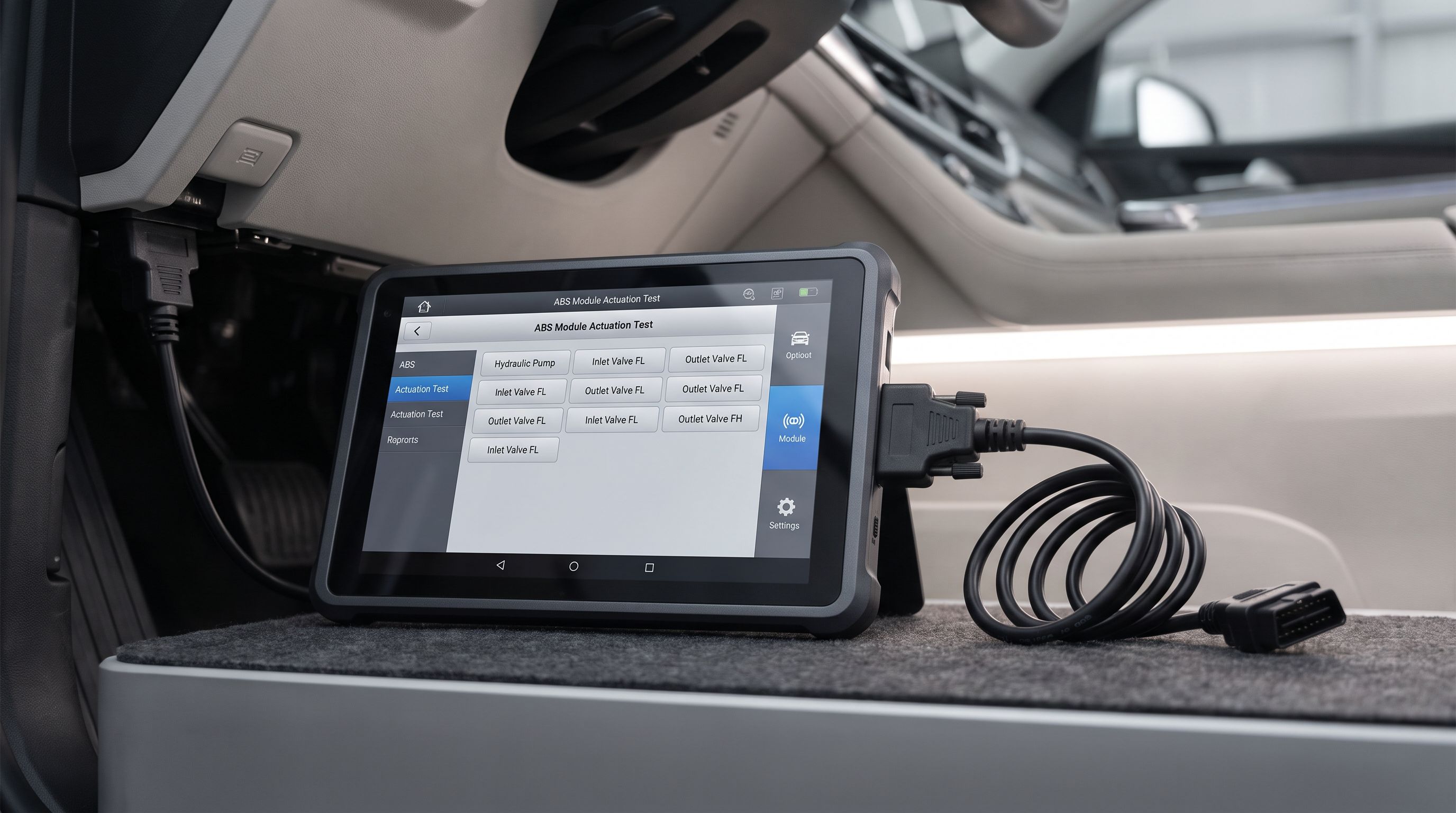
Active tests (actuations). The tool commands a component directly: cycle the ABS solenoids and pump motor, fire an injector, spin a cooling fan, energize a purge valve, toggle a relay. This is the tier that turns a two-hour guessing game into a five-minute confirmation.
Service resets and relearns. Oil life, EPB retract/extend for rear pad jobs, throttle body relearn after cleaning, steering angle sensor (SAS) calibration after an alignment or rack job, TPMS relearn, battery registration/BMS reset on cars with smart charging, DPF regeneration on diesels, and injector coding.
Coding and adaptations. Changing module configuration — retrofitting options, adapting a replacement module, adjusting comfort settings. At the $150–$600 level you'll get some of this on some brands, usually a curated list of common adaptations rather than open-ended variant coding. Treat any coding claims in this price band as a bonus, not a guarantee.
The honest summary: nearly every tool here does active tests on the powertrain and ABS of mainstream Toyota, Honda, Ford, GM and Stellantis vehicles. Where they separate is European coverage, newer model years, CAN FD and DoIP support, and how many systems beyond engine/ABS/airbag/transmission they'll actually open.
How to choose
Start with the ABS bleed — and verify it by model
An automated ABS bleed is not a generic function. The tool has to hold a specific routine for that module (Bosch 9, Continental MK100, Mando, Nissin, etc.), and coverage is published per make, model and year. Before you buy anything, go to the manufacturer's vehicle coverage lookup, enter your exact year/make/model, and confirm the words you need appear: "ABS bleeding," "ABS automated bleed" or "HCU bleed." Do the same for EPB, SAS and any other reset you care about.
This matters most if you've opened the hydraulic system upstream of the modulator — replaced a master cylinder, an ABS unit, or run the reservoir dry. On many modern vehicles you physically cannot purge air from the HCU chambers without commanding the pump, and a conventional pedal bleed will leave you with a spongy pedal forever.
Match the protocol to your model year
If your newest vehicle is 2020 or later, check two acronyms. CAN FD (flexible data rate) appears on many GM vehicles from roughly 2020 onward and a growing list of others; without it the tool may not communicate at all. DoIP (Diagnostics over Internet Protocol) is used by recent Jaguar Land Rover, BMW, Volvo and others for high-speed module access. Most 2026-era tools in this bracket support both, sometimes via an adapter cable — but "supports CAN FD" on the box isn't the same as "supports your car," so check the coverage list again.
Understand the subscription model before you commit
Almost every brand here bundles an initial update period — commonly one or two years — then charges annually to keep adding new model years and functions. Crucially, most tools keep working on their existing coverage after the subscription lapses; you just stop receiving new vehicle support and bug fixes. If you're diagnosing a 2014 Silverado for the next decade, a lapsed subscription is a non-issue. If you buy a new car every three years, budget for renewals as part of the tool's real cost.
Count systems, not features
Look for "all systems" or "full system" coverage and a printed list. Four-system tools (engine, ABS, SRS, transmission) will not touch your body control module, HVAC, transfer case, immobilizer or gateway. That's fine for brake and drivability work, and a dealbreaker the day a window regulator module or a BCM-controlled lighting fault shows up.
Live data quality is a real differentiator
Bidirectional control is only half the diagnostic loop. The other half is watching PIDs while you command something. Prioritize tools with graphing, multi-PID overlay, and a data recording/playback function you can review after a road test. Slow or stuttery sampling makes intermittent faults nearly impossible to catch.
Comparison table
| Tool | Best for | System coverage | ABS bleed | Typical reset set | Notes |
|---|---|---|---|---|---|
| Autel MaxiCOM MK808Z-BT | All-round DIY + side-gig work | All systems on supported vehicles | Yes, on a broad list of makes — verify by VIN | Oil, EPB, SAS, BMS, TPMS, DPF, throttle, injector | Wireless VCI, mature software, largest active-test library in class |
| Launch X431 PRO Elite | Mixed European/Asian fleets | All systems on supported vehicles | Yes, wide published coverage | Very long list including common coding/adaptations | Strongest breadth per dollar; UI is busier |
| Topdon Phoenix Nano | Space-constrained, phone/tablet users | All systems on supported vehicles | Yes on supported models | Core resets plus extended list by brand | No screen of its own — needs your device |
| Mucar BT200 Pro | First bidirectional tool, one or two family cars | All systems on supported vehicles | Model-dependent — check before buying | Oil, EPB, SAS, throttle, TPMS, BMS | Best value entry point; thinner European depth |
The picks
Autel MaxiCOM MK808Z-BT — best overall
Autel MaxiCOM MK808Z-BT
Broad system coverage, reliable active tests and a mature ABS bleed routine across most mainstream brands.
Autel's MK808Z-BT is the default recommendation for a reason: it pairs a full-system tablet with a Bluetooth VCI, and its active-test library is the deepest thing you'll find without stepping up to professional-tier pricing. Reviewers consistently single it out for how many actuations it exposes per module rather than just the headline ABS bleed — you get fan, injector, relay, purge and solenoid commands alongside the service resets. Service functions cover the mainstream list: oil, EPB, SAS, BMS, DPF, TPMS, throttle and injector coding.
What it gives up: coding is limited compared with Autel's own higher-tier MaxiSys line, and advanced brand-specific programming is out of scope. Renewals aren't cheap either. For diagnosis and repair rather than retrofits, it's the most complete package here.
Launch X431 PRO Elite — best coverage for the money
Launch X431 PRO Elite
Full-system bidirectional control plus a deep service-reset list and strong European/Asian brand support.
If your driveway includes a VW, a BMW or a Kia alongside the domestic stuff, the X431 PRO Elite is the value play. Launch publishes one of the longest service-function lists in this bracket and its European coverage is traditionally stronger than similarly priced rivals — useful for EPB retraction on VAG cars, battery registration on BMWs and DPF regens on diesels. Bidirectional control extends across the systems it can see, and the reset menu goes well beyond the usual four.
What it gives up: the interface is dense and takes a weekend to learn, and software updates are more frequent than polished. Coverage also varies more by model than the marketing implies — run the lookup for your exact VIN before you buy.
Topdon Phoenix Nano — best compact pick
Topdon Phoenix Nano
Pocketable wireless VCI with real active tests and resets, ideal if you already own a tablet or phone.
The Phoenix Nano takes the opposite approach: instead of a tablet, you get a tiny wireless VCI that pairs to a phone or tablet you already own. It still performs genuine bidirectional actuations and full-system scans rather than generic OBD-II reads, and it's been picked as a top overall scanner by mainstream reviewers who valued its size-to-capability ratio. For anyone working in a tight garage, doing mobile pre-purchase inspections, or who doesn't want another device to charge, it's an easy call.
What it gives up: no dedicated screen means you're dependent on your phone's battery and screen size for live data graphing, and long sessions on a small display get tedious. Function depth is also more brand-dependent than the Autel's.
Mucar BT200 Pro — budget pick
Mucar BT200 Pro
Entry-level bidirectional control and the core resets — oil, EPB, SAS, throttle — without tablet-tier pricing.
For a first bidirectional tool on one or two mainstream family vehicles, the BT200 Pro hits the essentials without tablet-tier spend. You get full-system scanning, bidirectional control on supported modules and the core reset set — oil, EPB, SAS, throttle and TPMS — which covers the DIY jobs that most often stall out with a basic code reader. Mucar's lineup has earned steady owner feedback for punching above its price, with the flagship models adding coverage rather than fundamentally different capability.
What it gives up: European depth and newest-model-year support are thinner, and the ABS bleed routine is genuinely model-dependent here — treat it as a must-verify item, not an assumption. Live data refresh is adequate, not fast.
Fitment: check before you click
Every function discussed above is vehicle-specific. There is no universal ABS bleed, and no universal EPB retract. Before buying:
- Find your exact year, make, model and — for European cars — engine/market variant.
- Open the manufacturer's online vehicle coverage or function lookup (Autel, Launch, Topdon and Mucar all publish one).
- Search for the specific function name you need, not just "bidirectional."
- If your vehicle is 2020 or newer, confirm CAN FD and, where relevant, DoIP support — including whether an extra cable is required.
- Check what's included in the initial update period and what a renewal costs.
If a function isn't listed, assume it isn't there. Support chat answers of "yes, it supports that" are worth less than a printed coverage chart.
FAQ
Can any of these tools actually bleed ABS without a helper? The automated routine cycles the pump and solenoids to move trapped air into the lines, but you still need someone (or a pressure bleeder) working the pedal and the bleed screws in the sequence the tool prompts. It reduces the job to something achievable; it doesn't make it a one-person job on every vehicle.
Do I lose everything when the subscription expires? Generally no. Most tools in this range retain the vehicle coverage and functions already installed and simply stop receiving updates. You lose new model-year support and future bug fixes. Confirm this policy with the specific brand before purchase, as terms do change.
Is bidirectional control safe on my car? Active tests are the same commands dealer tools send, but they move real hardware. Follow on-screen prompts, keep hands clear of fans and belts, chock the wheels, and never run actuations on a vehicle with a weak battery — low voltage during a module command is a genuine way to corrupt a configuration.
Do I need coding, or just bidirectional? For maintenance and repair, bidirectional control plus service resets covers almost everything. Coding matters when you're installing a replacement module that needs configuring or retrofitting equipment. If that's your goal, budget beyond this price band or accept brand-specific limits.
Will a cheap $60 "bidirectional" dongle do the same thing? Rarely. Most sub-$100 tools offer a small set of actuations on a short list of vehicles and skip ABS bleeds entirely. The jump from code reading to real module control is where the money in this category goes.
Get the best car care deals in your inbox
Join the GarageProof newsletter for hand-picked car care deals and new buying guides. No spam, unsubscribe anytime.
Related reads
Which OBD2 Scanner Should You Buy in 2026?
Compare the best OBD2 scanners of 2026 on bidirectional control, ABS/SRS coverage, vehicle-make support and subscription costs — so you buy one that talks to your car.
ABS SRS Code Reader 2026: Check Coverage Before You Buy
An ABS SRS code reader is only as good as its vehicle list. Here are the mid-tier scan tools worth buying in 2026 — and how to verify coverage for your car first.
Car Battery Load Tester 2026: AGM and Mild-Hybrid Traps
A car battery load tester has to match your chemistry. Compare conductance analyzers for AGM, EFB, lithium and 48V mild-hybrid systems in 2026.